
IB Business Big Data Guide
Big data, digital Taylorism, data mining and MIS ethics explained for IB Business Management HL - with real-world examples, the 5 Vs, and exam questions.
IB BUSINESS MANAGEMENTIB BUSINESS MANAGEMENT HLIB BUSINESS MANAGEMENT MODULE 5 OPERATIONS MANAGEMENT
Lawrence Robert
3/12/202628 min read


Businesses Know What You're Going to Buy Before You Do
Target question:
What is big data and what are the '5 Vs' in IB Business Management?
Big data, loyalty schemes, digital Taylorism and the ethics of a world where your every move is recorded as a data entry
Imagine your supermarket knows you're pregnant before you've told your family. Not a guess - a calculated prediction, based on what you've been quietly adding to your trolley over the past few weeks. This isn't the new HBO TV series. It famously happened to a US shopper at Target, whose purchasing data flagged the pregnancy before she'd told anyone. Her father complained to the store - and then had to apologise when he found out Target was right.
Today we are covering big data. Where every scan, click, swipe, and scroll is a data point. Where businesses don't just react to what you want - they predict it. And where the question isn't really whether businesses are collecting data about you, but rather what on earth they're doing with it.
Big Data: IB Business Management Definitions (HL)
IB Business Management definition - Big data:
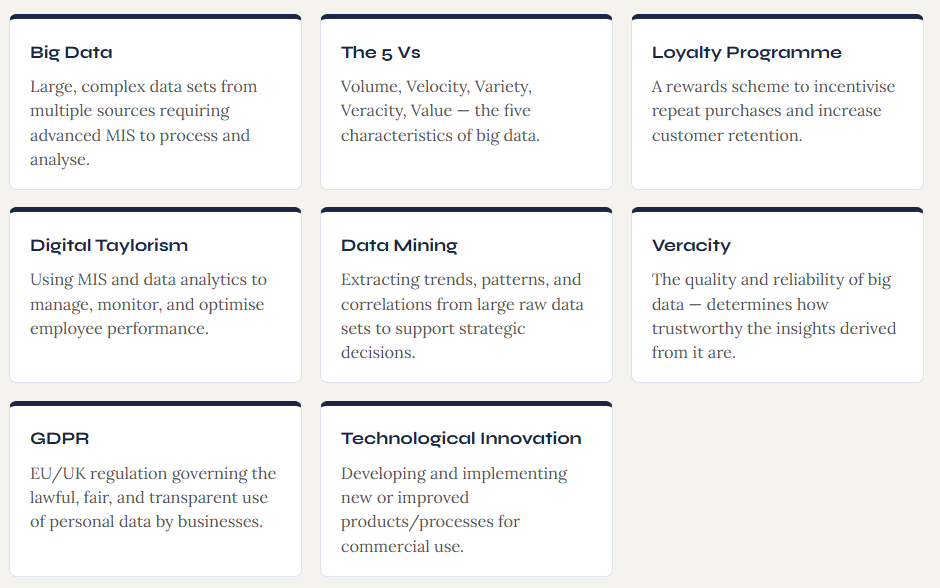
Refers to the large and complex sets of data generated by business activity that are difficult to process or manage using traditional methods, generated from sources including social media, IoT devices and transactional systems, characterised by the "5 Vs": Volume, Velocity, Variety, Veracity and Value.
IB Business Management definition - A customer loyalty programme:
Is a rewards scheme designed to encourage repeat purchases, using MIS - databases, data analytics and AI - to personalise offers and measure programme effectiveness.
IB Business Management definition - Digital Taylorism:
Is the use of management information systems - data analytics and surveillance software - to measure, monitor and control employee performance in order to increase efficiency, raising significant ethical concerns around privacy and algorithmic bias.
IB Business Management definition - Data mining:
Is the management process of extracting useful information and correlations from large sets of raw data using machine learning algorithms, to support strategic decision making - powerful, but bound by data protection law and ethical obligations around consent.
The key IB Business Management exam principle: MIS benefits - competitive advantage, efficiency, better customer experiences - are real, but so are the risks (cybersecurity, job displacement, system dependency) and ethical concerns (consent, manipulation, algorithmic bias). Benefits are not automatic and are rarely distributed equally across stakeholders, so claims that MIS "always" benefits a business should be challenged and evaluated in context.
Part 1: Big Data - The 5 Vs That Are Extremely Relevant
Think about how much data people generate in a single day. Every WhatsApp message. Every TikTok watched. Every Amazon order placed. Every Oyster card tapped on the London Underground. Every fitness tracker step recorded. All of it is data. And the sheer quantity of it - the speed at which it's generated, the variety of forms it takes - is what makes it big data.
IB Business Management Definition - AO2
Big data refers to the large and complex sets of data generated by business activity that are difficult to process or manage using traditional methods. It is generated from sources including social media platforms, IoT devices, and business transactional systems. Big data requires efficient MIS (Management Information Systems) to turn raw data into useful, actionable information for business decision making.
The IB Business syllabus identifies five key characteristics of big data - known as the 5 Vs. These tell the story of what makes big data extremely different from the kind of data businesses managed 30 years ago.
V1 - Volume
The sheer amount of data generated and collected. We're talking petabytes - millions of gigabytes - of new data created every single day.
V2 - Velocity
The speed at which data is generated and processed. IoT devices generate data in real time, continuously, without pause.
V3 - Variety
The different types of data - structured (spreadsheet rows), semi-structured (emails), and unstructured (videos, voice recordings).
V4 - Veracity
The quality and reliability of the data. Big data is only valuable if it's accurate. Poor quality data leads to poor quality decisions.
V5 - Value
The potential benefit a business derives from the data - the insights and competitive advantages it can extract.
The relationship between big data and other MIS components is critical for the IB Business exam. AI and machine learning analyse big data to make predictions. Databases store it. Data analytics processes it. And cybersecurity protects it. Big data doesn't exist in isolation - it sits at the heart of the entire MIS ecosystem.
IB Business Management Real-life Example:
Spotify processes over 600 billion streaming events per day. That's not just songs played - it's every skip, every replay, every playlist add, every time you leave the app mid-song. All of that behavioural data is fed into Spotify's recommendation engine and surfaces as your Discover Weekly playlist every Monday morning. Spotify Wrapped - that end-of-year summary my students absolutely love - is just big data presented as a personalised story. The Value of all that data? Spotify's competitive advantage. Nobody switches to a rival service because no rival service knows them as well as Spotify does after years of listening data.
Part 2: Customer Loyalty Programmes - The Points You Earn Are Not Free
Tesco gives you a Clubcard. Every time you shop, you earn points. You feel good - you're getting rewarded for doing your weekly shop. But what is Tesco actually getting in return?
Everything. They're getting everything.
Every single product you buy. The time and the days you shop. How often you visit. Whether you prefer own-brand or premium. Whether your spending changes during school holidays, suggesting you have kids. Whether your basket suddenly starts including pregnancy vitamins. That data - attached to your personal profile - is arguably worth far more to Tesco than the few pounds of points they're handing you back.
IB Business Management Definition - AO3
A customer loyalty programme is a rewards scheme offered by a business to encourage repeat purchases. Its main purpose is to increase customer retention and sales revenue by incentivising customers to continue buying from the business.
Loyalty programmes can take many forms: reward points for future discounts, exclusive access to promotions, early access to sales, or personalised offers. But what makes modern loyalty programmes genuinely powerful is the MIS infrastructure behind them. Big data, databases, and data analytics all combine to make these schemes far smarter - and far more commercially effective - than a simple "buy 10, get 1 free" stamp card.
IB Business Management Real-life Example:
Tesco Clubcard is the undisputed gold standard of loyalty schemes. Launched in 1995, it now has over 23 million members - representing more than 80% of UK households - and 82% of all Tesco transactions are made by Clubcard members. In 2024, Tesco launched Clubcard Challenges with AI firm Eagle-AI, giving members personalised shopping challenges to earn up to £50 in Clubcard points over six weeks. The AI makes over 190 individual decisions to tailor each challenge to each customer. The initiative reached 10 million customers and won the Best Global Loyalty Launch award at the 2025 International Loyalty Awards. Tesco reported record digital engagement during Christmas 2024, with customers collecting over half a billion extra Clubcard points through Challenges alone. This is what MIS-powered loyalty looks like at scale.
How MIS powers loyalty programmes
The IB Business syllabus is very specific about the role MIS plays here, and examiners love this link. Here's how it works in practice:
Personalisation: MIS stores customer purchase histories and uses data analytics to identify patterns - enabling the business to offer personalised rewards and product suggestions rather than generic ones. Tesco's AI literally decides which specific products to challenge you to buy based on your individual shopping behaviour.
Gap identification: MIS can identify categories a customer hasn't explored yet but is statistically likely to be interested in. This turns a loyalty programme into a discovery tool - surfacing products customers didn't know they wanted, increasing basket size and revenue.
Programme optimisation: MIS measures the effectiveness of the loyalty scheme itself - tracking engagement rates, redemption rates, and incremental sales - so the business can continuously improve the offering.
Future marketing strategy: Data from loyalty programmes reveals how customer needs and preferences are changing over time, directly informing future product development, pricing, and promotional decisions.
Part 3: Digital Taylorism - Big Brother Has a Clipboard
Try to imagine for a sec a Victorian factory floor. The year is 1890. A man called Frederick Winslow Taylor is walking around with a stopwatch, timing workers' every movement, calculating the most efficient way to shovel coal or tighten a bolt, and using that data to set productivity quotas. Workers who hit the quota get a bonus. Workers who don't get dismissed. Everything is measured, monitored, and optimised.
130 years later. Same idea. Different technology.
Amazon's fulfilment centres track how many items a warehouse worker picks per hour - a metric called the "pick rate." Workers wear wristbands. Cameras watch their movements. Algorithms calculate their efficiency score in real time and flag anyone falling behind. Targets are set not by a manager with a stopwatch but by a machine that always performs and never needs a rest. Workers have described the pressure as relentless. A 2024 report found that serious injury rates at Amazon warehouses were nearly double the industry average - 5.9 per 100 workers compared to 3.0 at non-Amazon facilities.
This is digital Taylorism. And it's one of the most contested ideas in modern business management.
IB Business Management Definition - AO3
Digital Taylorism refers to the use of management information systems - such as data analytics and surveillance software - to manage and monitor employees in order to increase operational efficiency and productivity. It is based on three pillars:
1. Measurement - identifying what can be improved and how.
2. Monitoring - tracking performance against targets in real time.
3. Control - using rigorous data analysis of inputs, outputs, and costs to drive decision making.
The business case for it
From a purely operational standpoint, digital Taylorism delivers results. It removes subjectivity from performance management - workers are assessed on data, not on whether their manager likes them. It can identify bottlenecks in workflows that human supervisors would miss. It enables real-time corrective action rather than waiting for quarterly appraisals. And it holds managers accountable too - data on decision-making quality can be used to evaluate whether leaders are performing effectively, reducing the influence of personal bias or instinct.
The human cost
"Every action within a fulfilment centre can be converted into a data point, allowing for real-time performance analysis against stringent targets. The same automation tools that drive world-class efficiency can also foster burnout." - from CEO Today, 2025
Ethical concerns: Constant surveillance creates immense psychological pressure. Workers report that the inability to take a toilet break without it appearing as "idle time" in the system is genuinely dehumanising. High turnover, burnout, and physical injury rates are the main documented consequences. There is also the risk that algorithmic management perpetuates bias - if historical data reflects discriminatory patterns, the algorithm will encode and amplify them. The ethical question isn't just "is it legal?" - it's "is it right?"
Digital Taylorism also raises serious data privacy concerns. Collecting, storing, and analysing detailed performance data about individual employees requires clear legal justification. In the UK, this falls under GDPR. Employees have rights regarding how their personal data is used - and businesses must ensure that monitoring is proportionate, transparent, and used only for legitimate purposes.
Lawrence's Tip:
Digital Taylorism questions often ask you to weigh efficiency gains against ethical concerns. The strongest answers don't just list both sides - they link the ethical issues specifically to stakeholder groups: employees face surveillance and burnout; customers benefit from faster delivery; shareholders benefit from cost efficiency; but society bears the long-term cost of degraded working conditions. Establish a relationship between those connections and you'll reach the top mark bands.
Part 4: Data Mining - Digging for Gold In a Mountain of Numbers
Here's a question for you. Netflix has 270 million subscribers. Each one watches different content, at different times, for different durations, on different devices. How does Netflix decide which shows to commission next? How does it know that a thriller series set in 1980s England will resonate with young adults in South Korea?
The answer is data mining - one of the most powerful (and ethically complex) tools in modern business.
IB Business Management Definition - AO3
Data mining is the management process of extracting useful information and insights from large sets of raw data to support strategic decision making. It identifies broad trends, patterns, and correlations that would be impossible to uncover manually, using machine learning algorithms to process and analyse large data sets and transform them into practical information for managers.
The key word in that definition is correlations. Data mining doesn't just tell you what people did - it reveals unexpected relationships between variables that a human analyst would never spot. Target's infamous pregnancy prediction was the result of data mining: analysts discovered that purchasing patterns involving 25 specific products (including unscented lotion and certain vitamin supplements) correlated strongly with pregnancy - and the system could predict it with remarkable accuracy.
IB Business Management Real-life Example:
Netflix used data mining to decide to commission House of Cards back in 2013 - before a single episode was filmed. The algorithm identified that the intersection of users who watched the original British series, users who watched David Fincher films, and users who watched Kevin Spacey content was large enough - and engaged enough - to justify a $100 million investment without a traditional pilot. It was one of the most data-driven creative decisions in television history. The show went on to win multiple Emmy awards and kickstart the streaming original content revolution.
Data mining and the law
Data mining uses personal data - and that personal data is protected by law. In the UK, businesses must comply with the Data Protection Act and GDPR, which require that personal data is collected and used lawfully, fairly, and transparently. Individuals have the right to know what data is held about them, the right to request its deletion, and the right to object to certain types of automated processing. Businesses that use data mining in breach of these regulations face substantial fines. The ICO (Information Commissioner's Office) fined Meta £17.5 million in 2022 for breaches related to the Cambridge Analytica scandal - a stark reminder that data mining without proper consent carries real legal consequences.
Part 5: The Big Picture - Benefits, Risks and Ethics of MIS
You've now covered every major component of MIS across this unit and the IB Business Management Information Systems (MIS) Guide. The final piece - and the one most likely to appear in a longer IB Business essay question - is the ability to step back and evaluate the whole picture: what does MIS genuinely do for businesses and their stakeholders? And at what cost?
The Benefits
Competitive advantage: MIS gives businesses a deeper, real-time understanding of their customers, employees, and market. Tesco's Clubcard data is so comprehensive that the supermarket has launched a media arm - Tesco Media and Insight - selling targeted advertising to brands based on first-party shopping data. The data itself has become a revenue stream.
Operational efficiency and cost reduction: AI and machine learning automate processes that previously required manual labour - from stock reordering to invoice processing to customer service chatbots. Businesses can do more with less, reducing costs and improving speed and accuracy simultaneously.
Better products and customer experiences: MIS enables businesses to respond faster to changing customer needs. Real-time data analytics means a business can identify a trend in customer behaviour today and have a response - a new product, a targeted promotion, an adjusted price - in market within days rather than months.
The Risks
Cybersecurity vulnerabilities: Every system that holds data is a target. As the M&S, Co-op, and Harrods attacks of 2025 demonstrated, even major businesses with dedicated security teams are vulnerable. The more a business relies on MIS, the greater the potential damage from a successful attack.
Job displacement: MIS automates tasks that previously required human workers - invoicing, stock management, customer service, quality checking. While this creates efficiency for businesses, it creates unemployment for workers. This is one of the most significant and contested social consequences of MIS adoption.
System failure and dependency: A business that has built its entire operation around digital infrastructure is catastrophically vulnerable to hardware failures, software bugs, or power outages. When an airline's check-in system fails, thousands of passengers miss flights. When a bank's app goes down, customers can't access their money. Critical single points of failure are a genuine strategic risk.
The Ethical Considerations
This is where the IB Business syllabus really encourages you to think. Ethics in MIS is more about the fundamental question of whether businesses are using data in ways that are fair to the people it affects.
IB Business Management Real-life Example: Ethical Case Cambridge Analytica
In 2018, it emerged that political consultancy Cambridge Analytica had harvested the personal data of 87 million Facebook users without their knowledge or consent - and used data mining to build psychological profiles that were used to target voters in the 2016 US election and the Brexit referendum. Facebook was fined $5 billion by the US Federal Trade Commission. The scandal forced a fundamental conversation about who owns personal data, how it can be used, and what consent really means in the digital age. The GDPR regulations that followed are a direct consequence.
This is data mining used in a way that was arguably not just unethical, but profoundly damaging to democratic processes.
The IB Business syllabus identifies several key ethical obligations for businesses using MIS:
Data must be collected and used for legitimate purposes only - and must be handled fairly and transparently.
Digital Taylorism must not be used to harass or exploit employees.
AI systems must not encode or amplify discrimination.
Data shared with third parties must be handled responsibly.
And businesses must never use MIS to gain unfair competitive advantages or manipulate markets - doing so is not just unethical, it's illegal.
The broader point is this: MIS is a tool. Like any tool, what matters is how you use it. A hammer can build a house or break a window. AI can diagnose cancer earlier than any human doctor - or it can be used to manipulate election results. The businesses that will thrive long-term are those that understand not just the power of these technologies, but the responsibility that comes with them.
Lawrence's comment - What This Unit Is About
This unit is not just a list of technologies. It's a question about what kind of businesses - and what kind of society - we want to build. The companies that use data well, ethically, and responsibly will earn long-term trust. Those that use it recklessly or exploitatively will face regulation, fines, reputational damage, and increasingly, active consumer resistance. That tension between commercial opportunity and ethical responsibility is at the heart of modern business management - and it's exactly what your IB Business examiner wants you to explore.
IB Business Management - Syllabus and Programme Full Guide →
Practise This Topic: The IB Business Management Activity Book
Big data and its ethical dimensions are among the most evaluative HL topics on the syllabus, and the AO4 essay later in this entry is exactly the style of extended-response question Paper 3 tests. The Activity Book's Unit 5.9 Management Information Systems HL gives you further practice at this level of ethical evaluation.
The IB Trainer's IB Business Management Activity Book covers:
✓ All 6 IB Business Management modules (5 Modules + the Complete IB Business Management Toolkit broken down unit-by-unit
✓ 2-6 case studies per unit (some units need more practice than others)
✓ Every IB Business Management Assessment Objective (AO) explicitly addressed
✓ All 15 IB Business Management Toolkit tools with worked examples
✓ IB Business Exam Socially responsible companies (business as force for good)
✓ Platform access with supporting video content
Key Terms Cheat Sheet
Exam Practice Questions
Easily find IB Business Management Exam practice questions with model answers and Marking schemes, IB Business exam style case studies and hundreds of activities covering all assessment objectives in our 2026-updated IB Business Management Activity book.
Original practice questions aligned to IB Business Management Assessment Objectives. Not from past papers.
AO1 - 2 marks
Define the term "data mining" and state one business purpose for which it is used.
AO1 - 2 marks
Identify two of the "5 Vs" of big data and briefly explain what each one means.
AO2 - 4 marks
Explain how management information systems support the design and management of a customer loyalty programme.
AO2 - 4 marks
Explain two ethical concerns associated with the use of digital Taylorism in the workplace.
AO3 - 6 marks
Analyse the potential benefits and risks of using big data to inform strategic decision making in a large multinational business.
AO3 - 6 marks
With reference to a business you have studied, analyse the ethical implications of using data mining to target customers.
AO4 · 10 marks
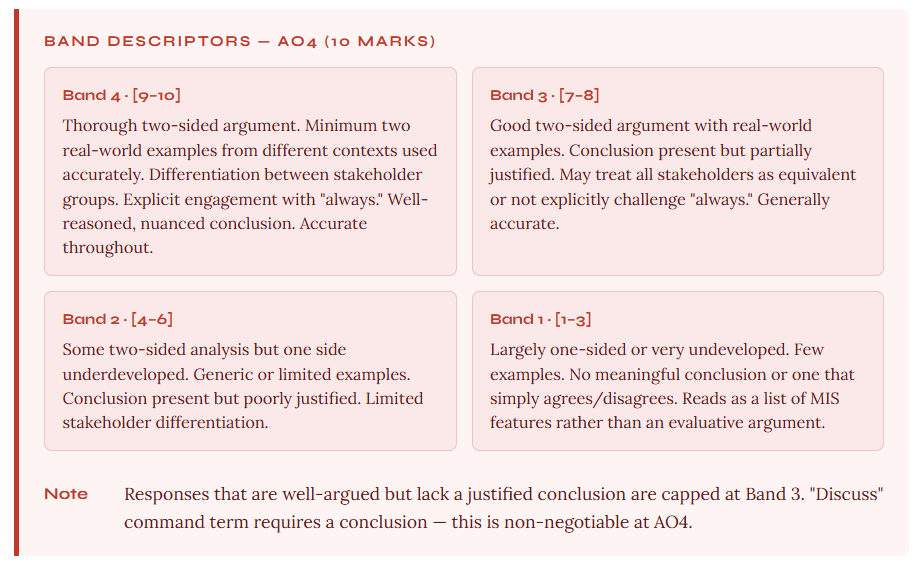
"The benefits of management information systems for businesses always outweigh the risks and ethical concerns for their stakeholders." Discuss this statement with reference to businesses and industries you have studied.
Exam Practice Model Answers
How to use this document Each question includes a full model answer, an examiner note explaining what earns marks, and a simplified mark scheme. Use these as a benchmark - the IB Business examiners always accept equivalent valid responses, so focus on understanding the structure and level of development required rather than memorising the exact wording. Memorising by itself will NOT get you access to grades 6 or 7 in the IB Business Management exam.
1 - AO1, 2 Marks
Define the term "data mining" and state one business purpose for which it is used.
Data mining is the management process of extracting useful information, trends, and patterns from large sets of raw data in order to support strategic business decision making. It uses machine learning algorithms to identify correlations and insights that would be too complex to uncover through manual analysis.
One business purpose: data mining can be used to predict future consumer behaviour - for example, Netflix used viewing pattern data to identify that a specific audience segment would respond positively to a political drama series, which directly informed its decision to commission House of Cards.
Lawrence's Note
The definition must go beyond "finding patterns in data" - it should convey that data mining is a deliberate management process using algorithmic tools, and that it is purpose-driven (supporting strategic decision making). The second mark requires a specific, named business purpose - not just "to make decisions." Identifying a real-world example strengthens the response significantly, though it isn't mandatory at AO1.
Mark Scheme
[1]
Award one mark for a definition that includes: extracting meaningful patterns/insights from large data sets AND that it supports decision making. "Finding information in data" alone is insufficient without the decision-making link.
[1]
Award one mark for any valid, specific business purpose: predicting consumer behaviour, identifying new market opportunities, personalising marketing, detecting fraud, commissioning new products based on customer data patterns. Accept any valid response.
2- AO1, 2 Marks
Identify two of the "5 Vs" of big data and briefly explain what each one means.
1
Velocity - the speed at which data is generated, collected, and processed. With billions of IoT devices continuously transmitting data and social media generating millions of posts per minute, the rate at which data flows has increased exponentially. Businesses need real-time processing capabilities to act on high-velocity data before it loses relevance.
2
Veracity - the quality and reliability of data. Because big data comes from such a wide variety of sources - some highly reliable, others less so - businesses cannot assume all data is accurate. Poor-quality data leads to poor-quality analysis and flawed decision making. Businesses must implement data validation processes to ensure that the insights derived from big data are trustworthy.
Lawrence's Note
Any two of the five Vs are acceptable. The mark is split: one mark per V, for correctly identifying the term AND giving an accurate explanation of what it means. Students who just list two Vs without explaining them earn a maximum of 1 mark. "Veracity" and "Value" are the two most commonly misunderstood - veracity is about data quality (not just volume), and value is about the commercial benefit derived, not the monetary cost. Watch the difference.
Mark Scheme
[1+1]
Award one mark per V: one mark for correctly naming any of the five (Volume, Velocity, Variety, Veracity, Value) AND one mark for an accurate brief explanation of what that specific V means. Accept any two distinct Vs. Do not award a mark for a name alone without explanation, or an explanation that confuses one V with another.
3- AO2, 4 Marks
Explain how management information systems support the design and management of a customer loyalty programme.
1
Data collection and personalisation: MIS - specifically databases and data analytics - store and process customers' purchase histories, enabling the business to understand the individual preferences and behaviours of each member. This allows the loyalty programme to offer personalised rewards and targeted promotions, rather than generic discounts applied to all members. For example, Tesco's Clubcard Challenges uses AI to make over 190 individual decisions to assign each of its 10 million participating members a unique, tailored set of shopping challenges. Personalisation increases engagement and makes the scheme commercially more effective by rewarding incremental spending rather than purchases the customer would have made anyway.
2
Performance monitoring and scheme improvement: MIS enables the business to measure how well the loyalty programme is performing - tracking metrics such as redemption rates, repeat purchase frequency, and the uplift in revenue attributable to the scheme. Data analytics can identify gaps - for example, customer segments with low engagement - and allow managers to adjust the rewards structure, communication strategy, or incentive thresholds accordingly. This continuous feedback loop means the loyalty programme can be iteratively improved, maintaining its relevance and effectiveness over time.
Lawrence's Note
This is an AO2 "explain" question, so the formula is:
Identify what MIS does → explain the mechanism → link to the outcome for the loyalty programme. Two distinct ways are needed for full marks. A common error is treating this as a definition question and simply describing what a loyalty programme is. The question is specifically about the role MIS plays - that's what the marks reward. Real-world examples (Tesco Clubcard, Starbucks Rewards, Boots Advantage Card) all strengthen the answer.
Mark Scheme
[1+1]
For the first way: one mark for identifying a specific MIS function (data storage, data analytics, AI personalisation, big data processing), and one mark for explaining how this specifically benefits the loyalty programme (improves personalisation, increases engagement, drives incremental sales).
[1+1]
For the second way: same criteria as above. Must be a genuinely distinct MIS function or application. Accept: performance measurement, gap identification, marketing strategy informing, scheme design optimisation. Max [2] if only one way is given regardless of depth.
4- AO2, 4 Marks
Explain two ethical concerns associated with the use of digital Taylorism in the workplace.
1
Employee privacy and surveillance: Digital Taylorism requires the collection and continuous monitoring of detailed personal performance data - tracking workers' movements, productivity rates, break durations, and even communication in some cases. This level of surveillance raises serious concerns about employee privacy and dignity. Workers at Amazon fulfilment centres, for example, have described the constant algorithmic oversight as psychologically oppressive, with the inability to take unmonitored breaks creating significant stress and contributing to reported injury rates nearly double the industry average. Ethically, businesses must ask whether the commercial benefit of this level of monitoring justifies the intrusion into employees' personal autonomy and wellbeing.
2
Algorithmic bias and unfair treatment: If the data used to train and run digital Taylorism systems reflects historical patterns of unfair treatment - such as lower productivity scores associated with certain demographic groups due to systemic disadvantage rather than actual performance - the algorithm will encode and perpetuate those biases. Workers may be disadvantaged, disciplined, or dismissed based on outputs from a system that is structurally biased against them, with no transparent mechanism for appeal. This is ethically problematic because it removes human judgement and accountability from decisions that significantly affect employees' livelihoods, while hiding discrimination behind the appearance of objective, data-driven management.
Lawrence's Note
"Ethical concerns" is the key phrase - responses must engage with the moral dimension, not just list disadvantages of digital Taylorism. A response that says "it can cause stress" earns fewer marks than one that identifies the underlying ethical issue (violation of dignity and autonomy) and develops it. Real-life examples - Amazon, Uber driver monitoring, remote work surveillance software - strengthens the analysis considerably. Two distinct ethical concerns are required; surveillance and bias are excellent choices, but data privacy, dehumanisation, and lack of transparency are equally valid.
Mark Scheme
[1+1]
For each ethical concern: one mark for identifying a valid ethical issue (privacy/surveillance, algorithmic bias, dehumanisation, lack of transparency, GDPR compliance issues, psychological harm), and one mark for explaining why it constitutes an ethical problem - i.e. how it conflicts with principles of fairness, dignity, or lawful treatment. A concern stated without ethical development earns [1] only.
Max [4]
Two distinct concerns required. Maximum [2] if only one concern is given regardless of depth.
5- AO3, 6 Marks
Analyse the potential benefits and risks of using big data to inform strategic decision making in a large multinational business.
Big data - characterised by its volume, velocity, variety, veracity, and value - has transformed how large multinational businesses approach strategic decision making. However, its benefits are matched by significant risks that businesses must carefully manage.
Benefits: The most significant benefit of big data for strategic decision making is the ability to identify patterns and trends that are invisible to traditional analysis. Netflix's use of big data to commission original content such as House of Cards - based on the intersection of specific viewer behaviour patterns - is a prime example of data-driven strategic decisions that generated substantial competitive advantage. Rather than relying on market research surveys or executive instinct, Netflix's leadership could point to statistically significant demand signals. This reduces the risk inherent in major capital allocation decisions.
Additionally, big data enables real-time responsiveness. A multinational such as Zara (Inditex) uses point-of-sale data from thousands of global outlets to identify emerging fashion trends in near real time, feeding that information back into production decisions within days. This agility - impossible with traditional forecasting - allows the business to stay ahead of competitors and minimise inventory risk.
Risks: However, the value of big data is entirely dependent on its veracity - the quality and reliability of the underlying data. A large multinational aggregating data from dozens of markets, multiple platforms, and numerous data sources faces a significant risk of inconsistent, incomplete, or inaccurate data distorting its analysis. A strategic decision based on flawed data could be worse than no decision at all, particularly when significant capital is at stake.
There is also the substantial risk of data breaches and cybersecurity vulnerabilities. The more data a business holds and processes, the more attractive it becomes as a target for cybercriminals. The 2025 M&S ransomware attack illustrates that even major businesses with dedicated security teams can suffer catastrophic data breaches, with consequences including lost revenue, regulatory penalties, and lasting reputational damage.
On balance, the strategic benefits of big data are compelling - but they are not automatic. Multinational businesses that invest in data quality management, cybersecurity infrastructure, and the human analytical capability to interpret big data insights responsibly are positioned to gain genuine and durable competitive advantages. Those that collect data without the systems or skills to use it safely risk amplifying their vulnerabilities rather than their strengths.
Lawrence's Note
AO3 "analyse" requires genuine two-sided engagement - not just a list of pros and cons. The model answer earns top marks by: developing each point beyond the initial statement; grounding arguments in specific real-life examples; and closing with a qualified conclusion that acknowledges the conditional nature of big data's value ("benefits are not automatic"). The concluding sentence is important - it shows the student is thinking analytically, not just recounting facts. Avoid the common trap of writing the same generic points about "improved decisions" on the benefits side and "data breach risk" on the risk side without any development or specificity.
Mark Scheme
Indicative Band Descriptors
[5–6]
Well-developed two-sided analysis with at least two distinct benefits AND at least one substantively developed risk. Real-life examples present and accurate. Analytical conclusion that contextualises or qualifies the balance between benefits and risks. Clearly structured and free of significant errors.
[3–4]
Two-sided analysis attempted with reasonable development. Examples may be limited or generic. One side may be stronger than the other. Some attempt at qualification but conclusion may be superficial.
[1–2]
Predominantly one-sided or very limited development. Reads as a list rather than an analysis. Few or no examples. No meaningful conclusion.
6 - AO3, 6 Marks
With reference to a business you have studied, analyse the ethical implications of using data mining to target customers.
Business: Facebook / Meta (Cambridge Analytica scandal)
The Cambridge Analytica scandal of 2018 represents the most relevant case study in the ethics of data mining for customer targeting. Cambridge Analytica, working with data harvested from Facebook, used data mining to build detailed psychological profiles of approximately 87 million users without their explicit consent. These profiles were then used to micro-target political advertising - attempting to influence voter behaviour in the 2016 US presidential election and the Brexit referendum. The case raises profound ethical questions that go far beyond standard commercial data use.
Consent and transparency: The fundamental ethical violation in this case was the absence of genuine informed consent. Users had no reasonable expectation that their Facebook data would be used for political profiling. The GDPR principle that data must be collected "lawfully, fairly, and transparently" was comprehensively breached. The ethical implication for businesses is clear: data mining for customer targeting is only legitimate when customers understand and have genuinely agreed to how their data will be used - not buried in a terms and conditions document nobody reads.
Manipulation and autonomy: There is a deeper ethical concern beyond legality. Data mining that builds psychographic profiles and uses them to serve hyper-targeted persuasive content is designed to influence individuals' decisions in ways they are unaware of. This raises fundamental questions about human autonomy. Is it ethically acceptable to use someone's personality data to exploit their psychological vulnerabilities in order to change their political views - or their purchasing decisions? Critics argue that this crosses a line from marketing into manipulation, regardless of its technical legality.
Consequences and implications: Facebook was fined $5 billion by the US Federal Trade Commission - the largest privacy fine in US history at the time. The scandal directly precipitated the widespread adoption of GDPR in Europe, forcing all EU-operating businesses to fundamentally overhaul how they collect, store, and use personal data. The long-term reputational damage to Facebook has been significant, contributing to declining trust among younger users. The ethical lesson for businesses is that data mining practices which maximise short-term targeting effectiveness at the expense of user trust carry severe long-term commercial, legal, and reputational costs.
Lawrence's Note
The Cambridge Analytica case is the strongest possible example for this question - but Tesco's Clubcard (data used beyond primary shopping context), Amazon's customer profiling, or any business that uses loyalty data for third-party targeting are all valid. The key is that the analysis must specifically address ethical implications - not just consequences. Saying "Facebook was fined" is a consequence. Explaining why it was ethically wrong (breach of consent, manipulation of autonomy) is the analysis. Top-band answers integrate the ethical framework (GDPR principles, consent, transparency, autonomy) with the specific business case.
Mark Scheme
Indicative Band Descriptors
[5–6]
Named business clearly referenced throughout. Analysis addresses at least two distinct ethical dimensions (e.g. consent/transparency, manipulation/autonomy, data privacy law, stakeholder harm). Consequences are connected to underlying ethical principles, not just stated as facts. Some evaluative element - recognising complexity or competing interests. Well-organised and accurate.
[3–4]
Named business present with relevant reference. One or two ethical concerns identified with some development. May treat consequences as equivalent to ethical analysis. Limited evaluation.
[1–2]
Very limited ethical analysis. May describe data mining in general terms without engaging with ethical dimensions. No business named, or business reference is token only.
7- AO4, 10 Marks
"The benefits of management information systems for businesses always outweigh the risks and ethical concerns for their stakeholders." Discuss this statement with reference to businesses and industries you have studied.
The statement contains a compelling commercial argument - MIS has undeniably transformed business performance across industries - but the inclusion of "always" makes it empirically and ethically untenable. The reality is far more nuanced: whether MIS benefits outweigh risks and ethical concerns depends critically on who you are, how the technology is deployed, and what standards of ethical responsibility the business applies.
Arguments in support:
For many businesses, MIS has delivered transformative commercial benefits that clearly outweigh manageable risks. Tesco's Clubcard is perhaps the most compelling UK example. Over 30 years, the Clubcard has evolved from a simple points scheme into a sophisticated MIS-powered platform reaching over 23 million UK households. The 2024 launch of AI-driven Clubcard Challenges - generating record digital engagement and over half a billion extra points collected at Christmas 2024 - illustrates how MIS can simultaneously benefit customers (through personalised savings), shareholders (through increased revenue and loyalty), and the business's competitive position. The data collected also powers Tesco Media and Insight, a retail media advertising platform that has become a significant revenue stream in its own right. In this case, the benefits to business and customers are substantial and the risks - principally data privacy - are managed within GDPR compliance.
Similarly, AI and machine learning-powered MIS have produced genuine societal benefits. NHS England's trials of AI diagnostic tools capable of detecting diabetic retinopathy with greater accuracy than human clinicians represent MIS delivering benefits that go far beyond commercial efficiency - they protect patients' sight. In these contexts, it is difficult to argue that the risks outweigh the benefits.
Arguments against - why "always" fails:
However, the Cambridge Analytica scandal offers the most powerful counterargument. Facebook's data mining infrastructure - undeniably powerful MIS - enabled the harvesting of 87 million users' personal data without consent, the building of psychographic profiles, and the micro-targeting of political messaging designed to influence democratic elections. The commercial benefits to Cambridge Analytica's clients were real. But the costs to society - the erosion of democratic integrity, the violation of millions of people's privacy and autonomy, the regulatory backlash that followed - were profound and arguably irreversible. To claim that the business benefits "outweighed" these consequences is ethically indefensible.
Digital Taylorism presents a different kind of challenge. Amazon's algorithmic management of warehouse workers has delivered extraordinary operational efficiency - the company processes millions of orders daily at margins that would be impossible without MIS. But the documented injury rate of 5.9 serious incidents per 100 workers - nearly double the industry average - and widespread reports of psychological stress suggest that the efficiency gains for shareholders come at a direct and significant cost to employees. For that specific stakeholder group, the risks clearly outweigh the benefits. The statement's use of "stakeholders" (plural) is therefore internally inconsistent: MIS benefits are rarely distributed equally, and what benefits one stakeholder group may actively harm another.
There is also the cybersecurity risk dimension. The M&S ransomware attack of 2025 demonstrates that deep reliance on MIS infrastructure creates single points of catastrophic failure. Pre-tax profits collapsed from £391.9 million to £3.4 million in the six months following the attack. In that six-month window, for M&S shareholders, employees facing job uncertainty, and customers whose data was stolen, the risks of MIS very clearly outweighed the benefits.
Conclusion:
On balance, I disagree with the statement as written. MIS creates the potential for benefits to outweigh risks - but this is not automatic, and it is certainly not "always" true. The balance depends fundamentally on three factors: how ethically and responsibly the MIS is deployed; how equitably the benefits are distributed across stakeholder groups; and how effectively the business manages the cybersecurity, regulatory, and human consequences of its data practices. Businesses that treat MIS as a neutral efficiency tool, ignoring its capacity to harm employees, customers, and society, will eventually face the consequences - in regulatory fines, reputational damage, or catastrophic system failure. The most accurate framing is that MIS can generate net benefits for all stakeholders - but only when deployed with genuine ethical responsibility and robust risk management.
Lawrence's Note
This essay question is specifically designed to test the full breadth of this Unit. Top-band responses will:
(1) challenge the word "always" explicitly;
(2) differentiate between stakeholder groups - recognising that MIS may benefit shareholders while harming employees;
(3) use at least two contrasting real-world examples from different industries; and
(4) arrive at a nuanced, well-justified conclusion. The most common weakness in weaker responses is treating "benefits" and "risks" as inflexible - as though all stakeholders experience them equally.
Demonstrating that the balance varies by context, stakeholder, and deployment approach is the hallmark of genuine AO4 evaluative thinking. This is what we need for top marks.
Mark Scheme
Stay well,
Frequently Asked Questions: Big Data In IB Business Management
What is big data and what are the "5 Vs"?
Big data refers to the large, complex datasets generated by business activity that are too big or fast-moving to process with traditional methods, described by five characteristics: Volume (the sheer scale of data), Velocity (the speed it's generated and processed), Variety (structured, semi-structured and unstructured forms), Veracity (data quality and reliability), and Value (the commercial benefit that can be extracted). Spotify processing over 600 billion streaming events a day, all feeding into recommendations like Discover Weekly, is a clear illustration of the 5 Vs working together. Big data doesn't exist in isolation - it sits at the centre of the wider MIS ecosystem, stored in databases, processed by analytics, and interpreted by AI.
How do management information systems power customer loyalty programmes?
MIS - specifically databases, data analytics and AI - store customer purchase histories and turn them into personalised rewards, as Tesco's Clubcard Challenges does by making over 190 individual AI decisions to tailor challenges to each of its 10 million participating members. MIS also identifies product categories a customer hasn't explored but is statistically likely to want, and continuously measures the scheme's own performance - redemption rates, engagement, incremental sales - so it can be refined over time. In effect, the loyalty programme becomes both a marketing tool and a live data-collection engine that feeds Tesco's broader business strategy.
What is digital Taylorism and what are its ethical concerns?
Digital Taylorism is the use of MIS - data analytics and surveillance software - to measure, monitor and control employee performance for efficiency, built on the same principles as Frederick Winslow Taylor's stopwatch-based scientific management from the 1890s. Amazon's warehouse pick-rate tracking is the clearest modern example, and it comes with documented ethical costs: workers report psychological pressure from constant surveillance, and Amazon's serious injury rate has been reported at nearly double the industry average. There's also a risk of algorithmic bias, where systems trained on historically unfair data can encode and amplify discrimination while appearing objective.
What is data mining and what ethical and legal issues does it raise?
Data mining is the process of extracting useful patterns and correlations from large datasets using machine learning to support strategic decisions, as Netflix did when it used viewing pattern data to commission House of Cards before filming a single episode. The clearest cautionary example is Cambridge Analytica, which harvested 87 million Facebook users' data without proper consent to build psychological profiles for political targeting, resulting in a $5 billion FTC fine against Facebook and the widespread adoption of GDPR. Data mining is legally bound by data protection law requiring lawful, fair and transparent use, and ethically bound by questions of consent and whether targeting crosses the line from marketing into manipulation.
Do the benefits of MIS always outweigh the risks for stakeholders?
No - while MIS delivers real benefits like competitive advantage, operational efficiency and better customer experiences, it also carries real risks including cybersecurity vulnerability, job displacement and system dependency, plus ethical concerns around consent and algorithmic bias. Crucially, these benefits and risks are rarely distributed equally: Amazon's digital Taylorism may benefit shareholders through efficiency while directly harming warehouse workers through injury and stress. The most accurate position is that MIS benefits are not automatic or universal - they depend on how ethically and responsibly the technology is deployed and how well risks are managed, not a guaranteed "always" outcome.
Related Content:
Continue Learning: IB Business Management Blog
IB Business Management Information Systems (MIS) Guide - read this one first if you haven't already, since big data, digital Taylorism and data mining all build directly on the MIS foundations (data analytics, databases, cybersecurity, AI) covered there.
IB Business Management Operations Management - your complete hub for all Module 5 topics
IB Business Management Toolkit - big data and MIS ethics connect to several of the 15 Toolkit tools, so this is where students can see them applied alongside other strategic models.
IB Business Management - for the full course overview, syllabus breakdown and links into every other module.
Take Your Revision Further
Once you can explain the 5 Vs, evaluate MIS-powered loyalty programmes, and weigh the ethics of digital Taylorism and data mining with real examples, the next step is practising full AO1-AO4 exam-style questions like the ones in this entry. The IB Business Management Activity Book gives you exam-standard questions, model answers and marking schemes across every module - including the Operations Management chapter this topic belongs to.
Explore the IB Business Management Activity Book here.
© Theibtrainer.com 2012-2026. All rights reserved.
Legal
Have a Tip? Send us a tip using our anonymous form