
IB Business Management Paper 3
IB Business Management Paper 3 Guide: Format, command terms, quantitative skills, syllabus coverage, and annual exam analysis for HL students.
IB BUSINESS MANAGEMENTIB BUSINESS MANAGEMENT HL
Lawrence Robert
4/26/202610 min read


IB Business Management
Paper 3 HL
No pre-release case study. One fictitious social enterprise. Three carefully structured questions - worth 25 marks. Here is everything HL students need to understand about Paper 3 before they walk into the exam room.
1 Hour 15 Minutes - Stimulus-based - 3 Questions - HL Only - 2022-2026 Specification
What is Paper 3?
Paper 3 is the Higher Level examination paper unique to IB Business Management HL students. It tests your ability to read, analyse, and respond to a multi-resource stimulus about a fictitious organisation - almost always a social enterprise facing a complex strategic situation.
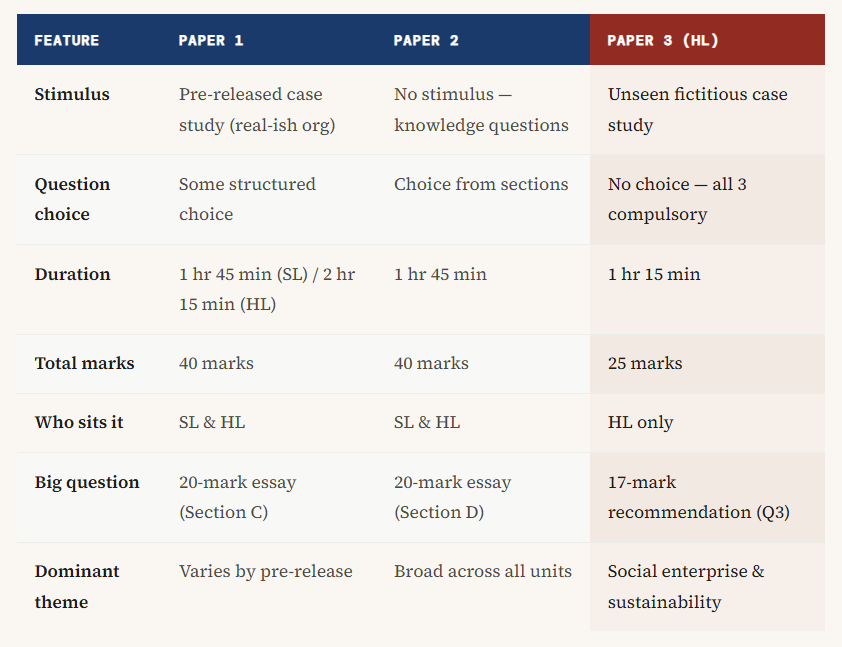
Unlike Paper 1, there is no pre-released case study. Unlike Paper 2, there are no choice questions. Paper 3 gives you one unseen stimulus pack and asks you to respond to three compulsory questions, each one building in analytical demand, paper 3 builds from a 2-mark question to a 17-mark extended recommendation.
Total Marks: 25
Minutes: 75
Questions 3
Key Point
Paper 3 is compulsory for all HL students and counts towards the HL-only component of the diploma. All three questions must be answered - there are no choices. Every mark available comes from a single source of material based on one company/organisation.
Mark Allocation
The Three-Question Structure
Paper 3 has a fixed three-question format that has remained consistent across all recent examination sessions (2024 & 2025). The mark allocation always follows the same pattern: 2 + 6 + 17 = 25. Each question tests a distinctly different skill level.
1- Motivation Theory Application
Knowledge & Understanding - Targeted Stimulus Reference [2 marks]
Question 1 asks you to describe one human need that the organisation in the stimulus meets, using a named motivation theory taken from the syllabus. You are directed to a specific resource and the theory to apply will always come from the IB Business Management specification - Maslow's hierarchy, Herzberg's two-factor theory, McClelland's acquired needs theory, or similar.
Two marks for two things: name and explain the relevant need, and link it explicitly to the context through the resources. One mark for each. Keep it tight - four or five well-chosen sentences is ideal. Do not write an essay here.
Command term: Describe - Targeted Resource - 5 Minutes
2- Dual Challenge Explanation
Application & Analysis - Two Specific Resources [6 marks]
Question 2 asks you to explain two challenges facing the organisation - one from each of two named functional areas. The question always specifies which resources to use and which business functions are under study. Pairings that have appeared through the years include human resources and operations management; financial challenges and human resource management; and two financial challenges.
Six marks across two challenges means approximately three marks per challenge. For each one, identify the challenge clearly from the resource text, explain why it is a problem for the organisation, and demonstrate the business management knowledge behind it. Avoid adding irrelevant material and focus on marks only - every written sentence here should add something analytical, not just describe what you have read.
Command term: Explain - Two Named Resources - 15 Minutes
3- Extended Strategic Recommendation
Synthesis, Evaluation & Judgement - All Resources + Theory [17 marks]
Question 3 is the heart of Paper 3. It asks you to recommend a plan of action - using all resources provided and your knowledge of business management tools and theories - to help the organisation achieve a specific strategic goal. That goal is usually framed around sustainability, continued growth, or overcoming a specific crisis, often with a concrete time horizon.
Seventeen marks. This is where Paper 3 students earn or give up on their grade. The IB expects you to integrate stimulus evidence with business management theory across multiple functional areas, evaluate the options available to the organisation, and arrive at a clearly justified recommendation. If you include generic IB Business theory paragraphs without kinking it to the available resources, or resource summaries without any theory, this will get you a low mark band score.
Strong answers typically address three to five distinct strategic issues, each anchored in a specific resource together with an IB business management tool or theory, and including analysis of both advantages and limitations of the recommended course of action.
Command term: Recommend - All Resources - 50 Minutes
The Stimulus Pack - The Resource Material
What the Resources Look Like
Each Paper 3 exam contains a single set of resources about one fictitious organisation, typically spread across four to six numbered resources. These resources are deliberately varied - giving you information from different perspectives, in different formats, and at different points in time.
Types of Resource That Appear in Paper 3
Founder or CEO annual report excerpts
Internal emails from HR or operations managers
External business or journal articles
Financial data tables with ratios and comparisons
STEEPLE or strategy analysis excerpts
Social media posts from employees or customers
Board of directors meeting minutes or memos
Data charts showing market or usage trends
Quotes, testimonials, or stakeholder perspectives
Email correspondence with external organisations
Reading the stimulus carefully before attempting any question is essential. Paper 3 rewards students who actively annotate as they read - marking which resources are relevant to which functional area, spotting tensions between what the data says and what the founder believes, and noting any business management concepts that are explicitly or implicitly present in the text.
IB Business Management Exam Insight
Across recent Paper 3 exams, the fictitious organisation has consistently been a social enterprise - a business with both commercial and social objectives. Knowing the issues and characteristics inherent to social enterprises (profit vs. purpose, growth vs. mission, stakeholder conflict) beforehand, gives you a reliable analytical lens before you even read the stimulus.
Content Coverage
Topics, Tools & Theories
Paper 3 does not specify which topics will appear - that depends on the included resources. However, analysis of recent exam sessions reveals a consistent set of business management themes, tools, and theories that reward preparation. Q3 in particular expects you to draw on content from across the full IB Business management syllabus, not just one unit.
Module 1 - Business Organisation
Social Enterprises & Stakeholders
Social enterprises appear in every recent Paper 3 stimulus. Understanding their objectives, stakeholder conflicts, and the tension between commercial viability and social mission is basic to scoring well in Q3.
Module 2 - Human Resources
Motivation Theories & HR Challenges
Q1 always draws on motivation theory. Q2 frequently features an HR challenge. Maslow, Herzberg, McClelland, Taylor, and Adams all appear in the 2024-2025 exams. Know the needs each identifies and how they relate to workplace scenarios.
Module 3 - Finance
Ratio Analysis & Financial Position
Financial data tables with profitability, liquidity, and gearing ratios appear regularly. Q2 financial challenges require you to interpret these figures, compare them with industry averages or competitors, and explain the implications.
Unit 4 - Marketing
Pricing, Positioning & Competitive Strategy
Price elasticity, premium pricing, differentiation strategy, and market positioning feature across the stimulus and Q3 responses. Porter's generic strategies are a reliable theoretical framework for strategic recommendations.
Module 5 - Operations
Capacity, Quality & Technology
Operations challenges - capacity constraints, quality management, the role of AI and technology, supply chain issues - appear in Q2 and form strong pillars for Q3 recommendations.
Business Management Toolkit
Strategic Analysis Tools
SWOT, STEEPLE, force field analysis, Ansoff matrix, and stakeholder mapping are all viable Q3 frameworks. Demonstrating that you can select, apply, and evaluate the right tool for the situation is what will get you the top mark bands.
Paper 3 Assessment Criteria
How Question 3 is Marked
Question 3 uses a mark band descriptor to assess holistic quality. What does this mean? The IB does not award marks for each separate point - instead, the examiner reads the whole response and places it in the band that best describes its overall level. This means that understanding what separates the bands is how you build a high-scoring strategy. So:
14-17 A balanced, well-structured recommendation that integrates all or most resources with relevant business management theory. Analysis is perceptive and shows genuine evaluation - weighing alternatives, acknowledging limitations, and arriving at a justified recommendation. Business management terminology is used accurately and naturally.
10-13 A competent response that uses most resources and applies relevant theory. Analysis is present but may be uneven - some areas well developed, others more superficial. The recommendation is clear but may lack depth of justification or fail to consider alternative perspectives.
6-9 A reasonable attempt that uses some resources and includes some business management knowledge. However, analysis tends to be descriptive rather than evaluative. Theory may be applied without meaningful connection to the stimulus context.
3-5 Limited engagement with the stimulus and limited application of business management theory. The response may summarise what the resources say without analysing the implications, or apply theory without linking it to the organisation's situation.
1-2 A very limited response that shows little understanding of the stimulus or the relevant business management concepts. May address the question only in passing.
Paper Comparison
How Paper 3 Differs from Papers 1 & 2
Understanding what makes Paper 3 structurally unique is just as important as knowing what it contains. Several features set it apart from the other two papers.
Paper 3 Exam Strategy
How to Approach Paper 3 on Exam Day
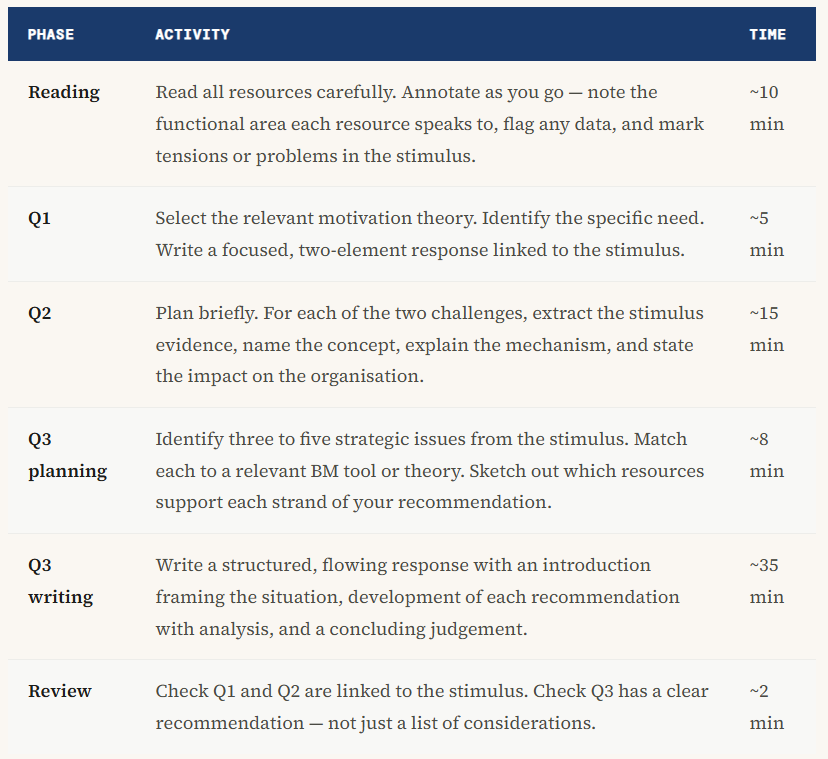
Timing Your 75 Minutes
With 25 marks to earn in 75 minutes, you have roughly three minutes per mark - but don't be misled by that high average, instead think about how differently you should allocate your time across the three questions.
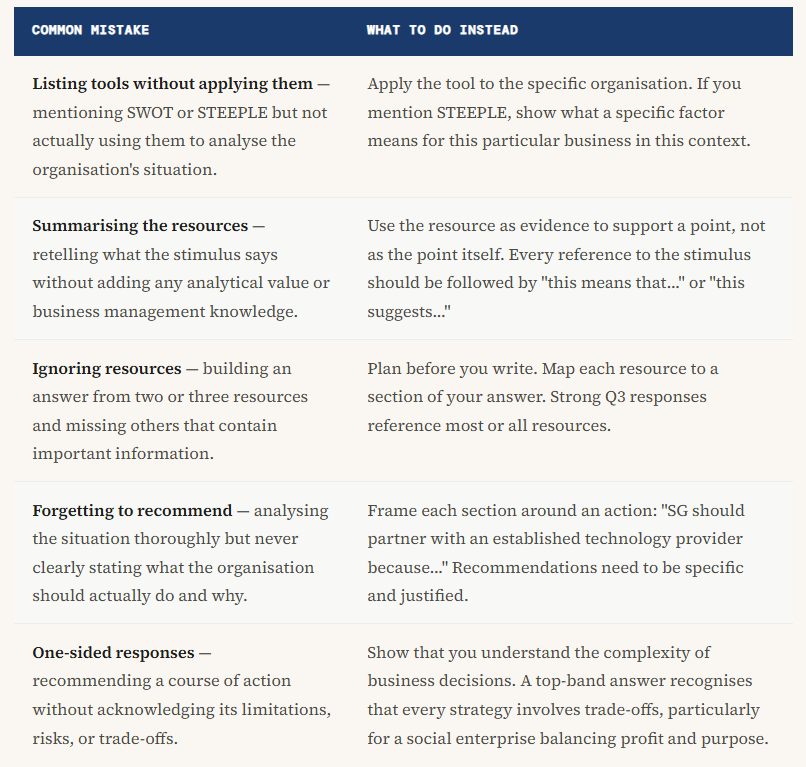
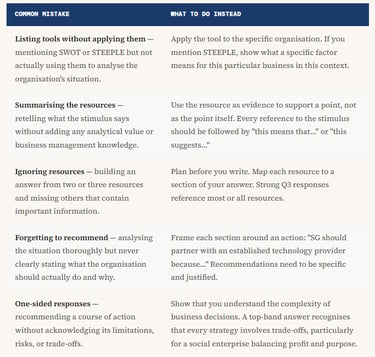
The Biggest Q3 Mistakes to Avoid
These are the patterns that keep good students out of the top mark bands in Question 3:
Lawrence's Past Paper Reviews
Paper 3 Exam Session Reviews
Each page below provides a detailed review of that exam session - some of you have already practised those papers with me. My notes will focus on analysing the resource organisation, the question demands, the mark allocations, and the key business management concepts rewarded in model answers. Use these alongside your own practice to build a clear picture of the main patterns the IB Business Management paper 3 returns to.
Frequently Asked Questions About IB Business Management Paper 3
Is Paper 3 only for HL students?
Yes. Paper 3 is exclusively for Higher Level Business Management students. Standard Level students sit Paper 1 and Paper 2 only. Paper 3 is one of the features that distinguishes the HL programme and contributes to the additional depth expected of HL candidates.
Is there a pre-released case study for Paper 3?
No. Unlike Paper 1, which uses a pre-released case study that students can study in advance, Paper 3 uses a completely unseen stimulus. The organisation is fictitious and the resources are only revealed in the exam room. There is nothing to prepare in terms of the specific company - your preparation is about building the skills to analyse any organisation, and refining your knowledge of the tools and theories the IB may ask you to apply.
Will the organisation in the stimulus/resources always be a social enterprise?
Based on all recent exam sessions under the 2022 specification, the organisation has consistently been a social enterprise - one that balances commercial objectives with a social mission. This is not guaranteed by the specification, but it is a very strong pattern. Understanding the characteristics, tensions, and strategic challenges specific to social enterprises is one of the most efficient forms of Paper 3 preparation.
Which motivation theory should I use for Question 1?
The question will tell you which theory to use - or instruct you to choose an "appropriate" one. In some sessions the question explicitly excludes Maslow (instructing you to use a different theory), so you need to know more than one. Maslow's hierarchy of needs, Herzberg's two-factor theory, and McClelland's acquired needs theory are the strongest candidates to prepare beforehand. The key is selecting the theory whose language maps most naturally onto the specific need the stimulus describes.
How long should my Question 3 answer be?
There is no fixed word count, but 17 marks requires substantial, detailed writing. Most top-band answers run to three or four well-structured pages of examination booklet. The priority is not length but integration - showing that you have used the resources, applied relevant theory, evaluated options, and reached a clear, justified recommendation. A sprawling answer that repeats the same points gains nothing; a focused, analytical answer that addresses three to five key strategic issues will score far more effectively. Theory by itself without application scores very little, resource reference without IB Business Management theory will also get you disappointing marks.
Do I need to use all of the resources in Question 3?
The question instructs you to use "all the resources provided," and the mark bands reward responses that demonstrate engagement with most or all of them. In practice, some resources may be more central to your recommendation than others, but a response that ignores two or three resources entirely is probably leaving a lot of marks on the table. During your reading phase, identify what each resource contributes and plan to reference each one at least briefly.
Can I use a calculator in Paper 3?
Yes. Students are permitted access to a calculator for Paper 3. This is relevant when financial data is provided - you may be asked to interpret or calculate ratios, or the data may require you to work through figures as part of your analysis. Even if you are not directly asked to calculate anything, showing that you can accurately read and interpret numerical data from the stimulus is part of demonstrating business management competence and you should be rewarded for that.
Paper 3 Quick Reference
Level HL only
Duration 75 min
Total marks 25
Questions 3 (all compulsory)
Q1 marks 2
Q2 marks 6
Q3 marks 17
Calculator Permitted
Stimulus / Reference material Unseen
Specifications IB Business Management 2022-2026
Examiner Tips
Q1 Tip
Know at least three motivation theories. The question sometimes excludes Maslow - and if it does, you need a second theory ready without hesitation.
Q2 Tip
Three marks per challenge. Aim for: identify the issue → explain the mechanism → state the impact. Do not mix the two challenges together.
Q3 Tip
Plan for 8 minutes before you write. Identify 3–5 issues, match each to a resource and a theory, and decide your overall recommendation before your pen hits the page.
All Questions
Social enterprises balance profit and purpose. Every recommendation in Q3 should acknowledge both dimensions - pure profit maximisation is not an appropriate answer for this type of organisation. Apply both dimensions throughout your written work.
Ready to Practise Paper 3?
The IB Trainer's resources give you model answers, marking guidance, and targeted exam preparation across every Paper 3 session - built by an IB-registered teacher who knows exactly how the programme works.
Related IB Business Management Resources
Paper 1 draws on knowledge from across the entire IB Business Management syllabus. The following hub pages on The IB Trainer cover the most frequently examined units in depth - use them alongside your session-specific guide to strengthen the theory behind your answers.
Module 1 Introduction to Business Management
Module 2 Human Resource Management
Module 3 Finance and Accounts
Module 4 Marketing
Module 5 Operations Management
Module 6 Business Management Toolkit (Ansoff, Swot, etc)
IB Business Management Activity book for exam style questions, case studies, activity practice, IB model answers and IB marking schemes
© Theibtrainer.com 2012-2026. All rights reserved.
Legal
Have a Tip? Send us a tip using our anonymous form