
IB Business Management Paper 2 HL November 2025
IB Business Management Paper 2 HL from November 2025: Format, command terms, quantitative skills, theory, and annual exam analysis for HL students.
IB BUSINESS MANAGEMENTIB BUSINESS MANAGEMENT HL
Lawrence Robert
4/27/202618 min read


IB Business Management
Paper 2 HL - November 2025
Target Question:
What topics come up on IB Business Management Paper 2 HL November 2025?
Secondary target questions:
How do you calculate the break-even point for PN in IB BM November 2025?
What is the critical path in Gupta Industries IB BM 2025?
Should I choose Question 4 or 5 in IB BM Paper 2 November 2025?
Question-by-question analysis. Every calculation worked out, every command term explained, and mark-scheme insight on where students earn - and waste - marks.
Paper: HL Paper 2
Session: November 2025
Duration: 1 hour 45 minutes
Total marks: 50
How this review works: This page walks through every question on the November 2025 HL Paper 2. You'll find the key topics being tested, the command terms explained, worked calculations where needed, and specific examiner guidance that separates a 7 from a 4.
Section A covers three compulsory stimulus or resource-based questions (Questions 1–3). Section B offers a choice between Question 4 and Question 5, each carrying 10 marks for the extended response.
Structure:
Section A [30 marks] - answer all three questions.
Section B [20 marks] - answer one question.
Section A - Answer All Questions
Picnic Naturale (PN)
Terrific Cars (TC)
Gupta Industries (GI)
Question 1 - Picnic-Naturale (PN) - NGO Nature Reserve - Break-Even Analysis & Pricing
PN is a non-profit NGO operating a nature reserve picnic venue. 15 spaces, available 8 days per month, at full capacity usually fully rented in advance. Bad weather has reduced rentals by 20%. Financial data provided in a table.
Q1(a) Command Term: State Two benefits of a customer loyalty programme
2 marks - 1 per benefit
One mark per distinct benefit, up to two. No need to explain - simply stating the benefit earns the mark. Application to PN is not required.
Boosts repeat purchasing and customer retention
Builds ongoing customer relationships and engagement
Enables targeted marketing through data collected on repeat customers
Encourages customers to spend more per visit (upselling)
Attracts new customers if competitors lack a loyalty scheme
Lawrence's Note:
Do not write "increases customer loyalty" here - that's a tautology and earns zero marks. Also avoid writing from the customer's perspective (e.g. "customers receive discounts") unless you clearly link it back to a business benefit.
Q1(b) Command Term: Construct Fully labelled break-even chart for PN [4 marks]
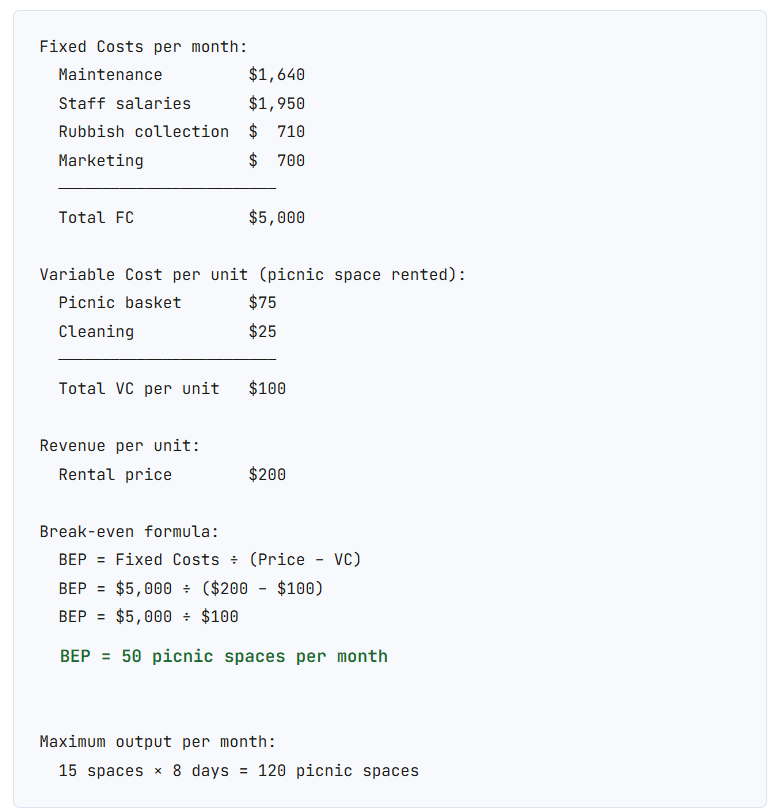
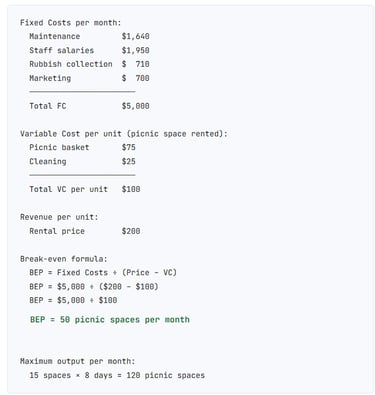
All the figures you need to draw the chart must be calculated first. Here is the full working:
Chart requirements (1 mark each):
Axes: Y-axis labelled "Revenue / Cost ($)" - must show dollar sign. X-axis labelled "Units" or "Picnic spaces". Scale must be consistent.
Total Cost (TC) line: Starts at FC ($5,000 on Y-axis at x=0), rises to $17,000 at x=120. Labelled "TC".
Total Revenue (TR) line: Starts at origin (0,0), rises to $24,000 at x=120. Labelled "TR".
Break-even point: Marked where TR and TC intersect - at 50 units, $10,000. Labelled "BEP".
Key scale check:
At 50 units → TC = $5,000 + (50 × $100) = $10,000. TR = 50 × $200 = $10,000.
Lines cross correctly. Maximum output = 15 × 8 = 120 units. Use this as your right-hand boundary.
Lawrence's Notes:
The mark scheme caps at [2] if the chart is not neat, not drawn with a straight edge, or is not to scale. In an exam, use a ruler.
Also note: the FC line is a separate horizontal line - it's common but not compulsory to include it. If included, label it "FC". A table of values instead of a chart = zero marks.
Q1(c) Command term: Calculate Rental price needed for $1,600 target surplus at 80% occupancy
2 marks - 1 for method, 1 for correct answer with $ sign
Step 1 - Find units at 80% occupancy:
Maximum units = 15 spaces × 8 days = 120 80% of 120 = 96 picnic spaces rented
Step 2 - Find variable costs: VC = 96 × $100 = $9,600
Step 3 - Set up the target profit equation: Target profit = Revenue – Fixed Costs – Variable Costs $1,600 = (96 × P) – $5,000 – $9,600 $1,600 = 96P – $14,600 96P = $16,200 P = $16,200 ÷ 96
Rental price needed = $168.75 per picnic space per day
Lawrence's note:
Award method mark even if there's a calculation error, as long as the approach is correct. The dollar sign must appear in working or final answer to earn the accuracy mark. Note the answer is lower than the current price of $200 - this is intentional context for part (d).
Q1(d) Command term: Comment. The effect of the new lower price on occupancy.
2 marks - 1 for comment + 1 for application
The calculated target price ($168.75) is approximately 16% lower than the current rental price ($200). "Comment" means observe and explain what the data suggests - go beyond just stating a direction and include the explanation.
Comment [1]: A price decrease of ~16% may increase occupancy - the stimulus states PN is currently unaffordable for most local residents, so a lower price could bring in new customers.
Application to PN [1]: However, a lower price may undermine PN's exclusive positioning. Customers attracted at the lower price point may be different from the current clientele, potentially changing the character of the venue.
If demand is price elastic, the fall in price increases bookings enough to restore revenue. The extent of the occupancy increase depends on price elasticity of demand - not given in the stimulus, which is a limitation.
Lawrence's comment:
A response that simply says "occupancy will increase because the price went down" earns only [1]. The second mark requires genuine application to PN's specific context - the exclusivity angle, the local resident demographic, or the elasticity of demand argument.
Question 2 - Terrific Cars (TC) Financial Ratios - Capacity, Liquidity, Gearing
Q2(a) Command term: State two disadvantages of high capacity utilisation [2 marks]
TC's factory operates at high capacity utilisation - this is the context. Application not required. One mark per disadvantage.
Cannot take on additional orders - limits revenue growth
Greater pressure on staff - potential for demotivation and burnout
Quality may deteriorate under constant production pressure
Higher maintenance costs and risk of machinery breakdown from overuse
Longer delivery/lead times - risk of customer dissatisfaction
May trigger diseconomies of scale, pushing average unit costs up
Q2(b)(i) Command term: Calculate Creditor days ratio for 2024 [1 mark - no working required]
Creditor Days = (Trade Creditors ÷ Cost of Sales) × 365 = (58 ÷ 300) × 365 = 70.57 days ≈ 71 days
(Do NOT accept 70 days - must round up to 71)
Q2(b)(ii) Command term: Calculate Debtor days ratio for 2024 [1 mark - no working required]
Debtor Days = (Debtors ÷ Sales Revenue) × 365 = (281 ÷ 570) × 365 = 179.94 days ≈ 180 days
Interpretation: TC's debtor days (180) are dramatically higher than its creditor days (71). TC waits nearly 6 months to collect payment from customers but pays its suppliers within 71 days. This creates a significant cash flow problem - TC is effectively financing its customers. For a high-end car manufacturer, this may reflect the nature of bespoke orders, but it represents a serious working capital risk.
Q2(b)(iii) Command term: Calculate Gearing ratio for 2024 [2 marks - 1 for working, 1 for correct answer with %]
Gearing = (Non-current Liabilities ÷ Capital Employed) × 100 Capital Employed = Non-current liabilities + Equity Equity = Share capital + Retained earnings Equity = $500m + $375m = $875m Capital Employed = $700m + $875m = $1,575m Gearing = (700 ÷ 1,575) × 100 = 44.44% ≈ 44.4%
Common Error:
Capital employed = long-term debt + total equity (share capital + retained earnings). Many students forget to include retained earnings, giving an incorrect denominator. The bank overdraft and short-term loans are current liabilities, not included in gearing. Accept 44%, 44.4%, or 44.44%.
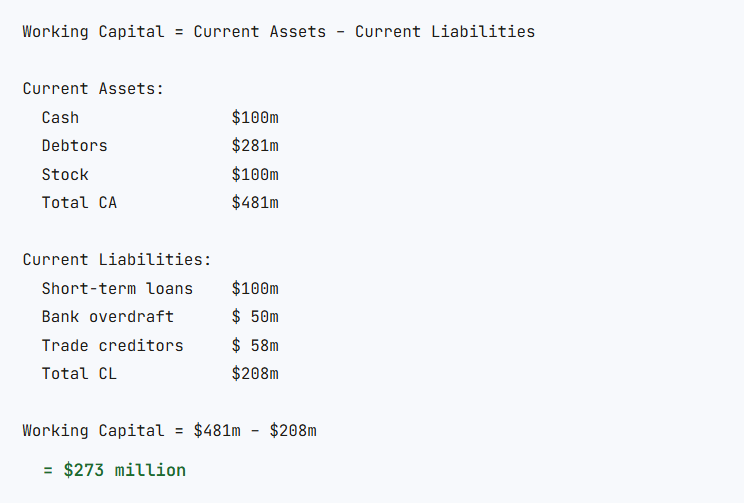
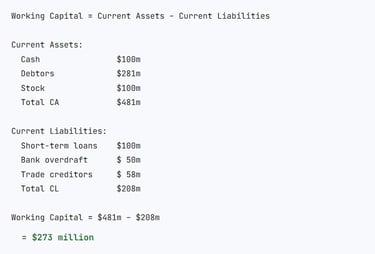
Q2(b)(iv) Command term: Calculate Working capital as at 31 December 2024 [2 marks - 1 for working, 1 for correct answer with $m]
Lawrence's comment:
Long-term borrowings ($700m) are not a current liability - do not include them in the working capital calculation. All figures must be in $ millions. The $ sign (or $m) must appear in the answer.
Q2(c) Command term: Explain How the new $250m long-term loan changes TC's gearing ratio [2 marks - 1 for explanation + 1 for application]
New non-current liabilities = $700m + $250m = $950m
New capital employed = $950m + $875m = $1,825m
New gearing ratio = (950 ÷ 1,825) × 100 = 52.05%
Change: gearing rises from 44.44% to 52.05% - an increase of ~7.6 percentage points.
TC crosses the conventional 50% "high gearing" threshold.
The gearing ratio increases because the new loan increases non-current liabilities while equity remains unchanged. A gearing ratio above 50% is generally considered high, meaning TC becomes more financially risky and more exposed to interest rate changes. Lenders may become more cautious about future borrowing requests.
Question 3 - Gupta Industries (GI)Critical Path Analysis - Induction Training Programme
Q3(a) Command term: State Two features of a publicly held company [2 marks]
Application not required. Do not confuse "publicly held" (PLC / publicly traded) with "public sector". GI is a company whose shares are available on a stock exchange.
Shareholders enjoy limited liability
The company has a separate legal identity from its owners
Shares can be bought and sold on a stock exchange
Can raise capital from the public through share issues
Required to publish audited financial statements
Subject to strict disclosure requirements under company law
Lawrence's Comment:
"Able to raise a lot of finance" is too vague - the mark scheme explicitly rejects this. Say how it raises finance: "by issuing shares on the stock exchange" or "through a public share offering".
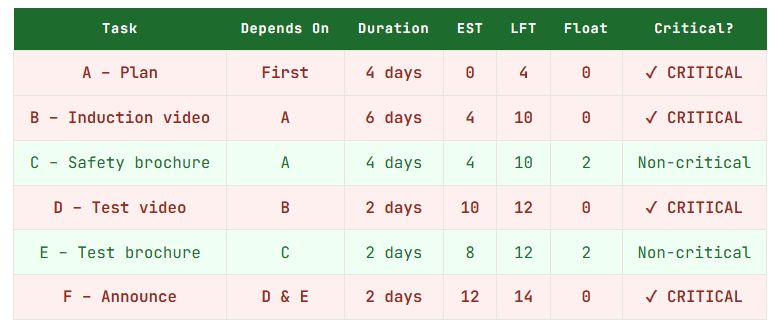
Q3(b)(i) Command term: Complete and Identify Critical path diagram and critical path identification [4 marks]
First, work through the network to find all Earliest Start Times (ESTs) and Latest Finish Times (LFTs).
Critical Path: A → B → D → F
Total project duration = 4 + 6 + 2 + 2 = 14 days. This is within GI's 15-day deadline - the project can be completed on time.
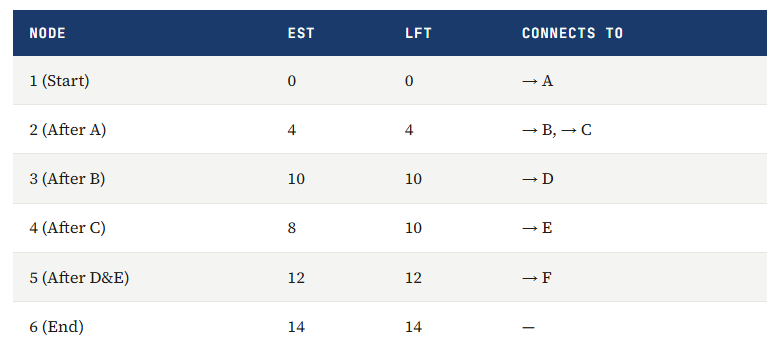
Node diagram values:
Each node is divided into quadrants. Top-left = node number, top-right = EST, bottom-right = LFT. Key values to include on your diagram:
Mark Allocation:
[1] correct ESTs - [1] correct LFTs - [1] correct task labels and durations on arrows + quadrant node format - [1] critical path identified (bold/double line or A-B-D-F written).
Activities must be labelled on the arrows, not inside the circles.
Q3(b)(ii) Command term: Calculate Total float for Task C [1 mark - no working required]
Total Float = LFT of end node – EST of start node – Duration of task = LFT(node 5) – EST(node 2) – Duration of C = 12 – 4 – 4 Total Float for Task C = 4 days
Alternative method using LFT of task C's end node: = LFT(node 4, working back) – (EST at node 2 + duration C) = 10 – (4 + 4) = 2
Note: The mark scheme accepts 2 days based on the standard formula Total Float = LFT(end node for C) – EST(start) – Duration = 10 – 4 – 4 = 2 days
Correct answer: 2 days.
Total float measures the maximum amount a task can be delayed without delaying the overall project. Task C can slip by 2 days - it completes no later than day 10 to allow E (2 days) to finish by day 12 when F begins on the critical path.
Q3(b)(iii) Command term: Calculate Free float for Task C [1 mark - no working required]
Free Float = EST of next activity – EST of current activity – Duration = EST(node 4: start of E) – EST(node 2: start of C) – Duration of C = 8 – 4 – 4
Free Float for Task C = 0 days
Free float = 0 means Task C cannot be delayed at all without delaying the earliest possible start of Task E. Even though there is total float of 2 days (before the project end is affected), Task E cannot start until C finishes - so C must finish by day 8 for E to start at its established or estimated time.
Q3(c) Command term: Explain How GI could use float time to protect against delay [2 marks - 1 for concept + 1 for application to GI]
Float time exists only on non-critical activities. In this network, Tasks C and E have float. GI can use this slack strategically:
Concept [1]: Resources (staff, budget) currently assigned to non-critical tasks (C or E) can be reallocated to support activities on the critical path (A, B, D, F) if those critical tasks face delays.
Application to GI [1]: If making the induction video (Task B) encounters problems - such as equipment failure or reshooting - staff working on the safety brochure (Task C) could be redirected to help complete B within its scheduled 6 days, preventing the overall project exceeding the 15-day deadline and protecting the engineering contract.
Section B Answer One Question (20 Marks) Choose between Question 4 (CropSkan Drones) OR Question 5 (Energia solar)
Question 4:
CropSkan Drones (CD) - Market Research, Growth Strategy & Ansoff Matrix
Q4(a) Command term: Describe One feature of a disruptive innovation [2 marks - 1 partial, 1 fuller description]
CD's drone photography service is the context. Disruptive innovation typically enters at a lower price point or with a simpler solution, gradually displacing established products or services.
May force out established companies by creating entirely new market dynamics or business models
Often offers simpler, more accessible, and more affordable alternatives to existing products
Frequently targets overlooked customer segments that incumbents have ignored
Uses new technology to deliver better customer experience and greater efficiency
Can streamline processes and eliminate traditional barriers to entry in a market
Mark Allocation:
[1] for a partial statement of a feature (e.g. "introduces new technology that reshapes an industry"). [1] for a fuller description that captures the disruption - explaining what makes it disruptive to existing companies or markets. Application to CD not required.
Q4(b) Command term: Calculate CD's market share of the regional market [2 marks - 1 for method, 1 for correct answer with %]
Market Share = (CD's Regional Sales ÷ Total Regional Market Sales) × 100 = ($754,400 ÷ $2,300,000) × 100 = 32.8%
Lawrence's notes: Don't let the national market figure ($18,860,000) distract you in this question - the question specifies the REGIONAL market share. Do not use the national figure here.
National market share = (754,400 ÷ 18,860,000) × 100 = 4.0%
Q4(c) Command term: Explain One advantage of quota sampling for CD [2 marks - 1 theory + 1 applied to CD]
CD used quota sampling based on farm size and crop output to research customer satisfaction. The quotas ensured different farmer types were represented.
Theory [1]: Quota sampling ensures that important subgroups within the population are represented - CD can be sure small, medium, and large farms all contribute to the data.
Application [1]: This means CD can identify whether complaints about wait times or data processing delays are concentrated among large or small farm operators - allowing targeted service improvements rather than a blanket response.
It is quicker and cheaper than random sampling since interviewers fill quotas without needing a sampling frame of all farmers.
Q4(d) Command term: Comment Comment on the correlation shown in Figure 3 (brand image vs satisfaction) [2 marks]
The scatter graph shows customer satisfaction (y-axis) plotted against CD's brand image (x-axis), both rated 1–10, with a trend line included.
[1]: There is a positive correlation between brand image and customer satisfaction - as brand image scores increase, customer satisfaction scores tend to increase too.
[1]: However, the correlation is weak - data points are widely scattered from the trend line, meaning brand image alone is not a reliable predictor of satisfaction. Some customers with high brand image scores rated satisfaction as low as 3–4. CD should investigate other variables that may correlate more strongly.
Q4(e) Command term: Explain One disadvantage of using focus groups for CD [2 marks - 1 theory + 1 applied to CD]
Theory [1]: Focus groups can suffer from groupthink, where participants follow dominant opinions rather than sharing genuine views. Small sample size limits representativeness. The moderator's influence can bias outcomes.
Application to CD [1]: Archie himself led the focus groups - as the founder, his presence may have inhibited critical feedback from farmers reluctant to complain directly to the boss. Additionally, only the largest farm operators were included, so findings may not reflect the experience of smaller farms that make up the wider customer base.
Q4(f) Command term: Recommend Recommend a growth strategy for CD: Option 1, 2, or 3 [10 marks - see mark bands below]
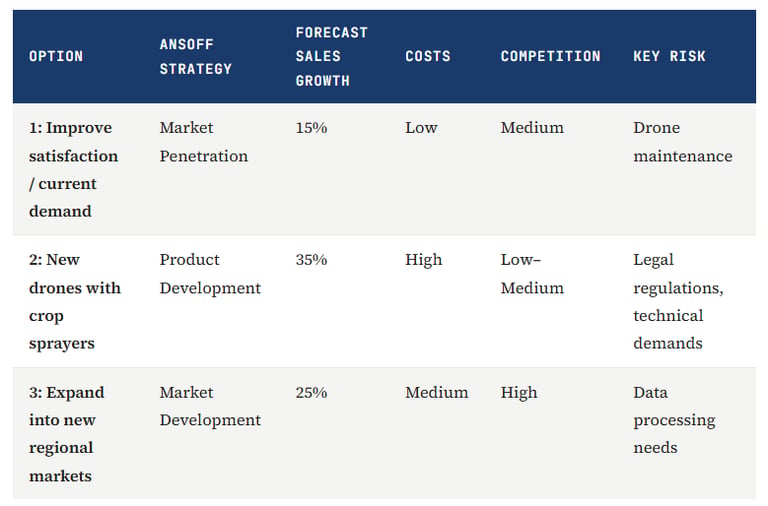
The Three Options mapped to the Ansoff Matrix:
Arguments for each option:
Option 1 (Market Penetration) - Lowest risk, immediate actionability: CD's focus group identified specific weaknesses (wait times, data delays) - these can be addressed directly. The market research provides a roadmap. CD already holds 32.8% of the regional market; the existing drones require no additional capital outlay. However, 15% forecast sales growth is the lowest of the three options, and the current complaints may erode this if unaddressed.
Option 2 (Product Development) - Highest sales potential, moderate risk: A 35% forecast sales growth and low–medium competition make this attractive. The crop-spraying add-on leverages CD's existing drone expertise and customer relationships. The main concerns are the high upfront cost of new larger drones, additional pilot training, and legal regulatory compliance for agricultural spraying - all of which are significant for a growing business.
Option 3 (Market Development) - Medium growth, highest risk: CD holds only 4% of the national market, signalling potential. But entering new regions means competing against established local providers with deeper customer knowledge. Data processing is already flagged as a problem at current scale - expansion would exacerbate this. Competition is rated "high".
Mark Band Guidance:
Marks, What's Required:
9–10 All three options evaluated with balanced, substantiated arguments. Clear recommendation supported by stimulus evidence. Acknowledges limitations of the data/stimulus.
7–8 Mostly addresses all three options. Good use of Table 4 and stimulus. Arguments generally substantiated and balanced.
5–6 Some relevant arguments using Table 4, but one-sided or missing depth. Partially addresses all three options.
3–4 Superficial treatment. May only name options without developing arguments. Limited use of stimulus.
1–2 Little understanding. Arguments unsubstantiated. Minimal engagement with Table 4.
Key Examiner Rules:
Max [3] if only one growth option is considered.
Max [4] if no reference to Table 4, market research, or stimulus (even with balance).
Max [5] if only one option is discussed (even with balanced arguments).
Max [6] if arguments rest only on Table 4 data without broader stimulus context. The top mark band requires a recommendation that goes beyond "Option 2 is best because the sales growth is highest" - you must engage with risk, cost, CD's current situation, and the focus group findings.
Suggested recommendation approach for top marks:
Product Development (Option 2) offers the strongest long-term growth at 35% with lower competition - but the regulatory and cost risks mean CD should first stabilise its customer satisfaction problems (Option 1 actions) before committing to Option 2 capital expenditure.
A phased strategy, with Option 1 as the immediate priority and Option 2 as the medium-term goal, represents the most balanced recommendation given CD's current quality complaints and data processing delays.
Question 5 - Section B Option
Energia Solar (ES) (Solar Energy) - Scientific Management, Financial Analysis & Offshoring
Q5(a) Command term: Describe One feature of off-the-job training [2 marks]
ES uses both on-the-job and off-the-job training. Application not required.
Takes place away from the employee's normal place of work
Delivered by an external provider, such as a specialist training organisation, college, or university
Can take the form of seminars, short courses, professional qualifications, or simulations
Employees are not productive during training - this represents an opportunity cost to the business
Mark Allocation:
[1] for stating a relevant feature (e.g. "takes place away from the workplace"),
[1] for describing it with sufficient detail (e.g. "provided by external specialists such as universities or training organisations, allowing employees to develop skills that are not easily taught on the production floor").
Q5(b) Command term: Explain One benefit AND one cost of introducing scientific management for ES [4 marks - 2+2 (1 theory + 1 application each)]
Benefit:
Scientific management (Taylor's approach) breaks tasks down and optimises each step through time-and-motion study, setting clear performance standards.
Theory [1]: Scientific management provides a systematic, data-driven approach to organising production - tasks are standardised, inefficiencies are identified and eliminated, and workers are trained to follow the "one best way".
Application [1]: Table 5 shows ES's productivity rate is forecast to rise from 7.2 (2025) to 8.4 units per input in 2026 once scientific management is introduced - above even the 2024 rate of 8. This improvement should reduce unit costs and, if revenue holds, improve the declining net profit margin.
Cost:
Theory [1]: Scientific management is associated with de-skilling, close supervision, and removing employee autonomy - this can significantly demotivate workers, especially those who previously enjoyed input into decision-making.
Application [1]: ES currently uses intuitive management and employees contribute to decision-making. Table 5 forecasts labour turnover will increase above the industry mean in 2026 - indicating that the workforce is likely to resist the shift, leading to higher recruitment and retraining costs, and potentially disrupting the JIT production system that relies on motivated, skilled workers.
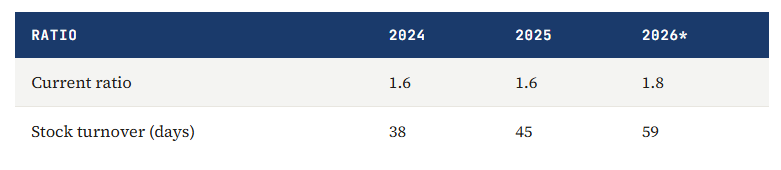
Q5(c)(i) Command term: Comment ES's liquidity position using Table 6 [2 marks - must reference data explicitly]
[1]: The current ratio remains stable at 1.6 in 2024 and 2025, rising to 1.8 in 2026 - suggesting ES is solvent and able to cover short-term liabilities. A ratio above 1.0 is generally considered adequate.
[1]: However, stock turnover in days rises sharply from 38 to 59 days - a near 55% increase - suggesting stock is increasingly slow-moving. Since the current ratio includes stock in current assets, the liquidity picture may be overstated. Removing slow-moving stock would suggest tighter real liquidity than the current ratio implies.
Examiner Watch:
Maximum [1] if the comment references only one ratio. To earn both marks, you must engage with both the current ratio and the stock turnover data - and explain the tension between them.
Q5(c)(ii) Command term: Explain One reason for the difference between gross profit margin and net profit margin [2 marks]
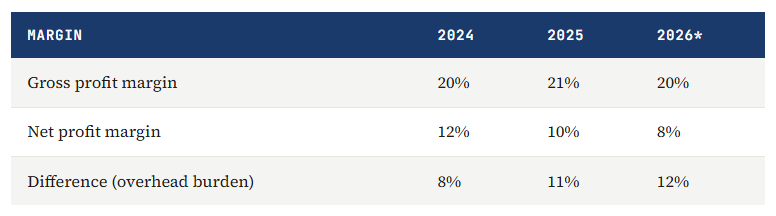
[1] - Observation: The gross profit margin is roughly stable (20–21%), but the net profit margin is falling steadily from 12% to a forecast 8%. The gap between the two is widening.
[1] - Explanation: The widening gap means ES's indirect costs (overheads / operating expenses) are growing faster than revenue. These could include increased administrative costs, higher interest payments on debt, additional training costs in preparation for scientific management, or rising depreciation on capital equipment. Cost of sales is not the cause - gross profit is stable - so the issue lies entirely with overhead expenditure between gross and net profit.
Q5(d) Command term: Recommend Recommend offshoring to Country Y or Country Z [10 marks - see mark bands below]
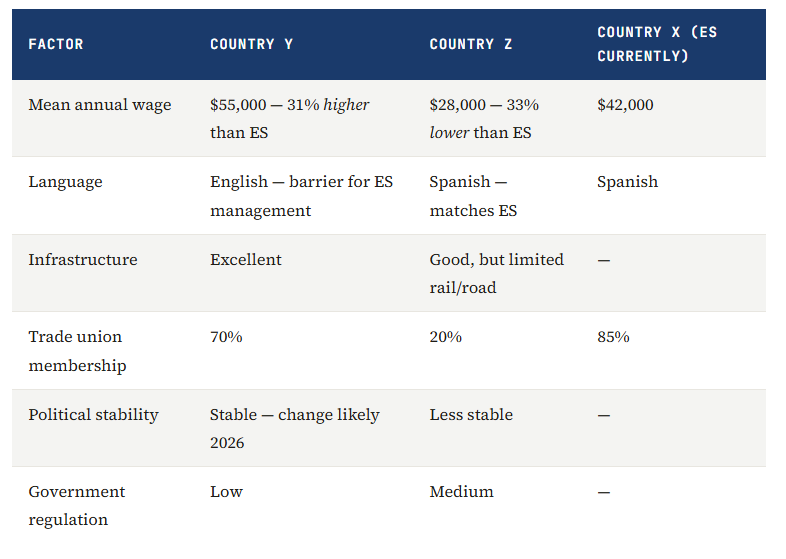
STEEPLE Comparison Summary:
Key arguments for Country Y:
Excellent infrastructure and transport links are critical for shipping finished solar panels back to Country X - this directly affects product costs and delivery reliability. Low government regulation reduces compliance costs. A government change is pending in 2026, but Country Y is still rated as currently stable. High union membership (70%) could be a challenge, though ES has experience managing a heavily unionised workforce (85% in Country X).
Key arguments for Country Z:
The wage advantage of Country Z ($28,000 vs $55,000 in Country Y and $42,000 in Country X) is the most compelling single factor - labour costs would be significantly lower. Spanish is spoken, eliminating the communication barrier that would affect most of ES's management. Low trade union membership (20%) may simplify industrial relations. However, the "less stable" political environment represents a risk for long-term capital investment in solar panel manufacturing - significant capital expenditure is involved. Limited rail and road infrastructure could increase transportation costs back to Country X, partially diminishing the wage advantage.
Mark Band Guidance:
Marks, What's Required:
9-10 Both countries evaluated with substantiated, balanced arguments. Clear recommendation supported by stimulus evidence. Acknowledges limitations (e.g. incomplete STEEPLE - no technological, ethical, or environmental factors given).
7-8 Both countries addressed. Good use of Table 7. Arguments generally balanced and substantiated.
5-6 Some relevant arguments but largely one-sided, or incomplete use of Table 7.
3-4 Superficial. May mention factors without developing arguments.
1-2 Little understanding. Minimal engagement with stimulus.
Same Rules as Q4(f)
Max [3] for one country only. Max [4] without Table 7 evidence. Max [5] for one-country focus even with balance. Max [6] for Table 7 alone without wider stimulus or reference material. Limitation identification (e.g. noting incomplete STEEPLE categories) is required to access the top mark band.
Suggested recommendation for top marks:
Country Z is the stronger recommendation on balance, given the significant wage cost advantage (~33% below Country X), Spanish language alignment, and lower trade union complexity. However, ES's management must conduct further due diligence on the political risk and invest in improving the infrastructure situation - potentially negotiating with local logistics providers. The limitation of the stimulus is that no technological, environmental, or ethical factors are included in the STEEPLE, which could be decisive for a manufacturer of solar panels (an inherently sustainability-focused product).
Frequently Asked Questions - IB BM Paper 2 HL November 2025
What topics were tested on IB Business Management HL Paper 2 November 2025?
The paper covered: customer loyalty programmes and break-even analysis (Module 3 Finance and Module 4 Marketing); capacity utilisation, financial ratios including gearing, debtor days, creditor days, and working capital (Module 3); critical path analysis and features of publicly held companies (Module 2 and Module 5 Operations); disruptive innovation and market research methods (Module 4); the Ansoff matrix growth strategies (Module 4 + Toolkit); scientific management versus intuitive management (Module 2); profitability and liquidity analysis; and offshoring decisions using STEEPLE analysis (Module 1 and Module 2 + toolkit).
How do you calculate the break-even point for PN in Question 1?
Fixed costs for PN total $5,000 per month (maintenance $1,640 + salaries $1,950 + rubbish collection $710 + marketing $700). Variable costs per unit are $100 (picnic basket $75 + cleaning $25). The rental price per unit is $200. Break-even = Fixed Costs ÷ (Price – Variable Cost) = $5,000 ÷ ($200 – $100) = 50 picnic spaces per month. Maximum capacity is 15 spaces × 8 days = 120 spaces, so PN needs to rent 50 out of 120 spaces to break even.
What is the critical path for the Gupta Industries training programme in Question 3?
The critical path is A → B → D → F, taking 14 days in total (4 + 6 + 2 + 2 = 14). This is within GI's 15-day deadline. Tasks C and E are not on the critical path - they form the parallel branch and have a total float of 2 days each, though Task C's free float is 0 (it cannot delay E's earliest start time without consequences).
How is TC's gearing ratio calculated in Question 2?
Gearing = (Non-current liabilities ÷ Capital Employed) × 100. Capital Employed = long-term borrowings + equity (share capital + retained earnings) = $700m + $500m + $375m = $1,575m. Gearing = ($700m ÷ $1,575m) × 100 = 44.44%. After the proposed $250m new loan, gearing rises to ($950m ÷ $1,825m) × 100 = 52.05%, crossing the conventional 50% high-gearing threshold.
What is the difference between total float and free float in critical path analysis?
Total float measures how much a task can be delayed without delaying the overall project completion. Free float measures how much a task can be delayed without delaying the earliest possible start of the next activity. In the Gupta Industries question, Task C has a total float of 2 days (the project won't be late) but a free float of 0 days (any delay to C will push back when Task E can begin, even if the project still finishes on time).
Should I choose Question 4 or Question 5 for Section B?
Both are 20-mark questions with the same structure. Question 4 (CropSkan Drones) centres on Ansoff growth strategy and market research - choose this if you are confident with the Ansoff matrix, quota sampling, and evaluating strategic options. Question 5 (Energia Solar) focuses on scientific management, financial ratio interpretation, and offshoring decisions using STEEPLE analysis - choose this if those areas are your strengths. Both 10-mark extended responses require balanced evaluation of all the options available, not just a recommendation of a single side.
Related IB Business Management Resources
Paper 2 draws on knowledge from across the entire IB Business Management syllabus. The following hub pages on The IB Trainer cover the most frequently examined units in depth - use them alongside your session-specific guide to strengthen the theory behind your answers.
Module 1 Introduction to Business Management
Module 2 Human Resource Management
Module 3 Finance and Accounts
Module 4 Marketing
Module 5 Operations Management
Module 6 Business Management Toolkit (Ansoff, Swot, etc)
IB Business Management Activity book for exam style questions, case studies, activity practice, IB model answers and IB marking schemes
© Theibtrainer.com 2012-2026. All rights reserved.
Legal
Have a Tip? Send us a tip using our anonymous form