IB Business Workplace Conflict & Industrial Relations
Discover how workplace conflict unfolds through real strikes, work-to-rule actions and lockouts. Learn IB Business Management industrial relations and more
IB BUSINESS MANAGEMENTIB BUSINESS MANAGEMENT MODULE 2 HUMAN RESOURCE MANAGEMENTIB BUSINESS MANAGEMENT HL
Lawrence Robert
11/10/202515 min read
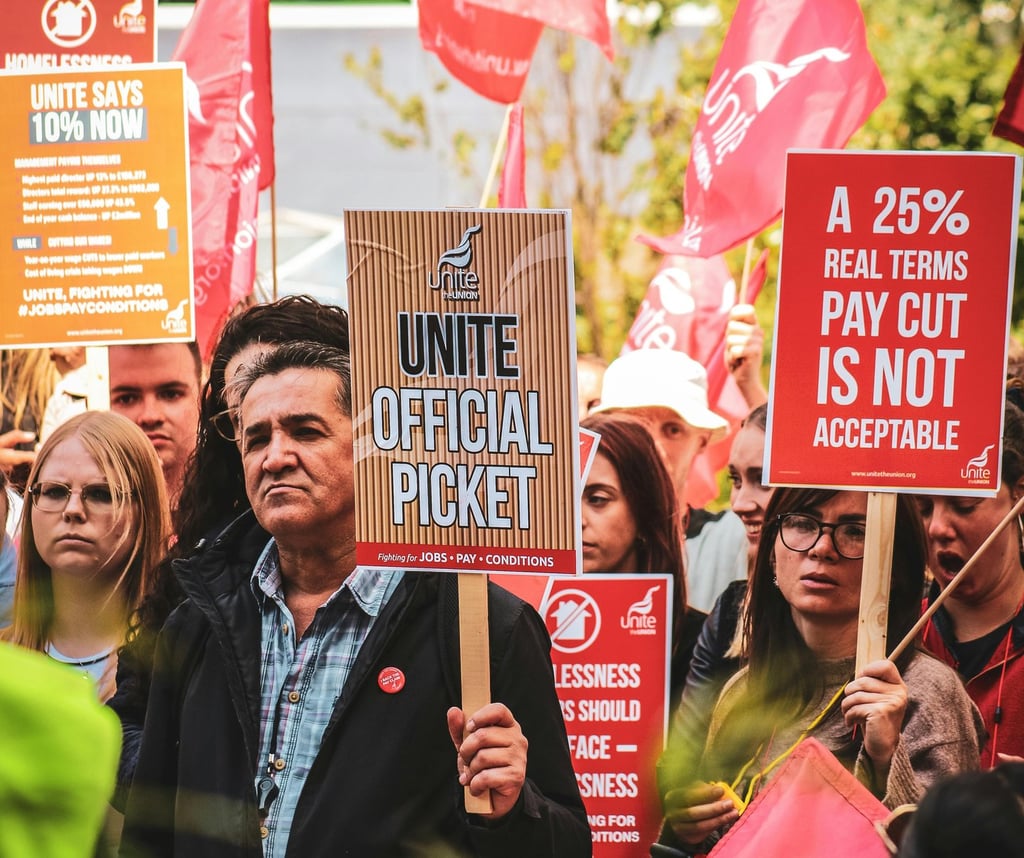
War at Work? Understanding Workplace Conflict and Industrial Relations
Target question:
What are the causes and methods of industrial action in IB Business Management?
Let's go back for a minute to the famous railway industrial action that took place in the UK in December / January 2023. It's 6:45 AM on a freezing December morning in 2023. You're standing on a railway platform somewhere between Manchester and London, staring at a digital departures board that's completely blank. Not delayed. Not cancelled. Just... nothing. This was the UK's biggest wave of industrial action since 1989, where over 40,000 railway workers decided enough was enough.
Workplace conflict is rarely that simple. One person's "greedy union demanding too much" is another person's "workers fighting for fair pay after years of real-term wage cuts." And as future business managers studying for your IB Business Management exams, you need to understand both sides of this story.
Workplace Conflict & Industrial Relations: IB Business Management Definitions
IB Business Management Definition - Workplace conflict:
In IB Business Management refers to friction, disagreement, or open dispute between employees and employers (or between groups within an organisation) arising from incompatible interests, unmet needs, or miscommunication. Conflict itself is not inherently destructive - it can surface real problems that need addressing. What determines whether conflict strengthens or damages an organisation is how it arises and, critically, how it is managed.
The main causes of workplace conflict are: employees' needs and wants being ignored or consistently unmet (particularly around pay, safety, and working conditions), incompatible values and objectives between management and staff, miscommunication and information distortions, internal workplace politics that prioritise self-interest over problem-solving, and perceived injustices or inequity in treatment. Unresolved conflict typically leads to absenteeism, higher labour turnover, reduced productivity, and industrial unrest.
IB Business Management Definition - A grievance:
Is a formal complaint raised by an employee about a perceived injustice or unfair treatment in the workplace - such as unsafe conditions, discriminatory treatment, or pay inequity. Unaddressed grievances are a primary cause of escalating workplace conflict. Junior doctors in England, who went on strike multiple times between 2022 and 2024 after what they described as over a decade of real-term pay cuts, are a frequently cited example of grievance-driven industrial action.
IB Business Management Definition - Collective bargaining:
Is the process by which employee representatives (typically trade unions) negotiate with employer representatives over pay, working hours, and conditions of employment on behalf of the workforce as a whole. It is the primary mechanism through which industrial conflict is managed and resolved without resorting to industrial action. Collective bargaining works both ways - employer representatives negotiate on behalf of management, while employee representatives negotiate on behalf of workers.
IB Business Management Definition - Employee representatives:
Are individuals or organisations (most commonly trade unions) elected or appointed to represent the collective interests of workers in negotiations with management. Their role includes making employees' views known to management, negotiating for improved pay, training, and conditions, representing workers during legal disputes or redundancy processes, and building trust between workers and employers.
IB Business Management Definition - Work-to-rule:
Is a form of industrial action in which employees follow every workplace rule, policy, and procedure to the absolute letter - with the deliberate intention of slowing production and reducing output without technically breaking any rules. It exposes how much businesses depend on employees' goodwill and willingness to go beyond their strict contractual obligations. Workers cannot be disciplined for work-to-rule because they are, by definition, complying fully with their employment terms. In August 2024, GPs in England voted to cap appointments at 25 per day - the recommended safe limit they had regularly been exceeding - as a form of work-to-rule action.
IB Business Management Definition - Strike action:
Is the most extreme form of employee industrial action - a collective refusal to work, typically used as a last resort after collective bargaining has failed. It is highly disruptive but costly for striking workers, who forgo pay during the strike period. In many countries, legal requirements must be met before a strike can proceed - in the UK, for important public services, at least 50% of eligible members must vote, and at least 40% of all eligible members must vote in favour. The 2022-2024 UK rail strikes, which lasted two years and reduced rail capacity to 20% on strike days, illustrate both the power and the cost of prolonged strike action.
IB Business Management Definition - Redundancy:
Is the termination of employment when a job role ceases to exist - due to cost pressures, technological change, or reduced demand. Unlike dismissal, redundancy is not a consequence of employee misconduct. Employers sometimes use the threat of redundancy as a bargaining tool in industrial disputes. Redundancies can be voluntary (with severance incentives) or compulsory (forced), with compulsory redundancy typically causing severe damage to staff morale and organisational trust.
IB Business Management Definition - A lockout:
Is an employer-initiated form of industrial action in which the business prevents employees from entering the workplace during a dispute, stopping all production and denying workers access to their jobs and pay. Like strike action, lockouts are a weapon of last resort - damaging to both parties and typically harmful to the employer's public reputation. In August 2024, two Canadian railway companies (CN and CPKC) declared lockouts that shut down rail activity across Canada, causing immediate supply chain disruption.
The key IB Business Management exam principle on industrial relations: the outcome of any industrial dispute depends on the relative bargaining strength of each side - but the strongest long-term position is rarely about who can sustain the most damage. Businesses need workers, and workers need businesses. The most durable resolutions come from negotiation, trust-building, and finding solutions that both sides can accept - as demonstrated by the 2024 resolution of the UK rail dispute under a government willing to negotiate properly.
What Triggers Conflict In The Workplace?
So what actually causes conflict in the workplace? Turns out, it's not usually one massive blow-up moment or specific incident. It's more like death by a thousand paper cuts.
When Voices Go Unheard
Conflict kicks off when employees' needs and wants get ignored or swept under the carpet. Think about it from a human perspective - imagine you've been asking your boss for months about getting proper safety equipment, or you've noticed you're being paid less than colleagues doing the exact same job. At first, you might just grumble about it in the break room. But if nothing changes? That frustration builds.
This is what we call a grievance in business terms - it's when workers have a proper cause for complaint, especially around unfair treatment. It's basically a perceived injustice that festers if left unaddressed.
IB Business Management Real-life example: The junior doctors in England know this feeling intimately - they went on strike multiple times between 2022 and 2024, claiming they'd experienced over a decade of real-term pay cuts.
That's not a sudden decision; that's years of feeling undervalued building to a breaking point.
When Values Clash
Then there's the problem of incompatible opinions and values within organisations. Different stakeholders see the world differently. Management might think "we need to cut costs to stay competitive," while employees hear "we're going to make your job harder for the same pay." Both viewpoints might have some merit, but when they're miles apart, you get conflict.
Miscommunication and Office Politics
Add miscommunications and workplace politics into this mix, and you've got proper trouble. Ever played that game of telephone where a message gets completely twisted by the time it reaches the end? That's workplace communication on a bad day. And internal politics - where people are more focused on protecting their own positions than solving problems - just makes everything ten times worse. The result? Demoralised staff, people calling in sick more often (absenteeism), workers leaving for other jobs (labour turnover), and ultimately, industrial unrest.
Conflict itself isn't always bad. Sometimes it's exactly what's needed to drag real problems out into the open. It's how conflict arises and - crucially - how it's managed that determines whether it destroys a business or makes it stronger.
When Employees Fight Back: The Arsenal of Industrial Action
Alright, so employees are frustrated. What can they actually do about it? They've got three main weapons in their industrial action toolkit, ranging from "let's talk this through" to "right, we're shutting this down."
The Negotiation Table: Collective Bargaining
Collective bargaining is basically employees and employers sitting down for a proper chat about pay, hours, and working conditions. But here's what is relevant - individual workers have about as much negotiating power as a Year 7 trying to haggle with Apple over an iPhone price. Zero.
That's why we have employee representatives - individuals or organisations (like trade unions) that act as the collective voice of workers. They're elected by their colleagues to negotiate on everyone's behalf because, let's be real, a company with 5,000 employees can't sit down and hash out contracts with every single person individually. That would be chaos.
These representatives have a proper job description:
Make employees' views known to management
Fight for better training, improved conditions, and higher pay
Represent workers during legal disputes or redundancies
Build trust between workers and bosses (when things are going well)
When collective bargaining works, it's brilliant. Take the American Postal Workers Union in 2024 – they negotiated a three-year deal with the US Postal Service that 95% of members voted to accept. No givebacks, protection from layoffs, proper cost-of-living adjustments. That's collective bargaining doing its job.
But when negotiations fail? That's when things can get a bit nasty.
The Subtle Rebellion: Work-to-Rule
Work-to-rule is essentially malicious compliance turned into an art form. Employees follow every single rule, policy, and procedure of their organisation to the absolute letter - with the specific intention of disrupting production and reducing output.
Let's imagine you're a train driver, right? Normally, you might drive slightly over the speed limit when the line's clear, take a shortcut through the depot, or help out with announcements when the system's dodgy. These little extras keep everything running smoothly. But during work-to-rule? Nah. You'll drive at exactly the speed limit. Check every safety regulation three times. Take your full break. Not answer your phone during lunch. Follow your contract exactly as written.
In August 2024, GPs in England voted to work-to-rule by capping appointments at 25 per day - the recommended safe limit that they'd been regularly exceeding to keep the system afloat. Suddenly, appointment availability plummeted, and the government couldn't even complain because the doctors were literally just following safety guidelines.
The genius of work-to-rule is that workers can't be disciplined for it. They're following the rules! But it exposes how much businesses rely on employees' goodwill and willingness to go "above and beyond." and to do "the extra mile". It's like that moment when your parents tell you to "help around the house," and you respond by doing exactly what they asked and absolutely nothing more. Technically compliant. Practically disruptive.
The Nuclear Option: Strike Action
Strike action is when employees refuse to work, full stop. It's the industrial action equivalent of walking out - extreme, dramatic, and usually a last resort after everything else has failed.
When railway workers struck across the UK in 2022-2024, trains ran at just 20% of normal capacity on strike days. Junior doctors striking for six consecutive days in January 2024 led to almost one million lost NHS appointments. It's disruptive. That's entirely the point. It makes the system collapse.
Strikers don't get paid while they're on strike. Which means it's usually temporary, because most people need to, you know, pay their rent and eat food. That's why unions often have a "National Dispute Fund" (like the RMT does) to help support members during strikes. Some workers even get "strike pay" from their union.
There are also legal hoops to jump through. In many countries, trade unions need to give advanced warning before striking. In the UK, for "important public services," you need at least 50% turnout in the ballot, and at least 40% of all eligible members must vote in favour. These rules exist because strikes can cause a genuine crisis for businesses and the public.
The 2022-2024 UK rail strikes lasted two years - TWO YEARS - before being resolved. That's not a quick fix; that's a war of attrition where both sides are bleeding money and patience.
When Employers Strike Back
Right, so that's what employees can do. But employers aren't exactly sitting there powerless, are they? They've got their own playbook, and some of these moves are absolutely ruthless.
Employers Can Also Bargain
Yes, collective bargaining works both ways! Employer representatives - usually senior management or specialist consultancy firms - negotiate on behalf of the company.
Smart employers actually prefer negotiation to confrontation. Why? Because industrial action costs everyone money. Lower productivity, damaged reputation, lost customers - it's expensive. When your website is down is expensive. The UK government only managed to resolve the rail strikes after Labour won the 2024 election and actually sat down to negotiate properly. The previous Conservative government had refused to negotiate in England for over a year, while Scotland and Wales resolved their disputes quickly because transport is devolved there. Funny how talking helps, right?
Legally, employers sometimes have to consult employees about big decisions - relocations, redundancies, potential takeovers. It's not optional; it's the law.
The Threat: Redundancies
Redundancy happens when a business can't afford certain workers anymore, or when jobs disappear due to technology, seasonal factors, or lack of work. It's not the same as being sacked - redundancy means the job itself is gone, not that you did something wrong.
Employers sometimes use the threat of redundancies as a negotiation tactic. "Accept these new terms or we'll have to let people go" is a powerful motivator when people have mortgages to pay. It's dark, but it happens.
Redundancies can be voluntary (with decent severance packages to sweeten the deal) or involuntary (forced). The latter absolutely destroys staff morale and creates instability. How do you choose who goes? Often it's "last in, first out" (based on years of service), but it's always horrible.
Changing the Contracts
If threatening redundancies brings too much negative media attention, employers might go for changes of contract instead. But - and this is important - they can only legally change contracts when it's time to renew them. You can't just wake up one Tuesday and decide everyone's now working Sundays for less pay.
In extreme cases, employers have the legal right not to renew contracts for employees they consider "counterproductive." That's corporate speak for "we're getting rid of troublemakers," and yes, it's as controversial as it sounds.
The Ultimate Measure: Closure and Lockouts
Here's where things get properly brutal. Closure is when an employer stops all business operations to force workers to renegotiate. No work = no pay, which weakens employees' bargaining position pretty quickly.
Lockouts are even more specific - the employer literally prevents employees from entering the workplace during a dispute. We're talking changed locks, security guards, the whole nine yards.
IB Business Management Real-life Examples: In August 2025, Dalhousie University in Halifax became the first top Canadian university (U15 institution) to lock out its faculty union. They physically couldn't get into work.
In August 2024, two Canadian railway companies - CN and CPKC - declared lockouts that essentially shut down rail activity across the country. The supply chain chaos was immediate and massive.
The thing about closures and lockouts is they hurt everyone. Workers lose income, but the business loses revenue and - perhaps more importantly - its reputation. Public perception of a company locking out workers is usually... not great. It looks hostile, aggressive, and like you're playing hardball with people's livelihoods.
Some Real-World Details
Here's what your IB Business Management textbook might not tell you: in the real world, these situations are intense, emotional, and rarely have clear winners.
Take the 2022-2024 UK rail strikes. The unions argued that after years of below-inflation pay rises, railway workers' real wages had been decimated. Management countered that the industry needed modernisation and couldn't afford massive pay increases. Both had legitimate points! The strikes cost the economy millions, disrupted millions of journeys, and created genuine hardship for both workers and passengers.
The resolution? A 15% pay deal spread over multiple years. Was it perfect? Probably not for anyone. But it was what became possible when both sides finally sat down properly to negotiate.
Or look at the Birmingham bin workers currently striking in November 2025. Their dispute? The council wants to abolish a role that some workers claim will cost them up to £8,000 annually. The council says it's necessary cost-cutting. The bins pile up in the streets. Residents get angry. Workers feel undervalued. Everyone loses something.
What Is Relevant About All This?
As future business managers, you need to understand that industrial relations isn't just a chapter in a textbook - it's about real people, real livelihoods, and real consequences. The barista at your local coffee shop who's in a union. The warehouse worker at the Amazon depot. Your future employees, if you end up managing people.
The outcome of any negotiation depends on the methods used and the relative bargaining strength of each side. But the strongest position isn't always about who can hold out longest or cause the most damage. Sometimes it's about who can build the most trust, communicate most clearly, and find solutions that work for everyone.
Because at the end of the day, businesses need workers, and workers need businesses. The challenge - and this is what makes industrial relations so fascinating and frustrating - is figuring out how to make that relationship work when interests don't naturally align.
Practise This Topic: The IB Business Management Activity Book
Industrial relations questions are some of the most richly evaluated in IB Business Management - because there are always at least two legitimate perspectives, and the mark scheme rewards students who can present both sides, weigh them against each other, and reach a justified conclusion about which course of action a business should take. Whether it's evaluating whether a company should accept a union's demands or go to lockout, or assessing whether work-to-rule has been more or less effective than a full strike, the Activity Book's Module 2 Unit 2.7 industrial relations case studies are built around exactly those multi-perspective judgement calls - with model answers at AO3 and AO4 showing how to structure arguments that go beyond reproducing theory.
The IB Trainer's IB Business Management Activity Book covers:
✓ All 6 IB Business Management modules (5 Modules + the Complete IB Business Management Toolkit broken down unit-by-unit
✓ 2-6 case studies per unit (some units need more practice than others)
✓ Every IB Business Management Assessment Objective (AO) explicitly addressed
✓ All 15 IB Business Management Toolkit tools with worked examples
✓ IB Business Exam Socially responsible companies (business as force for good)
✓ Platform access with supporting video content
IB Business Management Exam Corner
For your exam, remember:
Sources of conflict: ignored needs, incompatible values, miscommunication, grievances
Employee industrial action: collective bargaining, work-to-rule, strike action
Employer responses: collective bargaining, threats of redundancies, contract changes, closure and lockouts
Key players: employee representatives and employer representatives
The big idea: Conflict isn't inherently bad, but unmanaged conflict leads to absenteeism, turnover, and industrial unrest
And when you're writing essays about this unit, don't just reproduce theory. Use real examples. Reference the UK rail strikes. Talk about the junior doctors. Mention work-to-rule at GP surgeries. Show you understand that behind every labour dispute there are actual humans trying to pay their bills, keep their dignity, and ideally, sleep at night without stress-induced nightmares.
That's what examiners want to see: theory application to the real world. And let's face it - in November 2025, we've got no shortage of real-world examples to choose from.
Stay well,
Frequently Asked Questions: Workplace Conflict & Industrial Relations (IB Business Management)
What are the causes and methods of industrial action in IB Business Management?
The main causes of industrial action in IB Business Management are employees' needs being consistently ignored (particularly around pay, safety, and working conditions), incompatible values between management and staff, unresolved grievances, and miscommunication. When conflict escalates, employees have three main methods of industrial action: collective bargaining (negotiating through trade union representatives - the preferred first step), work-to-rule (following every workplace rule to the letter to disrupt output without breaking any rules), and strike action (a collective refusal to work - the most disruptive last resort). Employers can respond with their own collective bargaining, threats of redundancy, contract changes, closure, or lockouts.
What is collective bargaining in IB Business Management?
Collective bargaining is the process by which employee representatives (typically trade unions) negotiate with employer representatives over pay, working hours, and conditions on behalf of the entire workforce. Individual workers have little negotiating power alone - collective bargaining gives them a unified voice. It works in both directions: employee representatives advocate for workers, while employer representatives advocate for management. When collective bargaining succeeds, both sides reach a mutually acceptable agreement without resorting to disruptive industrial action. The 2024 American Postal Workers Union deal - accepted by 95% of members with no givebacks and protection from layoffs - is a widely cited example of successful collective bargaining.
What is work-to-rule in IB Business Management?
Work-to-rule is a form of industrial action in which employees follow every workplace rule, policy, and procedure to the absolute letter - deliberately slowing production and reducing output without technically breaking any contractual terms. Employees cannot be disciplined for work-to-rule because they are, by definition, fully compliant. It is a particularly powerful tactic because it exposes how much businesses depend on employees voluntarily going beyond their strict contractual obligations in the normal course of work. GPs in England capping appointments at 25 per day (the recommended safe limit they routinely exceeded) in August 2024 is a widely cited example of effective work-to-rule action.
What is the difference between a strike and a lockout in IB Business Management?
A strike is initiated by employees - it is a collective refusal to work, typically used after collective bargaining has failed. Workers lose pay during a strike, making it a costly but powerful last resort. A lockout is initiated by the employer - the business physically prevents employees from entering the workplace, stopping all production and denying workers access to their jobs and income. Both are extreme forms of industrial action used when negotiations have completely broken down, and both damage all parties involved. The key distinction for IB exams is the direction: strikes are employee-initiated; lockouts are employer-initiated.
How should students evaluate industrial action in IB Business Management exams?
IB examiners expect students to present both perspectives in industrial relations questions - not simply to describe what happened but to evaluate whose position is stronger, what the consequences are for each stakeholder, and what resolution strategy is most likely to produce a sustainable outcome. Strong answers acknowledge that both sides typically have legitimate interests (workers need fair pay and dignity; businesses need viability and productivity), assess the relative bargaining strength of each party, evaluate whether the chosen method of industrial action is proportionate and effective in the specific context, and conclude with a justified recommendation. Using real examples - UK rail strikes, junior doctors, GP work-to-rule - demonstrates applied understanding that examiners reward.
Related Content:
Continue Learning: IB Business Management Blog
IB Business Workplace Conflict Resolution - the natural next step: the formal and informal mechanisms businesses use to resolve disputes before they escalate to full industrial action
IB Business Communication at Work Covered - how communication breakdown is one of the primary triggers of workplace conflict, and how better communication prevents escalation
IB Business Stakeholder Conflicts Detailed - industrial disputes are a specific, high-stakes form of stakeholder conflict between employees and employers
IB Business Labour Turnover Explained - how unresolved workplace conflict drives the labour turnover and absenteeism that damage business performance
IB Business Herzberg Motivation - how unmet hygiene factors (pay, working conditions, job security) are the root cause of most industrial disputes
IB Business Management Human Resource Management - your complete hub for all Module 2 topics
IB Business Management - your complete IB Business Management resource
IB Business Management Toolkit - all 15 analytical tools you need for the three IB Business Management exam papers and the IA
Take Your IB Business Management Revision Further
Want to practise evaluating industrial action from both the employee and employer perspective under exam conditions? Module 2 of the IB Business Management Activity Book includes industrial relations case studies built around real disputes - with model answers demonstrating how to construct balanced, evidence-driven arguments at AO3 and AO4 that go well beyond reproducing definitions.
Explore the IB Business Management Activity Book here.
© Theibtrainer.com 2012-2026. All rights reserved.
Legal
Have a Tip? Send us a tip using our anonymous form