
IB Business Management Paper 2 SL November 2025
IB Business Management Paper 2 SL from November 2025: Format, command terms, quantitative skills, theory, and annual exam analysis for SL students.
IB BUSINESS MANAGEMENTIB BUSINESS MANAGEMENT SL
Lawrence Robert
4/27/202618 min read


IB Business Management
Paper 2 SL - November 2025
Primary Question:
What topics came up on IB Business Management Paper 2 SL November 2025?
Secondary Questions:
How do you construct a P&L for Hear-Ear Tech IB BM November 2025?
What is the expected value for Books to Improve decision tree IB BM?
How do you calculate the break-even for Picnic Nature IB BM SL 2025?
Complete question-by-question analysis for Paper 2 SL. Every calculation worked out in full, the P&L statement constructed step-by-step, the decision tree built and interpreted, and examiner guidance on where SL marks are earnt and lost.
Paper: SL Paper 2
Session: November 2025
Duration: 1 hour 30 minutes
Total marks: 40
Structure of this paper:
Section A (Questions 1 and 2) is compulsory - answer all parts. Section B (Questions 3 and 4) requires you to answer one question of your choice. The 10-mark extended response in Section B carries the same mark band criteria as the HL paper.
This SL paper shares the NGO picnic scenario (Question 1) with the HL paper but uses different numbers and an additional P&L question. Section B introduces two completely different stimuli / refence sets of material from the HL version: a healthy meal plan company and a social enterprise.
SL vs HL reminder:
SL Paper 2 is 1 hour 30 minutes (vs 1h45 for HL), carries 40 marks (vs 50 for HL), has two Section A questions (vs three), and the Section B choice carries 20 marks total including a 10-mark extended response. The mark bands for the extended response are identical between SL and HL.
Section A - Answer All Questions Picnic Nature (PN) - Hear-Ear Tech (HT)
Question 1 - Picnic Nature (PN)
NGO Nature Reserve - Break-Even, Surplus Calculation & Target Pricing
PN is a non-profit NGO operating a city nature reserve. 20 picnic spaces, 8 days per month. Family-friendly and affordable. Financial data provided in reference material Table 1.
Q1(a) Command Term: State Two features of a non-governmental organisation (NGO) [2 marks - 1 per feature]
Application not required. One mark per distinct feature, up to two.
Operates as a not-for-profit entity / social enterprise
Independent from government control - not owned or run by government
Relies on funding from donations, grants, and voluntary contributions
Has a clear social, environmental, or humanitarian purpose
Has a formal structure - may have a board of trustees or directors
Often relies on volunteer work, reducing costs and increasing community involvement
May operate at local, national, or international level
Examiner Watch:
Do not award for examples only (e.g. "like Greenpeace") without application to theory. Do not award for vague statements ("they do good things"), "are part of the private sector", "they pay taxes", or "they keep all the profits" - all these vague answers are explicitly rejected by the mark scheme.
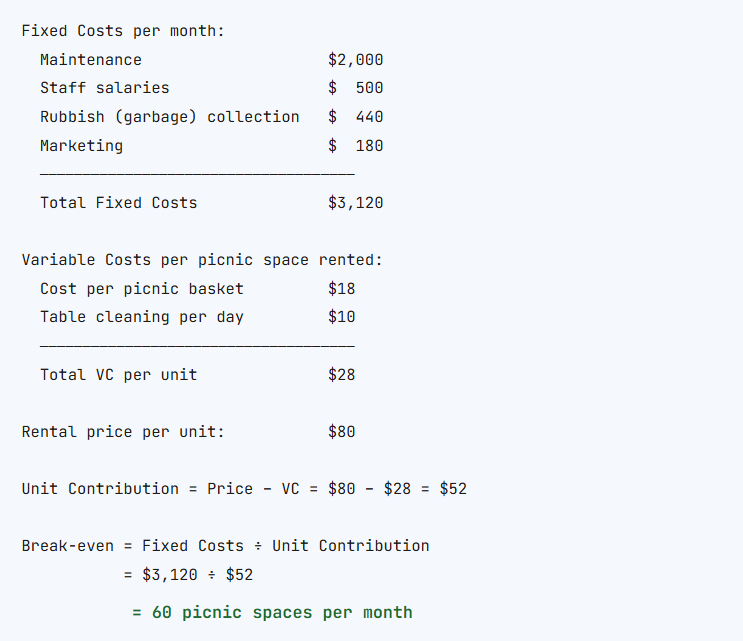
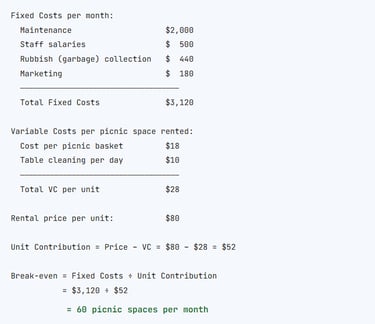
Q1(b) Command Term: Calculate Break-even quantity for PN [2 marks - 1 working, 1 answer in units]
Maximum capacity check: 20 spaces × 8 days = 160 rentals per month. PN breaks even at 60, meaning it needs to rent 60 out of a possible 160 spaces each month. This is a 37.5% occupancy rate - relatively achievable for a family-friendly venue.
Q1(c) Command Term: Calculate Monthly surplus at full capacity (all 20 spaces, 8 days) [2 marks - 1 working, 1 correct answer with $]
Units at full capacity = 20 spaces × 8 days = 160 rentals
Total Revenue = 160 × $80 = $12,800
Total Variable Costs = 160 × $28 = $4,480
Total Fixed Costs = $3,120
Surplus = TR – TFC – TVC = $12,800 – $3,120 – $4,480 = $5,200
Examiner Watch:
OFR applies - if there is a calculation error but the method is correct, award [1]. The $ sign must appear somewhere in the working or the answer. Note PN is an NGO so the exam correctly uses "surplus" rather than "profit" - using either term is acceptable.
Q1(d) Command Term: Calculate Rental price needed to achieve target surplus of $7,600/month (at full capacity) [2 marks - 1 working, 1 correct answer with $]
Assumption: All 160 spaces rented per month (full capacity)
Target profit = Revenue – Fixed Costs – Variable Costs
$7,600 = (160 × P) – $3,120 – $4,480
$7,600 = 160P – $7,600
$7,600 + $7,600 = 160P
$15,200 = 160P
P = $15,200 ÷ 160
P = $95 per picnic space per day
Verification: Revenue = 160 × $95 = $15,200
Less TVC = $4,480
Less TFC = $3,120
Surplus = $15,200 – $4,480 – $3,120 = $7,600
Q1(e) Command Term: Explain Effect on number of spaces rented if PN increases price to $95 [2 marks - 1 explanation + 1 application to PN]
The rental price would rise from $80 to $95 - an increase of 18.75%. The question asks what could happen to the number of spaces rented, not revenue.
Explanation [1]: A price increase of nearly 19% is likely to reduce demand for picnic spaces, as higher prices typically make a product less accessible to its target market.
Application to PN [1]: PN is specifically described as "family-friendly" and "affordable for residents" - a price rise to $95 could price out the families it was designed to serve, causing occupancy to fall below full capacity. If demand is price elastic, the revenue gain per space may be compensated by fewer spaces rented, potentially failing to deliver the $7,600 target anyway.
PN's capacity is capped at 160 rentals - it cannot compensate for falling occupancy by renting more spaces, making the demand response critical.
As a non-profit NGO, customers may also question whether a price increase is consistent with PN's community mission, damaging its reputation and reducing bookings further.
Examiner Watch:
The mark scheme explicitly rejects "will need to rent out less spaces to reach its target surplus of $7600" - that's not an explanation of what happens to occupancy; it's a non-answer. The response must explain why the number rented would change and must be linked to PN's affordability positioning.
Question 2 - Hear-Ear Tech (HT)P&L Statement, Market Share & Premium Pricing Strategy
Q2(a) Command Term: State Two features of strong brand value [2 marks]
HT entered the market 4 years ago with penetration pricing and has built strong brand value. Application not required.
High customer loyalty and repeat purchasing behaviour
Strong brand recognition - stands out clearly in the market
Ability to charge premium prices / price inelasticity of demand
Acts as a sustainable competitive advantage over rivals
Facilitates easier product line extensions under the same brand
Lower marketing costs due to existing recognition and consumer preference
Strong emotional connection with target customers
Examiner Watch:
Do not award: references to profit/profitability, references to shareholders, "will have high market share", or "will be seen as a good brand" - all explicitly rejected by the mark scheme.
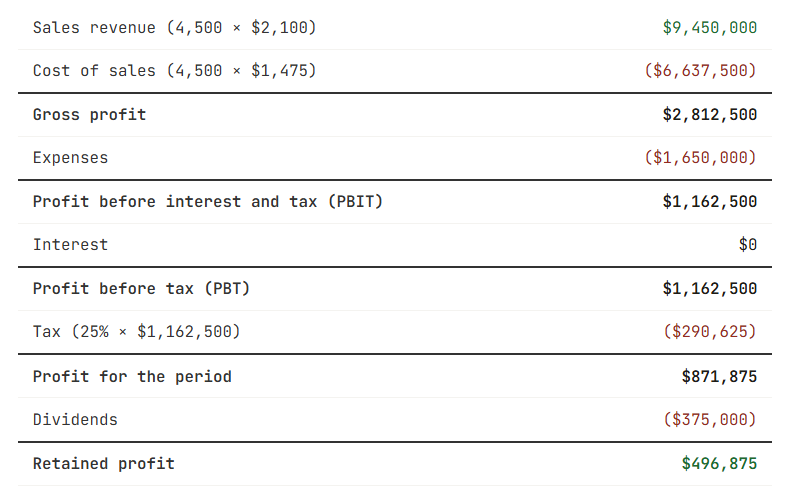
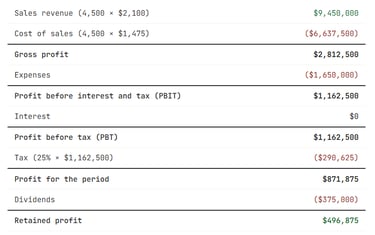
Q2(b)(i) Command Term: Construct Statement of profit or loss for HT, year ended 31 December 2024 [4 marks - see breakdown below]
All figures needed: Sales = 4,500 hearing aids × $2,100. Cost of sales = 4,500 × $1,475. Expenses = $1,650,000. Interest = $0. Tax = 25% on profit before tax. Dividends = $375,000.
Mark allocation:
[4]: Fully correct, in IB format, with title/date/$ sign, and all working shown (at minimum two calculations demonstrated)
[3]: One error - missing title, no working shown, one mathematical error, or one mislabelled line
[2]: Two or three errors as above
[1]: Four or more errors but shows understanding of P&L structure (correct order of revenue → costs → gross profit → retained profit)
Key P&L Requirements:
The IB Business Management format requires: a title ("Statement of profit or loss for HT for the year ended 31 December 2024"), $ signs, and the correct sequence of lines. Showing at least two calculations (e.g. Sales Revenue and Tax) satisfies the "show all your working" instruction.
Note: Interest is $0 - it must still appear on the statement.
Q2(b)(ii) Command Term: Calculate HT's market share in 2024 [2 marks - 1 working, 1 correct answer with %]
Market Share = (HT Revenue ÷ Total Market Revenue) × 100 = ($9,450,000 ÷ $55,000,000) × 100 = 17.18% (accept 17% or 17.2%)
Note: Use HT's REVENUE ($9.45m) not units sold. OFR applies from Q2(b)(i) revenue figure.
Context: At 17.2% market share after just 4 years in the market, HT has achieved significant penetration despite not having used premium pricing. This strong position - combined with the market research confirming strong brand value - supports the case for a shift to premium pricing without losing substantial volume.
Q2(c) Command Term: Explain One advantage for HT of changing to premium pricing [2 marks - 1 advantage + 1 application to HT]
Advantage [1]: Premium pricing generates higher profit margins per unit, helping HT absorb the supplier cost increases that are forecast for next year without passing the full cost increase to shareholders as reduced profits.
Application to HT [1]: HT's market research confirms consumers already perceive strong brand value - the brand reputation justifies a higher price in the minds of hearing aid buyers who associate price with reliability and performance. The premium price reinforces the quality positioning rather than contradicting it.
It differentiates HT from lower-cost competitors, attracting customers who prioritise quality in a medical-adjacent product where trust is critical.
It reinforces brand positioning consistent with the high quality that HT delivered even under penetration pricing.
Examiner Watch:
Do not award for statements that applied to the context: "revenue will increase", "profits will increase", "sales will increase", "market share will increase", or "can sell for a higher price" alone. The explanation must say why the advantage materialises for HT specifically.
Section B - Answer One Question (20 marks total) Choose Question 3 (Mindful Options) OR Question 4 (Books to Improve)
Question 3 - Section B Option
Mindful Options (MO) - Organisation, Motivation Theory & Growth Strategy
Q3(a) Command Term: Describe One feature of a privately held company [2 marks - 1 identify + 1 describe how it works]
MO is a privately held company (Ltd / private limited company). Application to MO not required - [1] for identifying a feature, [1] for explaining how it works.
Limited liability: Shareholders are legally responsible for company debts only up to the value of their investment, so personal assets are protected from business creditors.
Private share sale: Shares are sold privately to family, friends, or associates rather than traded on a stock exchange, so Kairus controls who becomes an owner and prevents hostile takeovers.
Financial privacy: Private firms are not required to publish full financial accounts, allowing them to keep financial information confidential and away from competitors.
Formal registration: Must be officially incorporated before operating, giving the company a separate legal identity from its owners.
Mark Allocation:
Do not award [2] for two identified features - the second mark requires development of how the feature actually works (shown in bold in the mark scheme). E.g. "limited liability" alone = [1]; "limited liability, so shareholders' personal assets are protected from company debts" = [2].
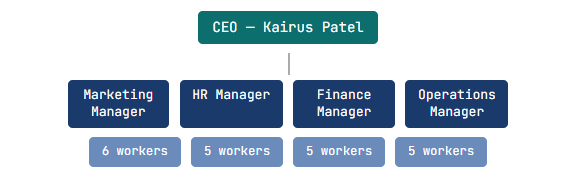
Q3(b) Command Term: Construct MO's organisation chart [2 marks]
From the stimulus: Kairus Patel = CEO. Four managers: Marketing (6 workers), HR (5), Finance (5), Operations (5). Total staff = 1 CEO + 4 managers + 21 workers = 26 people.
[2] for chart showing CEO at top, all four managers below with vertical reporting lines, and worker groups (6 + 5 + 5 + 5) at the bottom. Accept horizontal or vertical format if hierarchy is clear. Workers can be shown as numbered circles/boxes rather than individual boxes. [1] for partially correct (up to 2 errors - e.g. one manager missing, boxes unlabelled, or worker numbers omitted).
Q3(c) Command Term: Explain Two reasons for high motivation at MO, using an appropriate motivation theory [4 marks - 2+2 (theory link + application each)]
The question requires you to name and apply a specific motivation theory. Maslow's Hierarchy of Needs and Herzberg's Two-Factor Theory are the most suitable on paper.
Approach 1: Using Maslow's Hierarchy of Needs
Reason 1 - Self-actualisation [1+1]: Employees can see the real-world impact of their work through customer feedback and suggest improvements to well-being programmes. According to Maslow, this satisfies self-actualisation needs - the highest level, involving achieving one's full potential. When employees observe customers improving their fitness goals as a direct result of MO's meals, it creates a deep sense of purpose and fulfilment.
Reason 2 - Esteem needs [1+1]: The bi-annual staff survey and the opportunity to contribute suggestions at meetings satisfy esteem needs - the desire to feel valued and respected. MO's structure gives employees a voice, increasing their sense of status and recognition within the organisation.
Approach 2: Using Herzberg's Two-Factor Theory
Hygiene factor - Industry-standard salaries [1+1]: Herzberg identified pay as a hygiene factor - it does not motivate when present but demotivates when absent or inadequate. By providing industry-standard salaries, MO removes a potential source of dissatisfaction, freeing employees to focus on the intrinsic aspects of their work.
Motivator - Achievement and recognition [1+1]: Viewing customer feedback gives employees a sense of achievement - a key Herzberg motivator. When staff can directly see that their meal plans are supporting someone's well-being journey, this intrinsic reward drives sustained high motivation beyond what any pay rise could achieve.
Mark Allocation:
Marked as [2+2]. Each reason earns [1] for identifying the motivational factor linked to a named theory, and [1] for applying it with specific reference to MO's stimulus (customer feedback, surveys, training, salaries, meetings, etc.). A response that mentions two elements of Herzberg or two levels of Maslow with examples but no stimulus/reference material link can earn [2] maximum. The stimulus contains rich material - use it.
Q3(d) Command Term: Comment Comment on the survey results shown in Figure 1 [2 marks - 1 comment + 1 with numerical reference]
The survey covered: Salary, Opportunity to contribute at meetings, Training, Promotional opportunities, Leadership support, Happy with colleagues. The chart shows satisfied (grey) vs dissatisfied (black) bars for all 21 employees (excluding managers).
[1] Relevant comment: The majority of employees appear satisfied across most categories, particularly with leadership support, opportunity to contribute at meetings, and happiness with colleagues - reflecting MO's participative culture.
[1] With numerical data: However, satisfaction with training and promotional opportunities is notably lower - approximately 60% satisfied - suggesting some employees feel limited in career development prospects. Salary dissatisfaction affects around 15 employees out of 21, which is concerning despite the industry-standard pay claim.
Mark Allocation:
[1] for a valid observation. [1] for linking it to a specific numerical reading from Figure 1. A response that only makes general observations without referencing the chart data earns maximum [1].
Q3(e) Command Term: Recommend Recommend Option 1 or Option 2 for MO's growth strategy [10 marks - see mark bands below]
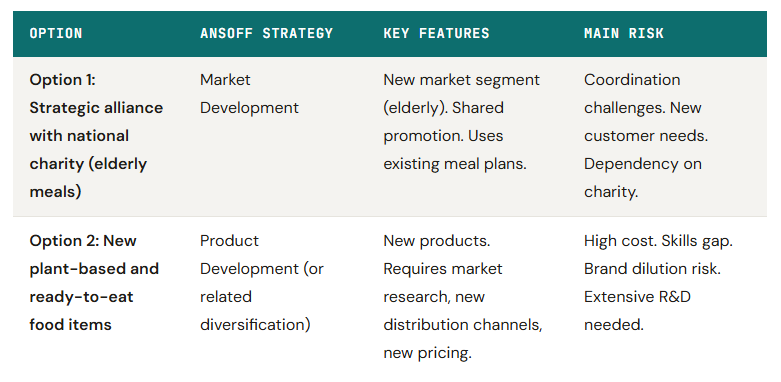
The Options mapped to Ansoff:
Arguments for Option 1: Reaches a new customer segment (elderly people) by leveraging the charity's established distribution - no new delivery infrastructure required. Shared promotional costs are critical given MO is already cost-constrained by rising ingredient prices and food safety compliance costs. The alliance aligns with MO's health and well-being mission, strengthening brand credibility. Lower financial risk: MO does not need to invest heavily in R&D or new logistics.
Arguments for Option 2: Plant-based and ready-to-eat products tap into the fastest-growing segment of the food market - high long-term potential. Premium pricing on new plant-based lines could improve margin. However: MO would need "extensive market research" (its own words), new distribution channels, and new pricing methods - three major investments simultaneously. Rising organic ingredient costs already strain MO's finances. The high risk of failure is amplified by Kairus's acknowledged limited business experience.
Mark Band Guidance:
Marks What's Required:
9–10 Both options evaluated with substantiated, balanced arguments. Clear recommendation supported by stimulus evidence. Acknowledges limitations of the data (e.g. no financial projections for either option, no data on charity's reach or plant-based market size).
7–8 Both options addressed. Arguments generally balanced and substantiated. Good use of stimulus context.
5–6 Some relevant arguments but largely one-sided, or incomplete use of stimulus.
3–4 Superficial. May mention options without developing arguments.
1–2 Little understanding. Minimal stimulus engagement.
Key Examiner Rules:
An option only has balance if it includes at least one advantage AND one disadvantage - but these must be explained, not just stated. "Profit margins will increase" earns nothing unless you explain why. Limitations of the stimulus that need mentioning in your answer: no financial data for either option, no information on how much MO saved switching to social media promotion, no data on the charity's reach or existing infrastructure, and no pricing data for the plant-based market.
Suggested recommendation approach:
Option 1 is the stronger short-to-medium-term recommendation. MO is financially constrained, has limited business experience (acknowledged in the stimulus), and is already under pressure from rising ingredient and compliance costs. A strategic alliance provides expansion without requiring new capital or implementing capabilities MO doesn't have. Option 2 would be more suitable once MO has stabilised its finances and built operational experience - it's a longer-term aspiration rather than an immediate solution.
Question 4 - Section B Option
Books to Improve (BI) - Crowdfunding, Data Interpretation, Decision Tree & Cash Flow Strategy
Q4(a) Command Term: Describe One advantage of crowdfunding as a source of finance [2 marks - 1 identify + 1 explain why advantageous]
BI used crowdfunding for its 2022 start-up capital. [1] for identifying the advantage, [1] for explaining how it benefits the business.
No interest or repayments: Money received through crowdfunding is typically donated or given in exchange for small rewards - there are no loan repayments or interest charges, which avoids creating long-term liabilities and preserves cash flow.
No dilution of ownership/control: Unlike equity finance, crowdfunding does not require giving up shares or decision-making power - Adriana retains full control of BI.
Low cost of raising funds: Avoids bank charges, arrangement fees, and interest, keeping the cost of capital minimal for a social enterprise operating on tight margins.
Marketing benefit: A crowdfunding campaign raises public awareness of BI's mission, potentially reducing future marketing expenditure and attracting ongoing donors.
Q4(b) Command Term: Explain Relationship between literacy levels and mean annual salary (Figure 2) [2 marks]
Figure 2 shows grouped bar charts for writing, reading, and numerical ability against mean salary at Levels 1, 2, 3, and 4/5.
[1] - Trend: There is a clear positive correlation between literacy level and mean annual salary - as literacy level increases across all three ability types, mean salary rises consistently.
[2] - With data: Salaries increase from approximately $19,000–$20,000 at Level 1 to approximately $34,000–$36,000 at Level 4/5. Each rise in literacy level corresponds to an increase of roughly $3,000–$4,000 in mean annual salary across all three ability types (reading, writing, and numerical).
Q4(c) Command Term: Calculate Mean annual salary for literacy levels 1–3 (Table 3) [2 marks - 1 working, 1 answer with $]
Level 1: $18,000
Level 2: $25,000
Level 3: $29,000
────────
Total: $72,000
Mean = $72,000 ÷ 3
Mean annual salary (levels 1–3) = $24,000
Q4(d) Command Term: Construct Fully labelled decision tree for both options + identify the best option [4 marks - [2] diagram + [1] EV calculations + [1] best option identified]
Expected Values:
Option 1 - Promotional campaign (BABAC):
EV = (Probability High × Revenue High) + (Probability Low × Revenue Low) – Cost = (0.5 × $12,000) + (0.5 × –$6,000) – $10,000 = $6,000 + (–$3,000) – $10,000 = –$7,000
Option 2 - Open retail outlet:
EV = (0.7 × $120,000) + (0.3 × $80,000) – $100,000 = $84,000 + $24,000 – $100,000 = +$8,000
Best option on expected value: Option 2 (+$8,000 > –$7,000)
Decision Tree Structure (describe for drawing in exam):
Decision tree layout - left to right:
[Square decision node] → Branch 1: OPTION 1 (cost: $10,000)
→ [Circle chance node]
→ High return (0.5): +$12,000
→ Low return (0.5): –$6,000
EV = –$7,000 ← REJECTED (double slash on branch)
[Square decision node] → Branch 2: OPTION 2 (cost: $100,000)
→ [Circle chance node]
→ High return (0.7): +$120,000
→ Low return (0.3): +$80,000
EV = +$8,000 ← SELECTED
Mark breakdown:
[2] for diagram: Decision point (square), 2 chance nodes (circles), a key, all figures labelled on branches (probabilities + revenues), rejected option marked (double slash), costs shown on branches leaving decision node.
[1] for both correct EV calculations with working shown.
[1] for identifying Option 2 as best (no working required - OFR applies if EV calculations are wrong but method is consistent).
Decision Tree Rules:
Option 1's low return is –$6,000 (a negative revenue figure - this is not a cost, it is a negative return). The EV of Option 1 works out to –$7,000, meaning over the 3-year forecast period the promotional campaign is expected to lose money on net.
Option 2 costs 10× more upfront but generates a positive EV of +$8,000. OFR applies - if EV figures are wrong but the better option is correctly identified from the student's own figures, award the [1] for best option.
Q4(e) Command Term: Recommend Recommend Option 1 or Option 2 to solve BI's cash-flow problems 10 marks - must use answer from (d) AND stimulus
Arguments for Option 1 (BABAC Promotional Campaign): Low initial cost of $10,000 - much more feasible given BI's cash-flow problems. Aligns with BI's non-profit social enterprise identity and does not risk mission drift. Low financial exposure - even in the worst-case scenario, any loss is modest and unlikely to threaten survival. However, the decision tree shows a negative EV of –$7,000. There are also ethical concerns raised by the journalist about asking for cash as well as books, which could harm donor trust and BI's reputation. The success of the campaign depends entirely on public response, which is uncertain.
Arguments for Option 2 (Retail Outlet): Positive EV of +$8,000 - the only financially rational choice based on the decision tree. Creates a new continuous income stream from book sales, directly addressing the cash-flow problem rather than relying on donations. The retail outlet could double as a distribution hub, potentially reducing storage and delivery costs (already rising). However: the upfront cost of $100,000 is 10× higher - where does BI find this money when it is already experiencing cash-flow problems? Adriana's lack of business experience (flagged in the article) is a real constraint. Running a retail outlet involves significant fixed costs not captured in the decision tree. Mission drift risk: commercialisation may conflict with BI's social enterprise identity.
Mark Band Guidance:
Marks What's Required:
9–10 Both options evaluated with substantiated, balanced arguments. Decision tree result from (d) explicitly referenced. Acknowledges limitations of the stimulus and the decision tree model itself.
7–8 Both options addressed. Good use of decision tree and stimulus. Arguments generally balanced.
5–6 Some relevant arguments but one-sided, or decision tree not effectively used.
3–4 Superficial treatment. Mentions options without developing arguments.
1–2 Little understanding. Minimal engagement with data or stimulus.
Limitations to Mention:
The mark scheme lists specific limitations that must be included to be awarded top marks: What is the actual size of BI's cash-flow problem? How long will it last?
For Option 1: What media will be used for BABAC? Is this a one-off campaign? How will BI respond publicly to the journalist's inaccurate claims?
For Option 2: What are the ongoing operating costs of the retail outlet? Are there existing social enterprises in the target city doing something similar? The decision tree only shows 3-year revenue forecasts - it excludes operating costs and qualitative factors.
Balanced recommendation approach:
If external funding can be secured (e.g. a new crowdfunding round or grant), Option 2 offers the more sustainable long-term solution with a positive expected return. Without new funding, Option 1 is the only realistic immediate step - it preserves cash while building brand awareness. A nuanced answer might recommend Option 1 now as a short-term bridge, while planning for Option 2 in the medium term once BI's financial position stabilises.
Frequently Asked Questions - IB Business Management Paper 2 SL November 2025
What topics were tested on IB Business Management SL Paper 2 November 2025?
The paper covered: features of NGOs, break-even analysis, target profit calculations and pricing, and the effect of price changes on demand (Question 1); brand value, constructing a P&L statement with tax and dividends, market share calculation, and premium pricing strategy (Question 2). Section B covered: privately held companies, organisation charts, motivation theory (Maslow/Herzberg), data interpretation from employee surveys, and growth strategy recommendations using the Ansoff matrix (Question 3); or crowdfunding, literacy data interpretation, mean calculation, decision trees with expected value, and cash-flow strategy recommendations (Question 4).
How do you calculate the break-even point for Picnic Nature in Question 1?
Fixed costs total $3,120 per month (maintenance $2,000 + salaries $500 + rubbish $440 + marketing $180). Variable costs per unit are $28 (basket $18 + cleaning $10). Rental price is $80. Unit contribution = $80 – $28 = $52. Break-even = $3,120 ÷ $52 = 60 picnic spaces per month. Full capacity is 20 × 8 = 160 spaces, so PN needs 37.5% occupancy to break even.
How do you construct the P&L statement for Hear-Ear Tech in Question 2?
Sales revenue = 4,500 × $2,100 = $9,450,000. Cost of sales = 4,500 × $1,475 = $6,637,500. Gross profit = $2,812,500. After deducting expenses of $1,650,000 and $0 interest, profit before tax = $1,162,500. Tax at 25% = $290,625. Profit for the period = $871,875. After dividends of $375,000, retained profit = $496,875. The IB format requires a title, date, dollar signs, and showing at least two calculations.
What is the expected value of each option in the Books to Improve decision tree?
Option 1 (BABAC promotional campaign): EV = (0.5 × $12,000) + (0.5 × –$6,000) – $10,000 = $6,000 – $3,000 – $10,000 = –$7,000. Option 2 (retail outlet): EV = (0.7 × $120,000) + (0.3 × $80,000) – $100,000 = $84,000 + $24,000 – $100,000 = +$8,000. Based on expected value alone, Option 2 is best. However, a $100,000 upfront cost when BI already has cash-flow problems raises significant feasibility concerns that the decision tree alone cannot display.
Which motivation theory should I use for Question 3(c)?
Both Maslow's Hierarchy of Needs and Herzberg's Two-Factor Theory work well. Maslow lets you link the stimulus to specific need levels: industry-standard salaries meet safety/physiological needs; colleague relationships meet social needs; survey participation and meeting contributions meet esteem needs; customer feedback and skill development meet self-actualisation needs. Herzberg distinguishes hygiene factors (salary, working conditions) from true motivators (achievement, recognition, responsibility). Either theory earns full marks if applied accurately to MO's specific practices described in the stimulus.
Should I choose Question 3 or Question 4 for Section B?
Choose based on your strongest topics. Question 3 (Mindful Options) tests privately held companies, organisation charts, motivation theory (Maslow/Herzberg), data analysis, and Ansoff matrix strategic recommendations. Question 4 (Books to Improve) tests crowdfunding, graph interpretation, mean calculation, decision trees with expected value calculations, and strategic recommendations for a non-profit social enterprise. Both 10-mark questions require balanced evaluation of both options using the stimulus / reference material - neither is inherently easier than the other.
Related IB Business Management Resources
Paper 1 draws on knowledge from across the entire IB Business Management syllabus. The following hub pages on The IB Trainer cover the most frequently examined units in depth - use them alongside your session-specific guide to strengthen the theory behind your answers.
Module 1 Introduction to Business Management
Module 2 Human Resource Management
Module 3 Finance and Accounts
Module 4 Marketing
Module 5 Operations Management
Module 6 Business Management Toolkit (Ansoff, Swot, etc)
IB Business Management Activity book for exam style questions, case studies, activity practice, IB model answers and IB marking schemes
© Theibtrainer.com 2012-2026. All rights reserved.
Legal
Have a Tip? Send us a tip using our anonymous form