IB Business Supply Chain JIT & JIC
JIT vs JIC: what do Toyota and COVID shelves teach us about supply chain management? Your IB Business guide to production planning, made interesting.
IB BUSINESS MANAGEMENTIB BUSINESS MANAGEMENT MODULE 5 OPERATIONS MANAGEMENTIB BUSINESS MANAGEMENT HL
Lawrence Robert
3/9/202612 min read


When the Shelves Go Empty: Everything You Need to Know About Supply Chains, JIT & JIC
Target question:
What is the difference between just-in-time (JIT) and just-in-case (JIC) stock management?
Do you remember those sad scenes from early 2020 when people were literally sprinting down supermarket aisles to grab the last toilet roll? Or the moment in late 2021 when you tried to buy a PlayStation 5 and found nothing but empty shelves, overpriced scalpers on eBay, and ended up with a huge disappointment?
Those weren't just unlucky moments. They were global supply chains breaking down in real time.
That chaos had everything to do with the production planning decisions businesses make every single day. In the following entry we unpack supply chains, and the very different approaches companies take to managing their stock. Understanding how the supply chain works is critical for your IB Business Management exam.
Supply Chains, JIT & JIC: IB Business Management Definitions
IB Business Management definition - A supply chain:
Is the entire journey a product takes from raw materials to the consumer, covering the sourcing, purchasing, storage and movement of raw materials, semi-finished goods and finished goods.
IB Business Management definition - A local supply chain:
Keeps sourcing and distribution close to home, with short delivery times and tight supplier relationships, while a global supply chain spans multiple countries and regulatory systems, offering cost advantages but far greater complexity and fragility.
IB Business Management definition - Just-in-time (JIT):
Is a stock control system where materials are ordered and delivered only when needed in production, eliminating buffer stock - pioneered by Toyota's kanban signalling system.
IB Business Management definition - Just-in-case (JIC):
Is a stock control system that holds a reserve buffer stock to guard against sudden demand spikes or supplier disruption, trading higher storage costs for greater resilience.
The key IB Business Management exam principle: there is no universally "right" choice between JIT and JIC - it depends on the business, the product, the industry and the external environment, and the strongest answers evaluate which approach (or hybrid of both) suits a specific context rather than declaring one superior in the abstract.
A World That Runs on Invisible Threads
Let's start with your morning. You wake up, grab your phone (assembled in China from chips made in Taiwan), make a coffee (beans shipped from Colombia, roasted in the UK), and pull on a T-shirt (cotton from India, sewn in Bangladesh, distributed from a warehouse in the Netherlands).
Before you've even had your breakfast, you've touched at least five different supply chains.
So what exactly is a supply chain? Think of it as the long, complicated journey a product takes - from raw materials all the way to the moment it lands in your hands. The supply chain process is the management of that entire journey: the sourcing, purchasing, storage, and movement of raw materials, semi-finished goods, and finished goods from production all the way to the consumer.
And it can run at two very different scales.
Local vs. Global: The Corner Shop vs. the World
A local supply chain keeps things close to home. A bakery in Manchester that buys flour from a Yorkshire mill, eggs from a Lancashire farm, and sells its loaves from a shop down the road? That's a local supply chain. Relationships are tight, delivery times are short, and if something goes wrong, you can get in the car drive a few miles and sort it out.
A global supply chain is a completely different proposition. Think about Apple building an iPhone. The aluminium comes from Australia, the lithium for the battery from Chile, the chips are designed in California but manufactured in Taiwan, assembled in factories in China, then shipped to retail stores across 60+ countries. Every country involved has its own regulations, its own trade rules, its own economic quirks. It's massively complex - and massively fragile.
Which brings us to the big lesson of the last few years: a long supply chain or ineffective supply chain management is expensive, stressful, and risky. More links in the chain means more things that can go wrong.
And yes, many things have gone wrong over the years.
When the Chain Snaps: IB Business Management Real-Life Examples
In 2024, global supply chain disruptions rose a staggering 38% compared to the previous year. The culprits? Factory fires (number one for the sixth year running), extreme weather events (up 119% year-on-year), labour strikes, geopolitical tensions, and even cyber-attacks. The Red Sea crisis - caused by Houthi attacks on cargo ships - forced vessels to reroute around the entire continent of Africa, adding weeks to delivery times and sending shipping costs through the roof.
Meanwhile, droughts in the Panama Canal (one of the world's most critical trade routes, carrying over 40% of US containerised goods) reduced transit capacity by roughly 32%, causing delays of up to three weeks for some shipments.
And in 2025, with new US tariffs reshuffling global trade priorities, businesses are panic-buying stock, hunting for new suppliers, and rethinking entire logistics strategies. Around 45% of companies affected by tariffs are increasing their inventories as a defensive measure.
The point? Global supply chains are extraordinary when they work. And extraordinarily stressful when they don't.
IB Business Management - Syllabus and Programme Full Guide →
Two Big Stock Management Strategies
So how do businesses deal with all this uncertainty? There are essentially two opposing philosophies - and understanding them is absolutely IB Business Management exam-critical.
JIT: The Art of Perfect Timing
Let's imagine for a second you're a sushi chef. You don't buy 200 salmon fillets on Monday and hope for the best. Instead, you call your supplier each morning, get exactly what you need for the day's service, and serve it fresh. No waste. No storage. No grey salmons sitting in the fridge.
That, in essence, is Just-in-Time (JIT) production.
JIT is a stock control system where raw materials and component parts are ordered and delivered only when they are needed in the production process. There's no sitting in a warehouse. No buffer stocks gathering dust. Just a perfectly synchronised flow of materials turning up precisely when the production line requires them.
The whole system was pioneered by Toyota in post-war Japan, where factory space was tight, cash was scarce, and waste was simply unaffordable. Toyota's engineers developed what they called the Toyota Production System (TPS) - a philosophy built around eliminating muda (the Japanese word for waste). JIT became its beating heart.
Here's how Toyota makes it work today: when a component is used on the assembly line, a signal - traditionally a card called a kanban - is sent back to the supplier to deliver more. The right part, in the right quantity, at the right time. Toyota builds cars essentially to order, meaning individual vehicles can be customised because every component arrives exactly when needed for that specific build. No stockpiles. No guessing.
The result? Lower storage costs, better cash flow, less waste, and higher quality - because defects get spotted immediately rather than buried in a pile of stockpiled parts. JIT is a core pillar of lean production, which is all about doing more with less by cutting out every form of waste.
The Advantages of JIT (Finance Directors Love It)
No buffer stocks needed, so storage and stock management costs are slashed
No cash tied up in mountains of unsold inventory - working capital stays healthy
Promotes lean production and productive efficiency throughout the business
Lower costs help boost profit margins
The Disadvantages of JIT (and Why It Can Spectacularly Fall Apart)
Complete reliance on third-party suppliers - if they're late, your production line stops
Admin and implementation costs are high; the system needs detailed planning and scheduling
Can't respond quickly to unexpected surges in demand
Suppliers often charge premium prices for urgent or frequent deliveries
That last point about supplier reliability is where JIT can really bite you.
IB Business Management Real-life Example:
Remember the global semiconductor shortage of 2021? When the COVID-19 pandemic disrupted chip factories in Taiwan and South Korea, carmakers like Ford, General Motors, and Volkswagen - all running lean, JIT-style supply chains - had to halt production lines. Ford alone lost billions in revenue. No chips, no cars. JIT only works when every link in the chain holds their own.
Even Toyota - the inventor of JIT - had to adapt. After the catastrophic 2011 earthquake and tsunami in Japan crippled its supplier network, Toyota quietly began holding small "buffer" stocks of critical components, particularly semiconductors. The master of JIT was hedging its own system. Sometimes you have to bend your own rules.
JIC: Because Life Is Unpredictable
Now let's talk about the opposite approach.
Just-in-Case (JIC) is a stock control system built around one simple idea: what if something goes wrong? Rather than ordering stock exactly when you need it, JIC means keeping a reserve stock level - called a buffer stock - so that if demand suddenly spikes or your supplier lets you down, you've got inventory ready to go.
Think of JIC like meal-prepping for an entire week. Yes, it takes up a lot of your fridge. Yes, some of it might go off before you eat it. But when Thursday rolls around and you can't be bothered to cook, you're very glad it's there for you.
JIC is common in industries where demand can be unpredictable and where the products aren't perishable - think cotton, rubber, ball bearings, wine. It's less useful for fresh produce (you can't buffer-stock fresh flowers for three months) or fast-changing markets like fashion or tech (last season's phones and last season's jeans don't sell well).
The Advantages of JIC
Flexibility to respond immediately to sudden or unexpected rises in demand
Production can continue even if a supplier is delayed or disrupted
Customer satisfaction stays high - they don't have to wait
Businesses can buy in bulk and benefit from purchasing economies of scale
The Disadvantages of JIC
Higher costs: storage, maintenance, security, insurance all add up
Risk of stock becoming obsolete - especially dangerous in tech or fashion
Potential for wastage if stock isn't sold quickly
Stocks can be damaged or stolen while sitting in warehouses
Liquidity issues: all that working capital is locked up in stock, not available for other uses
IB Business Management Real-life example:
When COVID-19 hit in March 2020, supermarkets running lean stock management systems simply couldn't cope. Demand for pasta, toilet paper, and canned food spiked overnight. Warehouses were cleared in days. Tesco and Sainsbury's scrambled to impose purchase limits. It was the JIT system's worst nightmare - and a brilliant argument for keeping a bit of buffer stock around.
Practise This Topic: The IB Business Management Activity Book
JIT vs JIC questions reward students who can argue which approach suits a specific business context - product type, industry, external environment - rather than picking a "winner" in the abstract. The Activity Book's Unit 5.6 gives you exactly that kind of evaluative case study practice.
The IB Trainer's IB Business Management Activity Book covers:
✓ All 6 IB Business Management modules (5 Modules + the Complete IB Business Management Toolkit broken down unit-by-unit
✓ 2-6 case studies per unit (some units need more practice than others)
✓ Every IB Business Management Assessment Objective (AO) explicitly addressed
✓ All 15 IB Business Management Toolkit tools with worked examples
✓ IB Business Exam Socially responsible companies (business as force for good)
✓ Platform access with supporting video content
JIT vs. JIC: And The Winner Is...
There's no universally "right" answer between the two. It entirely depends on the business, the product, the industry, and - increasingly - the global environment it operates in.
Why Is This Relevant Right Now
For the last few decades, the whole trend in global business was towards JIT and lean supply chains. Companies outsourced manufacturing to the cheapest global locations, built long, intricate supply chains, and kept costs down by holding as little stock as possible.
Then COVID hit. Then the Suez Canal got blocked by a container ship. Then Red Sea attacks started rerouting global shipping. Then US tariffs started influencing trade relationships overnight.
Suddenly, businesses everywhere are asking themselves a very uncomfortable question: have we gone too lean?
In 2025, roughly 45% of companies affected by new tariffs have responded by increasing their inventories as a defensive measure - essentially shifting towards JIC thinking. Companies are also nearshoring (moving production closer to home), building dual supply sources, and accepting higher short-term costs in exchange for long-term resilience.
The era of the ultra-lean, ultra-global supply chain may be giving way to something more balanced - a hybrid approach that takes the best of JIT (efficiency, low waste) and pairs it with some JIC-style insurance policies for the bits that really can't be allowed to fail.
IB Business Management Exam Gold
If you're heading into an IB Business Management exam, here's what you need to to get this topic just right:
Define the supply chain and explain the difference between local and global supply chains
Explain why longer or poorly managed supply chains increase risk and cost
Contrast JIT and JIC with clear definitions and examples
Evaluate the pros and cons of each - and crucially, argue which is more appropriate for a given business context (look at the product type, industry, and external environment)
Apply real-world examples: Toyota for JIT, semiconductor shortages for JIT risks, COVID stockouts for JIC arguments
The examiners love to see students who connect the theory to what's actually happening in the world. So next time your algorithm serves up a video about empty shelves or delayed shipments, don't just scroll past - think about which supply chain decision caused it.
The Bottom Line For Your IB Business Management Course
Supply chains are the invisible infrastructure holding modern life together. When they work, you barely notice them. When they break - as they have, spectacularly, over the past few years - the world notices very quickly. As a matter of fact, nothing works.
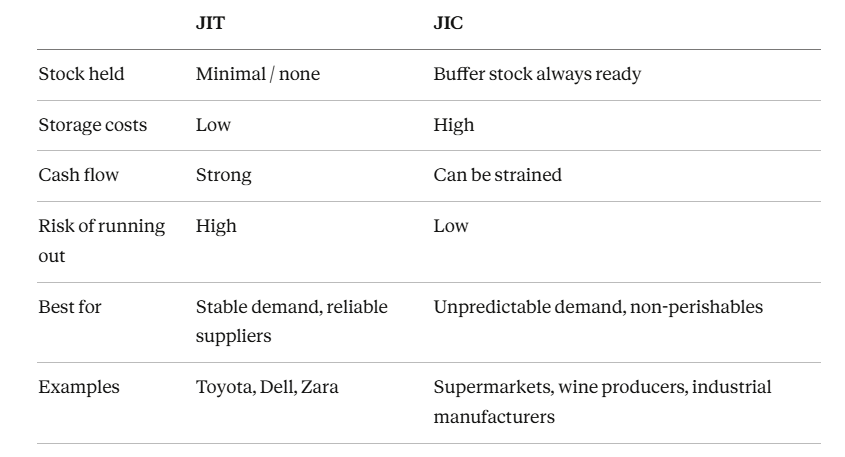
JIT keeps things lean, efficient, and cheap - but fragile. JIC keeps things flexible and resilient - but expensive. The best businesses in the world are those that understand when to apply which, and how to build supply chains that can bend and be flexible enough without breaking.
Stay well,
Frequently Asked Questions: Supply Chains, JIT & JIC In IB Business Management
What is a supply chain and what's the difference between local and global supply chains?
A supply chain is the full journey a product takes from raw materials to the consumer, covering sourcing, purchasing, storage and movement at every stage. A local supply chain, like a Manchester bakery sourcing flour and eggs from nearby suppliers, keeps things close with short delivery times and tight relationships. A global supply chain, like Apple sourcing aluminium from Australia and lithium from Chile before assembling iPhones in China for sale in 60+ countries, offers cost and scale advantages but is far more complex and fragile, since every extra link is another point where something can go wrong.
What is just-in-time (JIT) production and how does Toyota's kanban system work?
JIT is a stock control system where materials are ordered and delivered only when needed in production, eliminating buffer stock entirely. Toyota's kanban system triggers this: when a component gets used on the assembly line, a signal (traditionally a card) is sent back to the supplier requesting more, so the right part arrives in the right quantity at exactly the right time. The benefits are lower storage costs, healthier cash flow and less waste, but the system depends entirely on suppliers never letting the business down.
What is just-in-case (JIC) stock management and when is it more appropriate than JIT?
JIC is a stock control system that holds a reserve buffer stock so a business can respond to sudden demand spikes or supplier disruption without stopping production. It suits industries with unpredictable demand and non-perishable products - cotton, rubber, ball bearings, wine - but works poorly for fresh produce or fast-changing markets like fashion and tech, where stock can quickly become obsolete or unsellable. COVID-19's supermarket stockouts in March 2020 are the clearest real-world argument for keeping at least some buffer stock on hand.
What are the risks of relying on JIT production?
JIT leaves a business completely reliant on third-party suppliers, meaning a single late delivery can halt the entire production line, and it struggles to respond quickly to unexpected surges in demand. The 2021 global semiconductor shortage demonstrated this clearly - Ford, General Motors and Volkswagen, all running lean JIT supply chains, had to halt production when chip factories in Taiwan and South Korea were disrupted, costing Ford alone billions in revenue. Even Toyota, JIT's inventor, began holding small buffer stocks of critical components after the 2011 earthquake and tsunami exposed how fragile a pure JIT system can be.
Why are businesses moving toward hybrid JIT/JIC strategies in 2025?
After years of disruption - COVID, the Suez Canal blockage, the Red Sea crisis, and new 2025 US tariffs - many businesses are questioning whether decades of ultra-lean JIT supply chains left them too fragile. Around 45% of companies affected by the new tariffs have responded by increasing inventories, a clear shift toward JIC-style thinking, alongside nearshoring production and building dual supply sources. The emerging approach blends JIT's efficiency with JIC-style insurance for the components or products that genuinely cannot be allowed to run out.
Related Content:
Continue Learning: IB Business Management Blog
IB Business Break even Analysis In Depth - worth reading alongside this entry, since holding buffer stock under JIC directly raises the fixed costs that feed into a business's break-even calculation.
IB Business Lean Production & Quality Management - JIT is one of the core lean production techniques covered in that entry, so it's worth revisiting for the full picture of how JIT fits into the wider lean philosophy.
IB Business Operations Methods Explained - stock control decisions like JIT and JIC directly shape how job, batch and mass production actually run day to day.
IB Business Production Planning Productivity Metrics In Depth - the natural next step, covering how businesses measure and plan output once their supply chain strategy is in place.
IB Business Management Operations Management - your complete hub for all Module 5 topics
IB Business Management Toolkit - supply chain decisions connect to several of the 15 Toolkit tools, so this is where students can see them applied alongside other strategic models.
IB Business Management - for the full course overview, syllabus breakdown and links into every other module.
Take Your Revision Further
Once you can evaluate JIT against JIC for a specific business context and back it up with real examples, the next step is practising that judgement on full exam-style case studies. The IB Business Management Activity Book gives you exam-standard questions, model answers and marking schemes across every module - including the Operations Management chapter this topic belongs to.
Explore the IB Business Management Activity Book here.
© Theibtrainer.com 2012-2026. All rights reserved.
Legal
Have a Tip? Send us a tip using our anonymous form