
IB Economics The Government Balancing the Market
Dive into IB Economics with fun, real-life stories, practical exam tips, and accessible insights on government intervention in markets.
IB ECONOMICS HLIB ECONOMICS MICROECONOMICSIB ECONOMICSIB ECONOMICS SL
Lawrence Robert
2/3/202521 min read


Why Can't the Government Just Leave Markets Alone?
Target Question:
What are the reasons for government intervention in markets in IB Economics?
Secondary Target Question:
What is the difference between a price ceiling and a price floor?" and "How do indirect taxes cause a welfare loss?
What's in this entry? Why governments intervene in markets, the MORE CBL reasons, price ceilings and floors, indirect taxes (specific and ad valorem), subsidies, direct provision, command and control regulation, consumer nudges (HL), and why intervention doesn't always go to plan. Plenty of IB Economics real-life examples from the UK and beyond.
IB Economics Diagrams Programme, What's included:
200+ exam-ready diagrams covering the entire IB Economics syllabus
Video for every diagram showing you exactly how each model looks
Image version perfect for modelling diagrams in you essays, presentations, and your IA
Detailed written explanations of the IB Economics theory behind each diagram
Both SL and HL IB Economics diagrams clearly labelled and organised by topic
Real IB Economics exam application showing how to use diagrams effectively in Paper 1 and Paper 2
You're 18, you've just finished your A-Levels or IB, and you're moving to London for university. You start searching for a flat. Within about four minutes, you either burst into tears or have an existential crisis. Average asking rents outside London in late 2025 were sitting at around £1,370 a month. In London? Try £2,716. Per month. For a flat. A flat that might not even have a hob working properly.
Your friend in Stockholm, meanwhile, has been on the waiting list for a rent-controlled apartment for nine years and counting. Your cousin in New York is in a building that's been rent-stabilised since 1978 but only houses wealthy tenants because the landlord found clever legitimate ways around the rules.
And your mate who stayed in your hometown? He's fine, actually. Nice pub. Cheap rent.
This is part of the story of government intervention in markets - well-intentioned, sometimes brilliant, sometimes a complete disaster, but always a good topic for conversation. And it's exactly what IB Economics examiners love to see you analyse. So let's get on with it.
Why Should the Government Intervene?
Markets are pretty impressive, actually. Left to their own devices, they match buyers with sellers, set prices through supply and demand, and allocate resources with remarkable efficiency. The free market is basically the algorithmic feed of the economy - it responds to what people want and gives it to them.
But, like your algorithmic feed, the free market sometimes has some seriously questionable outputs. It can leave people behind, wreck the environment, produce too much of things that harm society, and too little of things that genuinely benefit it.
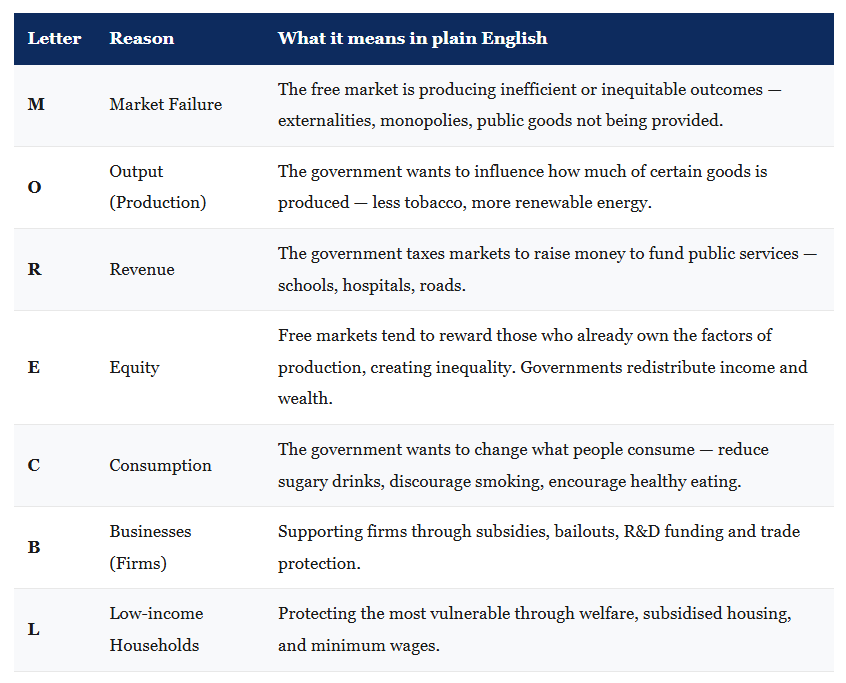
That's where the government steps in. And economists use the acronym MORE CBL to remember the reasons why.
Internal Assessment (IA) Guide – Free Download
Step-by-step support on topic selection, structure, evaluation, and most common IB Economics IA mistakes.
Understanding key IB Economics Internal Assessment concepts
Applying and explaining them in real-world IB Economics contexts
Building IB Economics IA confidence without drowning in dry theory and explanations.
Download the IA guide now for free and boost your IB Economics grades and confidence
IB Economics Key theory - Reasons for government intervention in Markets:
In IB Economics, the reasons for government intervention in markets are summarised by the acronym MORE CBL: Market failure, Output (production levels), Revenue generation, Equity, Consumption control, Business support, and Low-income household protection.
IB Economics Exam Tip: If an exam question asks you to "explain the reasons for government intervention," work through MORE CBL and choose the most relevant reasons for the specific market in the question. You won't need all seven every time - pick the ones that fit best in the context you have been provided.
Notice that the government has different and sometimes competing goals here. It wants to raise revenue (R) but also keep prices low for households (L). It wants to support businesses (B) but also regulate their output (O). This tension is half the reason intervention is so interesting - and why it so often produces unintended consequences.
Tool 1: Price Controls - When the Government Sets the Price
Imagine you're the government and you're watching rents spiral. Renters are furious. It's all over the news. What do you do?
One option: just tell landlords what they're allowed to charge. This is a price control, there are two types of price controls:
Price Ceilings (Maximum Prices)
IB Economics definition - Price Ceiling:
A government-imposed maximum price set below the free-market equilibrium, designed to make goods or services more affordable for consumers. A price ceiling creates excess demand - a shortage - because the quantity demanded at the artificially low price exceeds the quantity supplied.
If the market price of renting a flat in Manchester is £1,200 per month and the government sets a price ceiling of £900, landlords can charge no more than £900. Great, right? Renters save £300 a month. Sorted.
Not really. Let's explain what happens in the market.
At £900, more people want to rent (quantity demanded goes up - it's more affordable now), but fewer landlords want to supply - because their potential income has just been slashed (quantity supplied falls). The result is excess demand: more people want to rent than there are homes available. A shortage.
In economic terms, the price ceiling has kept the price below equilibrium (PE), creating a gap between what consumers want to buy (D₁) and what suppliers are willing to provide (S₁). The market can't clear at this artificial price.
Key Diagram - Price Ceiling: Draw a downward-sloping D curve and upward-sloping S curve intersecting at PE, QE. Place the price ceiling PC below PE. At PC, read across to the S curve (QS) and the D curve (QD). The gap QS to QD is the shortage. Show welfare loss as the deadweight loss triangle between the two quantities. Source visit: IB Economics Diagrams
And welfare? Consumer surplus was originally areas A+B. Producer surplus was C+D+E. After the ceiling, some consumers benefit (area A+C - they get the good at a lower price), but producer surplus collapses to area E, and there's a welfare loss of B+D that disappears from the economy entirely. That's the deadweight loss - output that would have been mutually beneficial just doesn't happen.
IB Economics Real-life Examples: UK Rents, 2025
The UK right now is in the middle of a live debate about this. UK private rents rose by 4% in the twelve months to December 2025, according to the ONS, with the average monthly rent now at £1,368. In London, average asking rents hit £2,716 in Q4 2025.
The government's response? The Renters' Rights Act 2025 - which restricts landlords to one rent increase per year and gives tenants the right to challenge increases through a tribunal. Crucially though, the UK government explicitly confirmed in its guide to the Act: "The government does not support the introduction of rent controls." Instead, the stated strategy is to boost housing supply.
Meanwhile, Scotland went further and tried rent freezes and caps from 2022. The result? Many landlords exited the market, supply tightened further, and leasing costs in Scotland actually rose above the UK average. This was textbook price ceiling in action.
And in Sweden, the average wait for a rent-controlled apartment in Stockholm is over nine years. Nine years. Your entire IB journey, plus six years on top.
The lesson? Price ceilings protect existing tenants who manage to get a place, but over time, they reduce the supply of rental housing, and can lead to deteriorating property quality (landlords invest less), and create parallel or black markets. The intention is good. The outcome is a different matter.
Price Floors (Minimum Prices)
IB Economics definition - Price Floor:
A government-imposed minimum price set above the free-market equilibrium, designed to guarantee producers a minimum income. A price floor creates excess supply - a surplus - because the quantity supplied at the artificially high price exceeds the quantity demanded.
Imagine you're a wheat farmer in rural France. You've had a terrible harvest, global commodity prices are low, and the supermarkets are squeezing your margins. Left to the free market, the price of your wheat might fall below your production costs. You go bankrupt. Rural farming communities collapse.
So the EU's Common Agricultural Policy (CAP) steps in and sets a guaranteed minimum price for your wheat that's above the market equilibrium. Now you have an incentive to produce more - quantity supplied increases. But at this artificially high price, consumers buy less - quantity demanded falls. The result is excess supply: a surplus. More wheat than anyone wants to buy.
Key Diagram - Price Floor: Draw a downward-sloping D curve and upward-sloping S curve intersecting at PE, QE. Place the price floor PF above PE. At PF, read across to the D curve (QD) and the S curve (QS). The gap QS to QD is the surplus. Show welfare loss as the deadweight loss triangle. Source visit: IB Economics Diagrams
On the welfare analysis side: consumer surplus was originally A+B+C. Producer surplus was D+E. The price floor reduces consumer surplus to area A only (higher price, less consumption), while producer surplus shifts to B+D. The welfare loss is C+E - another deadweight loss, gone from the economy.
The EU historically bought up surplus agricultural produce to maintain the price floor. That's why, at various points in history, there have been famous "butter mountains" and "wine lakes" - the government literally stockpiling excess produce. During poor harvests, that surplus is released back into the market to stabilise prices. It's intervention managing intervention.
IB Economics Real-life Examples: The UK National Living Wage
The most famous price floor most students walk past every day without realising it: the National Living Wage. The labour market has a price - it's the wage rate. The government sets a floor, a minimum wage, below which employers cannot pay workers.
From 1 April 2025, the UK National Living Wage rose by 6.7% to £12.21 per hour for workers aged 21 and over - an annual increase of approximately £1,400 for full-time employees. Workers aged 18–20 saw their rate jump from £8.60 to £10.00 - a 16.3% increase.
Supporters argue it reduces income inequality, boosts consumer spending, and reduces reliance on welfare. Critics argue it increases costs for small businesses - particularly in hospitality and retail - and could lead to reduced hours or fewer jobs. The minimum wage is a textbook price floor debate: the theory predicts a surplus of labour (unemployment), but the empirical evidence on job losses is actually much more mixed than the diagram suggests. Real markets are often more complex than models.
Tool 2: Indirect Taxes - Making Harmful Stuff More Expensive
Here's a question. Why does a can of Coke cost more in the UK than in the US? The answer, in large part, is government intervention. Specifically, the Soft Drinks Industry Levy - better known as the sugar tax.
Indirect taxes are levies placed on the production or sale of goods and services, rather than directly on your income. The producer pays the tax to the government, but - crucially - they typically pass a chunk of it on to consumers through higher prices.
IB Economics definition - Indirect Tax:
A tax levied on producers for producing or selling specific goods and services. Often passed onto consumers through higher prices. Used to raise government revenue and/or reduce consumption of harmful products.
Governments love indirect taxes on demerit goods - goods that are over-consumed in regards to what's socially optimal. For instance: tobacco, alcohol, sugary drinks, petrol, gambling. The tax is supposed to shift the supply curve left (increasing costs for producers), which raises the market price and reduces the quantity consumed. Two birds, one stone: revenue raised and consumption reduced.
Two Types of Indirect Tax:
IB Economics definition - Specific Tax:
A specific tax is a fixed per-unit indirect tax, applied uniformly regardless of the product's price. It causes a parallel leftward shift of the supply curve, with the vertical distance between the old and new supply curves equal to the tax amount.
So, it is a fixed amount per unit, regardless of the price of the good. E.g., 30p per litre of sugary drink. The supply curve shifts parallel (leftward), with a constant vertical distance between S₁ and S₂ equal to the tax amount.
IB Economics definition - Ad Valorem Tax:
An ad valorem tax is a percentage-based indirect tax levied on the value of a good or service. It causes a pivotal (rotational) leftward shift of the supply curve - the higher the price of the good, the larger the absolute tax amount."
So, it is a percentage of the product's price. E.g., 20% VAT. The supply curve pivots/rotates leftward - the higher the price of the good, the larger the absolute tax amount. The vertical distance between S₁ and S₂ gets bigger as the price rises.
In both cases, the effect is similar: price rises from P₁ to P₂, and quantity falls from Q₁ to Q₂. The rectangular area between the two prices across the new quantity represents total tax revenue. Part of it is borne by consumers (who pay higher prices) and part by producers (who receive a lower price net of tax). Source visit: IB Economics Diagrams
And yes - there's a welfare loss. A triangle of deadweight loss appears, representing transactions that would have been mutually beneficial at the old price but no longer take place. Society isn't automatically better off just because the government collected some tax.
Who Pays More of the Tax? It Depends on PED.
Whether consumers or producers bear the brunt of an indirect tax comes down to price elasticity of demand (PED).
If demand is price inelastic - consumers don't really change their behaviour much when the price goes up - firms can easily pass the tax on. Consumers pay a lot of the tax. This is why tobacco taxes are so popular with governments: smokers have inelastic demand (addiction makes it hard to quit), so the tax sticks.
If demand is price elastic - consumers switch to alternatives easily when the price rises - firms can't pass the tax on without losing lots of sales. Producers absorb more of the burden. The government still gets revenue, but the market impact is larger.
IB Economics Real-life Examples: The UK Sugar Tax (Soft Drinks Industry Levy)
Introduced in 2018, the UK's Soft Drinks Industry Levy (SDIL) is an excellent real-world example of an indirect tax. Rather than just taxing consumers directly, it targets producers and importers of sugary drinks, with rates tiered by sugar content.
The result? Rather than simply paying the tax, around 89% of soft drinks sold in the UK are now below the taxable threshold - companies reformulated their recipes to avoid the levy altogether. The industry delivered an average 43.5% reduction in sugar in soft drinks between 2014 and 2020. That's not just behaviour change at the consumer level - it's behaviour change by producers.
The SDIL was increased for the first time in April 2025, rising in line with the 27% inflation seen since 2018. And in December 2025, the UK government confirmed a major expansion: from January 2028, the levy will extend to sweetened milk-based beverages - including flavoured milks, milkshakes, sweetened yogurt drinks, and some ready-to-drink coffee products. The sugar threshold will also be tightened from 5g to 4.5g per 100ml.
The government says the expansion could cut 17 million calories a day from the nation's sugar intake. One cautionary tale though: when Lucozade Energy Orange reformulated from 13g to 4.5g of sugar per 100ml ahead of the original levy, sales fell by more than £25 million. Sometimes reformulation has unintended costs of its own.
IB Economics Exam Tip: In a diagram question about indirect taxes, you need to clearly show:
(1) the leftward shift of the supply curve,
(2) the new equilibrium price and quantity,
(3) the tax revenue rectangle,
(4) the consumer and producer tax burdens, and
(5) the deadweight welfare loss triangle.
A well-labelled diagram earns serious marks.
Tool 3: Subsidies - The Government Pays Firms to Do Good Things
If taxes are the government's stick, subsidies are the carrot.
A subsidy is a payment from the government to a firm, designed to lower production costs and encourage the firm to produce more at a lower price. It shifts the supply curve to the right - the exact opposite of an indirect tax.
IB Economics definition - Subsidy:
A subsidy is a government payment to producers that reduces production costs and shifts the supply curve rightward, increasing quantity supplied and lowering the market price for consumers.
At the new equilibrium, consumers pay a lower price (P₂ instead of P₁) and buy more (Q₂ instead of Q₁). Firms receive more than the market price (because the government tops up what consumers pay). Both consumer surplus and producer surplus increase. Source visit: IB Economics Diagrams
But - and there's always a but - subsidies create a welfare loss too. The government's payment is larger than the combined gain in consumer and producer surplus, because it's artificially propping up production that wouldn't otherwise exist at that scale. There's a small triangle of welfare loss (area E in your standard diagram). And of course, the subsidy has to be funded by taxpayers.
The Limits of Subsidies
There are three big problems worth knowing:
1. Cost: Subsidising entire industries gets expensive fast. The EU's Common Agricultural Policy - essentially a giant subsidy programme for European farmers - historically consumed around 40% of the entire EU budget.
2. Reduced Efficiency Incentives: If the government will always bail you out, what's your incentive to innovate, cut costs, and become more competitive? Subsidies can protect inefficient firms - the economic equivalent of keeping a football player in the starting XI because you feel bad leaving them on the bench, even though they're not actually performing.
3. Opportunity Cost: Every pound spent on a subsidy is a pound not spent on schools, hospitals, or infrastructure. Governments have limited budgets. Choices have to be made.
IB Economics Real-life Examples: EV Subsidies Across Europe
Electric vehicles are expensive. Without government support, most consumers wouldn't buy them, and the market would transition to net-zero transport far too slowly to meet climate targets. So across Europe, governments are subsidising EV purchases heavily.
As of 2025, the most generous direct purchase subsidies in the EU come from Italy (up to €11,000 per vehicle), Greece and Poland (each around €9,000), and Slovenia (up to €7,200). Cyprus tops the chart for specific vehicles at up to €20,000 for zero-emission cars. Spain offers between €4,500 and €7,000, depending on income.
France, which previously offered subsidies of up to €7,000, cut its EV subsidy budget from €1.5 billion to €1 billion in 2025 due to fiscal pressures - a reminder that even well-designed subsidies can hit political and financial limits. Germany ended its Umweltbonus subsidy programme in December 2023, though it retains generous tax incentives.
Meanwhile, the EU is now moving towards making subsidies conditional on where EVs are manufactured, with proposals that cars must be at least 70% made in Europe to qualify for state support - partly to protect European manufacturers from Chinese competition. Even the subsidies have subsidies for local content requirements now. This is basically government intervention layering on government intervention.
Tool 4: Direct Provision - The Government Does It Itself
Sometimes the government doesn't use taxes and subsidies. It just provides the good or service itself.
IB Economics definition - Direct Provision:
The government directly produces and supplies goods and services, typically funded through taxation. Used for public goods and merit goods that the free market would underprovide.
Think about schools in your area. Or the NHS. Or the roads you cycle on. Or the street lights that mean you don't walk into a lamppost at midnight. These are all examples of direct provision. The government funds them through taxation and provides them because the free market would either underprovide them or wouldn't provide them at all.
Public goods (like national defence, street lighting, flood defences) have two key characteristics - they're non-excludable (you can't stop people benefiting) and non-rival (one person using it doesn't reduce availability for others). The free market won't provide these because there's no way to charge people for them. The government steps in.
Merit goods (like education and healthcare) generate positive externalities - society benefits more from their consumption than the individual doing the consuming. The free market under-prices and underprovides them. Direct provision ensures wider access.
It's worth noting that direct provision doesn't mean free. The government might still charge a fee - just a lower one than profit-driven alternatives. University tuition fees in England, for instance: the government directly funds much of higher education but still charges students, just at a regulated, subsidised rate.
IB Economics Real-life Examples: NHS vs US Healthcare
The contrast between the NHS (direct provision, funded by general taxation) and the US healthcare system (primarily private, market-based) is probably the most powerful real-world comparison you can make in an IB Economics essay. In the UK, a cancer diagnosis doesn't automatically mean a financial disaster. In the US, medical debt is one of the leading causes of personal bankruptcy. Both systems have flaws, but the equity argument for direct provision in healthcare is hard to ignore.
Tool #5: Command and Control Regulation - Making Things Illegal
Sometimes the government doesn't bother trying to use price signals. It just writes a law.
Command and Control (CAC) Regulation: Laws and regulations that directly prohibit or require the display of specific behaviour by producers or consumers. Sets standards and limits without relying on market incentives.
You can't sell cigarettes to someone under 18. You can't dump toxic waste in a river. Cars must have seatbelts. Employers can't pay below the minimum wage. These are all command and control policies - the government has decided certain behaviours are harmful enough that it won't try to price them out of existence; it'll just ban or restrict them outright.
The Case For CAC
Regulation can be effective and clear-cut. The Clean Air Act in the US (1970) has been credited with preventing millions of premature deaths. Paris banned diesel cars from 2024. The UK's ban on single-use plastics has removed billions of pieces of plastic from the waste stream. When the harm is serious enough and immediate enough, a direct ban can achieve results faster than nudging prices through taxation.
The Case Against CAC
CAC policies are inflexible. They apply equally to a massive multinational company with enormous compliance resources and a tiny family business that's genuinely struggling to meet the same standards. They can raise production costs, reduce competitiveness, and - in some cases - cost jobs. And enforcement is expensive: it requires monitoring, inspectors, and courts to actually work.
There's also the one-size-fits-all problem. A carbon emissions limit set for an entire industry treats a small artisan bakery the same as a steel plant. The economic costs and benefits are vastly different, but the regulation doesn't care.
IB Economics Real-life Examples: The UK's Renters' Rights Act 2025
A brand new CAC example: the UK's Renters' Rights Act, which passed in October 2025, represents one of the biggest reforms to England's private rental sector in decades. It abolishes "no-fault" evictions (where a landlord could remove a tenant without giving a specific reason), restricts landlords to one rent increase per year, and requires landlords to give two months' notice of any increase. Tenants gain the right to challenge increases they think are excessive via a tribunal.
The Act also bans landlords from accepting above-advertised rents - meaning bidding wars for properties are now illegal in England. This is Command and control of the rental market, without going as far as full price controls.
Tool 6: Consumer Nudges - The Intelligent One (HL Only)
IB Economics Higher Level Only
Consumer nudges are an HL topic. If you're SL, feel free to read this out of interest - but you don't need it for your exams. If you're HL, this is a genuinely fascinating area of economics that blends psychology, behavioural science, and policy in ways that feel very updated and very current.
We're not the perfectly rational, information-processing machines that classical economics assumes we are. We're easily influenced by how choices are presented to us. We go with defaults. We copy what other people do. We respond to social norms. We procrastinate. We make terrible decisions when we're hungry or stressed.
That's where nudge theory comes in. Rather than banning things or taxing them, nudges gently steer behaviour by changing the choice environment - without removing anyone's freedom to choose.
IB Economics definition - Nudge:
A nudge is a subtle change in choice architecture that influences behaviour in a predictable direction without restricting freedom of choice or significantly altering financial incentives.
The concept was popularised by Richard Thaler and Cass Sunstein in their book Nudge (2008), and Thaler won the Nobel Prize in Economics in 2017 partly for this work. The UK government actually set up a dedicated "Nudge Unit" (the Behavioural Insights Team) in 2010 to apply this thinking to public policy.
Every episode of Pint-Sized links back to what matters most for your IB Economics course:
Understanding key IB Economics concepts
Applying them in real-world IB Economics contexts
Building IB Economics course confidence without drowning in dry theory.
Subscribe for free to exclusive episodes designed to boost your IB Economics grades and confidence
IB Economics Real-life Examples: Classic Nudge
Default Options: Probably the most powerful nudge. Organ donation in the UK switched from an opt-in system to an opt-out system in 2020 - meaning you're automatically on the register unless you actively remove yourself. Registered donors increased dramatically. The legal right to say no is preserved, but the default changed the outcome.
Similarly: if a school cafeteria puts the salad bar at the front and the chips at the back, salad consumption goes up - not because chips are banned or taxed, but because the default option changed. Amazon's "Subscribe and Save" is a nudge too - the subscription option is presented as the easier choice.
Social Norms: Energy companies in the US and UK began printing on household bills something like: "Most of your neighbours use less electricity than you do." People who saw that their usage was above average tended to reduce it - not because they were fined, but because no one wants to be the wasteful one on the street. The power of social comparison at work.
Placement and Visibility: Supermarkets place healthier products at eye level and near checkouts. Less healthy items are still there - you can still buy them - but the arrangement of the space nudges you towards the healthier choice. This is exactly what Tesco and Sainsbury's are doing when they move fruit to the entrance and put the crisps in a far corner.
Feedback and Reminders: Your fitness app telling you that you haven't moved in three hours. Your phone showing you your daily screen time and looking slightly judgemental about it. These are nudges - real-time feedback that makes you more aware of your behaviour without forcing any change.
Upselling in Reverse: Businesses also nudge - and not always in your interest. "Do you want to go large?" at McDonald's. The pastry next to the till at Costa. The extended warranty you don't need at Currys. Nudges can serve corporate interests just as easily as public ones, which is an important limitation of the framework.
IB Economics Real-life Examples: The UK Pension Auto-Enrolment Nudge
One of the most successful nudges in UK policy history: in 2012, the government introduced automatic enrolment for workplace pensions. Instead of asking workers to actively opt in to a pension scheme, all eligible workers were automatically enrolled, with the right to opt out if they chose. The result? Pension participation rates in the UK jumped from around 55% to over 85% within a few years. Nobody was forced to save - but the default changed everything. "Nudging" wins.
Criticisms of Nudges
Nudge theory sounds almost too good to be true - and in some ways, it is. Critics argue that nudges are paternalistic: who decides what behaviour is "better"? If the government decides you should eat more salad, who gave them the authority to steer your lunch choices, even a little bit?
There's also the issue of effectiveness - nudges tend to work well for low-stakes, daily decisions (like what to pick off a menu or whether to sign up for a pension). For deep-rooted, complex behaviours - like addiction, poverty, or climate change - a gentle nudge in a cafeteria probably won't cut it.
When Government Intervention Goes Wrong: Government Failure
Government intervention doesn't always work. Sometimes it makes things worse.
IB Economics definition - Government Failure:
Government failure occurs when government intervention in a market creates new inefficiencies or unintended consequences, and the costs of intervention outweigh the original social costs of the market failure it was designed to correct.
When government intervention in a market creates new inefficiencies, inequities, or unintended consequences - and the costs of intervention outweigh the original social costs of the market failure being addressed.
The market has a problem - a market failure. The government intervenes to fix it. But if the cost of that intervention (in money, in distorted incentives, in unintended consequences, in opportunity cost) is greater than the cost of the original problem, you haven't made things better. You've made them worse.
Real examples of government failure in action:
Rent controls in Stockholm creating nine-year waiting lists. EU agricultural price floors generating butter mountains. Subsidies keeping inefficient industries alive long past their natural lifespan. Complex regulations that larger firms can navigate easily but smaller competitors can't, effectively acting as a barrier to entry that protects the same monopolies the regulation was designed to challenge.
Government failure is a topic coming up constantly in IB Economics assessment. Examiners love to see you acknowledge that "intervention is the solution" and "intervention is always better than no intervention" but these are both oversimplifications. The real answer always involves weighing costs and benefits, considering context, and thinking about unintended consequences and possible trade-offs.
For access to all IB Economics exam practice questions, model answers, IB Economics complete diagrams together with full explanations, and detailed assessment criteria, explore the Complete IB Economics Course
"The government struggles when the costs of addressing market imperfections or distortions exceed the social costs of the initial market failure."
IB Economics Summary
You now have two complementary frameworks for the government's role in markets:
The reasons governments intervene: MORE CBL - market failure, output, revenue, equity, consumption, businesses, low-income households.
The tools they use: price controls, indirect taxes, subsidies, direct provision, command and control regulation, and nudges (HL).
In any real policy situation, a government is likely using several of these simultaneously, motivated by several of the MORE CBL reasons at once. The sugar tax, for instance, is an indirect tax (tool) used to reduce consumption of a demerit good (C) and raise revenue (R) while addressing a market failure in the form of negative externalities on the NHS (M). Three reasons, one tool, multiple outcomes - some intended, some not.
For IB Economics exams, your job is to identify which tools are being used, explain the economic mechanism (usually with a diagram), evaluate the effectiveness, and consider unintended consequences. That's the formula. Practice this and you're in good shape.
Frequently Asked Questions: Government Intervention In Markets (IB Economics)
What does MORE CBL stand for in IB Economics?
MORE CBL is the IB Economics acronym for the seven main reasons governments intervene in markets: Market failure, Output (production), Revenue, Equity, Consumption, Businesses (firms), and Low-income households. It is a core AO2 concept in Unit 2.8 of the IB Economics syllabus.
What is the difference between a price ceiling and a price floor in IB Economics?
A price ceiling is a maximum price set below the equilibrium - it protects consumers but creates a shortage (excess demand). A price floor is a minimum price set above the equilibrium - it protects producers but creates a surplus (excess supply). The UK National Living Wage is a real-world price floor; rent controls are a real-world price ceiling.
How does an indirect tax create a welfare loss?
An indirect tax shifts the supply curve left, raising the market price and reducing the quantity traded. Some transactions that would have been mutually beneficial at the original price no longer take place - this lost surplus is the deadweight welfare loss. It appears as a triangle on the supply and demand diagram between the old and new equilibrium quantities.
What is the difference between a specific tax and an ad valorem tax?
A specific tax is a fixed amount per unit (e.g., 50p per litre), causing a parallel leftward shift of the supply curve. An ad valorem tax is a percentage of the price (e.g., 20% VAT), causing a pivotal (rotational) shift - the absolute tax amount increases as the price rises.
Why do consumer nudges work, and what are their limitations?
Nudges work because human decision-making is influenced by how choices are framed, not just by rational cost-benefit calculation. Changing defaults, using social norms, and adjusting placement can shift behaviour without restricting freedom. Their main limitation is that nudges work best for low-stakes habitual decisions - they tend to be ineffective for deeply entrenched behaviours like addiction or decisions driven by poverty.
Stay well,
Related Topics:
IB Economics your IB Economics daily guide
IB Economics Microeconomics access Government Intervention in Markets content as well as the rest of module 2
IB Economics Diagrams Check Unit 11 for All Role of Government in Microeconomics diagrams with explanations
IB Economics Paper 1 as Government intervention in Markets is a popular topic for paper 1
IB Economics Activity book Module 2 Microeconomics Units 2.7 to 2.9 for Government Intervention in Markets exam practice, activities, model answers and IB Economics Marking schemes
IB Economics Behavioural Economics as there is a very direct link between Nudges and Behavioural Economics particularly for HL students
IB economics Calculations Book make sure you check unit 8 for Government Intervention in Markets calculations exercises, IB model answers, and IB marking schemes
Read Next: IB Economics Common Pool Resources Failure
© Theibtrainer.com 2012-2026. All rights reserved.
Legal
Have a Tip? Send us a tip using our anonymous form