
IB Economics the Minimum Wage Explained
Discover how the UK's minimum wage impacts workers, businesses, and poverty levels. Essential reading for IB Economics students with 2024 statistics.
IB ECONOMICS HLIB ECONOMICS MACROECONOMICSIB ECONOMICSIB ECONOMICS SL
Lawrence Robert
5/19/202512 min read


The Minimum Wage in IB Economics: Price Floors, Labour Markets, and Why the Debate Isn't Over
Target question:
What are the effects of a minimum wage in IB Economics?
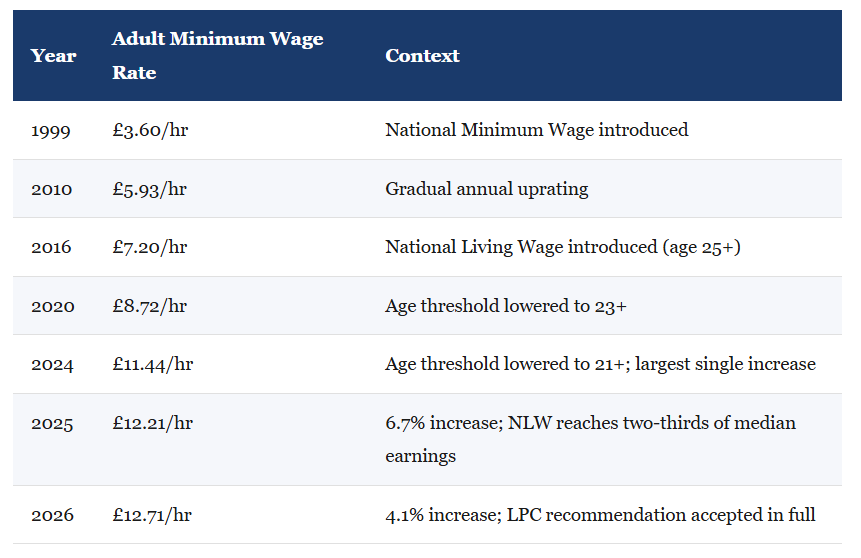
In April 2026, the UK's National Living Wage rose to £12.71 per hour for workers aged 21 and over - an amount that would have seemed extraordinary when the National Minimum Wage was first introduced in 1999 at £3.60 per hour. Over those twenty-seven years, the UK minimum wage has increased more than threefold in nominal terms, and mostly kept pace with - or in some periods exceeded - inflation. Whether that is a good outcome depends entirely on which part of the IB Economics key concepts you apply. The minimum wage is one of the most instructive topics in the whole syllabus, because it sits at the intersection of labour market theory, government intervention, equity, and the gap between economic models and real-world evidence.
IB Economics Related Content:
IB Economics Market Failure and IB Economics Government Intervention (Module 2): The minimum wage is a price floor in the labour market - a form of government intervention designed to correct the market failure of inequitable wage outcomes. It is required knowledge for IB Economics Module 2.
Labour Markets (Module 2): Wage determination through the interaction of labour demand and labour supply is core Unit 2 content. The minimum wage must be analysed using a labour market diagram. Source: IB Economics Diagrams
IB Economics Unemployment (Module 3): The debate over whether minimum wages cause unemployment connects directly to Module 3 macroeconomics and the types and causes of unemployment.
Equity (Key Concept): The minimum wage is explicitly motivated by equity concerns - the IB Economics key concept of fairness in the distribution of income.
Monopsony (HL Module 2): HL students must understand how a monopsony employer in the labour market changes the analysis of minimum wage impact significantly.
1. How Wages Are Determined: The Labour Market Framework
IB Economics definition - Labour Market:
A market in which workers (suppliers of labour) and firms (demanders of labour) interact to determine the wage rate and level of employment.
Derived Demand for Labour - the demand for labour is not valued independently but mostly because of the output it produces. Firms demand labour because workers produce goods and services that generate revenue. If demand for a firm's output rises, its demand for labour rises too - demand for labour is derived from demand for the final product.
IB Economics definition - Equilibrium Wage:
The wage rate at which the quantity of labour demanded by firms equals the quantity supplied by workers. In a competitive labour market, wages tend toward this equilibrium.
In a competitive labour market, wage rates are set by supply and demand. The demand for labour is downward-sloping - as wages rise, firms hire fewer workers because each additional worker costs more relative to the output they produce. The supply of labour is upward-sloping - as wages rise, more workers are willing to offer their time to this type of work. The equilibrium wage is where these two curves intersect. Source: IB Economics Diagrams
Three broad forces can increase wages following this system: an increase in the demand for labour (workers become more productive or the output they produce rises in value), a decrease in the supply of labour (fewer workers are available for this type of job - as happened in UK hospitality after Brexit reduced EU worker availability), or government intervention to set a wage floor above the market equilibrium. The minimum wage is that third route.
2. The Minimum Wage as a Price Floor
IB Economics definition - Minimum Wage (Price Floor in the Labour Market):
A legally mandated minimum wage rate set by the government above the equilibrium wage, making it illegal for employers to pay workers less than the specified amount. Because it is set above equilibrium, it is an effective price floor - it prevents the wage from falling to its market-clearing level.
Labour Market Diagram - Minimum Wage as a Price Floor
Draw a standard labour market diagram with the wage rate (W) on the vertical axis and quantity of labour (Q) on the horizontal axis. The demand for labour curve (DL) slopes downward; the supply of labour curve (SL) slopes upward. Mark the equilibrium at We and Qe.
Now draw a horizontal line above We at Wmin (the minimum wage). At Wmin:
The quantity of labour supplied (Qs) is greater than at equilibrium - more workers want these jobs at the higher wage
The quantity of labour demanded (Qd) is less than at equilibrium - firms hire fewer workers at the higher cost
The difference (Qs − Qd) represents a labour surplus - unemployment caused by the price floor
The workers who retain employment earn higher wages (from We to Wmin). The workers displaced from employment are worse off. This is the fundamental trade-off at the heart of minimum wage analysis. Source: IB Economics Diagrams
IB Economics Exam:
In Economics Paper 1 Part (a), if asked to "explain the effects of a minimum wage using a diagram," you must draw the labour market diagram with the minimum wage set above equilibrium, clearly label the labour surplus (unemployment), and explain both the gain for workers who keep their jobs and the loss for those displaced. A diagram without explanation, or an explanation without a diagram, will not score full marks. Always label your axes - W (wage) and Q (quantity of labour). Source and example: IB Economics Diagrams
IB Economics - Syllabus and Programme Full Guide →
3. The UK's Minimum Wage: A Brief History
The UK introduced the National Minimum Wage in April 1999 under Tony Blair's Labour government - at the time it was a politically contested move, with significant employer lobbying against minimum wages. Starting at £3.60 per hour for adults, it has been uprated almost every year since following the recommendations of the independent Low Pay Commission (LPC).
The introduction of the National Living Wage in 2016 - a higher tier applying to workers aged 25 and over (subsequently lowered to 21 and over) - represented a a more ambitious initiative, explicitly targeting two-thirds of median hourly earnings as a benchmark.
Lawrence's note: The Low Pay Commission (LPC) is a significant idea when applying critical thinking for IB Economics evaluation. Rather than politicians setting the minimum wage for electoral reasons, the UK delegates this to an independent body that weighs employment effects, cost-of-living data, and business impact before making recommendations. This evidence-based approach is widely credited for helping avoid the sharp employment shocks that some economic models predicted.
4. The Great Minimum Wage Debate: Theory vs Evidence
Standard economics competitive labour market theory predicts that a minimum wage set above equilibrium will reduce employment - as the diagram above shows. But real-world evidence is considerably more complex than this, and the IB Economics syllabus requires you to evaluate both.
The Traditional View: Minimum Wages Cause Unemployment
In a competitive labour market, raising the wage floor above equilibrium creates a labour surplus. Firms facing higher labour costs respond by reducing hours, investing in automation (self-service checkouts, ordering kiosks), raising prices, or exiting the market altogether. The workers most likely to lose employment are those generating the lowest productivity - young workers, those with few qualifications, and workers in regions where wages are naturally lower and the minimum wage therefore applies more pressure.
Studies typically find that a 10% increase in the minimum wage reduces employment among low-wage workers by around 1–3%. This is not zero - but it is substantially smaller than early theoretical predictions.
The Card and Krueger Challenge: Does Monopsony Change Everything?
In 1994, economists David Card and Alan Krueger published a landmark study comparing fast-food employment in New Jersey (which had raised its minimum wage) with neighbouring Pennsylvania (which had not). Their finding was revolutionary: employment in New Jersey's fast-food sector actually rose after the minimum wage increase, contrary to competitive market predictions.
Their explanation drew on the concept of monopsony - a market with a single buyer of labour, or more broadly, a labour market where employers have significant wage-setting power over workers.
IB Economics definition - Monopsony:
A labour market structure in which there is a single employer (or a small number of dominant employers), giving that employer market power over wage determination. A monopsonist pays workers less than their marginal revenue product - the wage is set below the competitive equilibrium.
In a monopsonist labour market, a minimum wage set at or below the competitive wage can actually increase both employment and wages simultaneously, reversing the prediction of the competitive model.
In practice, many low-wage labour markets - fast food, retail, social care, cleaning services - have monopsonist characteristics. Workers face high search and switching costs, geographic constraints, and limited outside options. This gives employers wage-setting power even without being a literal single employer. When Card and Krueger found employment rising after a minimum wage increase in fast food, the monopsony explanation was convincing: the minimum wage was partially correcting a pre-existing exploitation of workers below the competitive equilibrium wage.
Lawrence's IB Economics HL Notes:
The monopsony argument is one of the strongest evaluation points available in a Paper 1 Part (b) essay on minimum wages. The structure is: (1) the competitive model predicts unemployment from a minimum wage; (2) but if the labour market has monopsony characteristics, the employer was already paying below the competitive wage; (3) a minimum wage up to the competitive level can increase both wages and employment; (4) therefore, the employment effect of a minimum wage depends critically on the degree of competition in the labour market - the minimum wage impact is not always negative. This demonstrates evaluation and critical thinking IB Economics examiners reward.
5. How Employers Actually Respond - Beyond the Diagram
The standard labour market diagram shows one employer response to a minimum wage: reduce employment. But real employers have several other margins of adjustment, which helps explain why the measured employment effects are smaller than the diagram initially predicts:
Reduce hours rather than headcount - cutting a worker's weekly hours avoids redundancy costs and maintains staffing flexibility while reducing the total wage bill
Accelerate automation - the higher relative cost of labour makes capital investment more attractive; self-service ordering systems and automated checkouts become more viable
Raise prices - businesses pass some of the cost increase onto consumers, particularly in sectors (hospitality, retail) where demand is relatively price-inelastic and consumers have limited alternatives
Reduce non-wage benefits - cut pension contributions, reduce paid breaks, or eliminate perks rather than reducing stated wages or headcount
Hire more productively - at a higher wage, employers can be more selective, hiring higher-skill workers who generate more output per hour, partially offsetting the cost increase
6. Winners and Losers from a Minimum Wage Increase
Winners from a Minimum Wage Increase
Workers who retain their jobs at the higher wage. The majority of minimum wage workers keep their jobs and see a real income increase. For full-time workers, the 2026 UK increase from £12.21 to £12.71 represents approximately £1,000 extra annually.
Workers with stronger bargaining positions. A higher wage floor can pull up wages slightly above the minimum too, as firms maintain pay differentials between entry-level and more experienced workers.
Local economies with high minimum wage employment. Higher wages for low-income workers tend to be spent locally and quickly, generating a multiplier effect in the community.
Losers from a Minimum Wage Increase
Workers who lose hours or jobs. Young workers, those with few qualifications, and workers in low-wage regions face the highest risk of reduced employment or hours.
Small businesses with thin margins. Independent retailers, cafés, and care providers operating on narrow margins face high pressure compared to large firms that can absorb costs or automate more easily.
Consumers. If firms pass cost increases onto prices, consumers - particularly those on low incomes who spend a high proportion on affected goods and services - face a real income reduction.
Young workers entering the labour market. Evidence suggests higher minimum wages may reduce the number of entry-level positions available, making it harder for young people to gain their first job and build work experience.
7. Is the Minimum Wage Effective at Reducing Poverty?
This is one of the most important IB Economics syllabus evaluation questions concerning minimum wages - and the answer is more complex than minimum wages supporters often suggest.
The minimum wage is a relatively poorly targeted anti-poverty instrument for two structural reasons. First, many minimum wage earners do not live in poor households: they are students working part-time, secondary earners in middle-income households, or workers whose household income is supplemented by a higher-earning partner. Second, many genuinely poor households have no one in employment at all - the unemployed, the disabled, and those providing unpaid care - and therefore receive no direct benefit from minimum wage increases regardless of the rate set.
UK research has estimated that only around 17% of minimum wage increases reach households in the bottom income quintile - meaning that most of the wage gain goes to households that are not in poverty. This does not mean the minimum wage is worthless as a policy - raising the incomes of low-paid workers has genuine social value - but it does mean that it works best as part of a broader policy package that includes in-work benefits (such as Universal Credit), progressive taxation, childcare provision, and skills training, rather than as a standalone anti-poverty tool.
IB Economics Exam Application:
Paper 1 Part (b) essays on the minimum wage reward a structured evaluation that covers: the standard competitive model prediction (labour surplus, unemployment); the monopsony counter-argument (Card and Krueger); the real-world evidence (small but non-zero employment effects); the alternative employer adjustments; and the poverty-targeting limitation.
A strong conclusion acknowledges that the employment effect of a minimum wage depends on the degree of competition in the labour market, and that its effectiveness as anti-poverty policy depends on how it is complemented by other economic policies or interventions. Avoid treating the minimum wage as either purely beneficial or purely harmful - IB Economics rewards evaluative, evidence-based judgement.
Related IB Economics entries:
For full coverage of labour market failure and government intervention, see:
IB Economics Market Failure - Full Guide →
For the connection between low wages, inequality and poverty, see:
IB Economics Inequality - Full Guide →
IB Economics Poverty - Full Guide →
IB Economics Diagrams Programme, What's included:
200+ exam-ready diagrams covering the entire IB Economics syllabus
Video for every diagram showing you exactly how each model looks
Image version perfect for modelling diagrams in you essays, presentations, and your IA
Detailed written explanations of the IB Economics theory behind each diagram
Both SL and HL IB Economics diagrams clearly labelled and organised by topic
Real IB Economics exam application showing how to use diagrams effectively in Paper 1 and Paper 2
Frequently Asked Questions: Minimum Wage in IB Economics
Q: What are the effects of a minimum wage in IB Economics?
In IB Economics, a minimum wage set above the market equilibrium wage acts as a price floor in the labour market. The standard analysis predicts that at the higher wage, the quantity of labour supplied exceeds the quantity demanded, creating a labour surplus - unemployment. Workers who retain their jobs benefit from higher wages; workers who lose employment or hours are worse off. Employers may respond by reducing hours, raising prices, investing in automation, or reducing non-wage benefits. However, if the labour market has monopsony characteristics - where employers already pay below the competitive equilibrium - a minimum wage can increase both wages and employment simultaneously. Real-world evidence suggests employment effects are modest but not zero, and tend to fall most heavily on young workers and those with fewer qualifications.
Q: How is a minimum wage shown on a labour market diagram in IB Economics?
A minimum wage is shown as a horizontal line drawn above the equilibrium wage (We) at the mandated minimum wage level (Wmin) on a standard labour market diagram, with wage on the vertical axis and quantity of labour on the horizontal axis. At Wmin, the quantity of labour supplied (Qs) exceeds the quantity demanded (Qd). The gap between Qs and Qd represents the labour surplus - structural unemployment created by the price floor. Workers who retain employment earn the higher wage; the number employed falls from the equilibrium quantity to Qd. IB Economics requires this diagram in Paper 1 Part (a) responses on minimum wage effects.
Q: What is monopsony and why does it matter for minimum wage analysis in IB Economics?
A monopsony is a labour market where a single employer (or a small number of dominant employers) has wage-setting power over workers. In a monopsonist market, employers pay workers below their marginal revenue product - below what a competitive market would pay. In this case, a minimum wage set at or below the competitive equilibrium wage can actually increase both employment and wages simultaneously, because it corrects the existing exploitation rather than distorting a competitive equilibrium. This is the explanation offered by Card and Krueger for their finding that a New Jersey minimum wage increase actually raised fast-food employment. For IB Economics HL students, monopsony is a required topic and the key evaluation argument against the standard competitive model prediction of unemployment from minimum wages.
Q: Is the minimum wage effective at reducing poverty in IB Economics?
In IB Economics evaluation, the minimum wage is recognised as a relatively poorly targeted anti-poverty policy. Two structural limitations reduce its effectiveness: first, many minimum wage workers do not live in poor households (they may be students or secondary earners in middle-income families); second, many genuinely poor households have no one in employment and therefore receive no direct benefit from minimum wage increases. UK research estimates only around 17% of minimum wage gains reach households in the bottom income quintile. The minimum wage is most effective as part of a broader policy package that includes in-work benefits, progressive taxation, and skills training, rather than as a standalone anti-poverty instrument.
Q: What is derived demand for labour in IB Economics?
Derived demand for labour means that firms do not demand workers for their own sake, but because of the output those workers produce. The demand for labour is derived from the demand for the goods and services workers help to create. If demand for a product rises, the demand for the labour that produces it rises too. This explains why wages vary across industries: workers in industries with high-value, high-demand output command higher wages because their labour generates more revenue for employers. It also explains why improving worker productivity - through training, technology, or better management - increases the demand for labour and puts upward pressure on wages independently of any minimum wage policy.
More information about:
IB Economics your IB Economics daily guide
IB Economics Microeconomics access The Labour Market and Monopsony content as well as the rest of module 2
IB Economics Diagrams Check Unit 18 for All Unemployment diagrams including monopsony with explanations, check unit 6 for all market equilibrium diagrams including the labour market.
IB Economics Market Failure directly linked to Monopsony
IB Economics Activity book Module 3 Macroeconomics Unit 3.11 for unemployment exam practice, activities, model answers and IB Marking schemes
IB Economics Government Intervention setting a minimum wage is a form of government intervention.
IB Economics Unemployment for exploring all unemployment content
IB economics Calculations Book make sure you check unit 18 for unemployment calculations exercises, IB model answers, and IB marking schemes
Income Inequality (unemployment and income distribution)
Read Next: IB Economics The Minimum Wage Debate
© Theibtrainer.com 2012-2026. All rights reserved.
Legal
Have a Tip? Send us a tip using our anonymous form