
IB Economics Activity Book
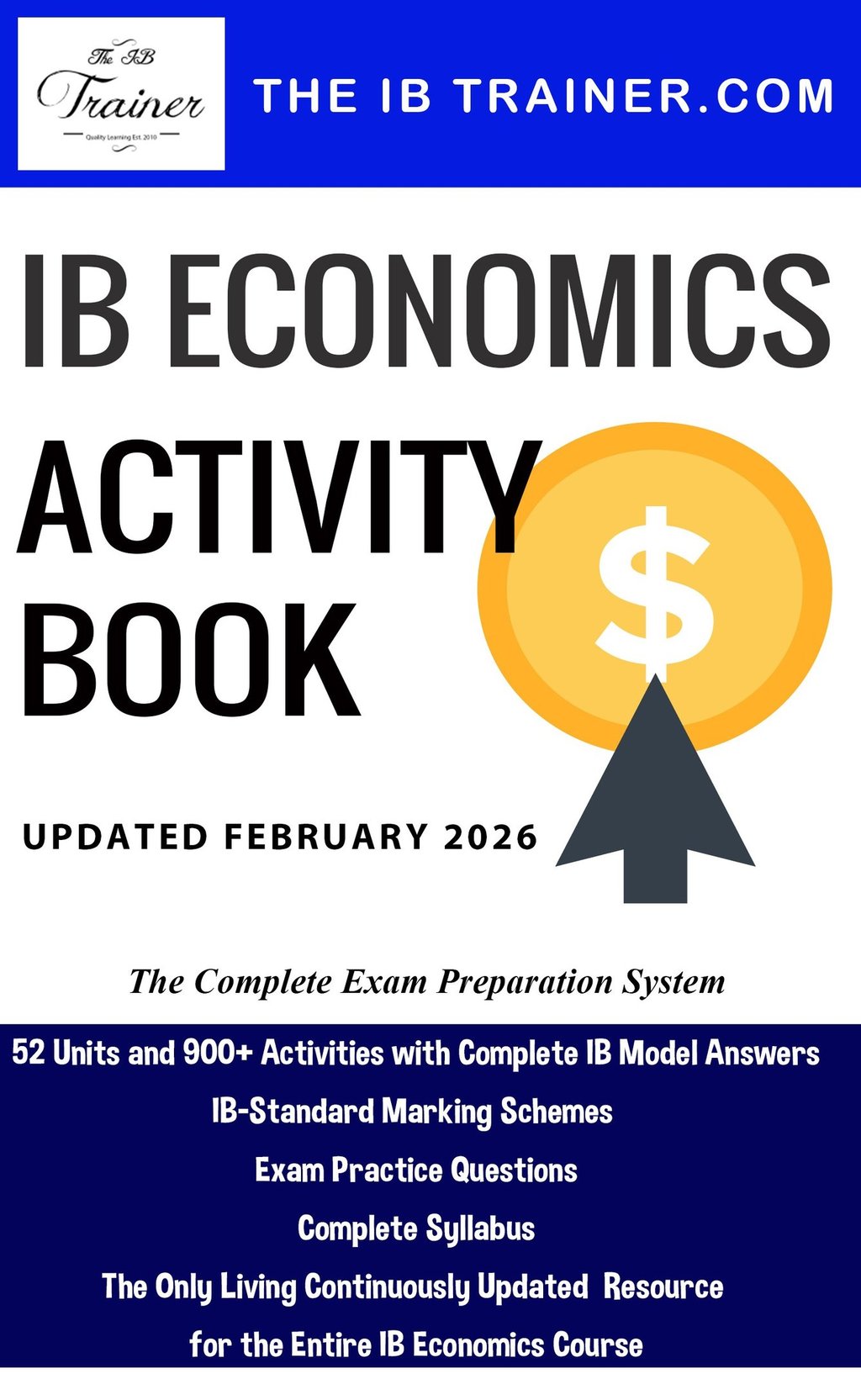
The IB Economics Activity Book provides perfect exam preparation through 900+ activities, complete model answers & IB marking schemes for all 52 units
IB ECONOMICS HLIB ECONOMICSIB ECONOMICS SLIB ECONOMICS INTRODUCTIONIB ECONOMICS MACROECONOMICSIB ECONOMICS MICROECONOMICSIB ECONOMICS THE GLOBAL ECONOMY / INTERNATIONAL TRADE
Lawrence Robert
2/18/20269 min read
IB Economics Activity Book (2026): 900+ Practice Activities, Model Answers and IB Marking Schemes
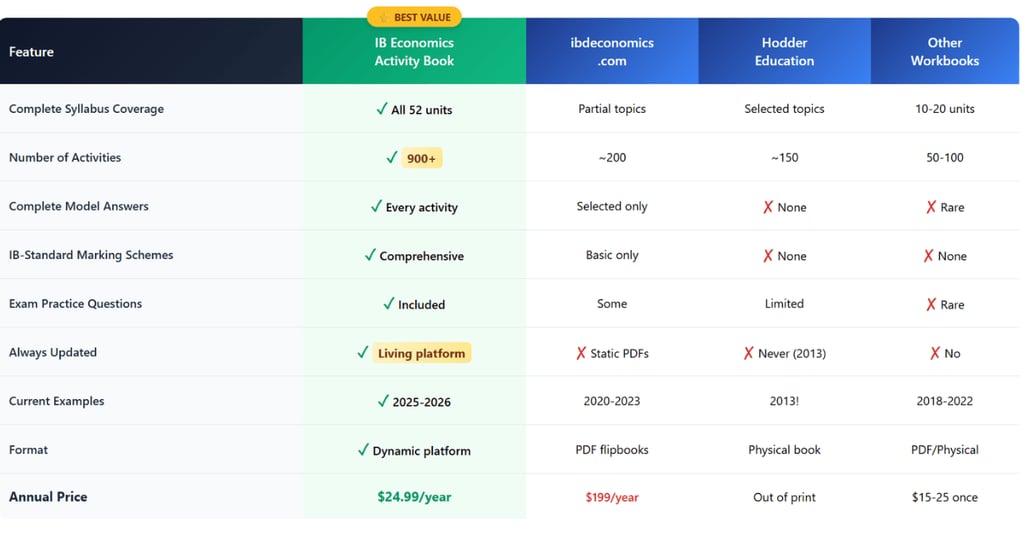
Understanding IB Economics theory is not enough - exams reward the ability to apply it, analyse it, and evaluate it under timed conditions. The IB Economics Activity Book provides 900+ structured practice activities across all 52 units of the 2022-26 specification, every one with a complete model answer and IB-standard marking scheme. It is a living platform, updated continuously with current economic examples, so students always practise with the kind of real-world context IB examiners actually expect.
52 units covering the complete IB Economics 2022 specification - SL and HL
900+ structured activities - 10 to 25 per unit depending on complexity
Complete model answer for every single activity, written in full sentences
IB-standard marking scheme for every activity - showing exactly how marks are allocated
100+ dedicated Paper 1, Paper 2, and Paper 3 (HL) style exam practice questions
HL-only content clearly flagged throughout
Living platform - updated continuously with current examples and data
One payment. One year access. No subscriptions, no hidden costs.
The IB Economics Activity Book is available for a one-time payment of $24.99 USD. You get immediate 12-month platform access to all 52 units, all 900+ activities, every model answer, and every IB marking scheme - updated continuously throughout your access period.
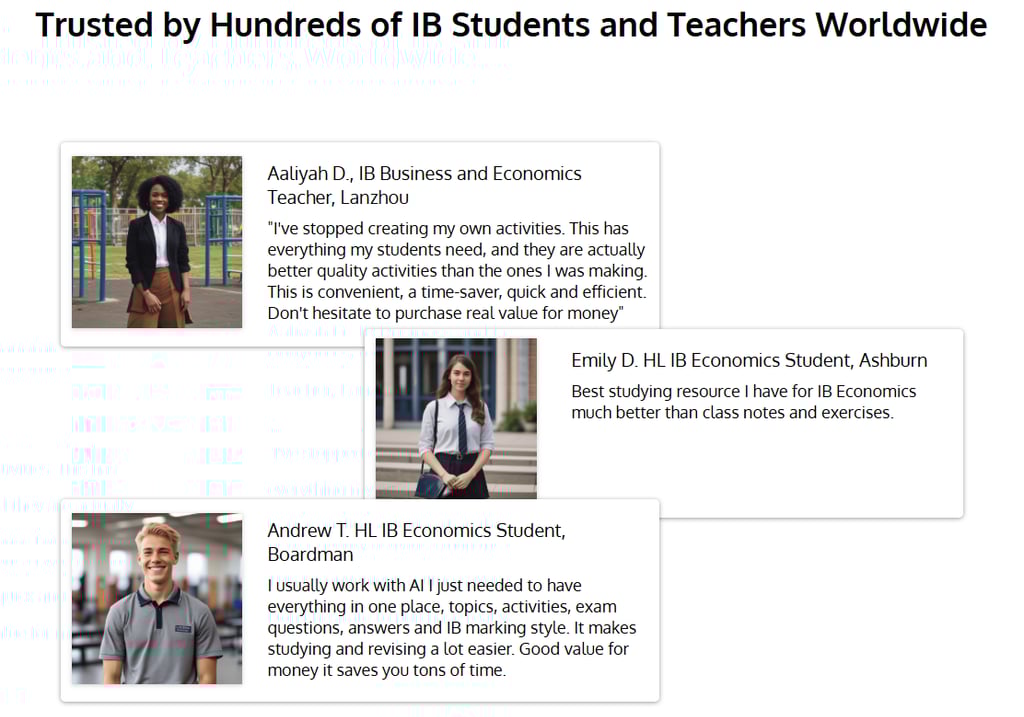
"Finally, a resource that doesn't use Brexit as a current example in 2025. My students engage much more with economics when examples are from this year, not five years ago. The model answers save me hours of creating exemplar responses."
- IB Economics Teacher
What Is the IB Economics Activity Book?
The IB Economics Activity Book is a comprehensive digital practice resource for the IB Economics 2022 specification, created by Lawrence Robert at The IB Trainer. It covers all 52 units across all four modules - Introduction to Economics, Microeconomics, Macroeconomics, and The Global Economy - with 10 to 25 structured activities per unit, each followed by a complete model answer and a detailed IB-standard marking scheme.
Unlike traditional textbooks that provide two to four practice questions per unit, or past papers that provide questions without worked responses, the Activity Book is built entirely around guided practice: students work through an activity, attempt their response, and immediately compare it against a full model answer that shows sentence-by-sentence how to structure an argument, how to integrate critical thinking, include economic terminology, connect theory to real-world examples, and reach a justified evaluative conclusion.
The platform updates continuously - new activities, refreshed data, and current economic examples are added regularly so that students always practise with the kind of contemporary real-world context IB Economics examiners expect. This is economics education designed for 2026, not a static workbook dead the year after it is published.
Why Practice and Not Theory - Builds IB Economics Marks
Many IB Economics students arrive at exams with solid theoretical knowledge and still underperform. The reason is almost always the same: they have read about how to apply concepts but have not practised applying them repeatedly, across varied scenarios, with feedback on what an appropriate IB Economics answer looks like. IB Economics exams do not reward theory recall - they reward application, critical thinking, analysis, and evaluation, all of which are skills that develop through structured, guided practice.
With 900+ activities compared to the 60–80 questions typically found across an entire textbook series, the Activity Book provides the volume of varied exposure needed to make exam application instinctive rather than effortful. Students who work through the activities systematically develop pattern recognition for how questions are structured and how answers should be built - which is precisely what distinguishes a 6 from a 7.
IB Economics - Syllabus and Programme Full Guide →
All Four IB Economics Assessment Objectives Covered
Every activity in the book is mapped to the IB Economics assessment objectives. This is for a very clear reason - it shapes how activities and model answers are constructed.
AO1 - Knowledge and Understanding: Activities require proper use of economic terminology and concepts in realistic contexts, including definitions, explanations of economic relationships, and demonstration of theoretical understanding.
AO2 - Application and Analysis: Real-world scenarios requiring students to apply economic concepts to specific situations, build clear analytical chains showing cause-effect relationships, use economic diagrams, and interpret economic data.
AO3 - Synthesis and Evaluation: Balanced evaluation of economic policies, consideration of multiple perspectives, and justified conclusions. Activities require students to assess trade-offs, weigh competing objectives, and make reasoned recommendations.
AO4 - Selection and Use of Appropriate Skills: Construction and interpretation of economic diagrams, quantitative calculations (PED, multiplier, GDP deflator, and others), data analysis, and use of economic models - the skills examiners assess explicitly across all papers.
The Model Answer Advantage
What distinguishes the Activity Book from typical practice resources is the inclusion of complete, fully written model answers for every activity - not abbreviated marking schemes or bullet-point outlines, but full sentence-by-sentence responses that demonstrate exactly how to build an economic argument for the specific mark allocation required.
What You See in Each Model Answer:
Complete sentence-by-sentence construction showing how to build economic arguments
Proper integration of economic terminology in context (producer surplus, aggregate demand, terms of trade, etc.) as well as real-life examples you can use in your IB Economics exams
Clear linkage between theory, real-world application, and diagram analysis
Structured paragraphs demonstrating logical progression from definition to application to analysis to evaluation
Explicit diagram descriptions where required, showing what should appear in economic graphs
Mark allocation guidance showing which parts of the answer earn which marks
Examiner tips highlighting common pitfalls like insufficient diagram labelling, weak evaluation, or missing real-world examples
The IB-standard marking schemes included go beyond the model answers to show how marks are allocated step by step - how many distinct points are needed for full marks, what level of diagram sophistication is required, and what distinguishes adequate from excellent evaluation. For students, this is unprecedented transparency about IB Economics examiner expectations. For teachers, it saves hours of creating assessment criteria while maintaining alignment with IB standards.
Complete Coverage: All 52 Units
Every unit in the IB Economics 2022-26 specification is covered. HL-only content is clearly flagged throughout so SL and HL students find exactly what they need without ambiguity.
Complete Module Breakdown
The resource includes comprehensive coverage across all four modules:
Module 1 Introduction to Economics 50+ activities covering:
Unit 1.1 What is Economics
Unit 1.2 The Approaches of Economists
Unit 1.3 Production Possibilities PPC or PPF
Unit 1.4 The Circular Flow Model of Economic Activity
Module 2: Microeconomics 280+ activities covering:
Unit 2.1 Demand
Unit 2.2 Supply
Unit 2.3 Market Equilibrium
Unit 2.4 Price Elasticity of Demand (PED)
Unit 2.5 Income Elasticity of Demand (YED)
Unit 2.6 Price Elasticity of Supply (PES)
Unit 2.7 Government Intervention Price Controls
Unit 2.8 Government Intervention Indirect Taxes
Unit 2.9 Government Intervention Subsidies
Unit 2.10 Market Failure Externalities
Unit 2.11 Market Failure Public Goods
Unit 2.12 Market Failure Asymmetric Information HL Only
Unit 2.13 Types of Market Structures HL Only
Unit 2.14 Profit Maximisation HL Only
Unit 2.15 Perfect Competition HL Only
Unit 2.16 Monopolies HL Only
Unit 2.17 Oligopolies HL Only
Unit 2.18 Monopolistic Competition HL Only
Unit 2.19 Critique of Maximising Behaviour HL Only
Module 3: Macroeconomics 240+ activities addressing:
Unit 3.1 The market’s Inability to Achieve Equity HL Only
Unit 3.2 Measuring Economic Activity
Unit 3.3 Calculating GDP
Unit 3.4 The Business Cycle
Unit 3.5 Aggregate Demand and Aggregate Supply: Aggregate Demand
Unit 3.6 Aggregate Demand and Aggregate Supply: Short-Run Aggregate Supply (SRAS)
Unit 3.7 Aggregate Demand and Aggregate Supply: Long-Run Aggregate Supply (LRAS)
Unit 3.8 Aggregate Demand and Aggregate Supply Equilibrium
Unit 3.9 Aggregate Demand and Aggregate Supply The Keynesian Multiplier
Unit 3.10 Economic Growth
Unit 3.11 Low Unemployment
Unit 3.12 Low and Stable Inflation
Unit 3.13 Economics of Inequality
Unit 3.14 Fiscal Policy
Unit 3.15 Monetary Policy
Unit 3.16 Supply-side Policies
Module 4: The Global Economy 190+ activities examining:
Unit 4.1 Benefits of International Trade
Unit 4.2 Absolute and Comparative Advantage (HL Only)
Unit 4.3 Types of Trade Protection
Unit 4.4 Trade Protection Arguments
Unit 4.5 The World Trade Organisation WTO
Unit 4.6 Economic Integration
Unit 4.7 Exchange Rates
Unit 4.8 Balance of Payments
Unit 4.9 Sustainable Development
Unit 4.10 Measuring Economic Development
Unit 4.11 Barriers to Economic Development
Unit 4.12 Strategies for Economic Development
Unit 4.13 The Balance Between Free Markets And Intervention
Plus Exam Practice Questions: 100+ dedicated Paper 1 & Paper 2 and Paper 3 style exam questions with complete model answers and marking schemes, distributed across all modules for authentic exam preparation.
Exam Practice Questions: Papers 1, 2, and 3
Beyond the unit-by-unit activities, the book includes dedicated exam practice structured to mirror the exact format, command terms, and mark allocations students face in real papers.
IB Economics Paper 1 practice (10-mark + 15-mark questions): Long-answer questions requiring explanation, diagram construction, and application to brief scenarios. Complete with timing guidance, model answers showing optimal structure, and marking schemes clarifying mark distribution.
IB Economics Paper 2 practice (15-mark questions): Extended response questions demanding comprehensive analysis and evaluation. Model answers demonstrate how to structure essay-style responses, balance multiple perspectives, use diagrams within longer answers, and reach justified conclusions.
IB Economics Paper 3 HL practice: Quantitative and policy analysis questions aligned to current examiner expectations. Every question includes command term guidance, suggested time allocation, complete model answer, and detailed marking scheme.
Digital Platform Benefits
The Activity Book operates as an integrated digital platform - not a static PDF or downloadable workbook. Key features include:
• Immediate access to model answers integrated alongside each activity - no separate files or answer booklets
• Searchable content across all 52 units - find any topic, term, or example type instantly
• Progress tracking - mark activities complete and identify areas for additional practice before exams
• Multi-device access - laptop, tablet, and smartphone, no downloads or installation required
• Continuous updates - new activities, current economic examples, and refreshed data added regularly throughout your access period
• Teacher administration - manage access for cohorts, track usage, and integrate with existing learning management systems
Who the Activity Book Is For
IB2 students preparing for final exams: 900+ activities provide comprehensive syllabus review with model answers showing exactly what top-band responses look like. The exam practice questions give authentic preparation for Papers 1, 2, and 3.
IB1 students building foundations: Using the Activity Book alongside regular coursework - practising each unit as it is taught - builds application habits before bad ones form. Model answers function as a virtual tutor, demonstrating best practice from day one.
HL students maximising Paper 3: Every HL-specific unit is covered with full model answers and marking schemes aligned to current Paper 3 quantitative and policy analysis expectations.
Self-studying and independent learners: The combination of structured activities, complete model answers, and detailed marking schemes creates a complete learning system for students without consistent teacher support.
IB Economics teachers: 52 units of ready-to-use activities with IB-standard marking schemes, updated continuously. Use as homework, classroom practice, mock questions, or differentiated materials - with assessment criteria already prepared.
Frequently Asked Questions: IB Economics Activity Book
What is the best way to practise for IB Economics exams?
Effective IB Economics exam preparation requires structured, guided practice with feedback - not just reading theory. Students who work through varied application activities with complete model answers consistently develop stronger exam technique than those who rely on textbook reading and a limited number of past paper questions. The IB Economics Activity Book provides 900+ structured activities across all 52 units, every one with a complete model answer and IB-standard marking scheme, covering all four assessment objectives.
How is the Activity Book different from a textbook?
Textbooks focus on theory explanation and typically provide two to four practice questions per unit with no model answers. The Activity Book inverts this: it centres entirely on application practice, with 10 to 25 activities per unit, each followed by a complete written model answer and IB marking scheme. It also updates continuously with current economic examples - students in 2026 work with 2025-2026 data and do not use examples from 2022.
Does the Activity Book cover both SL and HL?
Yes. All 52 units are covered, with HL-only content clearly flagged throughout. HL students have full coverage including the additional microeconomics units (market structures, profit maximisation, critique of maximising behaviour), the macroeconomics equity unit, and the international trade comparative advantage unit. Paper 3 (HL) exam practice questions are included alongside Paper 1 and Paper 2 practice.
Can teachers use the Activity Book for classroom materials?
Yes, and many do. Every unit provides ready-to-use activities with IB-standard marking schemes, structured to follow the 2022 specification unit by unit. The model answers provide consistent, examiner-aligned feedback without additional preparation time needed, and the platform updates continuously so teachers always have access to current economic examples without creating new materials each year.
How does the Activity Book compare to using past papers?
Past papers are an essential part of IB Economics preparation, but they have two significant limitations: they provide only 20 to 30 questions per paper, and they do not include complete model answers - only mark points and generic marking criteria. The Activity Book provides 900+ activities with complete model answers showing exactly how to structure top-band responses, making it a high-volume complement to past paper practice rather than a replacement for it.
Access the IB Economics Activity Book
900+ activities | Complete model answers | All 52 units covered | Always updated | 12-month access
Related Content:
IB Economics your IB Economics daily guide
IB economics Calculations Book 25 units of IB Economics SL and HL calculations exercises, IB model answers, and IB marking schemes
IB Economics Microeconomics, micro issues? go here
IB Economics Macroeconomics, don't understand macro? start here
IB Economics Introduction to Economics, stuck at the beginning of the course? Start here
IB Economics The Global Economy, need to prepare the last module? This is the place for you
IB Economics HL - explore IB Economics HL syllabus and content
Read Next: IB Economics Paper 3 HL
© Theibtrainer.com 2012-2026. All rights reserved.
Legal
Have a Tip? Send us a tip using our anonymous form