
Introduction to Economics
Target Question:
What does IB Economics Introduction to Economics cover?
Your complete guide to the IB Economics Introduction to Economics module - the foundational concepts, analytical tools, and ways of thinking that are behind the entire module.
Full introduction to economics activity practice breakdown, exam practice, model answers and evaluation tools are available exclusively in the IB Economics Activity Book and IB Economics Calculations book.
What Is Introduction to Economics About?
Introduction to Economics is the shortest module in the IB Economics course - approximately 15-20 teaching hours. Scarcity, opportunity cost, the PPC model, the nine key concepts, and the distinction between positive and normative economics are not only introductory ideas to be left behind: they are analytical tools through which we can examine a lot of the rest of the topics that appear in the course.
IB Economics definition:
Introduction to Economics establishes economics as a social science studying how individuals, firms, governments, and societies allocate scarce resources among unlimited competing wants. It introduces the foundational tools - scarcity, opportunity cost, the PPC model, the circular flow, and the nine key concepts - and the methodological framework (positive vs normative economics, ceteris paribus, model building) that structures all subsequent economic analysis.
What Is Economics?
Economics is a social science that studies how agents - individuals, households, firms, and governments - make choices about allocating scarce resources to satisfy unlimited wants and needs. It examines production, distribution, and consumption of goods and services, addressing fundamental questions about why things cost what they cost, why some people are rich and others poor, and how governments should manage economies.
Unlike natural sciences, economics studies human behaviour - which is inherently less predictable than physical phenomena. Economists build models (simplified representations of reality) to isolate specific relationships, test hypotheses with empirical evidence, and develop theories that explain and predict economic outcomes. The models are deliberately unrealistic - that is their point. A map that shows every feature of a landscape in perfect detail is useless; a good model strips away complexity to reveal the essential relationships and the specific economic contexts.
Quick Access to Introduction to Economics Topics
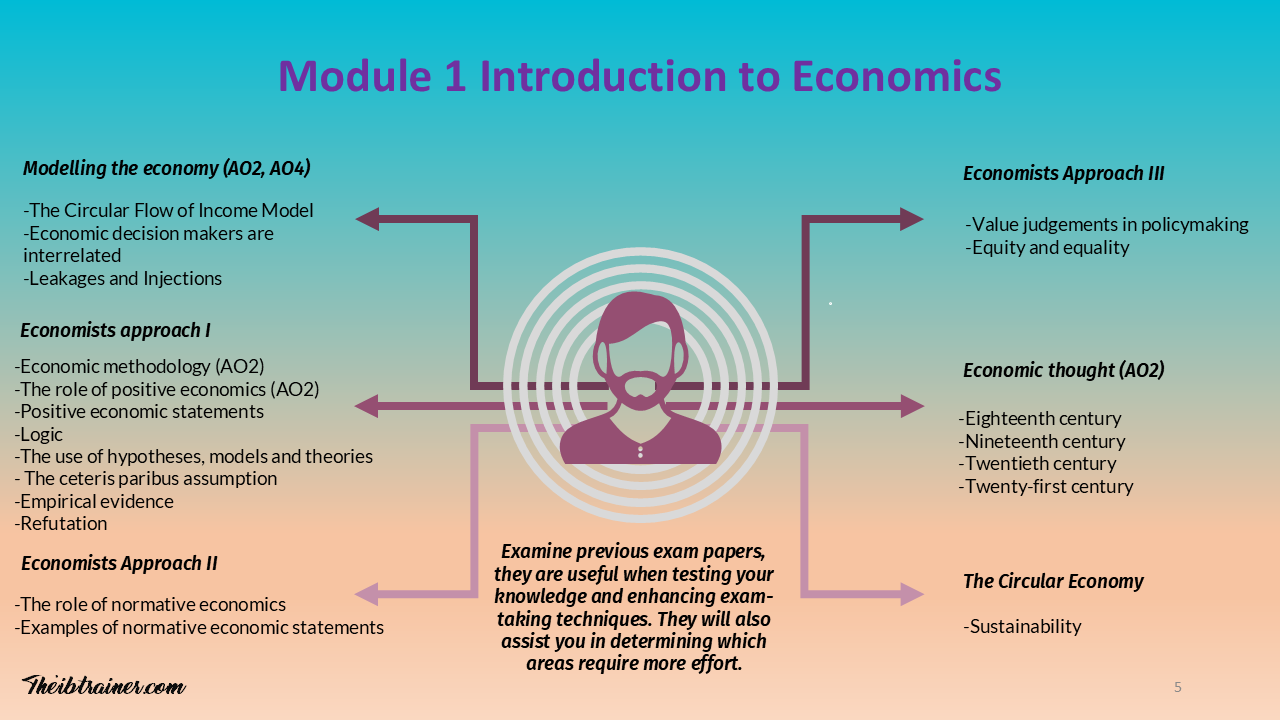
Module 1: Introduction to economics
The Factors of Production
All production requires inputs - factors of production - remembered in IB Economics using the acronym CELL:
Capital - man-made resources used in production: machinery, equipment, buildings, and infrastructure. Distinct from financial capital (money). Capital is accumulated through investment - devoting current resources to building productive capacity rather than current consumption.
Enterprise (Entrepreneurship) - the factor that organises the other three, takes risks, makes decisions under uncertainty, and drives innovation. Entrepreneurs identify opportunities, combine resources, and accept the possibility of loss.
Land - all natural resources: agricultural land, minerals, forests, water, and energy sources. Fixed in total quantity (though productivity varies). The distribution of natural resources shapes comparative advantage in international trade and development possibilities.
Labour - human physical and mental effort employed in production. Quantity (workforce size) matters, but quality (human capital - skills, education, health) increasingly determines productivity and wages in knowledge economies.
The returns to each factor - rent (land), wages (labour), interest (capital), and profit (enterprise) - flow back to households in the circular flow model.
Scarcity: The Fundamental Economic Problem
Scarcity exists because human wants are unlimited while the resources available to satisfy them are finite. No society - regardless of wealth - can produce everything its members desire. Even wealthy countries face scarcity of time, skilled labour, environmental capacity, and finite natural resources.
Scarcity is the reason economics exists as a discipline. Without scarcity, there would be no need to choose, no opportunity costs, and no economic problem to analyse. Every topic in IB Economics - from market failure to trade policy to development strategy - is ultimately about how to deal with and manage scarcity.
Scarcity forces choice. Every choice involves opportunity cost. Opportunity cost is the value of the next best alternative forgone.
IB Economics Scarcity - Full Guide →
IB Economics Opportunity Cost - Full Guide →
The Three Basic Economic Questions
Because resources are scarce, every society - regardless of its economic system - must answer three fundamental questions:
What to produce? Which goods and services should be produced, and in what quantities? More healthcare means fewer schools; more consumer goods means less capital investment. Market economies let demand signals determine what is produced; command economies use central planning; mixed economies use both.
How to produce? Which production methods and technologies should be used? Labour-intensive or capital-intensive? Renewable or fossil-fuel energy? Sustainable or extractive methods? Different answers reflect different factor prices, technologies, and values about environmental impact.
For whom to produce? How should the output be distributed? Market economies distribute according to purchasing power - who can pay. Governments modify this distribution through taxation, transfers, and public service provision. Different societies make different normative judgements about what constitutes a fair distribution.
These questions are the framework for analysing every economic policy. A minimum wage addresses "for whom to produce." Industrial policy addresses "what to produce." Environmental regulation addresses "how to produce."
The Production Possibility Curve (PPC)
The PPC - also called the Production Possibility Frontier (PPF) - is a diagram showing the maximum combinations of two goods an economy can produce when all resources are fully and efficiently employed. It makes scarcity, choice, opportunity cost, and efficiency visible in a single model.
Points on the curve represent productive efficiency - all resources are employed and it is impossible to produce more of one good without producing less of the other.
Points inside the curve represent productive inefficiency - resources are unemployed or misallocated. Recession, structural unemployment, or poor resource allocation push economies inside their PPC.
Points outside the curve are currently unattainable - beyond the economy's productive capacity with current resources and technology.
Movement along the curve demonstrates opportunity cost: producing more of good X requires sacrificing some of good Y. The slope of the PPC at any point measures the opportunity cost at that point.
Outward shifts represent economic growth - more or better resources, improved technology, or better allocation expand productive capacity.
The standard IB Economics PPC is concave (bowed outward) - reflecting increasing opportunity cost as resources are progressively less suited to alternative uses.
IB Economics PPC - Full Guide →
The Nine Key Concepts (WISE ChoICES)
The nine key concepts are the analytical tools through which all economic issues in the IB course are examined. Don't limit their use to the Introduction to Economics module - they appear in the Internal Assessment and you are expected to use them throughout exam responses.
Use the acronym WISE ChoICES:
W - Well-being: Economic analysis should consider material and non-material factors affecting quality of life, not just GDP. Income, health, security, freedom, and environmental quality all contribute to well-being.
I - Interdependence: Economic agents and economies are interconnected. One firm's pricing decision affects rivals; one country's monetary policy spills over to trading partners; one consumer's externality-generating decision affects others.
S - Scarcity: The fundamental problem. Limited resources relative to unlimited wants force choices and create opportunity costs in all economic contexts.
E - Efficiency: Optimal resource use - producing the maximum possible output from given inputs (productive efficiency) and allocating resources to their highest-valued uses (allocative efficiency, P = MC).
Ch - Change: Economic conditions, policies, technologies, and structures continuously evolve. Good economic analysis accounts for dynamic change rather than treating any situation as permanent.
o - (no acronym letter) - see below
I - Intervention: Government actions - taxes, subsidies, regulation, monetary policy, fiscal policy - affect economic outcomes. When should governments intervene? When does intervention help, and when does it create government failure?
C - Choice: Every economic decision involves choosing among alternatives given scarcity. Consumers, firms, and governments constantly make choices with opportunity costs.
E - Equity: Fairness in distribution. Equity is not the same as equality - equitable treatment may mean different outcomes for people in different circumstances. Economic analysis must consider not just efficiency but the distribution of costs and benefits.
S - Sustainability: Meeting present needs without compromising future generations' ability to meet theirs. Environmental sustainability, social sustainability, and economic sustainability are all relevant dimensions.
Applying the concepts in practice: analysing a minimum wage policy involves scarcity (limited employment opportunities), choice (the government's policy decision), efficiency (potential unemployment creating deadweight loss), equity (helping low-wage workers; potentially harming the unemployed), well-being (income and dignity effects), interdependence (employers, workers, and consumers), and intervention (government setting a price floor).
IB Economics - Syllabus and Programme Full Guide →
The Circular Flow of Income
The circular flow model illustrates the economic relationships between households and firms - and, in more complete versions, between the private sector, government, and the rest of the world.
Simple two-sector model: Households own factors of production (land, labour, capital, enterprise) and supply them to firms. Firms pay factor incomes (rent, wages, interest, profit) to households. Households spend this income on goods and services from firms. Two flows circulate simultaneously: the real flow (factors in one direction, goods and services in the other) and the money flow (factor payments in one direction, consumer expenditure in the other).
Leakages and injections: In the full model, money can leave the circular flow as leakages - savings (S), taxes (T), and imports (M) - and enter as injections - investment (I), government spending (G), and exports (X).
Equilibrium condition: the economy is in equilibrium when injections equal leakages: I + G + X = S + T + M. When injections exceed leakages, the economy expands; when leakages exceed injections, it contracts. This provides the foundation for macroeconomic policy analysis - fiscal stimulus (increasing G) is an injection; tax rises (increasing T) increase leakages.
Economic Methodology
IB Economics uses scientific methodology adapted for social science:
Hypotheses, models, and theories - economists develop testable propositions, build simplified models to isolate specific relationships, and develop theories supported by evidence. All models sacrifice realism for clarity - the PPC assumes only two goods; supply and demand assumes many buyers and sellers.
Ceteris paribus - "other things being equal." When analysing one economic relationship, economists hold all other factors constant. "Higher prices reduce quantity demanded, ceteris paribus" allows isolation of the price-quantity relationship without being complicated by simultaneous changes in income, preferences, or related prices.
Empirical evidence - economists gather data to test theories. Controlled experiments are difficult in economics (you cannot randomly assign countries to different policies), so economists use natural experiments, historical data, and econometric techniques to infer causation from correlation.
Refutation - following Karl Popper, economic theories can be challenged by contradictory evidence. The 2008 financial crisis challenged aspects of efficient market theory; the empirical literature on minimum wages challenges simple competitive labour market predictions. Good economics updates theories when evidence contradicts them.
Positive vs Normative Economics
This distinction is directly examined in IB Economics and is essential for critical policy evaluation.
Positive economics describes what is - factual statements that can in principle be verified or refuted with evidence:
"Unemployment rose to 4.2% in 2024" - verifiable with data
"Minimum wage increases reduce employment in competitive labour markets" - testable empirical claim (evidence is actually contested)
Normative economics describes what ought to be - value judgements that cannot be settled by evidence alone:
"Unemployment is unacceptably high"
"The minimum wage should be raised"
Most policy debates involve both types. A carbon tax debate combines positive economics ("a $50/tonne carbon tax will reduce emissions by X%") and normative economics ("we should accept this cost to protect future generations"). Disagreements are often normative - about values and priorities - rather than positive - about facts and mechanisms. Recognising the difference is essential for analytical rigour.
A Brief History of Economic Thought
Understanding where economic ideas come from enriches analysis.
Adam Smith (1776) - The Wealth of Nations established economics as a discipline. Smith argued that markets coordinate production through the "invisible hand" - individuals pursuing self-interest unintentionally promote social welfare through price signals. His analysis of specialisation and the division of labour remains foundational.
David Ricardo (1817) - developed comparative advantage theory, explaining why countries benefit from trade even when one is more productive at producing everything. The most counterintuitive and most powerful idea in trade economics.
John Maynard Keynes (1936) - The General Theory argued that market economies can become trapped in prolonged unemployment without government intervention. Keynes showed that aggregate demand deficiency can persist - markets do not always self-correct quickly enough. His ideas shaped macroeconomic policy for decades.
Milton Friedman (1960s-80s) - challenged Keynesian policies, arguing that monetary policy (not fiscal policy) is the primary macroeconomic tool, that markets self-correct given time, and that government intervention often creates more problems than it solves. Monetarism and the emphasis on central bank independence reflect his influence.
Behavioural economics (Kahneman, Thaler - 1970s-2000s) - incorporated psychology to show that real decision-makers systematically deviate from rational maximisation. Bounded rationality, loss aversion, framing effects, and herd behaviour have profound implications for market efficiency and policy design. Daniel Kahneman won the Nobel Prize in Economics in 2002; Richard Thaler in 2017.
IB Economics Adam Smith & Economic Thought - Full Guide →
The Circular Economy
The circular economy is an economic model designed to eliminate waste by keeping materials in use as long as possible - contrasting with the traditional linear "take-make-dispose" model.
Key principles: design products for durability, repairability, and recyclability; keep materials in circulation through reuse and remanufacturing; regenerate natural systems through sustainable sourcing.
The circular economy connects directly to the sustainability key concept - reducing material throughput addresses resource scarcity, reduces environmental externalities, and creates new business models (services rather than product sales; leasing rather than ownership). It is increasingly examined in IB Economics as an example of market design and government intervention addressing externalities and common pool resource problems.
How This Unit Connects to the Rest of the Course
Every concept introduced here will be shown again throughout IB Economics:
Scarcity and opportunity cost underlie every policy trade-off - from government budget allocation to development strategy choices
The PPC appears in macroeconomics (output gaps), international trade (comparative advantage), economic growth and development economics (poverty traps and outward shifts)
The nine key concepts must appear in Internal Assessment commentaries and strengthen all exam responses
Positive vs normative is the framework for evaluating any policy debate - distinguishing empirical disagreements from value disagreements
The circular flow provides the foundation for macroeconomic demand management and the multiplier
Economic methodology supports data response skills in Papers 1 and 2
Key Diagrams: Introduction to Economics
Foundation Concepts (Section 1.1)
Production Possibilities Curve (PPC) showing:
Choice and opportunity cost
Unemployment of resources
Actual growth vs growth in production possibilities
PPC with increasing vs constant opportunity cost
Circular flow of income model with leakages and injections
IB Economics Diagrams Course - Full Guide →
IB Economics Diagrams Course
Every introductory economics diagram - PPC variations, opportunity cost calculations, and circular flow models - fully labelled with video support.
✔ Concave and linear PPC diagrams
✔ Four-sector circular flow with leakages and injections
✔ 200+ diagrams covering the full syllabus · Both SL and HL labelled
Frequently Asked Questions: Introduction to Economics (IB Economics)
What does IB Economics Introduction to Economics cover? The unit covers: what economics is as a social science; the four factors of production (CELL - Capital, Enterprise, Land, Labour); scarcity as the fundamental economic problem; opportunity cost; the three basic economic questions (what, how, for whom to produce); the Production Possibility Curve model; the six real-world issues structuring the course; the nine key concepts (WISE ChoICES); the circular flow of income model; economic methodology (hypotheses, models, ceteris paribus); positive vs normative economics; value judgements in policymaking; and an overview of economic thought. It comprises approximately 15-20 teaching hours.
What are the nine key concepts in IB Economics? The nine key concepts - memorised as WISE ChoICES - are: Well-being, Interdependence, Scarcity, Efficiency, Change, Intervention, Choice, Equity, and Sustainability. They are analytical lenses applied throughout the entire course, not just the introduction. Each Internal Assessment commentary must reference at least one concept explicitly, and strong exam responses consistently apply relevant concepts to the issues being analysed.
What is the difference between positive and normative economics? Positive economics makes factual statements about what is - claims that can in principle be verified or refuted with evidence ("inflation rose to 4% in 2024"). Normative economics makes value judgements about what ought to be - claims that cannot be settled by evidence alone ("inflation is unacceptably high"). Most policy debates contain both. Recognising whether a disagreement is about positive facts or normative values is essential for analytical rigour in IB Economics.
What is the circular flow of income model? The circular flow illustrates economic relationships between households and firms. Households supply factors of production to firms and receive factor incomes (wages, rent, interest, profit); they spend this income on goods and services from firms. In the full model, money leaves the circular flow as leakages (savings, taxes, imports) and enters as injections (investment, government spending, exports). Equilibrium occurs when injections equal leakages (I+G+X = S+T+M). The model provides the foundation for understanding macroeconomic fluctuations and policy effects.
Why do the introduction to economics concepts matter throughout the whole IB Economics course? Because they are part of the analytical foundation everything else builds on. Scarcity and opportunity cost underlie every economic decision from consumer choice to government policy. The PPC appears in trade theory, macroeconomic output gap analysis, and development economics. The nine key concepts are expected in Internal Assessment commentaries and strengthen all exam responses. Positive vs normative economics is the framework for evaluating any policy debate. A student who internalises these concepts has the analytical toolkit to approach any economics question - not just the introductory ones.
This hub is updated regularly to reflect current IB Economics syllabus requirements.
Explore Topics:
IB Economics your IB Economics daily guide
IB Economics Diagrams Check this resource for All the IB Economics Introduction to Economics diagrams with explanations
IB Economics Activity book More IB Economics Introduction to Economics exam practice, activities, model answers and IB Economics Marking schemes, all units all modules covered
IB Economics Required Diagrams SL & HL This is a list of the required diagrams for IB Economics
IB Economics Calculations SL HL This is a list of the different calculations required for IB Economics
IB economics Calculations Book 25 units of calculations exercises for SL and HL, find your Introduction to Economics calculations here with IB model answers, and IB marking schemes
IB Economics Paper 1 all the information you need to understand your paper 1 exam and to practice Introduction to Economics questions
IB Economics Paper 2 all the information you need to understand your paper 2 exam and to practice Introduction to Economics questions
IB Economics Paper 3 HL for paper 3 practice and Introduction to Economics questions
Read Next: IB Economics Microeconomics
© Theibtrainer.com 2012-2026. All rights reserved.
Legal
Have a Tip? Send us a tip using our anonymous form