
The Global Economy
Target Question:
What does IB Economics The Global Economy cover?
Full IB the Global Economy activity practice breakdown, exam practice, model answers and evaluation tools are available exclusively in the IB Economics Activity Book and IB Economics Calculations book.
IB Economics: The Global Economy - Module Hub
Your complete guide to the IB Economics global economy module - international trade, exchange rates, balance of payments, sustainable development, and economic development strategies - with links to every topic page.
What Is The Global Economy Module?
The Global Economy is the international and development-focused module of IB Economics. It examines why countries trade, how trade policy affects welfare, what determines exchange rates, how economic integration works, how development is measured, what prevents progress, and which strategies can achieve sustainable growth.
It is the module that connects economic theory to real-world policy debates - from US-China trade tensions and Brexit to the UN Sustainable Development Goals and debt crises in developing countries.
IB Economics definition:
The Global Economy unit analyses international trade (comparative advantage, protectionism, integration), international finance (exchange rates, balance of payments), and development economics (measuring development, barriers to growth, development strategies) - applying microeconomic and macroeconomic tools to cross-border economic relationships and the challenges facing low-income countries.
Classroom teaching hours should be around approximately 30-35 hours at SL and 40-45 hours at HL for this module. The distinction between SL and HL is primarily one of depth and quantitative application rather than separate topics - HL students are expected to perform more sophisticated welfare calculations, apply terms of trade analysis, and evaluate development strategies with greater precision.
The Two Dimensions: International Economics and Development
The global economy module is divided into two distinct but interconnected areas:
International economics - how countries interact through trade, finance, and economic integration. This half of the module applies microeconomic tools (consumer/producer surplus, welfare analysis) and macroeconomic concepts (aggregate demand, inflation, monetary policy) to cross-border economic activity.
Development economics - why some countries are poor and what can be done about it. This half applies the full IB Economics toolkit - market failure, government intervention, growth theory, macroeconomic policy - to the specific challenges facing low-income economies.
The connection between them is direct: trade policy profoundly affects development prospects; exchange rate regimes constrain macroeconomic policy in developing countries; and sustainable development requires direct engagement with the global economy.
Quick Access to The Global Economy Topics
4.5 Exchange rates
Unit-by-Unit Overview
Unit 1 - Benefits of International Trade
Comparative advantage - the ability to produce a good at lower opportunity cost than a trading partner. Even if one country has absolute advantage in producing everything, both countries gain from specialising in their comparative advantage and trading for the rest.
Gains from trade include lower consumer prices, access to previously unavailable goods, economies of scale from larger markets, competitive pressure driving efficiency, and technology transfer. Global trade exceeds $32 trillion annually - approximately 40% of world GDP.
Trade also creates adjustment costs: import-competing industries face displacement, regions dependent on declining industries bear concentrated losses, and the distributional effects within countries can worsen inequality even when aggregate gains are positive.
IB Economics International Trade - Full Guide →
Unit 2 - Types of Trade Protection
The three main forms of trade protection are tariffs (taxes on imports), quotas (quantitative limits on imports), and subsidies to domestic producers. Each reduces imports, raises domestic prices, transfers welfare from consumers to producers and government, and creates deadweight welfare loss.
The welfare analysis differs considerably between tariffs and quotas: with a tariff, government captures revenue equal to the tariff × import volume; with a quota, that equivalent area is captured as quota rent by whoever holds import licences - typically foreign exporters or domestic importers. This makes quotas generally less efficient than equivalent tariffs.
Non-tariff barriers - technical standards, administrative procedures, sanitary regulations - have become increasingly important as formal tariff rates were abolished under WTO liberalisation policies.
IB Economics Tariffs - Full Guide →
IB Economics Quotas - Full Guide →
IB Economics Subsidies - Full Guide →
Unit 3 - Arguments For and Against Trade Protection
IB Economics requires evaluation of both sides of the protectionism debate - not just memorising arguments but understanding when they hold and when they fail.
Arguments for protection: infant industry development (temporary protection while industries achieve competitive scale); national security (maintaining domestic production of strategic goods); employment protection in declining industries; anti-dumping (countering below-cost foreign sales); revenue generation (significant in developing countries with limited tax capacity).
Arguments against protection: welfare losses from higher prices; retaliation risk escalating into trade wars; inefficiency in protected industries; harm to developing country exporters denied market access; corruption in quota allocation.
The 2025 US tariff escalation - bringing the average US effective tariff rate to its highest since the 1930s - is the most significant live example of protectionism at scale, directly applicable to IB Economics essay responses.
IB Economics International Trade - Evaluation Guide →
Unit 4 - Economic Integration
Economic integration moves across five stages: Preferential Trade Agreement (selective tariff reductions); Free Trade Area (zero internal tariffs, independent external policies); Customs Union (free internal trade plus Common External Tariff); Common Market (adds free factor mobility); Economic/Monetary Union (coordinated policies and potentially a shared currency).
The key welfare concepts are trade creation (replacing expensive domestic production with cheaper partner imports - welfare gain) and trade diversion (replacing efficient non-member imports with less efficient partner imports due to the CET - potential welfare loss). Whether integration improves welfare depends on which dominates.
Brexit - the UK's 2020 exit from the EU single market and customs union - is the most studied case of integration reversal. UK-EU goods trade fell approximately 15-20% in the years following departure, providing a direct empirical estimate of integration's value.
IB Economics Economic Integration - Full Guide →
Unit 5 - Exchange Rates
An exchange rate is the price of one currency in terms of another. IB Economics examines three systems: floating (market-determined); fixed (government-pegged); and managed float (primarily market-determined with periodic intervention).
Key determinants of floating exchange rates: interest rate differentials (the primary short-run driver - higher rates attract capital, appreciating the currency); relative inflation rates (higher inflation depreciates the currency over the long run - the basis of Purchasing Power Parity theory); trade flows; and speculation.
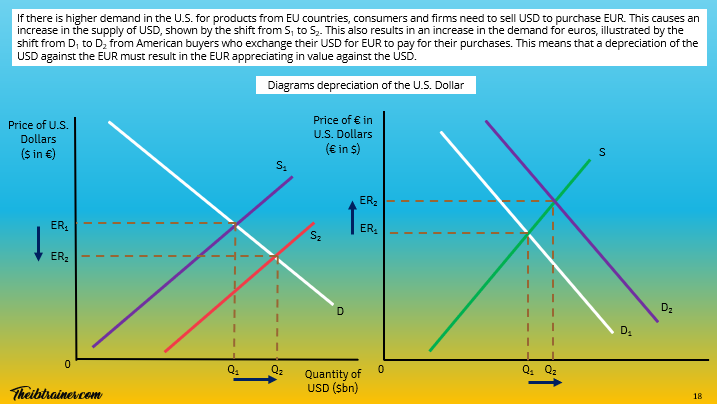
Currency appreciation makes exports more expensive and imports cheaper - cooling inflation but reducing export competitiveness. Depreciation does the reverse - boosting exports but generating imported inflation.
The Marshall-Lerner condition and J-curve effect connect exchange rates to the balance of payments: depreciation only improves the current account if the sum of export and import demand elasticities exceeds one, and typically worsens the balance in the short run before improving it in the medium term.
IB Economics Exchange Rates - Full Guide →
Unit 6 - Balance of Payments
The balance of payments records all economic transactions between a country and the rest of the world across three accounts:
Current account - trade in goods (visible balance), trade in services (invisible balance), primary income (investment income and wages), and secondary income (transfers). The current account balance is the most closely monitored.
Capital account - capital transfers and non-produced, non-financial assets (minor in most economies).
Financial account - foreign direct investment, portfolio investment, reserve assets, and other investment flows. By definition, the three accounts sum to zero - a current account deficit must be financed by a financial account surplus.
Current account deficits are not problematic if they finance productive investment; persistent deficits financed by short-term capital flows create vulnerability. Adjustment mechanisms include exchange rate depreciation, expenditure reduction, and expenditure switching.
IB Economics Exchange Rates and Balance of Payments - Full Guide →
Unit 7 - Sustainable Development
Sustainable development - meeting present needs without compromising future generations' ability to meet theirs (Brundtland, 1987) - integrates three dimensions:
Economic sustainability - maintaining productive capacity and living standards over time; avoiding debt levels or resource depletion that constrain future growth.
Social sustainability - reducing poverty and inequality, improving health and education, promoting social cohesion and inclusion.
Environmental sustainability - protecting natural capital, reducing emissions, preserving biodiversity, and managing common resources.
The UN Sustainable Development Goals (SDGs) - 17 goals targeting 2030 - provide the operational system. Progress is deeply uneven: global extreme poverty fell from 36% (1990) to approximately 8.6% by 2024, but climate change, COVID-19's impact (pushing 120 million back into poverty), and rising debt levels have complicated the picture.
Tensions between economic dimensions are evident: rapid economic growth can increase pollution and inequality. Green growth theory argues that technological innovation can decouple growth from environmental damage - renewable energy costs falling 90% (solar) and 70% (wind) over 2010-2024 represent the most significant evidence of this progress.
Unit 8 - Measuring Development
GDP per capita measures average income but ignores inequality, non-market production, environmental costs, and quality of life dimensions essential for understanding development.
GNI per capita (Gross National Income) includes net income from abroad - more accurate for countries with significant overseas investment or diaspora remittances.
The Human Development Index (HDI) combines income (GNI per capita), health (life expectancy), and education (mean and expected years of schooling) into a 0-1 index. It reveals that high income does not guarantee human development - some oil-rich countries have HDI scores below their income rank; others have HDI scores well above.
Alternative measures: the Multidimensional Poverty Index (MPI) assesses deprivation across health, education, and living standards; the Inequality-adjusted HDI (IHDI) discounts for distribution; and Genuine Progress Indicators attempt to adjust GDP for environmental costs and income distribution.
Single indicators - life expectancy, infant mortality, literacy rate, access to clean water and electricity - each reveal specific development dimensions that aggregate indices may hide.
IB Economics Poverty - Full Guide →
IB Economics Inequality - Full Guide →
Unit 9 - Barriers to Growth and Development
Understanding why some countries remain poor requires identifying the structural barriers that trap low-income economies.
The poverty trap - low income → insufficient savings → low investment → low productivity → low income — describes a self-reinforcing cycle that prevents escape without external intervention or policy change.
Human capital deficits - inadequate education and healthcare reduce productivity and limit the skills base available for development.
Infrastructure gaps - lack of transport, energy, and communications infrastructure raises costs, prevents market integration, and deters investment.
Institutional weaknesses - corruption, insecure property rights, poor rule of law, and excessive bureaucracy deter productive investment and divert resources from development priorities.
External barriers - primary commodity dependence (volatile export revenues, long-run terms of trade decline per the Prebisch-Singer hypothesis), trade barriers in developed countries blocking market access, debt burdens consuming government revenue, and brain drain depleting human capital.
Geographic disadvantages - landlocked countries face higher transport costs; tropical disease burdens health systems; climate vulnerability increases disaster risk.
IB Economics Strategies to Achieve Economic Growth - Full Guide →
IB Economics Social and Political Barriers to Growth - Full Guide →
IB Economics Strengths & Limitations of Growth and development Strategies - Full Guide →
IB Economics Roadblocks to Prosperity - Full Guide →
Unit 10 - Development Strategies
The debate over how to achieve development is one of the most contested in economics. IB Economics examines three broad approaches:
Market-oriented strategies - trade liberalisation, privatisation, deregulation, FDI attraction, and microfinance provision. Based on the principle that free markets allocate resources efficiently and that government intervention typically creates distortions. The Washington Consensus (IMF/World Bank prescriptions of the 1980s-90s) represented this approach in its most systematic form.
Interventionist strategies - infrastructure investment, industrial policy, state-directed credit, education and healthcare provision. Based on the principle that market failures in developing countries are pervasive and that strategic government intervention can address them. The East Asian developmental state model (South Korea, Taiwan, Singapore, Japan) is the most studied success case - combining export promotion with selective intervention.
Balanced approaches - combining market mechanisms with strategic state intervention. China's "socialist market economy" mixed planning with market competition; Botswana combined prudent macroeconomic management with diamond revenue investment in education and institutions.
Evaluation: no single approach has proven universally successful. Context matters - the appropriate strategy depends on institutional capacity, initial conditions, and the global environment. The East Asian model succeeded partly because it operated in an era of open export markets that current protectionism would not have permitted.
IB Economics Economic Growth - Full Guide →
IB Economics International Trade - Full Guide →
The Nine Key Concepts in The Global Economy
Scarcity and choice - comparative advantage arises from scarcity of factors of production. Development strategies involve choices between competing resource uses - infrastructure vs. social spending, present consumption vs. future investment.
Efficiency - free trade maximises global allocative efficiency through specialisation. Protectionism creates deadweight welfare losses. Development strategies involve efficiency-equity trade-offs.
Equity - trade creates winners and losers both between and within countries. Development economics directly targets inequity - reducing poverty and inequality are core SDG objectives.
Sustainability - sustainable development explicitly integrates environmental constraints into economic analysis. Commodity dependence creates unsustainable development paths. Debt sustainability constrains fiscal policy in developing countries.
Interdependence - no topic in IB Economics illustrates interdependence more directly than the global economy. One country's trade policy affects others; one country's monetary policy spills over through exchange rates and capital flows; climate change requires international cooperation.
Intervention - trade policy, exchange rate management, and development strategies all represent government intervention in international markets. The WTO governs what interventions are permissible; the tension between national policy autonomy and international rules is a recurring theme.
IB Economics - Syllabus and Programme Full Guide →
Key Global Economy Diagrams
Every diagram below is directly examined across Papers 1, 2, and 3 (HL):
Benefits of International Trade (Section 4.1)
Free trade illustrating exports when world price is above domestic price
Free trade illustrating imports when world price is below domestic price
Linear PPC showing differing opportunity costs and gains from specialization and trade (comparative advantage)
Trade Protection (Section 4.2)
Effects on price, production, consumption, expenditures, revenues, and welfare:
Tariff effects
Quota effects
Subsidy effects
Exchange Rates (Section 4.5)
Exchange rate determination and changes in equilibrium (floating exchange rate system)
AD/AS curves showing potential consequences of exchange rate changes on the economy
How fixed exchange rate is maintained
Exchange rate determination and changes in equilibrium (managed exchange rate system)
Balance of Payments (Section 4.6)
Relationship between current account balance and exchange rate
J-curve with reference to Marshall Lerner condition
Development Economics (Sections 4.9-4.10)
Barriers to Growth/Development (4.9):
Poverty cycle showing linked combination of factors that perpetuate poverty
Growth/Development Strategies (4.10):
Students should apply diagrams from other sections in relation to strategies promoting economic growth and/or development
IB Economics Diagrams Course - Full Guide →
IB Economics Diagrams Course
Every global economy diagram - trade welfare analysis, exchange rate systems, J-curve, and development indicators - fully labelled with video support and exam application guidance.
✔ All trade protection and exchange rate diagrams
✔ Development economics visual tools
✔ Both SL and HL content clearly labelled
Frequently Asked Questions: IB Economics The Global Economy
What does IB Economics The Global Economy cover? The Global Economy covers ten topics across two dimensions. International economics includes: benefits of trade (comparative advantage); types of trade protection (tariffs, quotas, subsidies); arguments for and against protection; economic integration; exchange rates; and balance of payments. Development economics includes: sustainable development (SDGs); measuring development (GDP limitations, HDI, MPI); barriers to growth and development; and economic development strategies (market-oriented, interventionist, and balanced approaches).
What is the difference between trade creation and trade diversion? Trade creation occurs when economic integration causes a country to replace expensive domestic production with cheaper imports from a partner country - a welfare gain from more efficient specialisation. Trade diversion occurs when integration causes imports to switch from the most efficient global producer to a less efficient partner, because the Common External Tariff makes the non-member's goods relatively more expensive - a potential welfare loss. Whether integration improves overall welfare depends on which effect dominates.
What is the Human Development Index (HDI) and why does IB Economics use it? The HDI combines income (GNI per capita), health (life expectancy), and education (mean and expected years of schooling) into a 0-1 index, providing a broader measure of development than GDP alone. IB Economics uses it because GDP per capita ignores how income is distributed and fails to capture health and education dimensions essential for human welfare. A country can have high GDP per capita but low HDI if income is highly concentrated or public services are poor, or vice versa.
What is the Marshall-Lerner condition and how does it connect to exchange rates? The Marshall-Lerner condition states that currency depreciation will improve the current account balance only if the sum of the price elasticities of demand for exports and imports exceeds one. If both demands are sufficiently price-elastic, the volume effect of depreciation (more exports, fewer imports) outweighs the price effect. In the short run, elasticities are typically low (contracts exist, habits are slow to change), so depreciation may worsen the trade balance before improving it - the J-curve effect.
What are the main barriers to economic development in IB Economics? The main barriers are: the poverty trap (low income → low savings → low investment → low productivity → low income); human capital deficits from inadequate education and healthcare; infrastructure gaps raising costs and preventing market integration; institutional weaknesses (corruption, weak property rights, poor governance); primary commodity dependence with volatile revenues and declining terms of trade; external debt burdens; trade barriers in developed countries blocking market access; brain drain; and geographic disadvantages including landlocked status and climate vulnerability.
This hub is updated regularly to reflect current IB Economics global economy syllabus requirements and international developments.
Explore Topics:
IB Economics your IB Economics daily guide
IB Economics Diagrams Check this resource for All the IB Economics the global economy diagrams with explanations
IB Economics Activity book More IB Economics the global economy exam practice, activities, model answers and IB Economics Marking schemes, all units all modules covered
IB Economics Required Diagrams SL HL This is a list of the required diagrams for IB Economics
IB Economics Calculations SL HL This is a list of the different calculations required for IB Economics
IB economics Calculations Book 25 units of calculations exercises for SL and HL, find your the global economy calculations here with IB model answers, and IB marking schemes
IB Economics Paper 1 all the information you need to understand your paper 1 exam and to practice the global economy questions
IB Economics Paper 2 all the information you need to understand your paper 2 exam and to practice the global economy questions
IB Economics Paper 3 for paper 3 practice and the global economy questions
Read Next: IB Economics Introduction to Economics
© Theibtrainer.com 2012-2026. All rights reserved.
Legal
Have a Tip? Send us a tip using our anonymous form