
IB Economics Paper 1
Target question:
What is IB Economics Paper 1 and how should students prepare for the examination?
Your complete resource for mastering Paper 1 in IB Economics - from essay structure and planning to evaluation excellence and real-world application
Paper 1 is the extended response paper where strong essay writing skills determine success. Many students struggle not from lack of IB Economics theoretical knowledge, but from poor essay structure, weak evaluation, and failure to use real-world examples effectively. This comprehensive hub covers every aspect of Paper 1 mastery, from the DEED framework to sophisticated evaluation techniques that will help you excel in your IB Economics course.
What You'll Master:
Complete Paper 1 structure: Part (a) 10-mark and Part (b) 15-mark essays
DEED framework application (Definitions, Examples, Explanations, Diagrams)
Time management strategies for 75-minute essays
Real-world example integration and evaluation excellence
Command term mastery and assessment objective understanding
Differences between SL and HL expectations and requirements
Full theory practice, topic exam questions, IB standard model answers and evaluation tools are available exclusively in the IB Economics Activity Book


Everything You Need to Know About IB Economics Paper 1
The essay paper. 75 minutes. One question from three. 25 marks that require you to explain economic theory, draw accurate diagrams, evaluate real-world evidence, and reach a justified conclusion - all under exam conditions. This guide covers the structure, the command words, what the mark scheme actually rewards, and a topic-by-topic breakdown of the last three sittings.
25 Total marks
75 Minutes
30% SL weighting
20% HL weighting
1 of 3 Questions answered
Every episode of Pint-Sized links back to what matters most for your IB Economics course:
Understanding key IB Economics concepts
Applying them in real-world IB Economics contexts
Building IB Economics course confidence without drowning in dry theory.
Subscribe for free to exclusive episodes designed to boost your IB Economics grades and confidence
How To Use This Page
This page explains how Paper 1 works, what the mark scheme rewards, and which topics have appeared in the most recent exam sittings. Each past paper entry links to a full topic-by-topic breakdown with content guidance and examiner insights.
What is IB Economics Paper 1?
IB Economics Definition - Paper 1:
IB Economics Paper 1 is the extended response component of the IB Economics examination, sat by both Standard Level and Higher Level students. Students choose and answer one question from a choice of three, each divided into Part (a) worth 10 marks and Part (b) worth 15 marks. The total mark is 25. The examination lasts 1 hour 15 minutes and accounts for 30% of the final grade at SL and 20% at HL.
Source: IB Economics Assessment Guide, 2022 specification
Paper 1 questions can be drawn from any of the four IB Economics modules: Introduction to Economics, Microeconomics, Macroeconomics, and the Global Economy. Because there is no way you can predict which units will appear, broad revision across all four is essential - selective preparation is one of the most common strategic mistakes students make.
Each of the three questions on the paper follows the same two-part structure. Part (a) asks students to explain or distinguish between economic concepts, with diagrams usually required. Part (b) asks students to evaluate or discuss an economic view, policy, or claim, using real-world examples. The two parts are designed to assess progressively deeper skills - knowledge and application in Part (a), and synthesis and evaluation in Part (b).
The Four Assessment Objectives
The mark scheme for every Paper 1 question is built around four assessment objectives. Understanding what each one means in practice is the fastest way to understand what examiners are looking for.
Objective / What it means in practice:
AO1 - Knowledge Accurate use of economic terminology; correct definitions; precise identification of concepts
AO2 - Application Using economic theory and diagrams to analyse the specific situation in the question
AO3 - Synthesis & Evaluation Presenting both sides of an argument; reaching a justified, balanced conclusion; engaging with the specific wording of the question
AO4 - Use of Skills Fully labelled diagrams integrated into the written response; accurate calculations where required; clear and logical structure
SL vs HL
Paper 1 at Standard Level and Higher Level
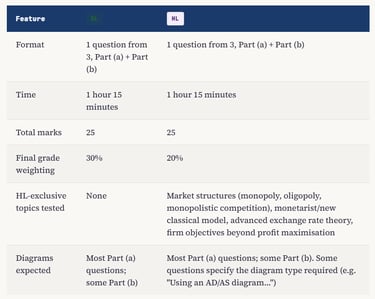
The format of Paper 1 is identical for IB Economics SL and IB Economics HL students - same structure, same time allocation, same number of marks. What changes is the topic content. HL students answer different questions from those set for SL students in the same exam session. This is because HL students study additional topic content that SL students are not required to master. These are the main differences:
The most significant practical difference between SL and HL Paper 1 is the theoretical depth expected in HL responses. HL questions draw on models and frameworks not covered at SL level - a student who attempts an HL question without the required HL content knowledge cannot access the top mark band regardless of how well they write. Always confirm which paper you are sitting before revision.
Command Words
The Main Four Command Words You Need to Master
Every IB Economics Paper 1 question is usually built around one of four command words. The command word defines exactly what the examiner expects - ignoring command words is the single most common reason students lose marks they should have earned. Each command word appears in a specific position: Explain and Distinguish in Part (a), Evaluate and Discuss in Part (b).
Explain PART (a) - 10 Marks
Show the chain of causation - one thing leading logically to the next. A definition alone is not an explanation. You need the mechanism: why does X lead to Y? Diagrams are usually required and must be integrated into the written explanation, not just drawn alongside it.
↳ Draw the diagram. Explain what it shows. Connect it to the question.
Distinguish PART (a) - 10 Marks
Show how two concepts differ from each other throughout your response - not just define each one separately. Contrast must run through the entire answer. A 6-mark cap applies if only one concept is addressed, or if no differentiation between the two is made.
↳ Contrast explicitly: "unlike X, Y does not..."
Evaluate PART (b) - 15 Marks
Present the case for the view in the question, then challenge it. Reach a justified conclusion. Pay close attention to the question and accompanying absolute words like "always" or "most important" - these signal that the conclusion must engage with conditions and exceptions, not just present two equal sides.
↳ Commit to a conclusion. "It depends" without specifics earns nothing.
Discuss PART (b) - 15 Marks
Present a two-sided argument using real-world examples, then reach a reasoned overall judgement. Real-world examples must be developed in the context of the argument - naming a country without connecting it to the economic point scores in the lower bands only.
↳ Two well-developed examples beat six name-drops every time.
Internal Assessment (IA) Guide – Free Download
Step-by-step support on topic selection, structure, evaluation, and most common IB Economics IA mistakes.
Understanding key IB Economics Internal Assessment concepts
Applying and explaining them in real-world IB Economics contexts
Building IB Economics IA confidence without drowning in dry theory and explanations.
Download the IA guide now for free and boost your IB Economics grades and confidence
Mark Scheme
Critical Mark Scheme Rules Every Student Should Know
The IB Economics mark scheme contains several non-negotiable rules - hard ceilings on marks that apply regardless of how well the rest of the answer is written. These rules appear across multiple papers and catch students every year. Knowing them before the exam removes the risk of hitting a cap you didn't know existed.
1
Two-part questions: maximum 6 marks if only one part is addressed. When a Part (a) question asks about two mechanisms, two types, or two aspects - covering only one limits the maximum to 6 regardless of quality. Seen in: the price mechanism question (Nov 2024), the short vs long-run growth question (Nov 2024), and all "explain two..." questions (Nov 2025).
2
One-sided Part (b) responses face caps of 9 or 12 marks. Several Part (b) questions carry explicit caps. A maximum of 9 applies if only advantages or disadvantages are addressed (trading blocs, monetary union). A maximum of 12 applies if alternative arguments or barriers are not considered (inequality as a development barrier). Balance is mandatory to access the top band.
3
Diagrams that are drawn but not explained in the text earn zero. A diagram only earns marks when it is fully labelled AND directly integrated into the written explanation. Drawing a diagram, not explaining it, not applying it to the essay arguments and continuing to write as if it isn't there is one of the most common reasons for losing marks at both SL and HL levels.
4
Some Part (b) questions explicitly state that no diagram is expected. The November 2024 public goods question is a clear example. Spending time drawing diagrams here takes time away from the evaluation and critical thinking content that actually earns marks.
5
Theory and definitions from Part (a) can be credited in Part (b) if referred to. You do not need to repeat full definitions already given in Part (a). A brief cross-reference ("as defined above, abnormal profit occurs where AR > ATC...") is sufficient and saves time for the evaluation content where most marks are earned.
6
Real-world examples must be developed, not just named. Naming a country or company earns marks in the lower bands only. A developed example connects the real-world context to the specific economic argument being made - what happened, what it demonstrates economically, why it supports or challenges the claim.
IB Economics - Syllabus and Programme Full Guide →
Past Paper Analysis
Each page below is Lawrence's breakdown of what was actually tested in that sitting. Every breakdown includes the topics covered, the content required at each mark band, the diagrams needed, and the specific mark scheme rules that determined where students gained and lost marks. No reproduced questions. No prediction lists. Just everything you actually need to prepare and most importantly, the how to achieve the marks you are looking for.
Lawrence's IB Economics Paper 1 Reviews
Topic Frequency
What Has Come Up - and How Often
The following information maps topic areas against the last three SL sittings (November 2024, May 2025, November 2025). Frequency should inform the depth of your revision, not the scope - in its current format every IB Economics syllabus topic could be in the exam.
Topic Area / Module / Frequency (Last 3 papers) / Last time in the exam
Market failure - public goods, merit goods, demerit goods - Module Microeconomics - OOO - Nov 2025, May 2025, Nov 2024
Demand, supply and market equilibrium - Module Microeconomics - OO - Nov 2025, Nov 2024
Government intervention tools (taxes, subsidies, price controls) - Module Microeconomics - OO - Nov 2025, May 2025
Economic growth (short-run and long-run) - Module Macroeconomics - OO - May 2025 (via Keynesian gap), Nov 2024
Macroeconomic objectives (inflation, unemployment, BOP) - Module Macroeconomics - OOO - Nov 2025, May 2025, Nov 2024
Monetary policy - Module Macroeconomics - O - Nov 2025
Investment determinants (e.g. AD) - Module Macroeconomics - O - Nov 2025
International trade and comparative advantage - Module Global Economy - OO - Nov 2025, May 2025
Trade protection and trading blocs - Module Global Economy - OO - Nov 2025, May 2025 (supply-side)
Development economics - foreign aid, barriers, supply-side - Module Global Economy - OOO - Nov 2025 (via trading blocs), May 2025, Nov 2024
Income inequality and poverty - Module Global Economy - O - Nov 2024
GDP per capita and development indicators - Module Global Economy - O - May 2025
The pattern across three sittings is clear: market failure appeared in the microeconomics question in every sitting. Macroeconomic objectives - whether through growth, unemployment, or monetary policy - appeared every time. Development economics anchored the global economy question in all three sessions. SL Topics that have not yet appeared in recent sittings - fiscal policy, elasticity as a standalone topic, exchange rates at SL - remain strong contenders.
IB Economics Calculations Book
Step-by-step calculations for every quantitative topic in the IB Economics syllabus. IB standard Model answers and marking schemes included.
Higher Level (HL) - Topic Frequency
Based on three HL Paper 1 sittings: November 2024, May 2025, and November 2025. Each "O" represents one sitting in which the topic appeared. "Os" run left to right: November 2024 → May 2025 → November 2025. Frequency should inform the depth of your revision, not the scope - every syllabus topic could appear in your exam.
Topic Area / Module / Frequency (Last 3 papers) / Last time in the exam
Monopoly & market power (abnormal profit, short run and long run) - Module Microeconomics - OO - Nov 2025, Nov 2024
Firm objectives - profit maximisation vs alternative goals - Module Microeconomics - O - Nov 2024
Price elasticity of demand (PED) - primary commodities vs manufactured goods - Module Microeconomics - O - May 2025
Monetarist / new classical model - natural rate of unemployment (NRU) and AD/AS - Module Macroeconomics - O - Nov 2024
Unemployment - causes, consequences, comparison with inflation - Module Macroeconomics - O - Nov 2024
Supply-side policies - interventionist and market-based - Module Macroeconomics - O - May 2025
Inflation - redistributive effects and policies to reduce - Module Macroeconomics - O - Nov 2025
Fiscal policy (effectiveness as an anti-inflation tool) - Module Macroeconomics - O -Nov 2025
Exchange rates - relative inflation rates and depreciation consequences - Module Global Trade - OO - May 2025, Nov 2024
Fixed vs floating exchange rate systems - Module Global Trade - O - May 2025
Monetary union - advantages and disadvantages - Module Global Trade - O - Nov 2024
Trade protection vs free trade - employment and economic growth - Module Global Trade - O -Nov 2025
Primary sector dependence as a barrier to economic growth and development - Module Global Trade - O - Nov 2025
Quick Facts
Duration 1h 15min
Questions 1 from 3
Part (a) 10 marks
Part (b) 15 marks
SL weighting 30%
HL weighting 20%
Reading time 5 minutes
IB Economics Paper 1 - Frequently Asked Questions:
Direct answers to questions from my students:
What is IB Economics Paper 1?
IB Economics Paper 1 is the essay-based component of the IB Economics exam, sat by both SL and HL students. Students choose and answer one question from a choice of three in 1 hour 15 minutes. Each question has two parts: Part (a) worth 10 marks requiring explanation with diagrams, and Part (b) worth 15 marks requiring evaluation or discussion using real-world examples. The total is 25 marks, accounting for 30% of the final grade at SL and 20% at HL.
What is the difference between IB Economics Paper 1 SL and HL?
The format is identical - same structure, same marks, same time available. The difference is topic content. HL students answer different questions that draw on HL-exclusive content: market structures (monopoly, oligopoly, monopolistic competition), the monetarist and new classical macroeconomic model, and advanced exchange rate theory. SL students are not tested on these topics in Paper 1. The HL paper also carries a lower weighting (20% vs 30% for SL) because HL students have an additional Paper 3.
What command words appear in IB Economics Paper 1, and what do they require?
Part (a) normally uses Explain or Distinguish. Explain requires a causal chain supported by diagrams. Distinguish requires explicit contrast between two concepts throughout - not just two separate definitions. Part (b) uses Evaluate or Discuss. Evaluate requires both sides of an argument and a justified conclusion, with particular attention to absolute terms like "always" in the question. Discuss requires a balanced two-sided argument with developed real-world examples and an overall judgement. In all cases, the command word defines the structure of the expected response - ignoring this is the main reason why students lose marks in Paper 1.
Which topics come up most often in IB Economics Paper 1?
Across the November 2024, May 2025, and November 2025 SL sittings, market failure sub-topics - public goods, merit goods, and demerit goods - appeared in the microeconomics question every time. Macroeconomic objectives (through growth, unemployment, or monetary policy) also appeared in every session. Development economics anchored the global economy question all three times. For HL, market structures, the monetarist model, and exchange rate theory all appeared in the November 2024 sitting. The broad pattern is consistent but no topic is guaranteed to appear - the safest revision strategy covers all syllabus units.
How important are diagrams in IB Economics Paper 1?
Diagrams are essential in most Part (a) questions and important in many Part (b) questions. A diagram earns marks only when it is fully labelled - with axes, curves, equilibrium points, and any relevant shifts clearly annotated - and when it is directly explained in the surrounding text. A diagram drawn in silence beside the answer earns zero. Some Part (b) questions explicitly state that no diagram is expected - in those cases, time is better invested in the written evaluation. The mark scheme for each question specifies whether diagrams are required, recommended, or not expected
IB Economics Diagrams Programme, What's included:
200+ exam-ready diagrams covering the entire IB Economics syllabus
Video for every diagram showing you exactly how each model looks
Image version perfect for modelling diagrams in you essays, presentations, and your IA
Detailed written explanations of the IB Economics theory behind each diagram
Both SL and HL IB Economics diagrams clearly labelled and organised by topic
Real IB Economics exam application showing how to use diagrams effectively in Paper 1 and Paper 2
Explore Topics:
IB Economics your IB Economics daily guide
IB Economics Diagrams Check this resource for All the IB Economics syllabus diagrams with explanations
IB Economics Activity book More IB Economics exam practice, activities, model answers and IB Economics Marking schemes, all units all modules covered
IB Economics Required Diagrams SL HL
IB Economics Paper 2 - All the information you need to complete IB Economics paper 2 successfully
IB Economics Paper 3 - Great help and guidance for your IB Economics Paper 3 HL
Read Next: IB Economics Calculations SL HL

© Theibtrainer.com 2012-2026. All rights reserved.
Legal
Have a Tip? Send us a tip using our anonymous form