
IB Economics Price Elasticity of Demand Guide
Get to grips with Price Elasticity of Demand (PED) in IB Economics. Learn how PED affects price changes, sales, and total revenue with clear examples.
IB ECONOMICS HLIB ECONOMICS SLIB ECONOMICS MICROECONOMICSIB ECONOMICS
Lawrence Robert
11/1/202413 min read


Why Some Companies Can Charge You More (And You'll Still Pay): A Student's Guide to Price Elasticity of Demand
Target Question:
What is price elasticity of demand and how does it affect business pricing decisions?
January 2025. You wake up, scroll through your phone, and there it is - another email from Netflix. They're putting their prices up. Again. Standard plan? Up. Premium plan? Up. And yet, later that same week, Netflix announced it had just added 19 million new subscribers in a single quarter - their biggest ever. By the end of 2024, they had 302 million global subscribers.
You'd think people would cancel in their millions, right? They didn't.
So what's going on? Why can a company raise its prices and still rake in more money? And why does the bloke at the petrol station keep filling up at 133p per litre without even basic complaining?
This is Price Elasticity of Demand - one of the most useful (and most examined) concepts in the entire IB Economics syllabus.
What Is Elasticity of Demand?
IB Economics definition - Elasticity of demand:
Elasticity of demand refers to how much the demand for a good or service changes when one of its key determinants shifts - most commonly, its price, or someone's real income.
In simple terms: if the price goes up, does demand fall off a cliff, or does it hardly change?
That's the question PED answers. The answer is very different depending on what you're buying.
IB Economics Diagrams Programme, What's included:
200+ exam-ready diagrams covering the entire IB Economics syllabus
Video for every diagram showing you exactly how each model looks
Image version perfect for modelling diagrams in you essays, presentations, and your IA
Detailed written explanations of the IB Economics theory behind each diagram
Both SL and HL IB Economics diagrams clearly labelled and organised by topic
Real IB Economics exam application showing how to use diagrams effectively in Paper 1 and Paper 2
Price Elasticity of Demand (PED)
IB Economics definition - Price Elasticity of Demand (PED):
Price elasticity of demand (PED) measures the percentage change in quantity demanded of a good relative to a percentage change in its price. PED = % change in quantity demanded ÷ % change in price.
Price Elasticity of Demand (PED) measures how sensitive consumers are to changes in price. Specifically, it tells us how the quantity demanded of a good changes in response to a price change.
Here's the formula you need to know in a good and in a bad day of yours:
PED = % change in quantity demanded ÷ % change in price Or: (%ΔQD) ÷ (%ΔP)
And to calculate a percentage change between two figures:
(New figure − Old figure) ÷ Old figure × 100
Some of my students find the following concept difficult: PED is almost always a negative number. That's because of the law of demand - when price rises, quantity demanded falls, and vice versa. One number goes up, the other goes down, so the result is negative. Simple.
But here's what examiner's tell you from the data they have collected: don't say "demand decreases when price rises" and call it elasticity. That's just the law of demand - that's true regardless of whether demand is elastic or inelastic. What matters with PED is the size of that response. Is the drop in demand bigger or smaller than the rise in price? That's the whole concept.
What Does the PED Value Actually Tell You?
Right, let's break this down because this is where a lot of marks are lost.
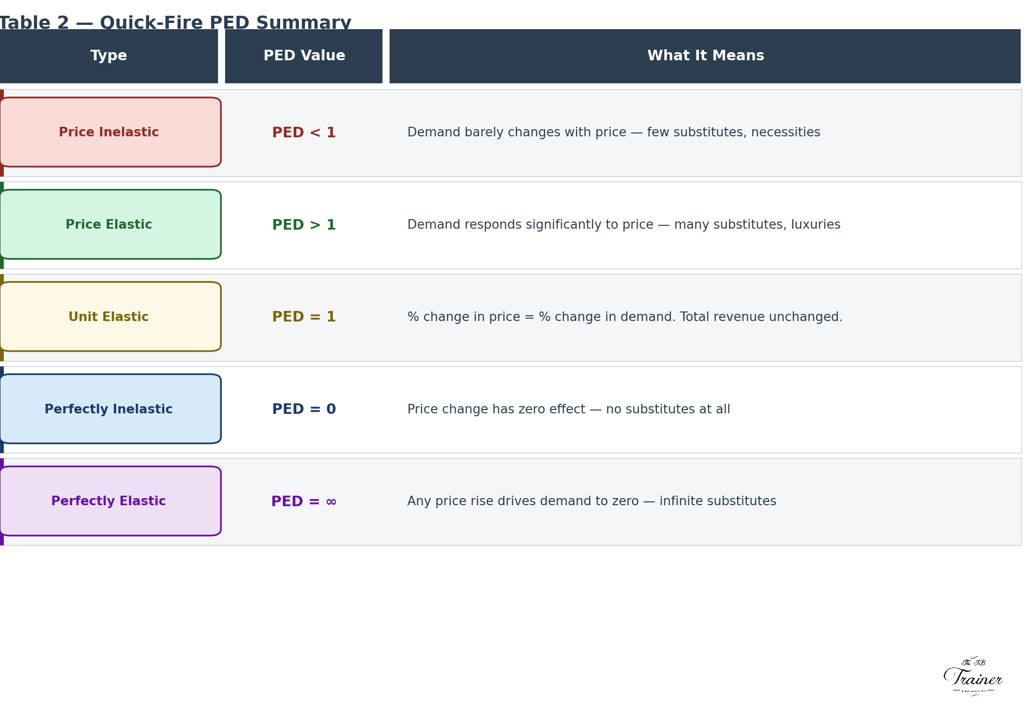
Price Inelastic Demand (PED < 1.0)
When PED is less than 1, demand barely reacts to price changes. Consumers essentially shrug their shoulders and keep buying.
IB Economics Real-life Examples: best example petrol. As of early 2026, the average petrol price in the UK was hovering around 133p per litre - well down from the eye-watering 191.5p per litre peak in July 2022, but still not exactly cheap. And yet, UK petrol demand actually increased by around 3% in 2024. People still need to get to work. Lorries still need to move goods. The bus still needs to get to the stop. There's no real substitute for fuel if you need to travel, so demand stays strong always.
Same story with cigarettes. Tobacco is a classic example of a price inelastic good - it's addictive, and there are no close substitutes, so higher prices tend to cause only a small percentage fall in demand. The UK government knows this, which is why tobacco duty currently accounts for a huge chunk of the price of a pack. The government earns over £7 billion a year from tobacco taxes.
Inelastic demand = reliable tax revenue. More on that shortly.
Other classic inelastic examples: salt, electricity, insulin, housing, and - for some of you - your morning coffee.
Examiner's note: Avoid saying a product is "elastic" or "inelastic" on its own. Always say "price elastic" or "price inelastic" - this shows you understand that PED specifically measures responsiveness to price changes.
Price Elastic Demand (PED > 1.0)
When PED is greater than 1, the percentage fall in quantity demanded is bigger than the percentage rise in price. Consumers are sensitive - raise the price a little, and demand drops a lot.
IB Economics Real-life Examples: Think about soft drinks, branded trainers, or - going back to our Netflix example - streaming services. Netflix faces a tricky situation: it has loads of competitors now (Disney+, Apple TV+, Amazon Prime, and more), which means if it gets too pricey, subscribers have alternatives. Netflix's subscription-based model includes both ad-free and ad-supported plans, enabling it to target diverse market segments and adapt to changes in consumer preferences. That ad-supported tier? That's Netflix acknowledging that some of its customers are price-sensitive - i.e., their demand is relatively elastic.
The more substitutes that exist, the more elastic demand becomes. That's no coincidence - it's economics.
Unit Elastic Demand (PED = 1.0)
This is the perfectly balanced middle ground. A 10% rise in price leads to exactly a 10% fall in quantity demanded. PED = 1.0. Total revenue stays the same. In real life, this is more of a theoretical point on the demand curve than a permanent state, but it is important for you to understand this idea.
The Three Special Cases
Beyond elastic and inelastic, there are three more specific cases your examiner will expect you to know:
1. Perfectly Price Inelastic (PED = 0)
A change in price has zero effect on quantity demanded.
The demand curve is a vertical straight line. This occurs when a product has absolutely no substitutes. Think life-saving medication - if you need it, no price rise is going to stop you buying it.
2. Perfectly Price Elastic (PED = ∞)
The tiniest price rise results in demand dropping to zero, as every consumer immediately switches to a substitute.
This gives a horizontal demand curve. It's essentially a theoretical extreme, but it models competitive markets well - in a perfect competition market, if one seller raises their price above everyone else's, they sell nothing.
3. Unit Elastic (PED = 1.0)
The percentage change in price equals the percentage change in quantity demanded.
Revenues stay flat.
What Determines PED? (The TINS Framework)
So why is petrol inelastic while strawberry-flavoured Fanta is elastic? It comes down to four key determinants, which you can remember using the acronym TINS:
T - Time Period
Consumers need time to find alternatives and change their habits. In the short run, demand tends to be more inelastic. In the long run, it becomes more elastic.
IB Economics Real-life Example: Take petrol again. When oil prices spiked after Russia's invasion of Ukraine in 2022, drivers couldn't immediately ditch their diesel cars and buy an electric vehicle. But over time? Car manufacturers began accelerating their shift to electric and hybrid vehicles precisely because of those sustained price increases. Over years, the market adapts - PED increases with time.
A smoker is unlikely to change their habits because of a single 10% rise in cigarette prices. However, persistent price increases over time may eventually motivate them to quit - though this can take considerable time. While demand may be very inelastic in the short run, in the long run it is likely to become more price sensitive.
I - Income (Proportion Spent on the Good)
When a good takes up a large chunk of your income, you become much more sensitive to price changes. If your broadband goes up by £2 a month, you probably won't cancel - it's a small share of your income. But if your rent goes up by £200 a month? Suddenly you have a new priority: Googling flats in a cheaper area.
As consumers spend more of their income on a good or service, the demand for it tends to become more price elastic.
N - Necessity
Essential goods - fuel, housing, food staples, medication - remain in demand even when prices rise, because you simply can't do without them. They exhibit price inelastic demand.
Luxury goods and discretionary spending? Much more elastic. Nobody needs a £4 oat milk latte. If the price goes up, people switch to a regular coffee. Or make it at home. Or just get on with life.
S - Substitution (Number and Closeness of Substitutes)
This is probably the biggest driver of all. The more substitutes available at competitive prices, the more price elastic demand becomes - because consumers can easily switch.
That's why supermarket own-brand cola is highly price elastic (dozens of alternatives exist), while insulin is practically perfectly price inelastic (there is no substitute if you're diabetic).
Internal Assessment (IA) Guide – Free Download
Step-by-step support on topic selection, structure, evaluation, and most common IB Economics IA mistakes.
Understanding key IB Economics Internal Assessment concepts
Applying and explaining them in real-world IB Economics contexts
Building IB Economics IA confidence without drowning in dry theory and explanations.
Download the IA guide now for free and boost your IB Economics grades and confidence
PED Along a Demand Curve (HL Students)
Here's something that usually surprises my IB Economics Higher Level students: even on a straight-line (linear) downward-sloping demand curve, PED changes as you move along it.
At higher price levels, a given change in price represents a larger percentage of the price - so consumers become more sensitive. PED is higher (more elastic) at the top of the demand curve, and lower (more inelastic) at the bottom, even though the slope of the line stays the same throughout.
So avoid describing a product as simply "elastic" or "inelastic" in all circumstances - its elasticity changes depending on the price level at the time. This is especially important when discussing total revenue, which we're about to get into.
PED and Total Revenue: So What?
Here's where PED stops being abstract and starts being genuinely useful.
Total Revenue (TR) = Price × Quantity Traded (P × Q)
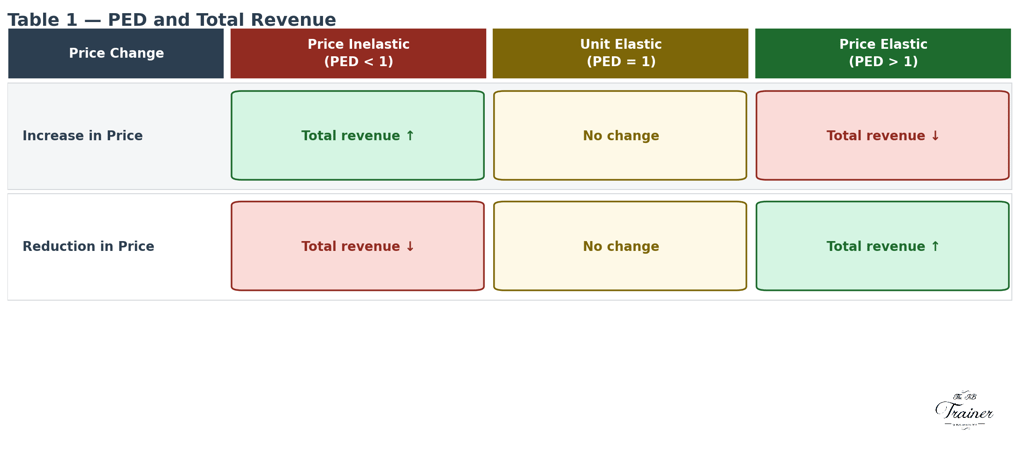
The relationship between PED and total revenue is one of the most frequently examined areas in IB Economics, and it follows a clear pattern:
For access to all IB Economics exam practice questions, model answers, IB Economics complete diagrams together with full explanations, and detailed assessment criteria, explore the Complete IB Economics Course
Let's understand this properly with examples:
IB Economics Real-life Examples:
Netflix - January 2025 - raised prices after reporting its biggest-ever subscriber jump. The company reported nearly 19 million new subscribers during the last fiscal quarter of 2024, putting them at 302 million global subscribers, the most of any streaming platform. Netflix calculated that despite price-sensitive customers, their loyal base - hooked on Squid Game Season 2, the Tyson vs Paul boxing match, and Christmas NFL games - would stick around. If demand is relatively inelastic, a price rise increases total revenue. That's exactly what they were betting on.
Budget airlines like Ryanair or easyJet. These operate in a highly price-elastic market - there are multiple airlines flying the same routes, and consumers will switch in a heartbeat for £10 less. So what do they do? They cut base fares to rock-bottom prices to attract massive demand, and then make their money back on luggage, seat selection, and overpriced airport sandwiches. When demand is elastic, reducing price increases total revenue.
It's the same economic principle.
Why PED Is Relevant: For Firms and Governments
PED genuinely drives real-world decisions.
For Businesses
If demand is price inelastic: Firms can raise prices to increase total revenue without losing too many customers. The UK government uses its fuel duty - currently set at 52.95p per litre - as a significant revenue source. Fuel duties raise more than £26 billion a year, which together with VAT charged on fuel, vehicle tax, and showroom taxes means motorists contribute more than £40 billion annually to government coffers. Petrol companies and the government can keep raising what they charge because consumers have few alternatives.
If demand is price elastic: Firms should reduce prices to boost sales volume and total revenue. Think supermarkets running "price wars" on staple goods, or streaming services offering student discounts.
Price Discrimination: Some firms exploit different PED values across customer segments to maximise revenue. Theme parks are a great example - adults pay full price (relatively inelastic demand - they've promised their kids a trip to Alton Towers and there's no going back), while students, children, and pensioners get discounts because their demand is more elastic. Same product, different prices, higher total revenue. Smart is a good word to describe this.
Exchange Rates and Exports: When a country's currency weakens, its exports become cheaper for foreign buyers. If export demand is price elastic, exporters benefit from a surge in sales - the lower price triggers a proportionally bigger increase in quantity demanded.
For Governments
Governments use PED to design taxation policy. The logic is pretty ruthless when you spell it out:
Tax cigarettes heavily → demand barely falls (inelastic) → massive revenue + slight reduction in consumption
Tax luxury cars heavily → demand falls significantly (elastic) → revenue limited + bigger behavioural change
A 10% price increase in tobacco is estimated to reduce consumption by around 4% in high-income countries - a clear sign of price inelastic demand. That's why tobacco and alcohol taxes are so popular with governments: they raise money and provide at least some public health benefit without collapsing the market entirely.
When demand is price inelastic, firms often pass the entire tax burden onto consumers - because they know buyers have no real alternative. You've probably never heard of a petrol station absorbing its fuel duty and taking the hit themselves. That's because they don't need to.
Primary Commodities vs Manufactured Goods (HL)
Higher Level students need to understand why PED for raw materials and primary commodities is generally lower than for manufactured products.
Primary commodities - crude oil, wheat, gold, iron ore - tend to be price inelastic because:
They have very few (if any) substitutes
They are essential inputs into production
Businesses that need them can't simply stop buying them when prices rise
Manufactured goods - laptops, cars, TVs - tend to be more price elastic because:
Many substitute brands and models exist
Consumers can delay purchases
They represent a significant share of disposable income
The market is more competitive, with brands competing on price
Crude oil goes up in price, and BP still has to buy it - there's no substitute for crude oil in refining petrol. But if the price of a Samsung TV goes up, you'll have a good long look at the Sony, the LG, and the Hisense before you decide which one to purchase.
Over time, products can shift from inelastic to more elastic. That's precisely what's happening with fossil fuels - China's diesel consumption stood at around 4.0 million barrels per day in April 2025, continuing a decline from a peak of 4.7 million barrels per day in 2023, as the shift to electric vehicles gradually reduces dependence on fossil fuels. The long-run PED for petrol is higher than the short-run PED - time allows consumers and businesses to find alternatives.
IB Economics Summary
Price Elasticity of Demand is one of those economic concepts that genuinely explains the world around you. It's why Netflix keeps putting its prices up and still profits. It's why a pack of cigarettes now costs over £15 in the UK and people still buy them. It's why Ryanair charges you 50p for a flight and £35 for your bag.
It's not a coincidence. It's elasticity.
Once you understand PED, you start seeing it everywhere - in every price tag, every budget announcement, and every business strategy. And that, for an IB Economics examiner, is exactly what they want to see, that you are able to understand the concepts and apply them to numerous scenarios.
Test yourself: why do you think the demand for insulin is perfectly inelastic, but the demand for brand-name painkillers is relatively price elastic? Discuss this question in class.
Every episode of Pint-Sized links back to what matters most for your IB Economics course:
Understanding key IB Economics concepts
Applying them in real-world IB Economics contexts
Building IB Economics course confidence without drowning in dry theory.
Subscribe for free to exclusive episodes designed to boost your IB Economics grades and confidence
Frequently Asked Questions: Price Elasticity of demand (IB Economics)
Q1: What does a PED value of less than 1 mean? A PED value of less than 1 means demand is price inelastic - the percentage fall in quantity demanded is smaller than the percentage rise in price. Consumers don't change their buying habits much, usually because the product is a necessity or has few substitutes. Examples include petrol, electricity, and cigarettes.
Q2: Why is PED usually negative? PED is usually negative because of the law of demand: when price rises, quantity demanded falls, and vice versa. One figure goes up, the other goes down - so the result is negative. The size of that negative number is what tells you whether demand is elastic or inelastic.
Q3: How does PED affect a firm's total revenue? If demand is price inelastic (PED < 1), a firm can raise its price and total revenue will increase - because the drop in quantity demanded is proportionally smaller than the price rise. If demand is price elastic (PED > 1), a price rise causes total revenue to fall, because consumers switch to substitutes.
Q4: What are the four main determinants of price elasticity of demand? The four main determinants are summarised by the acronym TINS: Time (consumers need time to find alternatives), Income (the proportion of income spent on the good), Necessity (whether the good is essential or a luxury), and Substitution (the number and closeness of available substitutes).
Q5: Why can Netflix keep raising its prices? Netflix can raise prices because its demand is relatively price inelastic - it has a loyal subscriber base, exclusive content that competitors don't offer, and strong brand recognition. When it raised prices in early 2025 after adding 19 million subscribers in Q4 2024, it calculated that most users would stay rather than cancel. When demand is inelastic, a price rise increases total revenue.
Stay well,
Filed under:
IB Economics your IB Economics daily guide
IB Economics Microeconomics access Price Elasticity of Demand content as well as the rest of module 2
IB Economics Diagrams Check Unit 8 for All Price elasticity of demand diagrams with explanations
IB Economics Activity book Module 2 Microeconomics Unit 2.4 for Price elasticity of demand exam practice, activities, model answers and IB Economics Marking schemes
IB economics Calculations Book make sure you check unit 5 for Price elasticity of demand calculations exercises, IB model answers, and IB marking schemes
IB Economics Demand for the "law of demand" reference in the PED formula section
IB Economics Income Elasticity of Demand (YED) helpful theory when discussing income as a determinant under TINS
IB Economics Price Elasticity of Supply (PES) this is directly related to the concept of price elasticity of demand
IB Economics Market Failure and IB Economics Government Intervention necessary background knowledge when discussing cigarette/tobacco taxation
IB Economics Perfect Competition and IB Economics Monopoly important background theory when discussing the perfectly elastic demand curve
Read Next: IB Economics Elasticity
© Theibtrainer.com 2012-2026. All rights reserved.
Legal
Have a Tip? Send us a tip using our anonymous form