
IB Economics Understanding Price Elasticity of Supply
Discover Price Elasticity of Supply (PES) with real-world examples, fun stories, and exam-ready tips for IB Economics students.
IB ECONOMICS HLIB ECONOMICS MICROECONOMICSIB ECONOMICSIB ECONOMICS SL
Lawrence Robert
1/13/202511 min read


Why Oasis Couldn't Add More Seats: The Economics of Supply
Target Question:
What is price elasticity of supply and what are the main determinants of PES in IB Economics?
Price Elasticity of Supply (PES) explained through concerts, crude oil, soft drinks, and the one question producers always ask: how quickly can we make more of this?
IB Economics Diagrams Programme, What's included:
200+ exam-ready diagrams covering the entire IB Economics syllabus
Video for every diagram showing you exactly how each model looks
Image version perfect for modelling diagrams in you essays, presentations, and your IA
Detailed written explanations of the IB Economics theory behind each diagram
Both SL and HL IB Economics diagrams clearly labelled and organised by topic
Real IB Economics exam application showing how to use diagrams effectively in Paper 1 and Paper 2
August 2024. Oasis - yes, that Oasis - the Britpop band announced their reunion tour. Ten million fans from 158 countries immediately rushed to buy tickets online. Queues stretched for hours. Ticketing websites buckled. Prices surged - some tickets doubled in cost before fans had even made it to the front of the virtual queue - thanks to dynamic pricing, which automatically hikes prices as demand spikes.
Wembley Stadium holds around 90,000 people. Cardiff's Principality Stadium holds 74,000. Those numbers don't change. Oasis couldn't just manage 20 extra gigs overnight. They couldn't clone Liam Gallagher. Supply was, in every possible sense, completely fixed.
This is the perfect example of a mismatch between exploding demand and a supply that simply cannot respond - and the perfect real-world illustration of Price Elasticity of Supply (PES) you'll find anywhere. And once you understand it, you'll never look at a sold-out event, an oil price spike (such as the current one in March 2026), or a can of Coke the same way again.
What Is Price Elasticity of Supply?
IB Economics Definition - Price elasticity of Supply (PES):
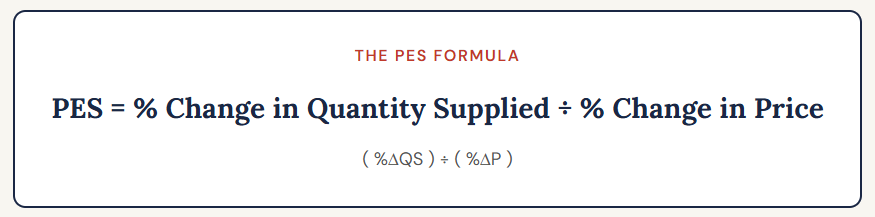
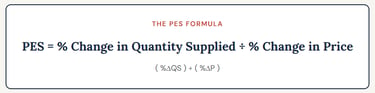
Price elasticity of supply (PES) measures how responsive the quantity supplied of a good is to a change in its price. It is calculated by dividing the percentage change in quantity supplied by the percentage change in price.
So, PES measures how responsive the quantity supplied of a product is to a change in its price. In plain English: if the price of something goes up, how quickly and how much can producers supply more of it?
Sometimes the answer is "loads, and right away." Sometimes it's "barely at all, and it'll take years." That gap in responsiveness is everything.
Internal Assessment (IA) Guide – Free Download
Step-by-step support on topic selection, structure, evaluation, and most common IB Economics IA mistakes.
Understanding key IB Economics Internal Assessment concepts
Applying and explaining them in real-world IB Economics contexts
Building IB Economics IA confidence without drowning in dry theory and explanations.
Download the IA guide now for free and boost your IB Economics grades and confidence
One important thing to note upfront PES is always positive:
PES is always positive because of the law of supply - when price rises, producers are willing to supply more, not less. This is in contrast to PED, which is typically negative.
That's because of the law of supply - when prices rise, producers want to supply more, not less. So price and quantity supplied move in the same direction, and the coefficient stays positive. No need to worry about negative signs here, unlike with PED.
The Five Degrees of PES
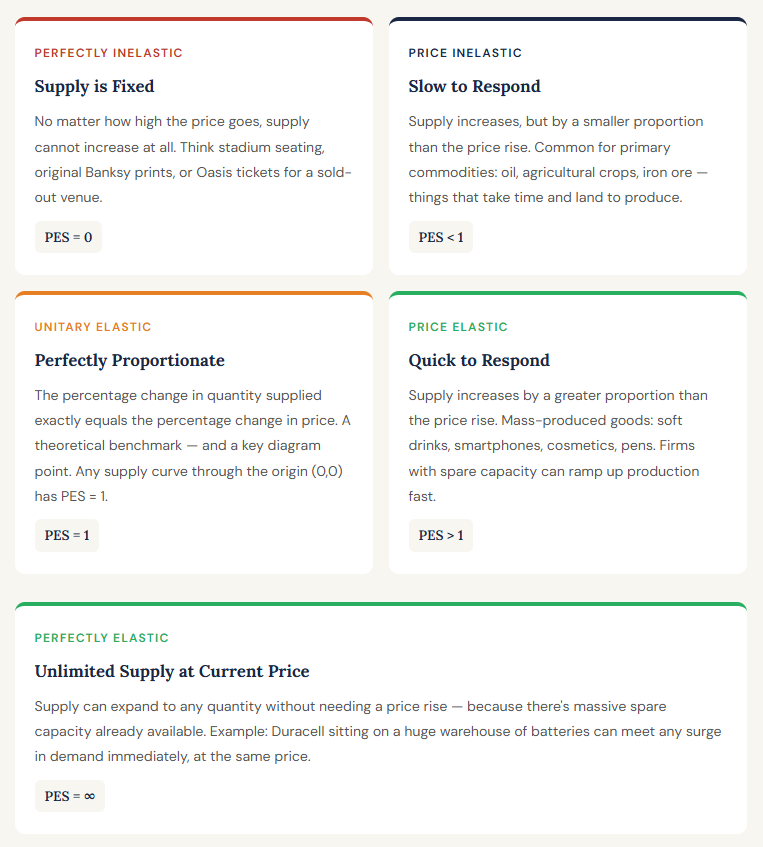
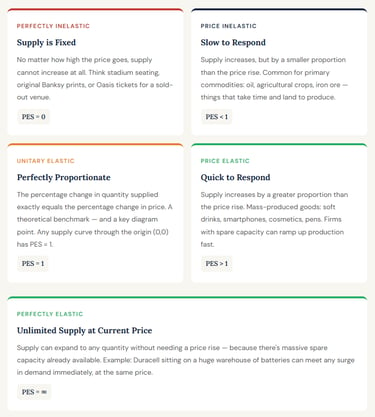
PES exists on a spectrum from completely frozen to infinitely flexible. Here's how the whole range breaks down:
For access to all IB Economics exam practice questions, model answers, IB Economics complete diagrams together with full explanations, and detailed assessment criteria, explore the Complete IB Economics Course
IB Economics Diagram Tip
Supply Curve Through Origin (PES = 1):
Any supply curve that passes through the origin (0,0) has a price elasticity of supply of exactly 1, regardless of its gradient. This means the percentage change in quantity supplied equals the percentage change in price.
This is a neat trick worth memorising. Perfectly inelastic supply is a vertical line. Perfectly elastic supply is a horizontal line.
Back to Oasis: The PES = 0
Dynamic pricing economics explained
Dynamic pricing allows businesses to adjust prices instantly based on real-time data and market conditions. Tools such as Google Flights now help consumers track historical price trends to navigate these shifts. PES = 0.
The Oasis reunion perfectly illustrates what happens when PES hits zero. Over 10 million fans queued online for tickets. Demand was astronomical. But supply - 17 dates across fixed venues with fixed capacities - could not budge an inch.
Perfectly inelastic supply occurs when quantity supplied cannot change regardless of price, giving a PES of 0. This happens when there is no spare capacity to increase output - for example, a concert venue with a fixed seating capacity.
Ticketmaster's dynamic pricing system did exactly what economics would predict: when you can't supply more, you let the price rise to allocate the fixed supply among the most willing (or wealthiest) buyers. Some tickets reportedly more than doubled in price while fans were mid-queue. Fans were furious. But from a pure PES perspective? The market was doing exactly what it's designed to do when supply is perfectly inelastic.
"Compare Oasis to a can of Coke. If Coca-Cola sees a sudden spike in demand - say, a heatwave hits the UK in July - what happens? Factory lines speed up. Warehouses are tapped. Lorries roll out faster. Within days, shelves are restocked at roughly the same price. PES is high. Now compare that to a Wembley gig. You can't build a second Wembley in a week. Supply is fixed. That's the difference PES is measuring."
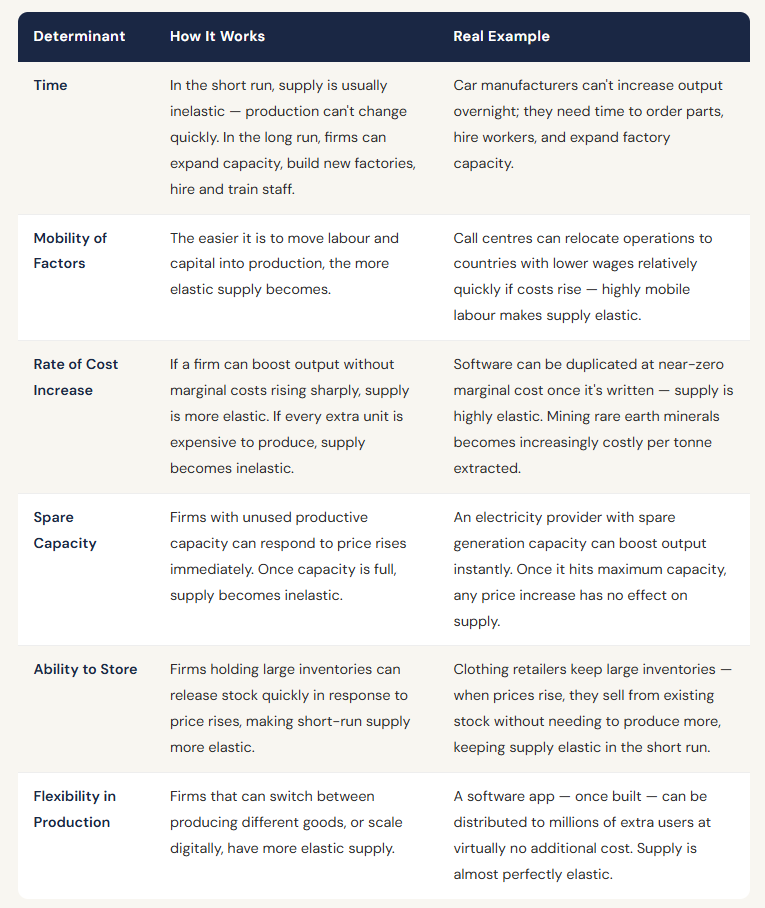
What Determines PES? Six Key Factors
So what makes some products easy to supply more of, and others practically impossible to scale up? There are six main determinants, learn them for your IB Economics exams.
Every episode of Pint-Sized links back to what matters most for your IB Economics course:
Understanding key IB Economics concepts
Applying them in real-world IB Economics contexts
Building IB Economics course confidence without drowning in dry theory.
Subscribe for free to exclusive episodes designed to boost your IB Economics grades and confidence
Oil: Classic Inelastic Supply
If Oasis tickets are the fun example of PES = 0, crude oil is the serious one - and still remains incredibly relevant for the global economy.
Oil supply is famously inelastic in the short run. You can't just drill a new oil field overnight. Infrastructure takes years to build, geological surveys take time, investment is enormous, and geopolitical complications (e.g. Saudi Arabia) are ever-present. When demand spikes, prices spike - because supply simply cannot respond fast enough.
This is exactly why OPEC (the Organisation of the Petroleum Exporting Countries) holds so much market power. By controlling production quotas - essentially managing how much of their spare capacity they allow to flow - OPEC can influence global oil prices significantly. In 2024, OPEC+ members reduced production by an estimated 1.3 million barrels per day to keep prices elevated. Because supply is inelastic, that modest production cut had a meaningful impact on global prices.
By 2025 and into 2026, the picture shifted: OPEC+ began gradually unwinding those cuts, and non-OPEC producers in the Americas (the US, Canada, Guyana, Brazil) had boosted output significantly. The result? Brent crude prices fell from around $81 per barrel in 2024 towards $74 and lower. More supply elasticity from non-OPEC producers was gradually eroding OPEC's pricing power - exactly what economic theory would predict. Today, March 18th 2026 in the middle of the Iran conflict the oil barrel of Brent crude hit around $106-$108.
IB Economics Real-life example:
The IEA estimates that a lasting 10% rise in oil prices reduces global oil consumption by only around 0.3% in the short term. That's inelastic demand. But supply is similarly sluggish - new oil fields can take a decade from discovery to full production. In the short run, both supply and demand for oil are highly inelastic. That combination creates the dramatic price swings we see every time there's a geopolitical crisis in the Middle East.
Software: The Other Extreme
Forget oil wells and concert venues - think about a mobile app.
Once Spotify, Netflix, or any software platform has been built, the cost of supplying it to one more user is essentially zero. There's no factory to expand, no raw material to mine, no lorry to book. If Spotify's price rises and the company wants to "supply more" to the market, it can do so instantaneously. PES importance is, for practical purposes, enormous.
This is why digital businesses have such radically different economics from traditional industries. Their supply curves are almost horizontal - perfectly elastic. A music streaming service that goes viral overnight doesn't face a supply crisis. A new oil refinery that gets unexpected demand does.
This also explains why tech companies scale so explosively during economic booms and why they're so profitable when they get it right - low marginal costs + highly elastic supply = massive potential upside.
How Firms Try to Make Their Supply More Elastic
Every smart business wants to be more responsive to price changes - because responsiveness means capturing more revenue when demand rises. Here's what firms actually do to improve their PES:
Build spare capacity - don't run factories at 100% all the time; keep headroom to ramp up production when needed.
Hold larger inventories - stock more finished goods and raw materials so you can respond without waiting for production.
Improve storage systems - better refrigeration, longer shelf-lives, bigger warehouses extend the usefulness of stored supply.
Upgrade technology - modern machinery can switch between products faster, scale output more efficiently, and reduce production bottlenecks.
Improve distribution - getting products to customers faster effectively increases supply responsiveness even without producing more.
Train and upskill workers - occupationally mobile workers who can perform a range of tasks give firms far more flexibility in production.
IB Economics Exam Tip - Short Run vs Long Run:
In the short run, supply is typically price inelastic because firms cannot quickly change their production capacity. In the long run, supply becomes more price elastic as firms can invest in new capital, hire and train staff, and build additional production facilities.
This is one of the most reliable marks in a PES question. In the short run, supply is almost always more price inelastic - firms can't immediately change their production setup. In the long run, supply becomes more price elastic - firms can invest in new capacity, train new staff, build new facilities. Always acknowledge this time dimension in your answers. It shows the examiner you understand the real world.
Primary vs Manufactured Goods HL
For IB Economics HL students, you need to go one level deeper - and the comparison between primary commodities and manufactured goods is one of the most important analytical distinctions in the whole PES topic.
Primary Products: Naturally Inelastic
Primary sector goods - oil, iron ore, coal, agricultural produce - tend to have low PES, and for very straightforward reasons. You can't hurry a wheat harvest. You can't drill an oil well in a week. Agricultural output is constrained by seasons, land availability, and growing cycles. Mining is constrained by geology, capital investment, and environmental regulation. These aren't inefficiencies - they're physical realities.
The result is that when prices spike for primary commodities, producers genuinely struggle to respond. Demand for these goods tends to remain relatively stable (they're essential inputs into everything), which means price volatility can be severe when supply is disrupted. Think of a drought cutting wheat output - or OPEC cutting oil production - and prices shooting up because supply just can't be flexible.
Manufactured Products: Built for Elasticity
Manufactured goods sit at the other end of the spectrum, and the reasons are just as logical. Mass production, by design, creates systems built for scalability. The marginal cost of producing one more smartphone, one more pair of trainers, or one more bottle of shampoo is relatively low once the production line is set up. Capital-intensive factories can often be run at higher rates without a proportionate rise in costs.
Add in the fact that manufactured goods often have substitutes available (if one firm can't supply more, another might be able to), and that global supply chains give manufacturers access to inputs quickly, and you get supply that responds far more readily to price signals.
IB Economics Sector Comparison
Primary sector (oil, agriculture, minerals): Low PES. Hard to scale quickly. Seasonal, geological, and infrastructural constraints dominate.
Secondary/manufacturing sector (phones, cosmetics, soft drinks): Higher PES. Mass production, lower marginal costs, scalable processes, and capital-intensive setups all increase responsiveness.
Digital/service sector (software, streaming, apps): Very high PES. Near-zero marginal cost of replication means supply can increase almost instantaneously.
IB Economics HL Exam Tip:
In HL essays and data response questions, you can score highly by linking PES to the structure of an economy. Developing economies with large primary sectors tend to be more exposed to commodity price volatility - because their export supply is inelastic. More industrialised economies, with diverse manufactured outputs, have more elastic supply structures and are better cushioned against price shocks. This kind of macro-level application of PES is exactly what examiners reward at HL.
IB Economics Summary
PES determines who benefits from a price rise - and who gets left behind.
When demand surges and prices jump, firms with elastic supply capture the windfall. They scale up, meet the demand, earn the revenue. Firms with inelastic supply can't. They watch prices rise but can't produce enough to take full advantage - and consumers face shortages or inflated prices in the meantime.
This plays out at a national level too. Countries heavily dependent on primary commodity exports - think oil in Nigeria, copper in Chile, cocoa in Côte d'Ivoire - are often at the mercy of price volatility they can't control, because their supply is inelastic. Their economies boom when commodity prices spike but suffer badly when they collapse. A more diversified economy with higher-PES manufacturing capacity is structurally more stable.
And then there are concerts. When 10 million people want to see Oasis and there are only 17 dates available - this is the type of thing economics can perfectly explain.
Frequently Asked Questions: Price Elasticity of Supply (PES) In IB Economics
What is price elasticity of supply (PES) in IB Economics?
Price elasticity of supply (PES) measures how responsive the quantity supplied of a good is to a change in its price. It is calculated as the percentage change in quantity supplied divided by the percentage change in price. PES is always positive because of the law of supply - when prices rise, producers supply more, not less.
What are the main determinants of price elasticity of supply?
The six main determinants of PES are: the time period (short run vs long run), the mobility of factors of production, the rate at which production costs increase, the availability of spare productive capacity, the ability to store goods, and the flexibility of the production process. Firms with spare capacity, large inventories, and flexible production tend to have more price-elastic supply.
Why is supply more inelastic in the short run than the long run?
In the short run, firms cannot quickly change their production capacity - they can't immediately build new factories, hire and train additional workers, or source new inputs. This makes supply relatively unresponsive to price changes. In the long run, firms have time to invest in new capital and expand capacity, making supply more price elastic.
Why do primary commodities have lower PES than manufactured goods?
Primary commodities like oil, iron ore, and agricultural produce have low PES because they take considerable time and resources to increase output - you cannot grow a wheat harvest faster or drill an oil well overnight. Manufactured goods have higher PES because mass production processes can be scaled more quickly, marginal costs are lower, and capital-intensive machinery allows for flexible output increases.
What does it mean when a supply curve passes through the origin?
Any supply curve that passes through the origin (0,0) has a PES of exactly 1, regardless of how steep or shallow it is. This means the percentage change in quantity supplied is exactly equal to the percentage change in price - a proportionate response. This is a key IB Economics diagram fact that often appears in multiple-choice and short-answer questions.
Stay well,
Explore Topics:
IB Economics your IB Economics daily guide
IB Economics Microeconomics access Price Elasticity of Supply (PES) content as well as the rest of module 2
IB Economics Diagrams Check Unit 10 for All Price Elasticity of Supply (PES) diagrams with explanations
IB Economics Price elasticity of demand (PED) worth checking this page and contrast the theory
IB Economics Activity book Module 2 Microeconomics Unit 2.6 for Price Elasticity of Supply (PES) exam practice, activities, model answers and IB Economics Marking schemes
IB Economics Income elasticity of demand (YED) demand for commodities also tends to be inelastic - as we explored previously in this entry, check it out.
IB economics Calculations Book make sure you check unit 7 for Price Elasticity of Supply (PES) calculations exercises, IB model answers, and IB marking schemes
Price Elasticity of Supply (PES) also plays a key role in determining taxes and how the burden of an indirect tax is split between producers and consumers. Refer to indirect taxes theory to complement PES
Read Next: IB Economics Supply
© Theibtrainer.com 2012-2026. All rights reserved.
Legal
Have a Tip? Send us a tip using our anonymous form