
Microeconomics
Target Question:
What does IB Economics microeconomics cover and what are the key topics?
Your complete guide to the IB Economics microeconomics module - what it covers, how the topics connect, key diagrams, and links to every topic page.
Full microeconomics activity practice breakdown, exam practice, model answers and evaluation tools are available exclusively in the IB Economics Activity Book and IB Economics Calculations book.
What Is Microeconomics?
Microeconomics is the study of individual economic decision-making - how consumers choose what to buy, how firms decide what to produce and at what price, how markets determine prices and quantities, and when and why markets fail to allocate resources efficiently.
The tools developed in microeconomics - supply and demand analysis, elasticity, welfare analysis, market failure theory - support macroeconomic policy analysis, international trade theory, and development economics. A student who masters microeconomics has the analytical framework to approach any economics question.
IB Economics definition:
Microeconomics analyses individual markets, consumers, and firms - examining how prices coordinate economic activity, when markets achieve allocative efficiency, and when market failures justify government intervention. It provides the theoretical toolkit for evaluating any economic policy from carbon taxes to minimum wages to competition regulation.
Microeconomics teaching support should include around 30-35 hours at SL and 40-45 hours at HL. HL students cover four additional topics: critique of maximising behaviour (behavioural economics), asymmetric information, market power (monopoly, oligopoly, monopolistic competition), and the market's inability to achieve equity.
The Core Topics: Demand, Supply and Market Equilibrium
All microeconomic analysis begins with demand and supply - the two forces that interact in every market.
Demand reflects consumer willingness and ability to pay. The law of demand states that as price falls, quantity demanded rises (income and substitution effects). Demand shifts when non-price determinants change: income, prices of substitutes or complements, preferences, expectations, or the number of consumers. Distinguishing movements along the demand curve (price changes) from shifts of the curve (non-price changes) is one of the most examined distinctions in IB Economics.
Supply reflects producer willingness to supply at different prices. The law of supply states that as price rises, quantity supplied rises (higher prices make production more profitable). Supply shifts with changes in production costs, technology, prices of related goods, the number of suppliers, government policy (taxes and subsidies), and expectations.
Market equilibrium occurs where quantity demanded equals quantity supplied. The price mechanism self-corrects: excess supply creates downward pressure on prices; excess demand creates upward pressure. Understanding how supply and demand shifts interact to produce new equilibria - and who gains and loses - is a central skill of microeconomics.
IB Economics Supply and IB Economics Demand - Full Guides →
Quick Access to SL Microeconomics Topics
2.1 Demand
2.2 Supply
2.4 Critique of the maximising behaviour of consumers and producers
2.8 Market failure - externalities and common pool or common access resources
Quick Access to HL Microeconomics Topics
2.1 Demand
2.2 Supply
2.4 Critique of the maximising behaviour of consumers and producers
2.8 Market failure - externalities and common pool or common access resources
Unit-by-Unit Overview
Units 1-3 - Demand, Supply and Market Equilibrium
Basic units establishing the law of demand, law of supply, determinants of each, and market equilibrium analysis. Most of the remaining microeconomics programme builds on this framework. Students must be able to draw accurate, fully labelled supply and demand diagrams and analyse the effects of any shift on equilibrium price and quantity.
Unit 4 - Critique of Maximising Behaviour (HL only)
Traditional economics assumes consumers maximise utility and firms maximise profit. Behavioural economics challenges these assumptions - real decision-makers display bounded rationality, cognitive biases (loss aversion, anchoring, framing effects, herd behaviour), and rules of thumb rather than optimised decisions. Firms may pursue satisficing rather than profit maximisation, particularly where principal-agent problems weaken shareholder results.
This HL unit connects directly to market failure analysis: if consumers systematically undervalue future costs (hyperbolic discounting), markets may underprovide saving and over-provide addictive goods - even with perfect information. Policy implications include nudge economics - using default options and framing to steer behaviour without restricting choice.
Units 5-7 - Elasticity
Price elasticity of demand (PED), income elasticity of demand (YED), cross-price elasticity of demand (XED), and price elasticity of supply (PES) measure the responsiveness of quantity demanded or supplied to changes in price, income, or related good prices.
Elasticity is directly examined in calculations and has major policy applications: tax incidence depends on relative elasticities; subsidy effectiveness depends on demand elasticity; the PED-total revenue relationship determines optimal pricing strategy; YED patterns explain structural change as economies develop.
IB Economics Elasticity - Full Guide →
Unit 8 - Government Intervention in Microeconomics
Governments intervene in individual markets through five main tools:
Price ceilings (maximum prices below equilibrium) - create shortages, black markets, and quality deterioration. Rent control is the standard example.
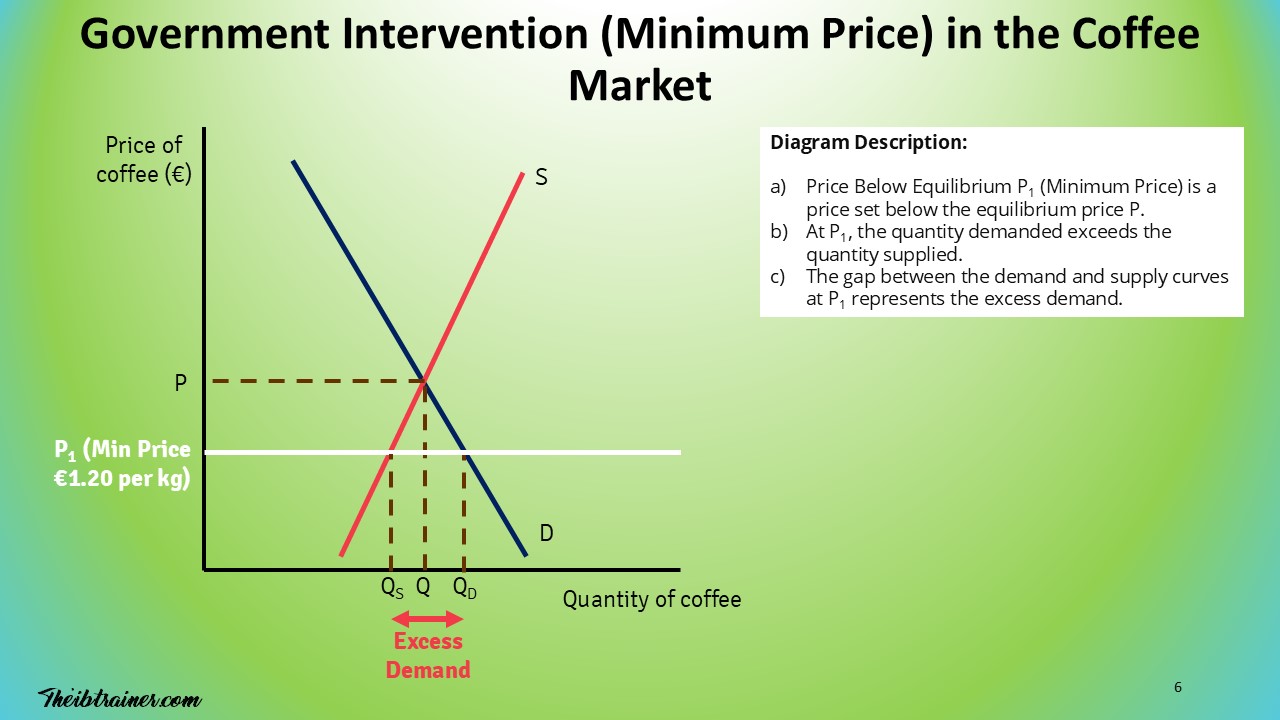
Price floors (minimum prices above equilibrium) - create surpluses and non-price rationing. Minimum wages and agricultural price supports are the standard examples.
Indirect taxes - shift the supply curve leftward; tax incidence is split between consumers and producers according to relative elasticities
Subsidies - shift the supply curve rightward; reduce consumer price and increase quantity toward the social optimum for goods with positive externalities
Direct provision - governments provide public goods and merit goods directly where markets fail to supply them adequately
IB Economics Price Ceilings and Price Floors - Full Guide →
IB Economics Subsidies - Full Guide →
IB Economics Government Intervention - Full Guide →
Unit 9 - Externalities and Common Pool Resources
Market failure occurs when free markets fail to achieve allocative efficiency. Externalities are one of the key concepts you need to learn from the IB Economics microeconomics module.
Negative externalities - costs imposed on third parties not involved in the transaction - cause overproduction of goods and services with reference to the social optimum. Pollution, congestion, and second-hand smoke are standard examples. The market produces where MPC = MPB but the social optimum is where MSC = MSB - the disparity creates a welfare loss.
Positive externalities - benefits to third parties - cause underproduction. Education, vaccination, and R&D spill-overs produce social benefits beyond those captured by buyers and sellers, leading to under-investment with reference to the social optimum.
Common pool resources - rival but non-excludable - face the tragedy of the commons: without regulation or property rights, individually rational decisions lead to collective over-exploitation. Ocean fisheries, groundwater aquifers, and common grazing land are classic examples. Solutions include quotas, property rights assignment, and community management.
Policy responses to externalities span market-based tools (Pigouvian taxes, subsidies, tradeable permits) and regulation (standards, bans, licensing). The EU Emissions Trading System - covering over 40% of EU greenhouse gas emissions with a carbon price above €60 per tonne - is the most commonly examined real-world application.
IB Economics Market Failure - Full Guide →
IB Economics Government Responses to Market Failure - Full Guide →
Unit 10 - Public Goods
Pure public goods are both non-rival (one person's consumption does not reduce availability to others) and non-excludable (it is impossible to prevent non-payers from consuming). These two characteristics together create the free rider problem - individuals have no incentive to pay voluntarily, so private markets underprovide or fail to provide public goods at all.
National defence, street lighting, flood protection, and public fireworks are standard examples. Government provision funded through taxation solves the free rider problem. However, determining the optimal quantity of public goods requires estimating aggregate willingness to pay - a significant information problem.
Quasi-public goods (impure public goods) have one characteristic but not both - roads are non-excludable but rival at peak times; cable TV is non-rival but excludable. The appropriate policy response depends on which characteristic generates the market failure.
IB Economics Market Failure - Full Guide →
Unit 11 - Asymmetric Information (HL only)
Asymmetric information arises when one party to a transaction has more information than the other, creating two market failures:
Adverse selection - a pre-transaction problem. When sellers know more about quality than buyers (used cars, insurance applicants), the market equilibrium is distorted: only low-quality goods trade because buyers discount all goods to reflect the risk of low quality (Akerlof's lemons model). Markets may thin or collapse entirely.
Moral hazard - a post-transaction problem. When one party's actions cannot be observed (insured drivers taking more risks, employees shirking when not monitored), the information gap changes behaviour in ways that reduce efficiency.
Solutions include mandatory disclosure requirements, quality standards and certification, signalling (warranties, education credentials, brand investment), and screening (application questionnaires, probation periods, no-claims discounts).
IB Economics Asymmetric Information - Full Guide →
Unit 12 - Market Power (HL only)
Monopoly - a single firm supplying the entire market, protected by barriers to entry - is the most extreme version of market power. The monopolist maximises profit at MC = MR, producing below the competitive output at a price above marginal cost. The result is allocative inefficiency (P > MC), a welfare transfer from consumers to producers, and deadweight welfare loss.
Barriers to entry that create and sustain monopoly include economies of scale (natural monopoly), patents and intellectual property, control of key resources, and government licences. Dynamic efficiency - the counter-argument - holds that monopoly supernormal profits fund R&D investment and incentivise innovation.
Government responses include competition policy (antitrust law, merger control), price regulation (for natural monopolies), and nationalisation.
IB Economics Monopoly - Theory and Diagrams →
IB Economics Monopoly Regulation and Competition Policy →
IB Economics Market Power - Full Guide →
Unit 13 - Market's Inability to Achieve Equity (HL only)
Markets allocate resources efficiently but distribute the resulting output according to factor ownership and market power - not according to need or fairness. Income and wealth inequality has increased in most advanced economies since the 1980s. The Lorenz curve and Gini coefficient measure the distribution of income; the HDI captures broader welfare and considers multiple factors beyond income.
Causes of market-generated inequality: differences in human capital (education, skills), inherited wealth, market power and rent-seeking, technological change favouring high-skilled workers, and discrimination. High inequality has economic costs - the IMF estimates that high inequality reduces growth sustainability - alongside the social costs.
Redistributive policy tools: progressive taxation, transfer payments, public provision of education and healthcare, minimum wages, and wealth taxes. These involve genuine equity-efficiency trade-offs, though evidence suggests moderate redistribution has minimal efficiency costs while extreme inequality itself reduces efficiency.
IB Economics Inequality - Full Guide →
IB Economics Poverty - Full Guide →
The Nine Key Concepts in Microeconomics
Scarcity and choice - every market interaction reflects scarcity. The price mechanism rations scarce goods among competing wants, allocating them to those with highest willingness and ability to pay.
Efficiency - microeconomics defines allocative efficiency as P = MC - the price consumers pay equals the cost of the last unit produced. Market failures produce P ≠ MC, creating welfare losses. Government intervention aims to restore efficiency but risks government failure.
Equity - markets achieve efficiency but not necessarily equity. The distribution of market outcomes depends on initial factor endowments. HL students evaluate the tension between efficient markets and equitable outcomes directly.
Sustainability - negative externalities (pollution, resource depletion) threaten environmental sustainability. Common pool resource over-exploitation illustrates how individually rational decisions produce collectively unsustainable outcomes.
Intervention - the central normative question in microeconomics: when should governments intervene in markets, and which tools are most effective? Every unit connects to this question.
Economic well-being - market failures reduce aggregate well-being below potential. Deadweight loss triangles on welfare diagrams directly measure the welfare cost of market failure or distorting intervention.
IB Economics - Syllabus and Programme Full Guide →
Key Microeconomics Diagrams
Every diagram below is directly examined in IB Economics Paper 1 and IB Economics Paper 2:
Introduction to Economics (Section 1.1)
Production Possibilities Curve (PPC) showing:
Choice and opportunity cost
Unemployment of resources
Actual growth vs growth in production possibilities
PPC with increasing vs constant opportunity cost
Circular flow of income model with leakages and injections
Demand and Supply (Sections 2.1-2.3)
Downward sloping demand curve
Movements along vs shifts of demand curve
Upward sloping supply curve
Movements along vs shifts of supply curve
Market equilibrium and changes in equilibrium
Consumer surplus and producer surplus (maximized at competitive equilibrium)
Elasticities (Sections 2.5-2.6)
Price Elasticity of Demand:
Relatively elastic and inelastic demand curves
Constant PED: perfectly elastic, perfectly inelastic, unitary PED
PED along straight-line demand curve
Revenue changes with price changes (elastic vs inelastic demand)
Income elastic, income inelastic, and inferior goods on Engel curve
Price Elasticity of Supply:
Relatively elastic and inelastic supply curves
Constant PES: perfectly elastic, perfectly inelastic, unitary PES
Government Intervention (Section 2.7)
Effects on markets and stakeholders:
Price ceiling (maximum price)
Price floor (minimum price)
Indirect tax
Subsidy
Market Failure - Externalities (Section 2.8)
Allocative efficiency
Negative externalities of production and consumption
Positive externalities of production and consumption
Government responses:
Indirect (Pigouvian) taxes
Carbon taxes on polluting industries
Subsidies
Legislation and regulation
Education
Market Power (Section 2.11) - HL ONLY
Perfect Competition:
Perfectly competitive firm as price taker (P = D = AR = MR)
Perfectly competitive firm showing abnormal profit, normal profit, and losses
Equilibrium showing allocative efficiency (P = MC or MB = MC) and maximum social surplus
Monopoly:
Monopoly market power (AR > MC)
Monopolist firm showing abnormal profit, normal profit, and losses
Price/quantity comparison: monopoly vs perfect competition
Welfare loss under monopoly
Natural monopoly
Collusive oligopoly acting as monopoly
Monopolistic Competition:
Monopolistically competitive firm showing abnormal profit, normal profit, and losses
Monopolistic competition with more elastic demand curve vs monopoly
Equity (Section 2.12)
Circular flow model illustrating why free markets result in inequalities
IB Economics Diagrams Course - Full Guide →
IB Economics Diagrams Course
Every microeconomics diagram - supply and demand, welfare analysis, externalities, price controls, taxes, subsidies, and monopoly - fully labelled with video walkthroughs and exam application guidance.
✔ All microeconomics SL and HL diagrams
✔ Video for every diagram
✔ Exam application for Papers 1 and 2
Frequently Asked Questions: IB Economics Microeconomics
What does IB Economics microeconomics cover? Microeconomics covers thirteen units: demand; supply; competitive market equilibrium; critique of maximising behaviour (HL); price elasticity of demand; income elasticity of demand; price elasticity of supply; government intervention (price controls, taxes, subsidies); externalities and common pool resources; public goods; asymmetric information (HL); market power/monopoly (HL); and the market's inability to achieve equity (HL). It is the fundamental analytical module for the entire IB Economics course.
What is the difference between a movement along and a shift of the demand curve? A movement along the demand curve occurs when the price of the good itself changes - quantity demanded rises or falls along the existing curve. A shift of the demand curve occurs when a non-price determinant changes - income, prices of substitutes or complements, consumer preferences, expectations, or the number of consumers. A rightward shift means more is demanded at every price; a leftward shift means less. This distinction is one of the most commonly tested in IB Economics.
What is market failure in IB Economics microeconomics? Market failure occurs when free markets fail to achieve allocative efficiency - producing either too much or too little relative to the social optimum. The main causes in microeconomics are: negative externalities (overproduction because private costs understate social costs); positive externalities (underproduction because private benefits understate social benefits); public goods (under-provision due to the free rider problem); common pool resource depletion; and asymmetric information (HL). Each type requires different policy responses.
Which microeconomics topics are HL only? Four topics are assessed at HL only: Unit 4 (critique of maximising behaviour - behavioural economics); Unit 11 (asymmetric information - adverse selection and moral hazard); Unit 12 (market power - monopoly theory, barriers to entry, welfare loss, regulation); and Unit 13 (the market's inability to achieve equity - income and wealth inequality, redistribution). These topics appear in Paper 1 HL essays and Paper 3.
How does elasticity connect to government intervention in microeconomics? Elasticity determines the effectiveness and incidence of government intervention. Tax incidence - how the burden of an indirect tax is split between consumers and producers - depends on relative elasticities: inelastic demand means consumers bear more of the tax. Subsidy effectiveness - how much of a subsidy reaches consumers as lower prices - also depends on elasticity. More broadly, whether a Pigouvian tax produces a meaningful reduction in a negative externality depends on the price elasticity of demand for the taxed good.
This hub is updated regularly to reflect current IB Economics microeconomics syllabus requirements.
Explore Topics:
IB Economics your IB Economics daily guide
IB Economics Diagrams Check this resource for All the IB Economics microeconomics diagrams with explanations
IB Economics Activity book More IB Economics microeconomics exam practice, activities, model answers and IB Economics Marking schemes, all units all modules covered
IB Economics Required Diagrams SL HL This is a list of the required diagrams for IB Economics
IB Economics Calculations SL HL This is a list of the different calculations required for IB Economics
IB economics Calculations Book 25 units of calculations exercises for SL and HL, find your microeconomics calculations here with IB model answers, and IB marking schemes
IB Economics Paper 1 all the information you need to understand your paper 1 exam and to practice microeconomics questions
IB Economics Paper 2 all the information you need to understand your paper 2 exam and to practice microeconomics questions
IB Economics Paper 3 HL for paper 3 practice and microeconomics questions
Read Next: IB Economics The Global Economy
© Theibtrainer.com 2012-2026. All rights reserved.
Legal
Have a Tip? Send us a tip using our anonymous form