
IB Economics Unemployment Uncovered
IB Econ students! Get the lowdown on unemployment: types, measurement woes & real-world examples (UK/global). Ace your exams! #IBEconomics #Unemployment
IB ECONOMICS HLIB ECONOMICS SLIB ECONOMICS MACROECONOMICSIB ECONOMICS
Lawrence Robert
4/24/202513 min read


Why Getting a Job Is Harder Than It Looks: The Economics of Unemployment
Target Question:
What is unemployment in economics and what are the different types and causes of unemployment?
The Class of 2024's Reality
Let's imagine you've just graduated (you will sooner than you think). Three/four years of essays, all-nighters, and surviving on beans on toast. You've got your degree, updated your LinkedIn profile, and you're ready to take on the world.
As you start job hunting you realise that...
In 2024, there were reportedly 1.2 million UK graduates competing for just under 17,000 entry-level positions. Do that maths. That's roughly 70 applicants for every single job. And that's before we factor in AI tools now automating entry-level tasks that used to be the career launchpad for graduates everywhere.
But this has nothing to do with bad luck or lazy millennials (or Gen Z, depending on who you ask). It's about labour markets, mismatches, and one of the most important macroeconomic objectives every government in the world is supposed to be managing: low unemployment.
Unemployment unlike inflation or exchange rates, isn't an abstract or any number for that matter. It's someone's dad losing his job in a factory that decided to automate production. It's a student unable to get their foot in the door. It's a single mum working part-time in a supermarket when she's actually a qualified teacher.
Let's explain it.
Internal Assessment (IA) Guide – Free Download
Step-by-step support on topic selection, structure, evaluation, and most common IB Economics IA mistakes.
Understanding key IB Economics Internal Assessment concepts
Applying and explaining them in real-world IB Economics contexts
Building IB Economics IA confidence without drowning in dry theory and explanations.
Download the IA guide now for free and boost your IB Economics grades and confidence
What Is Employment?
Employment refers to the use of labour resources in the production process. Simple. When labour is being used productively - when people are working and producing - the economy is generating output, income, and tax revenue. Everyone benefits (in theory).
A clear macroeconomic objective for governments is for everyone who is willing and able to work to be able to find employment. Note those words carefully: willing and able. Not everyone who is part of a population group. Not students or pensioners. It only includes those who are capable of work and want to do it.
Unemployment occurs when people who are willing and able to work, and are actively seeking employment, cannot find it. It's not a lifestyle choice. It's the labour market in disequilibrium - where the supply of labour outstrips demand.
IB Economics Definition - Unemployment:
Unemployment occurs when people who are willing and able to work and are actively seeking employment cannot find it - reflecting a state of disequilibrium in the labour market where labour supply exceeds labour demand.
And when that happens, the economy pays a heavy price.
Why Does Low Unemployment Matter So Much?
Governments care deeply about unemployment for a whole set of interconnected reasons:
1. It complements economic growth Higher employment means more people earning incomes. More incomes mean more spending. More spending drives aggregate demand. Higher AD typically leads to more output. The virtuous circle of a healthy economy runs through employment.
2. It improves living standards and social wellbeing Work isn't just about money. It provides structure, purpose, direction, social connections, and dignity. Unemployment has well-documented links to mental health struggles, family breakdown, and reduced life satisfaction. Low unemployment makes society healthier.
3. It increases tax revenues A working population pays income tax and spends money (generating VAT and other indirect taxes). This gives the government more to invest in schools, hospitals, and infrastructure - public services everyone relies on.
4. It reduces the welfare bill Fewer unemployed people means less demand for Jobseeker's Allowance, housing benefit, and other social transfers. The government spends less on welfare and has more fiscal headroom.
5. It prevents brain drain This one's important. When skilled workers can't find jobs at home, they leave. Permanently. Doctors, engineers, and graduates head abroad for opportunities. The economy loses talent that took years of education and investment to develop. Low unemployment keeps that talent in the country, where it can drive innovation and productivity.
For access to all IB Economics exam practice questions, model answers, IB Economics complete diagrams together with full explanations, and detailed assessment criteria, explore the Complete IB Economics Course
Measuring Unemployment: The Formula You Must Know
IB Economics Definition - The Unemployment Rate:
The unemployment rate measures the number of officially unemployed people as a percentage of the total labour force (also called the workforce).
Unemployment Rate = (Number of Unemployed People ÷ Labour Force) × 100
The labour force includes everyone in employment (including the self-employed) plus everyone actively seeking work. Crucially, it does not include people who have given up looking, students, or those who have retired.
IB Economics Example: A country with a workforce of 55 million, of which 2 million are actively seeking employment but unable to find jobs:
Unemployment Rate = (2 ÷ 57) × 100 = 3.51%
(Note: the labour force is 55 million employed + 2 million unemployed = 57 million total)
The UK right now? Not great, actually. The UK unemployment rate rose to 5.2% in the three months to December 2025 - its highest level since February 2021. That's 1.87 million people willing and able to work but unable to find it. And youth unemployment (16–24 year olds)? A discouraging 16% as of early 2026 - that's roughly 1 in 6 young people in the labour force unable to find work.
The Labour Market in Equilibrium
Think of the labour market like any other market - except instead of buying bananas or trainers, firms are buying labour. Workers supply it; firms demand it.
IB Economics Key Concept - Labour Market Equilibrium:
Labour market equilibrium exists when the demand for labour (DL) equals the supply of labour (SL). At the equilibrium real wage rate (WE), everyone who is willing and able to work at that wage can find employment. The market clears.
Source visit: IB Economics Diagrams
But real labour markets are not so simple, and they don't always clear. Which brings us to one of the most debated topics in economics.
Real Wage Unemployment: The Minimum Wage Debate
IB Economics Definition - Real Wage Unemployment:
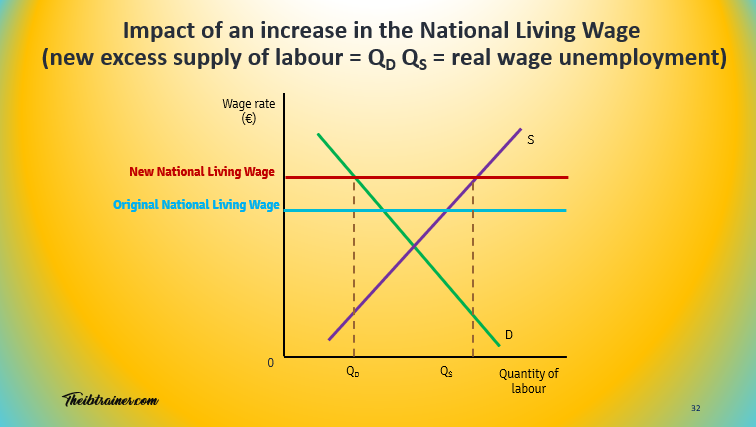
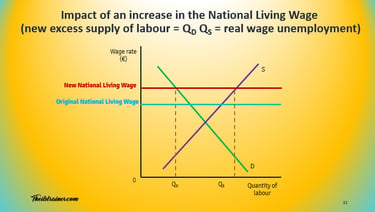
Real wage unemployment occurs when wages are set above the market equilibrium - for example, by a minimum wage - causing firms to reduce labour demand and creating an excess supply of labour.
Here's the diagram:
At equilibrium wage WE, 15 million people are employed (where DL = SL).
The government introduces a minimum wage (WM) above WE.
Firms face higher labour costs, so they reduce their demand for labour - DL falls from 15 million to 10 million.
But the higher wage attracts more workers to offer their labour - SL rises from 15 million to 20 million.
The result? An excess supply of labour of 10 million people (20 million wanting jobs, only 10 million available). Area F on the diagram represents this unemployment pool.
Source visit: IB Economics Diagrams
On the diagram:
Area A = employer surplus (firms still willing to pay above WM)
Area B+C = employee surplus (workers receiving WM even though some would accept less)
Area D+E = welfare loss to society - the market inefficiency created by the price floor
This is exactly why the minimum wage debate is so fierce. In April 2025, the UK's National Minimum Wage for 18–20-year-olds increased by 16.3% in a single year - a considerable jump. Businesses have pointed to this as a direct reason for reduced hiring, particularly of young workers. The youth unemployment rate rising to 16% hasn't happened in isolation.
The Monopsony Problem: When One Employer Calls All the Shots
Here's a concept that often my students have difficulties with and that can be key, depending on the question you get, for understanding top-grade IB Economics answers: monopsony.
IB Economics Definition - Monopsony:
A monopsony is a labour market with a single dominant employer, giving it the power to set wages below the competitive equilibrium - because workers have limited alternative employment options.
Think Amazon in certain warehouse towns. Think a professional football club in a small city. Or a large hospital in a rural area where it's the only major employer. Workers there don't have a meaningful choice - it's work for that employer or don't work.
In a monopsony:
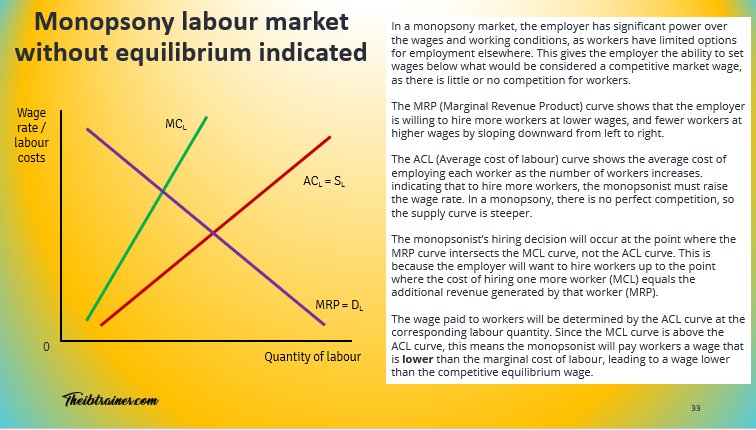
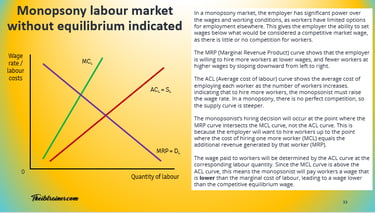
The MRP curve (Marginal Revenue Product - how much revenue each extra worker generates) slopes downward, as usual. The employer will hire more workers only at lower wages.
The ACL curve (Average Cost of Labour) shows the average wage paid per worker.
Crucially, the MCL curve (Marginal Cost of Labour) lies above the ACL curve - because hiring one more worker forces the monopsonist to raise wages for all existing workers too.
The monopsonist hires where MRP = MCL - not where MRP = ACL (which would be the competitive outcome).
The wage paid is read from the ACL curve at that quantity - and it's below the competitive market wage.
Source visit: IB Economics Diagrams
So in general, workers are paid less than they're actually worth to the firm. That's the monopsony exploitation outcome, and it's a key reason minimum wages can sometimes increase employment in monopsony markets - by pushing wages towards the competitive level rather than causing the excess unemployment they'd create in competitive markets.
Every episode of Pint-Sized links back to what matters most for your IB Economics course:
Understanding key IB Economics concepts
Applying them in real-world IB Economics contexts
Building IB Economics course confidence without drowning in dry theory.
Subscribe for free to exclusive episodes designed to boost your IB Economics grades and confidence
Why Is Unemployment Hard to Measure Accurately?
In reality the official unemployment rate in most countries is almost certainly an undercount. And IB Economics examiners reward students who can explain why.
1. There Is No Universal Definition
Different countries define unemployment differently. The retirement age varies - 65 in France, Finland, and Switzerland; 60 in China, Russia, and South Africa. The ILO sets the minimum working age at 15, but interpretations vary. Comparisons across countries do not really reflect reality.
2. Hidden Unemployment
Some people are technically unemployed but don't appear in the official figures because they've stopped looking. These are sometimes called "discouraged workers." They want a job, they need a job - but after too many rejections, or unfair offers they've given up applying. They're invisible in the data, but you see them everyday walking around your neighbourhood.
IB Economics Definition - Hidden unemployment:
Hidden unemployment refers to people who are effectively unemployed but excluded from official statistics because they have stopped actively seeking work, typically after repeated unsuccessful job applications.
3. Voluntary Unemployment
Some people choose not to work - parents who opt out of employment to raise children, people who take early retirement, those living off savings or investments. They're classified as economically inactive, not unemployed. They don't distort the figures, but they do remind us that "not working" means very different things for different people.
4. Underemployment
Underemployment refers to people who have a job but are not utilising their skills, experience, or preferred hours. The teacher driving an Uber at weekends. The software engineer on a zero-hours contract doing part-time data entry. They show up in the employment statistics as "employed" - but they represent a massive waste of human capital.
IB Economics Definition - Underemployment:
Underemployment describes workers who are employed but unable to fully utilise their skills or preferred working hours - representing an underutilisation of the economy's human capital.
5. Regional and Demographic Disparities
One national unemployment rate hides enormous variation. In early 2026, London's unemployment rate hit 7.5% - compared to the national average of around 5.2%. Young Londoners are being hit the hardest. And as we noted earlier, the youth unemployment rate nationally is already at 16%, compared to just 3.6% for those aged over 25. A single headline number hides all this complexity.
IB Economics - Syllabus and Programme Full Guide →
The Four Types of Unemployment
Your IB Economics examiners will expect you to identify and explain the cause of unemployment. Here are the four key types:
Cyclical (Demand-Deficient) Unemployment
The most severe and far-reaching type. This happens when there's a recession in the business cycle - a significant fall in aggregate demand across the economy. Firms sell less, so they produce less, so they need fewer workers. Layoffs spread across industries. It's called "demand-deficient" because the fundamental problem is that there simply isn't enough spending in the economy to sustain full employment.
IB Economics Definition - Cyclical unemployment:
Cyclical (demand-deficient) unemployment is caused by a fall in aggregate demand during a recession, reducing the demand for workers across all industries.
This is the type that devastated economies in 2008-09 and again in 2020. And it's the type Keynesian economists most want governments to tackle with fiscal stimulus.
Structural Unemployment
The most obstinate type. Structural unemployment results from a long-term, permanent decline in demand for labour in a specific industry - driven by technology, changing consumer preferences, or global competition.
Think about coal miners in South Wales. Or steelworkers in Sheffield. Or - right now - junior software developers being undercut by AI coding tools. The jobs don't just disappear temporarily; they're gone, restructured, automated. Workers have skills that no longer match what the labour market needs. The skills mismatch is the defining feature.
IB Economics Definition - Structural unemployment:
Structural unemployment results from a long-term decline in labour demand within a specific industry, creating a skills mismatch between available workers and available jobs - increasingly driven by automation and AI.
Today's version of structural unemployment is being written in real time right now. Globally, youth unemployment climbed to 12.4% in 2025, with the ILO explicitly warning that AI and automation could make things worse - particularly for educated young people in high-income countries seeking their first job in high-skill occupations. Goldman Sachs found that unemployment among 20-to-30-year-olds in tech-exposed occupations rose by almost 3 percentage points since the start of 2025. Entry-level white-collar jobs - the traditional first step on the career ladder - are being automated out of existence. That's structural unemployment for you at the beginning of the 21st-century.
This is directly relevant to you, reading this now. Something for you to think about.
Seasonal Unemployment
IB Economics Definition - Seasonal unemployment:
Predictable and cyclical, caused by regular fluctuations in demand for specific goods and services throughout the year.
Ski instructors are unemployed in the summer months. Construction workers slow down in the winter months because of harsh weather conditions. School bus drivers and teaching assistants face reduced hours during the holidays. Seasonal unemployment is part of the rhythm of certain industries - predictable but uncomfortable for workers.
Frictional Unemployment
The mildest type, and arguably inevitable in any healthy economy. Frictional unemployment occurs when people are in between jobs - they've left one position and haven't yet started the next. It takes time to search for the right job, attend interviews, and work through notice periods.
IB Economics Definition - Frictional unemployment:
Frictional unemployment refers to short-term unemployment arising from the time delay between leaving one job and starting another - considered an unavoidable feature of a functioning labour market.
A small amount of frictional unemployment actually signals a functioning labour market - people are moving to better opportunities, upskilling, changing careers. The bigger the labour market imperfections (lack of information about vacancies, slow hiring processes, geographic immobility), the longer this in-between period tends to be.
IB Economics Diagrams Programme, What's included:
200+ exam-ready diagrams covering the entire IB Economics syllabus
Video for every diagram showing you exactly how each model looks
Image version perfect for modelling diagrams in you essays, presentations, and your IA
Detailed written explanations of the IB Economics theory behind each diagram
Both SL and HL IB Economics diagrams clearly labelled and organised by topic
Real IB Economics exam application showing how to use diagrams effectively in Paper 1 and Paper 2
IB Economics Summary
The official unemployment rate is a starting point - not a conclusive answer. It misses the discouraged, the underemployed, the structurally trapped. It averages out enormous geographic and demographic differences. And it says nothing about the quality of jobs - whether people are in secure, fairly paid, dignified work, or whether they're on zero-hours contracts working two part-time jobs just to make ends meet.
In early 2026, the UK has 1.87 million officially unemployed people, a youth unemployment rate of 16%, and pay-rolled employee numbers falling - down 96,000 between January 2025 and January 2026. At the same time, AI is restructuring the entry-level job market faster than educational institutions can retrain people for new roles. The structural unemployment challenge of the next decade may be unlike anything we've seen since the deindustrialisation of the 1980s.
Low unemployment matters because work matters - not just as an economic input, but as a source of identity, purpose, community, and dignity. And when labour markets fail to provide it, the consequences ripple far beyond the employment statistics.
That's why governments care. That's why economists study it. And that's why you should understand it - especially if you're one of the 1.2 million graduates heading into this labour market in the next five to ten years.
Frequently Asked Questions: Unemployment (IB Economics)
Q: What is the definition of unemployment in economics? Unemployment occurs when people who are willing and able to work, and are actively seeking employment, cannot find it. It reflects a state of disequilibrium in the labour market where the supply of labour exceeds the demand for labour.
Q: How is the unemployment rate calculated? The unemployment rate is calculated using the formula: Unemployment Rate = (Number of Unemployed People ÷ Labour Force) × 100. The labour force includes all those in employment plus all those actively seeking work.
Q: What are the four main types of unemployment? The four main types are: (1) cyclical (demand-deficient) unemployment, caused by a recession and falling aggregate demand; (2) structural unemployment, caused by long-term changes in an industry often due to technology or shifts in demand; (3) seasonal unemployment, caused by regular fluctuations in demand for labour throughout the year; and (4) frictional unemployment, caused by the time delay between leaving one job and starting another.
Q: What is real wage unemployment? Real wage unemployment occurs when wages are held above the market equilibrium level - typically by a minimum wage - causing the quantity of labour demanded to fall below the quantity supplied. This creates an excess supply of labour (unemployment) in the market.
Q: Why is unemployment difficult to measure accurately? Official unemployment statistics often undercount true joblessness because they exclude hidden unemployment (discouraged workers who have stopped looking), voluntary unemployment (the economically inactive), and underemployment (those in jobs that don't match their skills or desired hours). They also present a national average that disguises significant regional and demographic disparities.
Stay well
More information about:
IB Economics your IB Economics daily guide
IB Economics Macroeconomics unemployment is directly related to clear macro objectives such as inflation, and economic growth
IB Economics Diagrams Check Unit 18 for All Unemployment diagrams with explanations
IB Economics Economic Growth Strategies ( to explore the relationship between unemployment and growth)
Expansionary Demand-Side Policies (IB Economics Fiscal policy & IB Economics Monetary policy): Used to combat cyclical unemployment by boosting Aggregate Demand. Cutting interest rates or increasing government spending stimulates consumer consumption and business investment.
IB Economics Activity book Module 3 Macroeconomics Unit 3.11 for unemployment exam practice, activities, model answers and IB Marking schemes
IB Economics Supply-Side Policies (to understand retraining and structural unemployment solutions)
IB economics Calculations Book make sure you check unit 18 for unemployment calculations exercises, IB model answers, and IB marking schemes
Income Inequality in IB Economics Inequality (unemployment and income distribution)
IB Economics Phillips Curve - IB Economics heavily evaluates the relationship between unemployment and inflation using the Phillips Curve - Short-Run Phillips Curve (SRPC): Shows an inverse relationship between unemployment and inflation. When unemployment is low, inflation is typically high, and vice-versa. Long-Run Phillips Curve (LRPC): Vertical at the Natural Rate of Unemployment, demonstrating that there is no trade-off between unemployment and inflation in the long run.
Read Next: IB Economics Inflation & CPI Explained
© Theibtrainer.com 2012-2026. All rights reserved.
Legal
Have a Tip? Send us a tip using our anonymous form