
IB Exchange Rate
Target Question:
What are exchange rates in IB Economics and what causes them to change?
Full activity practice breakdown, exam practice, model answers and evaluation tools are available exclusively in the IB Economics Activity Book.


IB Economics: Exchange Rates - Complete Hub
Everything you need to understand exchange rates, including diagrams, and critical and evaluation skills for your IB Economics course - systems, determinants, effects on trade and inflation, and key concepts including the Marshall-Lerner condition and J-curve.
What Is an Exchange Rate?
An exchange rate is the price of one currency expressed in terms of another. It determines how much of one currency must be given up to obtain a unit of another - for example, how many US dollars are needed to buy one British pound, or how many Japanese yen equal one euro.
Exchange rates are relevant because they affect the relative prices of exports and imports, the cost of foreign borrowing, the real value of remittances, and the effectiveness of monetary and fiscal policy in open economies.
IB Economics definition:
An exchange rate is the price at which one currency exchanges for another on the foreign exchange market. It is determined by the supply of and demand for currencies and can be influenced by interest rates, inflation differentials, trade flows, speculation, and government intervention.
Nominal vs real exchange rates:
The nominal exchange rate is the market price of one currency in terms of another. The real exchange rate adjusts for relative price levels between countries - it measures actual purchasing power and international competitiveness more accurately than the nominal rate alone.
The Three Exchange Rate Systems
IB Economics examines three exchange rate systems, each with distinct mechanisms, advantages, and limitations.
1. Floating Exchange Rates
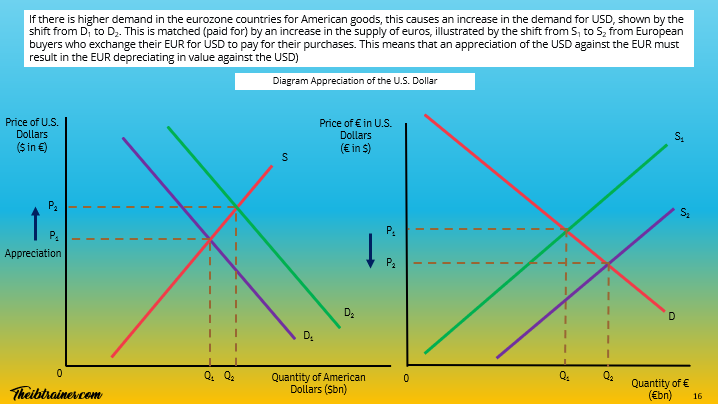
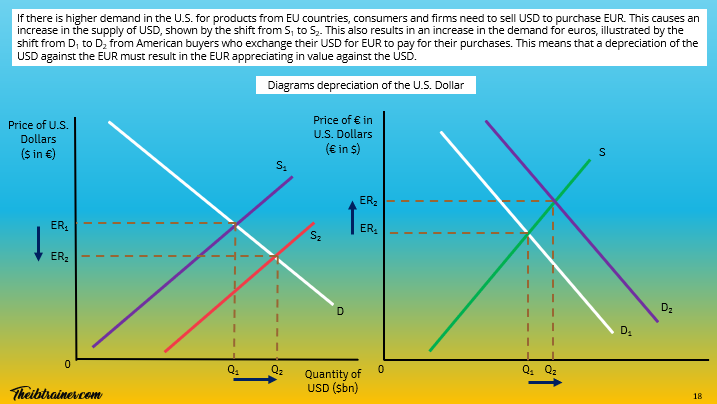
Under a freely floating system, the exchange rate is determined entirely by supply and demand in the foreign exchange market with no government intervention. If demand for a currency rises (because foreigners want to buy the country's exports or invest there), the currency appreciates - its price in terms of other currencies rises. If supply rises or demand falls, the currency depreciates.
Advantages: automatic adjustment to economic conditions; no need to hold large foreign currency reserves; monetary policy remains free to target domestic objectives.
Disadvantages: exchange rate volatility creates uncertainty for businesses engaged in international trade; speculation can cause misalignment from economic fundamentals; imported inflation from depreciation can be destabilising.
2. Fixed Exchange Rates
Under a fixed (or pegged) system, the government commits to maintaining the exchange rate at a specific value against another currency or basket of currencies. The central bank intervenes in the foreign exchange market - buying or selling its own currency - to defend the peg.
If the currency faces downward pressure (demand falls below supply at the pegged rate), the central bank buys its own currency using foreign reserves. If upward pressure exists, it sells its own currency, accumulating reserves.
Advantages: exchange rate certainty reduces transaction costs and supports international trade and investment; anchor for inflation expectations.
Disadvantages: requires large foreign currency reserves; monetary policy loses independence (interest rates must serve the exchange rate target rather than domestic objectives); the peg may become misaligned with economic fundamentals, leading to speculative attack.
Speculative attacks - if currency traders believe a fixed rate is unsustainable, they sell the currency in large volumes, forcing the central bank to deplete reserves defending it. The 1992 ERM crisis - when George Soros' Quantum Fund forced the UK to withdraw sterling from the Exchange Rate Mechanism - is a well-known IB Economics example.
3. Managed Float (Dirty Float)
Most real-world exchange rate systems sit between freely floating and fully fixed. Under a managed float, the exchange rate is primarily market-determined but the central bank intervenes periodically to smooth excessive volatility or prevent misalignment. China's managed yuan system is the most commonly examined example in IB Economics.
What Determines Exchange Rates?
Four main factors drive exchange rate movements under a floating system:
Interest rate differentials - the primary short-run driver. Higher interest rates attract foreign capital seeking better returns, increasing demand for the currency and causing appreciation. This is why central bank decisions are among the most closely watched events in currency markets. The US dollar's strength in 2024-2025 reflected the Federal Reserve maintaining higher interest rates than most other major central banks.
Relative inflation rates - over the long run, currencies of high-inflation countries tend to depreciate. Higher domestic inflation makes exports less price-competitive (reducing currency demand) and imports relatively cheaper (increasing currency supply). This is the basis of Purchasing Power Parity (PPP) theory.
Trade flows and current account balance - a country running a persistent trade surplus (exports exceed imports) experiences sustained demand for its currency from foreign buyers, supporting appreciation. A trade deficit implies the reverse.
Speculation and market sentiment - short-term capital flows driven by expectations, risk appetite, and market psychology can move exchange rates significantly and rapidly, sometimes independently of economic fundamentals.
Purchasing Power Parity (PPP)
Purchasing Power Parity is the theory that exchange rates should adjust in the long run so that identical goods cost the same in different countries when expressed in a common currency. If a basket of goods costs £100 in the UK and $130 in the US, PPP implies an exchange rate of £1 = $1.30.
The Big Mac Index - published by The Economist - uses the price of a McDonald's Big Mac as a simplified PPP measure, identifying currencies as overvalued or undervalued relative to the US dollar. It is widely used in IB Economics as an accessible illustration of PPP theory.
Limitations of PPP: it ignores non-tradeable goods (haircuts, rent), trade barriers, quality differences, and the fact that short-run exchange rates are heavily influenced by capital flows rather than goods prices.
Effects of Exchange Rate Changes
Effect on Trade: The Marshall-Lerner Condition
Currency depreciation makes exports cheaper for foreign buyers and imports more expensive for domestic consumers - in theory improving the trade balance. However, whether it actually does depends on the Marshall-Lerner condition: the trade balance improves following depreciation only if the sum of the price elasticities of demand for exports and imports exceeds one (|PED exports| + |PED imports| > 1).
If demand for exports and imports is price inelastic (as is typically the case in the short run - contracts exist, consumers have not yet adjusted behaviour), depreciation may initially worsen the trade balance before improving it. This is the J-curve effect.
The J-Curve Effect
Following depreciation, the trade balance typically deteriorates in the short run before improving in the medium to long run - tracing a J-shape over time. In the short run, import costs rise immediately (import contracts are denominated in foreign currency) while export volumes take time to respond. As time goes by, exporters gain competitiveness and import substitution occurs, eventually improving the trade balance - provided the Marshall-Lerner condition is met in the long run.
Effect on Inflation
Depreciation raises import prices directly, increasing costs for firms using imported inputs and raising consumer prices for imported goods. This is called imported inflation or exchange rate pass-through. For economies heavily dependent on imports (food, energy, intermediate goods), exchange rate depreciation can be significantly inflationary - creating a dilemma for central banks trying to balance growth support with price stability.
Effect on Economic Growth
Depreciation can boost growth by increasing net exports (if the Marshall-Lerner condition holds), but the inflationary effect may balance this if it triggers central banks to rise interest rates. Appreciation reduces imported inflation but dampens export competitiveness and can slow growth.
Real-World Applications
US dollar and euro (2024-2025) - the US dollar gained approximately 6.4% against the euro in 2024, reaching its strongest level in over two years. This reflected the Federal Reserve maintaining higher interest rates than the European Central Bank - a typical example of interest rate differentials driving capital flows and exchange rate movements.
Bank of Japan (2024) - Japan raised interest rates for the first time in 17 years in mid-2024, briefly strengthening the yen. This case illustrates how prolonged near-zero interest rates suppress currency value, and how even a small rate change can trigger significant exchange rate movements when markets have priced in a policy for years.
China's managed yuan - China maintains a managed float, setting a daily reference rate and allowing the yuan to trade within a band. This gives authorities control over export competitiveness while avoiding the full constraints of a fixed peg - a practical example of the managed float system in operation.
IB Economics - Syllabus and Programme Full Guide →
Exchange Rates in the IB Economics Exam
Exchange rates appear primarily within the Global economy module and are examined across all papers:
IB Economics Paper 1 - essay questions ask students to explain exchange rate determination with supply and demand diagrams, evaluate fixed vs floating systems, or analyse the effects of depreciation on the trade balance (Marshall-Lerner and J-curve). The 15-mark question requires genuine evaluation of trade-offs between systems.
IB Economics Paper 2 - data response questions present exchange rate data and ask students to explain movements, assess policy implications, or calculate percentage changes. HL students may be asked to calculate real exchange rates or apply PPP.
IB Economics Paper 3 HL - extended questions may integrate exchange rates with monetary policy, trade balance, development economics, or balance of payments analysis.
Most common exam mistakes: drawing exchange rate diagrams without labelling supply, demand, and the equilibrium exchange rate; confusing appreciation with revaluation (and depreciation with devaluation); applying the Marshall-Lerner condition without acknowledging the J-curve; evaluating only one exchange rate system.
IB Economics Balance of Payments - Full Guide →
IB Economics Monetary Policy - Full Guide →
IB Economics Trade - Full Guide →
IB Economics Diagrams Course
Every exchange rate diagram - floating rate supply and demand, central bank intervention for fixed rates, appreciation and depreciation shifts - fully labelled with video support.
✔ Floating exchange rate supply and demand diagrams
✔ Fixed rate intervention (excess supply and excess demand scenarios)
✔ J-curve diagram
✔ 200+ diagrams covering the full syllabus · Both SL and HL labelled
Frequently Asked Questions: Exchange Rates in IB Economics
What is an exchange rate in IB Economics? An exchange rate is the price of one currency in terms of another, determined by supply and demand in the foreign exchange market. It affects export and import prices, inflation, economic growth, and the effectiveness of monetary policy. IB Economics studies three systems: freely floating (market-determined), fixed (government-pegged), and managed float (primarily market-determined with periodic intervention).
What causes a currency to appreciate or depreciate? A currency appreciates when demand for it rises or supply falls - driven by higher interest rates attracting capital inflows, a trade surplus increasing export revenue, or improved economic confidence. It depreciates when demand falls or supply rises - from lower interest rates, trade deficits, higher inflation reducing competitiveness, or capital outflows. Speculation can amplify all these movements in the short run.
What is the Marshall-Lerner condition? The Marshall-Lerner condition states that currency depreciation will improve the trade balance only if the sum of the price elasticities of demand for exports and imports exceeds one. If demand for both exports and imports is sufficiently price elastic, the volume effects of depreciation outweigh the price effects and the trade balance improves. If demand is inelastic - as is typically the case in the short run - the trade balance may initially worsen.
What is the J-curve effect? The J-curve describes the typical pattern of trade balance adjustment following currency depreciation. In the short run, the trade balance worsens because import costs rise immediately while export and import volumes are slow to adjust. Over time, as buyers respond to changed relative prices, export volumes rise and import substitution occurs, improving the trade balance - tracing a J-shape over time.
What are the main advantages and disadvantages of a fixed exchange rate? A fixed exchange rate provides certainty for international trade and investment, reduces transaction costs, and can anchor inflation expectations. However, it requires large foreign currency reserves to defend, removes monetary policy independence (interest rates must serve the peg rather than domestic objectives), and can become misaligned with economic fundamentals - creating vulnerability to speculative attack if markets doubt the government's ability or willingness to maintain the peg.
This hub is updated regularly to reflect current IB Economics syllabus requirements and international currency developments.
Key Exchange Rates Diagrams
Related Topics:
IB Economics your IB Economics daily guide
IB Economics The Global Economy access Exchange Rates here as well as the rest of the module 4
IB Economics Activity book Module 4 The Global Economy Unit 4.7 for Exchange Rates exam practice, activities, model answers and IB Economics Marking schemes
IB Economics the balance of payments Accounts - revise this topic as it has a direct relationship with exchange rates
IB Economics Diagrams Check Unit 27 for All Exchange Rates diagrams with explanations
IB Economics Fiscal Policy and IB Economics Monetary Policy for discussing central bank intervention and interest rates, both topics directly related to exchange rates
IB Economics Economic growth and IB Economics the business cycle → for discussing economic growth effects of appreciation / depreciation
IB economics Calculations Book make sure you check unit 24 for Exchange Rates calculations exercises, IB model answers, and IB marking schemes
IB Economics Unemployment → for discussing job losses from appreciation
Read Next: IB Economics Monopoly
© Theibtrainer.com 2012-2026. All rights reserved.
Legal
Have a Tip? Send us a tip using our anonymous form