
IB Economics Paper 3 HL
Target Question:
What topics come up in IB Economics Paper 3 HL?
Your ultimate resource for mastering Paper 3 in IB Economics - from calculation techniques to policy response mastery.
If you also need help with the rest of the IB Economics exam papers: IB Economics Paper 1 and Paper 2.
Paper 3 is the make-or-break exam for HL students, yet most struggle with its unique blend of quantitative analysis and IB Economics policy evaluation. This comprehensive hub covers every aspect of Paper 3 you'll encounter, from fundamental calculation techniques and economic formulas to advanced policy response frameworks and real-world applications.
Full theory practice, topic exam questions, IB standard model answers and evaluation tools are available exclusively in the IB Economics Activity Book


IB Economics Paper 3 HL - Complete Preparation Hub
What Is IB Economics Paper 3 HL?
IB Economics Paper 3 is the HL-only examination paper, worth 20% of the final grade. Students answer two compulsory multi-part questions in 1 hour 45 minutes, covering all four syllabus units. A calculator is permitted. The maximum mark is 60.
Each question combines short calculations, diagram questions, and a 10-mark policy recommendation. Paper 3 is the most technically demanding paper in IB Economics - and the one where preparation directly pays off.
What Topics Come Up in Paper 3?
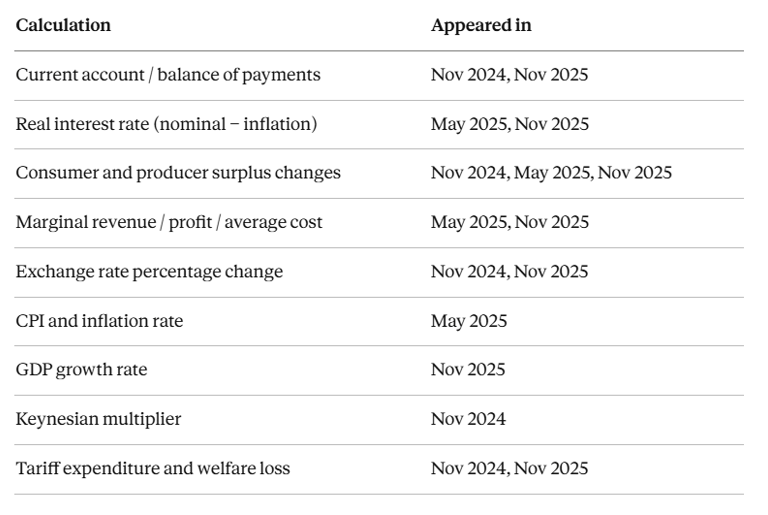
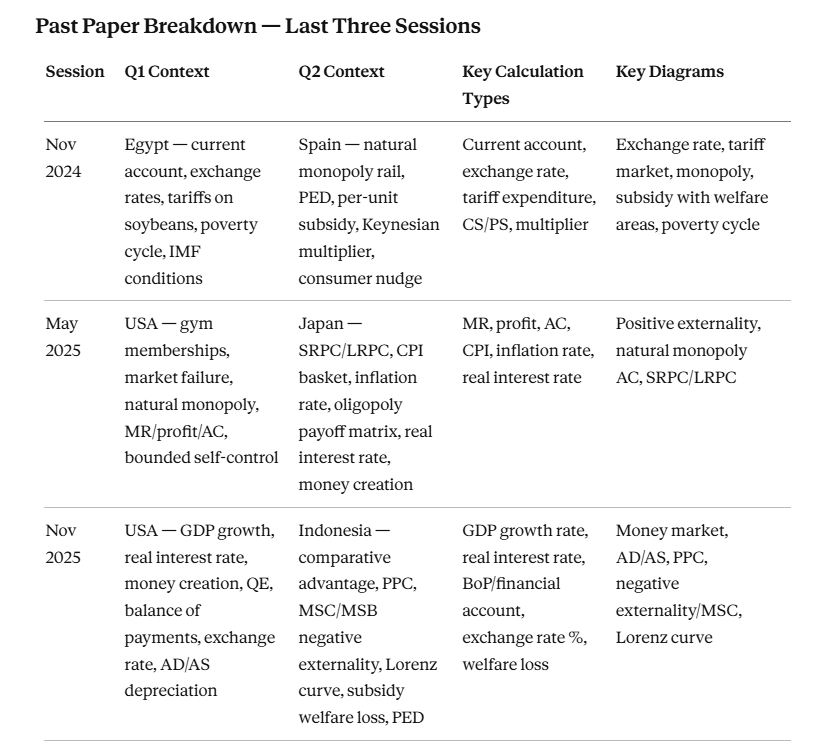
Based on the last three examination sessions (November 2024, May 2025, November 2025), Paper 3 consistently tests:
IB Economics The Global Economy Module 4 - current account calculations, exchange rate changes, balance of payments, comparative advantage, tariff market diagrams, trade deficits
Macroeconomics - real interest rate, CPI and inflation, GDP growth rate, Keynesian multiplier, money creation, quantitative easing, Phillips curve (SRPC and LRPC), AD/AS
Microeconomics - monopoly (MR/MC/AC), natural monopoly, consumer and producer surplus, market failure (negative and positive externalities), welfare loss, PED
Development and Inequality - Lorenz curve, Gini coefficient, poverty cycle, income distribution, remittances
Behavioural Economics - bounded self-control, consumer nudges
No module is off limits. Every Paper 3 has drawn from at least three of the four modules across its two questions.
Calculations You Must Master
These calculation types have appeared across the last three papers. You can find full worked examples in the [IB Economics Calculations Book →].
Key definitions for calculations:
Real interest rate - the nominal interest rate minus the rate of inflation.
Keynesian multiplier - 1 ÷ (1 − MPC); the ratio by which an initial spending injection leads to a larger increase in national income.
Consumer surplus - the area above the price line and below the demand curve; the difference between willingness to pay and price actually paid.
Marginal revenue - the change in total revenue from selling one additional unit of output.
IB Economics - Syllabus and Programme Full Guide →
The 10-Mark Policy Recommendation
Every Paper 3 ends with the same challenge: recommend and evaluate a policy using the question's data and your knowledge of IB Economics.
The four-step framework:
Name and define - identify one policy clearly. Avoid listing several.
Mechanism with diagram - explain how it works, supported by a fully labelled diagram. Apply the diagram to the specific case/context.
Apply to the context - use data from the question to justify your recommendation. Don't just copy the numbers, data has to be applied to the case/context
Evaluate - two genuine limitations or trade-offs, specific to the context.
Recent 10-mark topics have included: stabilising a depreciating currency, increasing rail travel, raising Japan's inflation to 2% using QE, correcting the USA's current account deficit, and reducing Indonesia's carbon emissions. In every case, depth on one policy outscores breadth across several poorly evaluated and applied policies.
Lawrence's IB Economics Paper 3 Reviews
Diagram Bank for Paper 3
Every diagram below has appeared in at least one of the last three papers. Fully labelled versions with examiner notes are available in the [IB Economics Diagrams Course →].
Exchange rate (supply and demand for currency)
AD/AS (demand-pull inflation)
Money market (interest rate equilibrium)
Monopoly (MR = MC profit maximisation)
Natural monopoly (falling AC curve)
Per-unit subsidy (with CS, PS, and welfare areas)
Tariff market (with welfare triangles)
Positive externality (MPB vs MSB, under allocation)
Negative externality (MPC vs MSC, overallocation)
Lorenz curve (income distribution)
SRPC and LRPC (Phillips curve)
Production possibilities curve (PPC)
Poverty cycle
For a list of diagrams that you need to cover as part of the IB Economics syllabus SL/HL: IB Economics Required Diagrams
IB Economics Diagrams Programme, What's included:
200+ exam-ready diagrams covering the entire IB Economics syllabus
Video for every diagram showing you exactly how each model looks
Image version perfect for modelling diagrams in you essays, presentations, and your IA
Detailed written explanations of the IB Economics theory behind each diagram
Both SL and HL IB Economics diagrams clearly labelled and organised by topic
Real IB Economics exam application showing how to use diagrams effectively in Paper 1 and Paper 2
Frequently Asked Questions - IB Economics Paper 3
What is IB Economics Paper 3? Paper 3 is the HL-only exam in IB Economics, lasting 1 hour 45 minutes and worth 20% of the final grade. Students answer two compulsory multi-part questions involving calculations, diagram work, and a 10-mark policy recommendation.
What topics come up in IB Economics Paper 3 HL? Paper 3 draws from all four syllabus modules. Recent sessions have consistently tested: balance of payments, real interest rate, consumer and producer surplus, MR/profit/AC, the Keynesian multiplier, exchange rate calculations, CPI and inflation, income inequality (Lorenz curve and Gini), and market failure externalities.
How do you answer the 10-mark question in Paper 3? Recommend one policy, define it, explain the mechanism with a diagram, apply it to the case study data, then evaluate two genuine limitations or trade-offs. One policy with depth scores higher than several policies listed without analysis.
What calculations are tested in IB Economics Paper 3? The most frequently tested calculations are: current account balance, real interest rate, consumer and producer surplus changes, marginal revenue, exchange rate percentage change, GDP growth rate, the Keynesian multiplier, and welfare loss from tariffs or subsidies.
Is Paper 3 only for HL students? Yes. Paper 3 is exclusively assessed at Higher Level. SL students sit Papers 1 and 2 only.
Explore Topics:
IB Economics your IB Economics daily guide
IB Economics Diagrams Check this resource for All the IB Economics syllabus diagrams with explanations
IB Economics Activity book More IB Economics exam practice, activities, model answers and IB Economics Marking schemes, all units all modules covered
IB Economics Required Diagrams SL HL
IB economics Calculations Book - 25 units of calculations exercises for SL and HL, IB model answers, and IB marking schemes
IB Economics Paper 2 - Not sure about IB Economics paper 2? Find all the answers here
IB Economics Paper 1 - All the information you need to complete IB Economics paper 1 successfully
Read Next: IB Economics Calculations SL HL
© Theibtrainer.com 2012-2026. All rights reserved.
Legal
Have a Tip? Send us a tip using our anonymous form