
IB Economics Absolute & Comparative Advantage
Unpack absolute and comparative advantage with real-life examples that make these economics concepts actually make sense. Perfect for IB Economics students
IB ECONOMICS HLIB ECONOMICSIB ECONOMICS THE GLOBAL ECONOMY / INTERNATIONAL TRADEIB ECONOMICS SL
Lawrence Robert
4/30/202512 min read


The Tiny Island Powering Every iPhone on Earth
Target Question:
What is comparative advantage in IB Economics HL, and how do you calculate it?
Taiwan is smaller than Switzerland. It has no oil. No rare earth minerals worth mentioning. Yet without Taiwan, your phone stops working, AI grinds to a halt, and modern civilisation stops. How? Two words: comparative advantage.
Taiwan: The Most Important Island You Often Ignore
Taiwan - an island of about 23 million people - produces over 90% of the world's most advanced semiconductor chips. Your iPhone? Made with a chip manufactured by a Taiwanese company called TSMC. The AI models you use? Running on TSMC-made chips. Medical devices, cars, satellites, fighter jets - all of them depend on a tiny island in the South China Sea.
Taiwan doesn't a lot land. It doesn't have a lot of workers. It doesn't have the cheapest labour. The United States, China, South Korea, and Germany have all thrown billions at trying to replicate Taiwan's model. And they're struggling to keep up. Because what Taiwan has is something far more powerful than resources - it has a comparative advantage so deep it's become the driving force of the entire global economy.
In 2024, Taiwan's TSMC held 64% of the global chip foundry market, up from 60% the previous year, generating $165 billion in revenue - a 22% annual increase. Taiwan accounts for over 90% of the world's most advanced semiconductor manufacturing capacity.
The world isn't just buying Taiwanese chips. It's becoming completely dependent on them the way it depends on oxygen and natural resources.
This is what today's lesson is about. Not just which country can make the most of something, but why it makes economic sense for countries to specialise in what they're relatively best at - even if they're not the absolute best at everything.
Internal Assessment (IA) Guide – Free Download
Step-by-step support on topic selection, structure, evaluation, and most common IB Economics IA mistakes.
Understanding key IB Economics Internal Assessment concepts
Applying and explaining them in real-world IB Economics contexts
Building IB Economics IA confidence without drowning in dry theory and explanations.
Download the IA guide now for free and boost your IB Economics grades and confidence
Absolute Advantage
Absolute advantage is basically about who's the best.
IB Economics definition - Absolute advantage:
A country has an absolute advantage if it can produce more of a good or service than another country using the same quantity of resources - or produce the same output using fewer resources.
Let's see if we can understand this, you are entering a cooking competition. If you can bake twice as many cakes as your mate using the same ingredients and the same amount of time, you have an absolute advantage in cake-making. You're just better than the rest at it.
IB Economics Real-life Examples:
Saudi Arabia - pumps oil at a far lower cost per barrel than the US or Russia, thanks to enormous reserves and existing infrastructure. If it costs Saudi Aramco $3 to extract a barrel and it costs a US shale producer $40, Saudi Arabia has a massive absolute advantage in oil production.
Brazil - produces coffee cheaper than virtually anywhere else on earth. The climate, altitude, and sheer scale of production (Brazil produces around a third of the world's coffee) give it an absolute edge.
New Zealand - dairy production. The grass-fed grazing model, perfect rainfall, and vast pastureland mean NZ dairy products are produced at lower cost than in most other countries, especially those without suitable farming conditions.
So Why Doesn't Every Country Just Produce What It Has Absolute Advantage In?
Because not every country has an absolute advantage in everything they need. The UK doesn't have oil reserves like Saudi Arabia. It can't grow coffee. And it definitely can't produce semiconductors the way Taiwan can.
Even if one country were better at producing everything, it would still make sense to trade. That's the insight that a British economist named David Ricardo figured out in the early 1800s - and it changed how people see global trade forever.
If countries specialise in producing what they can produce at the lowest opportunity cost, world output increases and all trading partners can enjoy gains from trade - even if one country has an absolute advantage in producing all goods.
For access to all IB Economics exam practice questions, model answers, IB Economics complete diagrams together with full explanations, and detailed assessment criteria, explore the Complete IB Economics Course
Comparative Advantage
This was David Ricardo's main theory, he asked: what if one country is better at producing everything than another? Should it still trade? Common sense might dictate a no - why would you buy something from someone who is worse than you at making it?
But Ricardo said: yes, you should, absolutely. And he was right. The key isn't who's best at producing something. The key concept is who gives up the least to produce it. That's opportunity cost - and that's the basis of the comparative advantage idea.
IB Economics definition - Comparative Advantage:
Comparative advantage exists when a country can produce a good or service at a lower opportunity cost than another country. This means it gives up fewer alternative goods to produce the same output. Countries should specialise in and export goods where their opportunity cost is lowest.
IB Economics - Syllabus and Programme Full Guide →
The Assumptions Behind the Theory
These are essentially the conditions the model needs to hold in order to "work":
Assumptions of the Comparative Advantage Model
Two countries, two goods - the model only considers two nations and two commodities to keep the maths manageable.
Labour as the only cost - costs of production are measured purely in labour hours. Capital, land, and entrepreneurship are ignored.
Labour is mobile within countries - workers can switch freely between industries inside a country without friction or cost.
Trade only happens when there are gains - countries only agree to trade if both sides benefit from the exchange.
IB Economics Worked Example: Opportunity Costs in Action
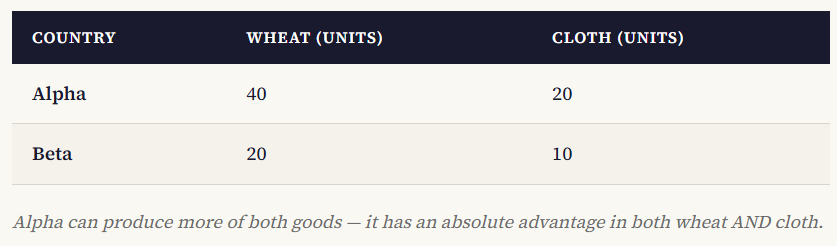
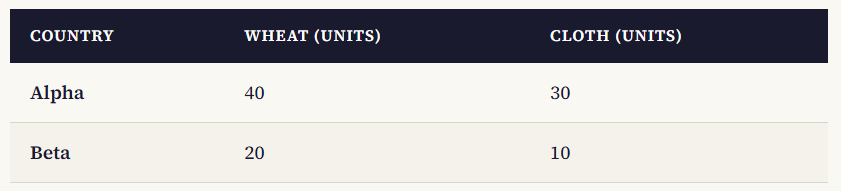
Imagine two countries - let's say Alpha and Beta - who can each produce wheat and cloth. Using 100 hours of labour each, here's what they came up with:
Production Possibilities (per 100 labour hours)
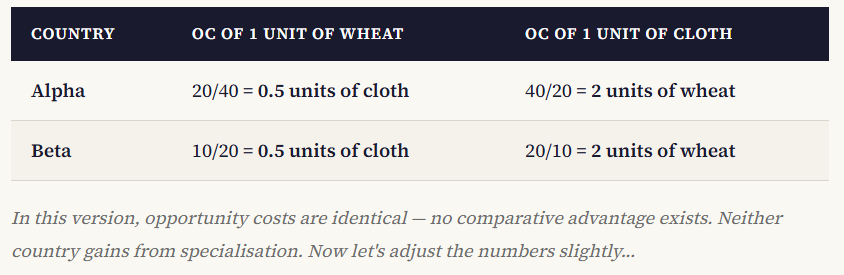
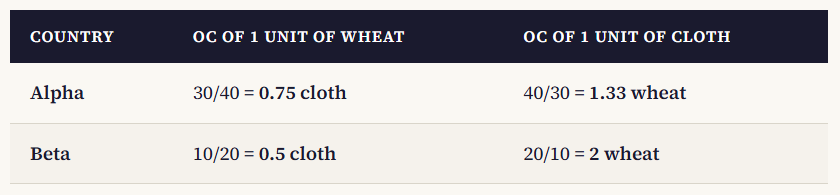
Now let's calculate the opportunity costs:
Revised Example - Comparative Advantage Emerges:
New Opportunity Costs:
Beta has a lower opportunity cost for wheat (0.5 cloth vs 0.75 cloth) → Beta should specialise in wheat.
Alpha has a lower opportunity cost for cloth (1.33 wheat vs 2 wheat) → Alpha should specialise in cloth.
Even though Alpha is better at producing BOTH goods, both countries gain by specialising!
IB Economics Exam Tip - How to Calculate Opportunity Cost:
Divide the output of the good you're not calculating by the output of the good you are calculating. So for the opportunity cost of 1 unit of wheat in Alpha: (units of cloth) ÷ (units of wheat) = 30 ÷ 40 = 0.75 units of cloth. Whichever country has the lower OC for a good should specialise in it. Practice this - it always appears on HL papers.
What Gives a Country Its Comparative Advantage?
Comparative advantage is not magic. It's built - sometimes over decades - through specific factors. Learn these well.
1- Factors of Production Availability
Countries with abundant, high-quality factors of production naturally develop lower opportunity costs in certain areas. Well-resourced nations can produce at lower cost and in greater volume.
IB Economics Real-life Examples:
Canada's vast forests give it a comparative advantage in timber and paper. Russia's enormous natural gas reserves mean it can produce gas more cheaply than most EU nations. China's massive, efficient labour force keeps manufacturing costs below almost any competitor.
2- Levels of Technology
Workers with access to the latest machinery are far more productive than those using outdated equipment. High-income countries can invest in physical capital and superior technologies, giving them comparative advantages in high-tech sectors over lower-income countries.
IB Economics Real-life Examples:
Taiwan's TSMC holds a comparative advantage in semiconductor manufacturing built on decades of R&D investment. In 2024, TSMC held 64% of the global foundry market - a lead its rivals, including Samsung and Intel, have failed to close despite billions in investment.
3- Investment in R&D
Comparative advantage evolves. Countries that invest in research and development can build new comparative advantages and maintain existing ones. Supply-side economists argue that continuous R&D investment is essential to staying competitive in global markets.
IB Economics Real-life Examples:
Germany has maintained its comparative advantage in precision engineering and luxury cars - e.g. BMW, Mercedes, Volkswagen - through sustained investment in industrial R&D and vocational training. It doesn't have the cheapest labour, but it has the best engineers.
4- Price Stability
A country with low and stable inflation can maintain comparative cost advantages. Higher prices - driven by high inflation - make a country's exports less attractive to foreign buyers, eliminating comparative advantage even for exceptional high-quality goods.
IB Economics Real-life Examples:
Argentina's chronic high inflation - which has at times exceeded 200% annually - has repeatedly undermined its agricultural export competitiveness, despite having some of the world's most fertile farming land. The product quality is there; the price stability isn't.
5- Exchange Rate Fluctuations
A favourable (depreciation) variation in the exchange rate makes a country's exports cheaper and more competitive in world markets. In the same way that currency appreciation, raises export prices and can erode comparative advantage - even if production efficiency remains unchanged.
IB Economics Real-life Examples:
When the pound fell sharply after Brexit in 2016, UK exports briefly became more competitive on world markets due to the fact the pound was weak. When sterling is strong, UK exporters face the opposite effect - good products priced away from foreign markets.
What Are the Weaknesses Of This Theory?
IB Economics examiners want HL students to be able to evaluate this theory. And Ricardo's model, has some serious flaws. Here are the six main limitations you need to be able to discuss:
1. It's a Static Model
The theory assumes comparative advantage is fixed and permanent. It isn't. Comparative advantages are dynamic - they shift between countries over time as technology, labour costs, and investment patterns change. Japan dominated consumer electronics in the 1980s. South Korea dominated shipbuilding in the 1970s. Both of those advantages have since been eroded or overtaken.
Comparative advantage is not static. It shifts over time as technology, labour costs, and investment patterns change. The UK once led in textiles; Japan once dominated consumer electronics; South Korea led in shipbuilding. All three advantages were eventually eroded by competitors with lower costs or superior technology
2. Barriers to Trade Are Ignored
The theory assumes free trade - no tariffs, no quotas, no restrictions. But the real world is full of them. The US imposed heavy tariffs on Chinese goods under Trump. The EU has extensive anti-dumping measures. India recently had tariffs of 150% on UK whisky. Barriers significantly distort the gains from comparative advantage.
3. Disparities Within Countries Are Ignored
Even if a country as a whole gains from specialisation and trade, the gains are not equally distributed internally. When the UK shifted away from manufacturing toward financial services, the gains were concentrated in London and the South East - while communities in the North of England and South Wales that depended on steel and coal were devastated. Trade theory is terrible at accounting for these regional inequalities.
4. Transport Costs Are Ignored
Ignoring transportation costs is significant. High shipping costs, geopolitical disruptions (like attacks on Red Sea shipping in 2023–24), and supply chain fragility can dramatically alter the real-world calculations of comparative advantage. A product that's cheapest to make on the other side of the world may not be cheapest to deliver.
5. Factor Immobility in Practice
The model assumes workers can effortlessly move between industries. In practice, a former steelworker in Sheffield cannot simply become a software engineer in London. Retraining takes time, costs money, and often doesn't fully work. Factor immobility means the theoretical gains from specialisation are harder and slower to achieve than the model suggests.
6. Imperfect Knowledge
The theory assumes both consumers and producers have perfect information about prices, exchange rates, and market conditions globally. In reality, exchange rate volatility and differing inflation rates across countries make it genuinely difficult for buyers and sellers to identify true comparative advantage in real time.
Comparative Advantage Changes
A key limitation of comparative advantage theory is that it is a static model - it assumes comparative advantages are fixed. In practice, they evolve over decades as countries invest in new technology, develop their labour force, and change their industrial specialisation.
Comparative advantage is not permanent. Countries that dominated entire industries for decades no longer do. And the pattern repeats itself generation after generation.
Then - The Dominant Era
UK Textiles - During the Industrial Revolution, the UK dominated global textile production, powered by coal, machinery and skilled labour.
US Manufacturing (post-WWII) - America led in cars, steel and machinery. Its industry was highly developed with a skilled, well-paid workforce.
Japan Consumer Electronics (1980s–90s) - Sony, Panasonic, Nintendo. Japan owned the TV, camera and gaming console market.
South Korea Shipbuilding (1970s–90s) - Dominated global production of cargo ships and oil tankers through low costs and advanced technology.
Now - A Proper Shift
India & Bangladesh took over textiles, offering lower labour costs and modern machinery - producing garments for H&M, Zara, and Primark.
China, Mexico, South Korea drew away US manufacturing through lower labour costs. The US "Rust Belt" - Michigan, Ohio, Pennsylvania - represented the human cost of that shift.
South Korea (Samsung) & China undercut Japan in electronics. Japan's higher labour costs and less agile corporate culture proved fatal to its dominance.
China is now the world's largest shipbuilder, with massive state-owned firms and lower labour costs. South Korea's comparative advantage in basic shipbuilding is gone.
So where are we right now in terms of comparative / competitive advantage? Taiwan's semiconductor comparative advantage is now being targeted by everyone. The US CHIPS Act has mobilised over $450 billion in private investment to build domestic chip capacity. The EU Chips Act has pledged €43 billion in the same direction. Industry analysts suggest Taiwan will remain the critical node for the most advanced and complex production for years to come - because comparative advantage, when it's deep enough, doesn't disappear overnight.
IB Economics Summary
Comparative advantage is one of the most sophisticated ideas in IB Economics. The core belief - that you should specialise in what you give up the least to produce, not just specialise on what you're best at overall - is counterintuitive, and genuinely smart.
IB Economics examiners will reward you if you can evaluate this theory. So remember: the theory assumes a tidy, static, free-trade world. Reality is different, dynamic, and full of barriers. Argentina's inflation problem. The UK's post-industrial regional consequences. China's aggressive push into sectors it once had no business being in. Taiwan's chip dominance that the entire world is now struggling to replicate.
IB Economics Diagrams Programme, What's included:
200+ exam-ready diagrams covering the entire IB Economics syllabus
Video for every diagram showing you exactly how each model looks
Image version perfect for modelling diagrams in you essays, presentations, and your IA
Detailed written explanations of the IB Economics theory behind each diagram
Both SL and HL IB Economics diagrams clearly labelled and organised by topic
Real IB Economics exam application showing how to use diagrams effectively in Paper 1 and Paper 2
Frequently Asked Questions: Absolute and Comparative advantage (IB Economics)
Q1: What is the difference between absolute advantage and comparative advantage?
Absolute advantage is when a country can produce more output than another using the same resources - it's simply better at producing that good. Comparative advantage is subtler: it's when a country can produce a good at a lower opportunity cost than another country, even if it isn't the absolute best producer. A country should specialise in goods where its opportunity cost is lowest, regardless of absolute advantage.
Q2: How do you calculate comparative advantage in IB Economics?
To find the opportunity cost of producing one unit of good X, divide the output of good Y by the output of good X (using the same resource input). Compare the opportunity costs for both countries. The country with the lower opportunity cost for a specific good has the comparative advantage in that good and should specialise in it.
Q3: What are the assumptions of the comparative advantage theory?
The model assumes: only two countries and two goods are involved; costs are measured in labour hours only; labour is freely mobile within each country; and trade only occurs when both parties gain. These simplifying assumptions make the model work mathematically but limit its direct applicability to the real world.
Q4: What are the main limitations of the comparative advantage theory?
The six main limitations are: (1) it is a static model - comparative advantage changes over time; (2) it ignores trade barriers like tariffs and quotas; (3) it ignores unequal distribution of gains within countries; (4) it ignores transport costs; (5) it assumes perfect factor mobility, which doesn't exist in practice; and (6) it assumes perfect knowledge of prices, which is unrealistic given exchange rate and inflation fluctuations.
Q5: Can a country have a comparative advantage even if it doesn't have an absolute advantage in anything?
Yes - this is the central idea behind comparative advantage theory. Every country has a comparative advantage in something, because comparative advantage is determined by relative opportunity costs, not absolute productivity. Even a less productive country will have a lower opportunity cost for at least one good comparing with a more productive country.
Stay well
Read More About:
IB Economics your IB Economics daily guide
IB Economics The Global Economy access Benefits of International trade here as well as the rest of the module 4
IB Economics Activity book Module 4 The Global Economy Unit 4.2 for Absolute and Comparative Advantage HL exam practice, activities, model answers and IB Economics Marking schemes
IB Economics Market Equilibrium for exploring in depth the Price Mechanism & Resource Allocation. It has a direct relationship with Benefit 8 on efficient resource allocation
IB Economics Benefits of International Trade - Explore this topic, comparative advantage is why those benefits exist
PPC Diagrams In IB Economics Diagrams: Specialisation and opportunity cost are visualised on the PPC
IB Economics Tariffs & Trade Protection - The logical next step - check what happens when trade is restricted
IB Economics Exchange Rate - Exchange rate fluctuations are listed as a factor influencing comparative advantage - have a look at the theory
IB Economics The Goals of Supply-Side Policies - R&D investment as a supply-side tool to build comparative advantage, have a look at the page
Read Next: IB Economics Tariffs
© Theibtrainer.com 2012-2026. All rights reserved.
Legal
Have a Tip? Send us a tip using our anonymous form