
IB Economics Paper 2
Your ultimate resource for mastering IB Economics Paper 2 - from data response techniques to 15-mark evaluation excellence
Paper 2 is where IB Economics students either excel or struggle - there's no middle ground. This comprehensive hub covers every aspect of the IB Economics Paper 2 you'll encounter, from fundamental data response techniques and diagram mastery to advanced evaluation frameworks and cross-topic synthesis that separates grade 6 / 7 students from the rest.
Full theory practice, topic exam questions, IB standard model answers and evaluation tools are available exclusively in the IB Economics Activity Book


IB Economics Paper 2: Complete Guide, Format & Past Papers
Target Question:
How do you answer IB Economics Paper 2?
What is IB Economics Paper 2?
IB Economics Paper 2 is a 1 hour 45 minute data response examination worth 40 marks, sat by both HL and SL students, in which candidates answer one question from two using real-world texts and statistical data to apply economic theory, draw diagrams, perform calculations, and write an extended analytical response.
IB Economics Paper 2 is a data response examination sat by both Higher Level (HL) and Standard Level (SL) students. It lasts 1 hour 45 minutes and carries a maximum of 40 marks. Students answer one question from a choice of two. Each question is based on a set of real-world extracts - typically two or three short texts combined with statistical tables - usually drawn from a developing or emerging economy.
Paper 2 tests whether students can apply economic theory to unfamiliar contexts, draw and interpret diagrams, perform IB Economics calculations, and construct extended analytical responses.
Paper 2 Format and Mark Breakdown
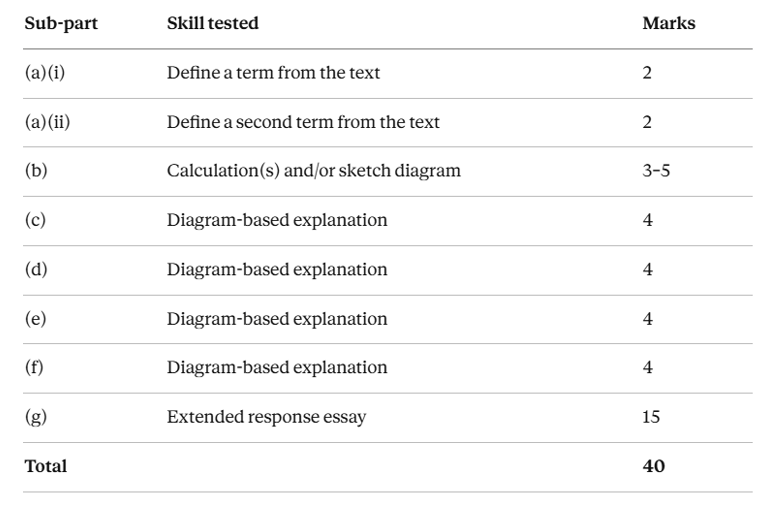
Each Paper 2 question usually follows the same sub-part structure:
Sub-parts (c) through (f) each require a fully labelled diagram and an explanation that links directly to the text or data provided. Sub-part (g) is the extended response, worth 15 marks, and requires students to discuss or evaluate a key economic issue drawn from the case study.
Every episode of Pint-Sized links back to what matters most for your IB Economics course:
Understanding key IB Economics concepts
Applying them in real-world IB Economics contexts
Building IB Economics course confidence without drowning in dry theory.
Subscribe for free to exclusive episodes designed to boost your IB Economics grades and confidence
How to Approach Each Sub-Part
(a) Definitions - 2 marks each
A strong definition does three things: names the concept precisely, explains the mechanism, and is free-standing (it makes sense without the question). Avoid confusing definitions.
Example: Monetary policy is the use of interest rates, money supply, or other monetary tools by a central bank to influence the level of aggregate demand, inflation, and economic activity.
Example: A current account deficit occurs when a country's total payments for imports of goods, services, income, and current transfers exceed its total receipts from exports over a given period.
Two marks are awarded for a precise, complete definition. One mark is awarded for a partial or vague response.
(b) Calculations and Diagrams
Calculations in Paper 2 include: real GDP, real GDP per capita, nominal GDP per capita, GNI, percentage change, price elasticity of supply, total revenue, YED-based projections, and import cost conversions. Always show full working - method marks are available even if the final answer is wrong.
IB Economics Calculations summary for SL and HL students
Some of The Calculations You Must Know for Paper 2
Real GDP Real GDP = (Nominal GDP ÷ GDP Deflator) × 100
Real GDP per capita Real GDP per capita = Real GDP ÷ Population
Percentage change % change = ((New value − Old value) ÷ Old value) × 100
Price elasticity of supply (PES) PES = (% change in quantity supplied) ÷ (% change in price)
Total revenue Total revenue = Price × Quantity
YED-based export projection % change in exports = YED × % change in world income
Nominal GNI GNI = GDP + Net income from abroad
Import cost conversion Cost in domestic currency = USD value × exchange rate (domestic currency per USD)
Sketch diagrams in (b) are awarded 2 marks: 1 mark for a correct shape/structure, 1 mark for correct labelling (axes, curves, key shifts).
IB Economics - Syllabus and Programme Full Guide →
(c)–(f) Diagram-based explanations - 4 marks each
Each question specifies the diagram type. The IB Economics mark scheme awards marks for:
A correctly drawn, fully labelled diagram (typically 2 marks)
A written explanation that directly links the diagram to the question context (typically 2 marks)
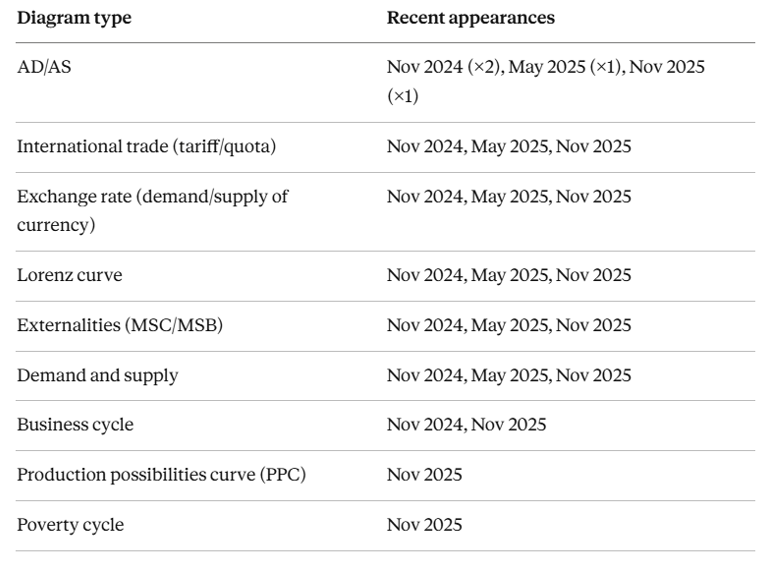
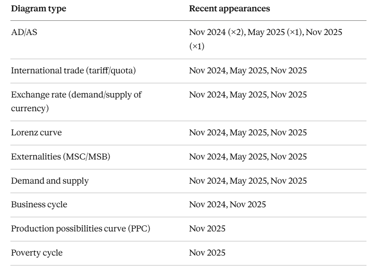
Diagrams appearing consistently in recent Paper 2 sessions:
The Lorenz curve, AD/AS diagram, and international trade diagrams have appeared in every single recent IB Economics paper 2.
(g) The 15-mark extended response
The Paper 2 (g) question is a 15-mark extended response requiring students to discuss or evaluate a major economic issue using evidence from the case study texts and data, economic theory, and a reasoned conclusion - it accounts for 37.5% of the total paper mark.
The command verb is usually either discuss or evaluate. Both require:
Two or more developed arguments - use theory, apply it to the case study, support it with data from the tables
Counter-arguments or limitations - address the other side of the debate
A conclusion - make a supported judgement; do not simply summarise
IB Economics uses a level descriptor (rubric) marking approach for (g). Responses are placed in Band 1 (1–5), Band 2 (6–10), or Band 3 (11–15). To reach Band 3, a response must demonstrate: accurate economic theory, consistent reference to the text and data, genuine two-sided analysis, and a reasoned conclusion.
Practical structure for (g):
Introduction: define the debate and signpost your two SDGs / two consequences / two sides
Body paragraph 1: argument + theory + diagram reference + data reference
Body paragraph 2: counter-argument or second theme, same structure
Body paragraph 3 (for top marks): a further idea, limitation, or real-world qualification
Conclusion: a clear, evidence-based judgement
Lawrence's IB Economics Paper 2 Reviews
Key Themes Across Recent Paper 2 Sessions
Development economics underpins every recent Paper 2. All six case study countries (India, Malaysia, Kenya, Bhutan, Argentina, Papua New Guinea) are developing or emerging economies. Expect questions on poverty, inequality, HDI, Gini coefficients, and SDGs.
Environmental sustainability has appeared in every session since November 2024. Fossil fuels, carbon taxes, tradable permits, externalities, and renewable energy have all been tested. The 15-mark essay in May 2025 asked students to discuss the impact of high growth on environmental sustainability directly.
Gender inequality appears in both definitions and data across all sessions. India's 23% female LFPR, Bhutan's 60% female share of youth unemployment, and Argentina's low female labour force participation have all featured. Questions on potential output and female participation have been explicitly tested.
Exchange rate policy has appeared in (c)–(f) sub-parts in every session: managed rates, fixed rates, depreciation, speculation, and the use of monetary policy to defend a currency.
International trade diagrams - specifically showing tariff changes and their effects on domestic consumers, producers, government revenue, and welfare - have appeared in every session.
The 15-Mark Essay: What Examiners Want
The (g) essay question accounts for 37.5% of the total paper mark. It is therefore the single highest-leverage area for improvement.
What the top band (11–15 marks) requires:
A Band 3 response consistently links economic theory to the specific country context, uses data from the tables and texts as evidence, develops arguments on both sides of the discussion, addresses limitations or conditions, and arrives at a clearly justified conclusion.
What brings responses down to Band 2 (6–10):
Generic economic theory applied to the country without precision, limited use of data, one-sided analysis, or a conclusion that merely restates the arguments without applying evaluation.
Recent (g) questions:
Nov 2024 Q1(g): Discuss the impact of an India-UK trade agreement on India's ability to achieve two sustainable development goals [15]
Nov 2024 Q2(g): Evaluate whether intervention in markets in Malaysia is meeting the government's economic objectives [15]
May 2025 Q1(g): Discuss the likely impact of high economic growth on environmental sustainability in Kenya [15]
May 2025 Q2(g): Evaluate the strengths and limitations of Bhutan's economic development strategy [15]
Nov 2025 Q1(g): Evaluate the likely consequences of Argentina's new economic reforms on its economy [15]
Nov 2025 Q2(g): Discuss the view that foreign aid is more beneficial than FDI for economic growth and development in PNG [15]
Internal Assessment (IA) Guide – Free Download
Step-by-step support on topic selection, structure, evaluation, and most common IB Economics IA mistakes.
Understanding key IB Economics Internal Assessment concepts
Applying and explaining them in real-world IB Economics contexts
Building IB Economics IA confidence without drowning in dry theory and explanations.
Download the IA guide now for free and boost your IB Economics grades and confidence
Frequently Asked Questions - IB Economics Paper 2
Q1: What is the format of IB Economics Paper 2? Paper 2 is a 1 hour 45 minute data response exam worth 40 marks. Students choose one question from two. Each question has sub-parts (a) through (g), covering definitions (4 marks), calculations and sketch diagrams, four diagram-based explanations worth 4 marks each, and a 15-mark extended response essay.
Q2: Is Paper 2 the same for HL and SL in IB Economics? Yes. Paper 2 is identical for Higher Level and Standard Level students - both sit the same paper, with the same questions, time allowance, and mark scheme. HL students are differentiated from SL students through Paper 1 and Paper 3.
Q3: What diagrams come up most often in IB Economics Paper 2? The AD/AS diagram, international trade diagram (showing tariff effects), exchange rate diagram, Lorenz curve, and externalities diagram (showing MSC or MSB) have all appeared in every recent session (November 2024, May 2025, and November 2025). These five diagrams should be a priority, but any diagram could come up.
Q4: How do you write a top-band (g) response in Paper 2? A top-band (g) response (11–15 marks) applies accurate economic theory to the specific case study country, uses data and statistics from the tables as evidence, analyses the issue from both sides, acknowledges limitations or conditions, and reaches a clearly justified conclusion - it does not simply list arguments without critical thinking and evaluation.
Q5: What topics appear most in recent IB Economics Paper 2 exams? Development economics, environmental sustainability (externalities, carbon markets, fossil fuels), gender inequality and labour force participation, exchange rate policy, international trade and trade protection, and real vs nominal GDP calculations have all featured prominently across November 2024, May 2025, and November 2025.
IB Economics Diagrams Programme, What's included:
200+ exam-ready diagrams covering the entire IB Economics syllabus
Video for every diagram showing you exactly how each model looks
Image version perfect for modelling diagrams in you essays, presentations, and your IA
Detailed written explanations of the IB Economics theory behind each diagram
Both SL and HL IB Economics diagrams clearly labelled and organised by topic
Real IB Economics exam application showing how to use diagrams effectively in Paper 1 and Paper 2
Explore Topics:
IB Economics your IB Economics daily guide
IB Economics Diagrams Check this resource for All the IB Economics syllabus diagrams with explanations
IB Economics Activity book More IB Economics exam practice, activities, model answers and IB Economics Marking schemes, all units all modules covered
IB Economics Required Diagrams SL HL
IB economics Calculations Book - 25 units of calculations exercises for SL and HL, IB model answers, and IB marking schemes
IB Economics Paper 1 - All the information you need to complete IB Economics paper 1 successfully
Read Next: IB Economics Paper 3 HL

© Theibtrainer.com 2012-2026. All rights reserved.
Legal
Have a Tip? Send us a tip using our anonymous form