
IB Economics Balance of Payments Accounts
Explore the Capital and Financial Accounts of the Balance of Payments in this teen-friendly guide. Essential knowledge for IB Economics students!
IB ECONOMICS HLIB ECONOMICSIB ECONOMICS SLIB ECONOMICS THE GLOBAL ECONOMY / INTERNATIONAL TRADE
Lawrence Robert
5/4/202510 min read

The Capital Account, Financial Account & How the Balance of Payments Actually Balances
Target Question:
How does the financial account offset a current account deficit in the balance of payments?
Three Friends, One Big Weekend
Imagine three mates - let's call them Cam, Fin, and Kay - go on a group holiday to Madrid. They split everything: Cam handles the hotels, Fin covers flights and transfers, and Kay looks after food, drinks, and activities to do. At the end of the trip, they sit down to work out who owes what. When they add it all up properly, everything cancels out. What one person spent extra, another covered. The group, as a whole, always balances in terms of money.
That's essentially what the balance of payments does for an entire economy. The three accounts - the current account, the capital account, and the financial account - are like Cam, Fin, and Kay. They all do different things, they all move money around differently, but in the end, the whole system is supposed to balance to zero.
Last time, we covered the current account - the trade in goods, services, income, and transfers. Today we're revising the other two: the capital account and the financial account. And then we'll look at how all three fit together inside the BoP.
The Capital Account:
The capital account is the smallest and least exciting of the three accounts. Your IB economics examiner knows this. Your teacher knows this. Everyone knows this. But you still need to understand it properly before you are able to apply it.
IB Economics definition - Capital Account:
The section of the balance of payments that records capital transfers (such as debt forgiveness) and transactions in non-produced, non-financial assets (such as patents and mineral rights). It is typically the smallest of the three accounts.
The capital account tracks capital inflows and outflows that don't involve the production or trade of goods and services. It has two components:
1. Capital Transfers
These involve the transfer of assets where nothing is given in return - no goods, no services, no economic value exchanged.
Examples include:
Debt forgiveness - a wealthy country writes off the debt owed by a developing nation. That's a capital transfer.
Development aid given as a one-off grant (as opposed to regular aid, which sits in the current account's secondary income section)
Gifts and inheritances crossing borders
IB Economics Real-life Example:
When the UK committed to forgiving portions of bilateral debt owed by low-income nations through the Heavily Indebted Poor Countries (HIPC) Initiative - that forgiven debt recorded as a capital transfer out of the UK's capital account.
2. Transactions in Non-produced, Non-financial Assets
It covers the buying and selling of assets that aren't physically produced and aren't financial instruments either. Specifically:
Natural resource rights - mineral rights, fishing rights, forestry rights. If a Norwegian company buys the rights to fish in Icelandic waters, that transaction goes here.
Intellectual property rights - trademarks, copyrights, patents, and licences being sold across borders
If Apple sold the patent of one of its technologies to a Japanese firm, that cross-border sale of an intellectual property right would appear exactly here in the capital account. Not the iPhone itself (that's a good in the current account) - but the right to use that specific technology behind it.
The formula:
Capital Account = Net capital transfers + Transactions in non-produced, non-financial assets
As your IB Economics teacher probably tells you - the capital account is small. The current account gets the headlines. The financial account moves the big numbers. But the capital account is also there, quietly doing its job.
The Financial Account: Real Money
The financial account is the one that tends to compensate whatever's happening in the current account - and to do that it needs large numbers.
IB Economics definition - Financial Account:
The component of the balance of payments that tracks changes in cross-border ownership of financial assets, including foreign direct investment, portfolio investment, reserve assets, and official borrowing.
In plain English: it records all the investing, borrowing, and lending that happens across borders.
It has four main components:
Component 1: Foreign Direct Investment (FDI)
IB Economics definition - Foreign Direct Investment (FDI):
Long-term investment by a multinational company in a foreign economy, involving the establishment or expansion of physical operations abroad, or the acquisition of at least 10% of shares in a foreign company.
So, FDI is when a multinational company (MNC) makes a long-term physical investment in another country - building a factory, opening a distribution centre, or acquiring at least 10% of shares in a foreign company.
That 10% threshold is very relevant: anything below 10% is classified as portfolio investment instead.
Net FDI = FDI inflows − FDI outflows
IB Economics Real-life Examples: The UK secured 853 FDI projects in 2024, ranking second in Europe behind France - though this represented a 13% decrease from 2023. Greater London alone recorded 265 FDI projects, making it Europe's leading region for investment for the second consecutive year.
When Tesla opened a Gigafactory in another country, or when a Japanese car manufacturer built an assembly plant in Sunderland (like Nissan), those are FDI inflows. Money flowing in to set up production on home soil. That's a credit in the financial account.
69,355 new jobs were created and 10,195 existing jobs were safeguarded through FDI projects landing in the UK in 2024 to 2025, with the United States being the top source market. Each one of those projects represents real money arriving in the UK's financial account - credit items that help offset the current account deficit we looked at last time.
Why is FDI so relevant? Because unlike portfolio investment, FDI is sticky. Once you've built a factory, you can't just take it with you and move it overnight. It represents genuine, long-term confidence in an economy.
Component 2: Portfolio Investment
Portfolio investment covers the buying and selling of financial assets - shares, government bonds, and corporate debt (debentures) - across borders. Unlike FDI, this involves financial ownership rather than physical operations.
Examples:
A German pension fund buying UK government gilts (bonds) - credit for the UK
A British investor buying shares in a US tech company listed on NASDAQ - debit for the UK
An overseas hedge fund snapping up shares in a FTSE 100 company - credit for the UK
Portfolio investment is fundamentally about lending and borrowing at a global scale. Governments issue bonds; overseas investors buy them. Companies issue shares; foreign investors hold them. The financial account tracks the net movement of all of this.
Component 3: Reserve Assets & Hot Money
Reserve assets are the stocks of foreign currencies and gold held by central banks - essentially the national emergency fund for international payments. The Bank of England, for example, holds reserves of US dollars, euros, and gold that can be used to settle international obligations or to intervene in foreign exchange markets when the pound needs a bit of a prop-up.
But alongside those reserves sits a great economic concept: hot money.
IB Economics definition - Hot Money:
Short-term capital flows that move rapidly between countries in pursuit of the highest available interest rate or investment return, typically recorded in the financial account of the balance of payments.
It's the finance equivalent of someone scrolling through every delivery app, in this case an investor, looking for the best deal - constantly moving, never loyal.
IB Economics Real-life Example:
In 2024, Turkey - with interest rates close to 50% - attracted huge amounts of foreign capital, simply because it offered higher returns than developed countries. That's hot money in action. Investors around the world moved funds into Turkish bank accounts and short-term assets to exploit the interest rate differential. The moment those rates fell comparing to elsewhere - or if political instability spooked investors - that money would vanish just as quickly as it had arrived.
The defining feature of hot money is its ability to move quickly in and out of investments and countries, often in response to changes in economic conditions. One week it floods into emerging market bonds; the next it retreats to the safety of US Treasury bills. It is investment that follows economic developments.
For an IB Economics student, the key insight is this: hot money inflows boost a country's financial account in the short run and can push up the exchange rate. But they're dangerously unreliable. A sudden change of economic terms - and investors pulling money out - can crash the currency, destabilise the banking system, and cause serious macroeconomic bad news. It's the financial equivalent of a caffeine rush: exciting while it lasts, dreadful when it wears off.
Component 4: Official Borrowing
This one's straightforward. When a government borrows from external creditors or international institutions (like the IMF or World Bank), that exact borrowing flows through the financial account as an inflow. Conversely, when it repays debt to foreign lenders, that's an outflow.
This certainly is different from private borrowing - it refers specifically to government-to-government or government-to-institution borrowing. Developing economies often rely on this to fund infrastructure projects or cover persistent current account deficits.
For access to all IB Economics exam practice questions, model answers, IB Economics complete diagrams together with full explanations, and detailed assessment criteria, explore the Complete IB Economics Course
How All Three Accounts Relate To Each Other
The balance of payments uses double-entry bookkeeping. Every single cross-border transaction is recorded twice - once as a credit, once as a debit - in different parts of the accounts. Which means that in theory, the whole system always sums to zero.
IB Economics definition - Balance of Payments Equilibrium:
The principle that the overall balance of payments always sums to zero, as any deficit in one account must be matched by a surplus in another - enforced through double-entry bookkeeping.
The fundamental relationship is:
Current Account = Capital Account + Financial Account
Or:
Current Account + Capital Account + Financial Account + Errors and Omissions = 0
IB Economics Real-life Example:
What does this actually mean in practice? Let's use the UK as our example.
The UK runs a persistent current account deficit - it spends more with the rest of the world (on goods, services, income, and transfers) than it receives. That deficit has to be financed somehow. And it is - in this case by a surplus in the financial account.
How? Foreign companies invest in the UK (FDI inflows). Overseas investors buy UK government bonds (portfolio investment inflows). Hot money flows in seeking competitive returns. All of these are credit items in the financial account, effectively funding the current account shortfall.
It's exactly like Jordan from our last blog post - his Deliveroo habit creates a personal "deficit," but he covers it with his part-time wages and his nan's birthday contributions. The system, overall, balances.
The UK's net international investment position was negative £271.4 billion in 2024 - meaning the rest of the world owns significantly more UK assets than UK residents own abroad. That's the cumulative legacy of years of current account deficits being financed through the financial account.
IB Economics - Syllabus and Programme Full Guide →
What About Errors and Omissions?
In the real world, the BoP almost never hits a perfect zero. Why? Because we're talking about millions of transactions - container ships, stock market trades, bank transfers, tourist spending - all happening at the same time across the globe. It's practically impossible to capture everything with perfect precision.
So statisticians add an errors and omissions line. It's not a cop-out - it's an honest acknowledgment that with this volume of data, some discrepancies are inevitable. The full formula becomes:
Current account + Capital account + Financial account + Errors and omissions = 0
For your IB Economics exam: if a question gives you three of the four components, you can calculate the fourth. That's why knowing the formula is genuinely useful - not just for ticking a box, but for answering numerical questions under pressure.
IB Economics Real-life Example: The Four Financial Accounts
Scenario 1: An overseas company announces an inward investment project into the UK renewable energy industry. → FDI inflow into the financial account. Credit item. A UK wind farm funded by a Norwegian energy company, for example, would fall here.
Scenario 2: Expectations of higher interest rates lead to an inflow of hot money into a country's banking system. → Portfolio/banking flows into the financial account. Credit item. If the Bank of England raised rates above the ECB's, eurozone investors might shift funds into UK banks to earn better returns.
Scenario 3: Overseas investors bid to buy new issues of government debt. → Portfolio investment into the financial account. Credit item. When the UK government issues gilts and foreign investors buy them, that's overseas lending to the UK government - money flowing in.
Scenario 4: A domestic UK company sells one of their foreign subsidiaries and repatriates several billions of pounds back to the UK. → FDI inflow (returning capital) into the financial account. Credit item. The UK company sold an overseas asset, and the proceeds flew home.
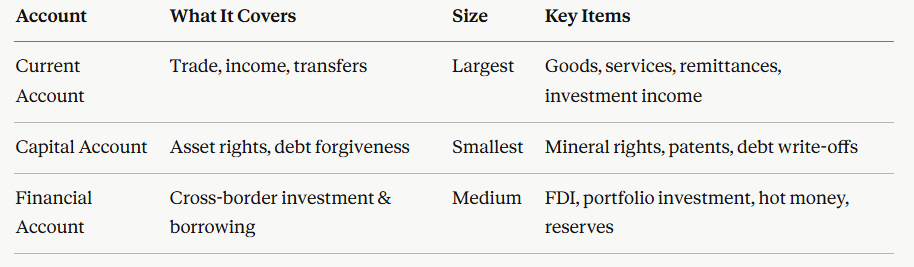
IB Economics Quick Reference: The Three Accounts
Every episode of Pint-Sized links back to what matters most for your IB Economics course:
Understanding key IB Economics concepts
Applying them in real-world IB Economics contexts
Building IB Economics course confidence without drowning in dry theory.
Subscribe for free to exclusive episodes designed to boost your IB Economics grades and confidence
Frequently Asked Questions: Balance of Payments - The Financial Account (IB Economics)
Q1: What is the difference between the capital account and the financial account? The capital account covers transfers of asset rights - debt forgiveness, natural resource rights, and intellectual property - and is the smallest of the three BoP accounts. The financial account is much larger and covers actual cross-border investment flows: FDI, portfolio investment, hot money, reserve assets, and official borrowing.
Q2: What counts as foreign direct investment (FDI)? FDI is when a company makes a long-term physical investment in a foreign country - building a factory, opening a subsidiary, or acquiring at least 10% of a foreign firm's shares. The 10% threshold is critical: ownership below that is classified as portfolio investment, not FDI.
Q3: What is hot money and why is it risky? Hot money is short-term capital that moves rapidly between countries chasing the highest interest rates or returns. It can flow into a country quickly, boosting the financial account and pushing up the exchange rate - but it can leave just as fast, causing currency depreciation and financial instability. In 2024, Turkey's near-50% interest rates attracted significant hot money inflows - a typical example of both the appeal and the fragility of this type of capital.
Q4: Does the balance of payments always equal zero? In theory, yes - because of double-entry bookkeeping, every transaction is recorded as both a credit and a debit. In practice, it doesn't quite reach zero, which is why statisticians include an "errors and omissions" line. The full condition is: current account + capital account + financial account + errors and omissions = 0.
Q5: If a country has a current account deficit, what happens to the other accounts? A current account deficit must be financed by a surplus elsewhere in the BoP - typically in the financial account. This happens through FDI inflows, overseas investors buying domestic bonds, or hot money entering the banking system. The UK is the typical example: its persistent current account deficit is consistently offset by financial account inflows from foreign investment.
IB Economics Diagrams Programme, What's included:
200+ exam-ready diagrams covering the entire IB Economics syllabus
Video for every diagram showing you exactly how each model looks
Image version perfect for modelling diagrams in you essays, presentations, and your IA
Detailed written explanations of the IB Economics theory behind each diagram
Both SL and HL IB Economics diagrams clearly labelled and organised by topic
Real IB Economics exam application showing how to use diagrams effectively in Paper 1 and Paper 2
Stay well,
Related Topics:
IB Economics your IB Economics daily guide
IB Economics The Global Economy access The Balance of Payments and The Financial Account here as well as the rest of the module 4
IB Economics Activity book Module 4 The Global Economy Unit 4.8 for The Balance of Payments and The Financial Account exam practice, activities, model answers and IB Economics Marking schemes
IB Economics Diagrams Check Unit 28 for All The Balance of Payments diagrams with explanations
IB Economics Paper 2 Exam Tips → relevant hub page for exam prep
IB Economics Paper 3 → relevant hub page for exam prep
IB economics Calculations Book make sure you check unit 25 for The Balance of Payments and The Financial Account calculations exercises, IB model answers, and IB marking schemes
Read Next: IB Economics Balance of Payments HL
© Theibtrainer.com 2012-2026. All rights reserved.
Legal
Have a Tip? Send us a tip using our anonymous form