
IB Economics Monopoly & Natural Monopoly
What happens when one firm runs the market? Explore monopoly and natural monopoly with real-life examples in this IB Economics HL Market Power series post.
IB ECONOMICS HLIB ECONOMICSIB ECONOMICS MICROECONOMICS
Lawrence Robert
4/13/202512 min read


One Firm Kingdom: Understanding Monopoly in Economics
Target Question:
What is a monopoly in IB economics and what are its characteristics?
The Search Engine You Didn't Choose
Quick question. When you last needed to look something up through a search engine, which search engine did you use?
Yes. Thought so.
You didn't dwell over the decision. You didn't weigh up the pros and cons of DuckDuckGo versus Bing versus Yahoo in some kind of sophisticated consumer spreadsheet. You just... Googled it. Because that's what everyone does. Because that's what Google has carefully, methodically, and - as US courts ruled in August 2024 - illegally ensured you would do.
Google's global search engine market share hovered just below 90% throughout the final months of 2024 - the first time it had dipped below that level since 2015. And even that small dip, to around 89.7%, was headline news. On mobile devices, Google's dominance is even more striking, holding roughly 94.6% of searches worldwide.
One firm. Nine out of every ten searches on the planet. The perfect introduction to monopoly.
What Is a Monopoly?
IB Economics definition - Monopoly:
A Monopoly is a market structure characterised by a single or dominant supplier of a good or service. The monopolist holds significant market power - enough to control market supply and influence price. Unlike firms in competitive markets, a monopolist is a price maker: it sets the price rather than accepting the market price. Because the firm is the only supplier, it faces the industry's entire downward-sloping demand curve.
There is a single or dominant supplier of a good or service
The firm has significant market power - enough control over supply to manipulate prices
IB Economics Definition - Price Maker:
A price maker is a firm with sufficient market power to set its own price rather than accept the price determined by market forces. Monopolists are price makers because they control market supply. However, a price maker cannot charge any price it wishes - it is still constrained by consumer demand. To sell more output, a monopolist must lower its price, in accordance with the law of demand.
That last point is the critical contrast with everything we covered in Part 1. Remember our tomato farmers who had to accept £1.50 per kilo or go home? A monopolist is the opposite. It's in charge. It decides. The market bends around it, not the other way round.
The Three Characteristics of a Monopoly
Your IB Economics examiner needs to see all three of these - and not just listed, but understood and reasoned with examples:
1. Single or Dominant Firm
A pure monopoly exists when there is literally only one firm in the market. Full stop. No competition, no alternatives.
In practice, economists also analyse situations where one firm is so dominant that it effectively behaves like a monopolist, even if a few tiny rivals technically exist.
IB Economics Real-life example: In August 2024, US District Judge Amit Mehta ruled that Google held monopoly power in the markets for general search engine services and text advertising, finding that it had unlawfully used that power to keep competitors out and drive up digital advertising prices. Google isn't the only search engine - Bing exists, Yahoo still staggers on - but Google's dominance is so overwhelming that you can say that in real terms Google is the market.
2. High Barriers to Entry
IB Economics Definition - Barriers to entry:
Barriers to entry are obstacles that prevent new firms from entering an industry and competing with established firms. In monopolistic markets, barriers may take several forms: high set-up costs, legal protections such as patents or exclusive licences, strong brand loyalty, control over key resources, or network effects that make it practically impossible for rivals to achieve comparable scale. High barriers to entry allow monopolists to sustain abnormal profit in the long run, because new competitors cannot enter and compete those profits away.
These barriers can take many forms:
Legal barriers - patents, licences, and exclusive rights (pharmaceutical companies hold patents on drugs, preventing rivals from producing the same medicine for years)
High set-up costs - the sheer capital required to compete makes entry impossible for most (think trying to build a rival rail network from scratch)
Brand loyalty and network effects - Google's dominance is self-reinforcing. More users generate more search data, which improves results, which attracts more users. A new search engine faces a chicken-and-egg problem that's almost impossible to crack
IB Economics Definition - High Barriers to entry and Abnormal Profit:
High barriers to entry also mean something crucial for profit: In a monopoly, abnormal profit can be sustained in the long run because high barriers to entry prevent new firms from entering the market and competing profits away. This distinguishes monopoly from perfectly competitive markets, where abnormal profits are only temporary - eroded as new entrants arrive and expand supply. A monopolist earns abnormal profit when its price (P = AR) exceeds its average cost (AC), so that AR > AC across the long run.
3. No Close Substitutes
IB Economics Definition - Close Substitutes:
A defining characteristic of monopoly is the absence of close substitutes. When consumers have no meaningful alternative to a product, demand becomes highly price inelastic - consumers have little choice but to continue purchasing even as prices rise. This gives the monopolist substantial pricing power. However, if prices rise far enough, consumers will eventually find distant alternatives or go without, which limits - but does not eliminate - the monopolist's pricing leverage.
Consumers can't easily go for alternative products or services, which gives the monopolist enormous pricing leverage.
Think about your internet connection at home. If you live in a rural area with only one broadband provider serving your postcode, what are you going to do if you don't like the price? Use a "special antenna"? No, You pay up. That's price inelastic demand working exactly as the theory predicts.
IB Economics - Syllabus and Programme Full Guide →
The Downward-Sloping Demand Curve: Why the Monopolist Is the Industry
Here's a concept that a lot of my students take some time to understand. In perfect competition, the industry has a downward-sloping demand curve, but the individual firm faces a horizontal one - because it's a price taker selling at a fixed market price.
In monopoly? The firm is the industry. There's only one supplier. So the monopolist faces the same downward-sloping demand curve as the whole market.
And this has a vital implication: to sell more, the monopolist must lower its price. It can't just sell unlimited quantity at one fixed price the way a perfectly competitive firm can. The law of demand applies to monopolists too - if the price is too high, consumers either go without or find some distant substitute. A monopolist controls supply; it cannot control demand.
This is also why firms in imperfect competition - including monopoly - face a downward-sloping demand (D = AR) curve. Average revenue falls as output rises, because the price must be reduced to shift more units.
Can Monopolists Charge You Whatever They Want?
My students often write something like: "As a price maker, a monopolist can charge whatever it wants."
This sounds logical. But it's wrong - and your examiner will spot it immediately.
IB Economics Key concept - Monopolists can charge "whatever they want":
A common misconception is that monopolists can charge any price they wish. In reality, a monopolist controls supply but not demand. As price rises along a linear demand curve, price elasticity of demand increases - consumers become more sensitive to price and begin seeking alternatives. A rational monopolist sets price at the profit-maximising level (where MC = MR), not at an arbitrary maximum. Charging too high a price reduces quantity sold sufficiently to reduce total revenue and profit.
In short: monopolists have significant pricing power. They don't have infinite pricing power.
Internal Assessment (IA) Guide – Free Download
Step-by-step support on topic selection, structure, evaluation, and most common IB Economics IA mistakes.
Understanding key IB Economics Internal Assessment concepts
Applying and explaining them in real-world IB Economics contexts
Building IB Economics IA confidence without drowning in dry theory and explanations.
Download the IA guide now for free and boost your IB Economics grades and confidence
Profit in a Monopoly: Short Run vs Long Run
Short Run: Normal Profit is Possible
A monopolist can earn only normal profit in the short run, if it chooses to set its price low enough.
This actually is a strategic choice - a monopolist might deliberately keep prices low to discourage potential entrants from even trying to compete. If the market looks barely profitable, why would a rival bother investing millions to break in? This is sometimes called limit pricing.
In this case: P = AR = AC - normal profit.
Long Run: Abnormal Profit is the Goal
But the real prize of monopoly power? Abnormal profit, sustained indefinitely.
Because barriers to entry are high, new firms can't rush in and compete the supernormal profits away (unlike in perfect competition). The monopolist can sit comfortably above its average costs year after year.
The condition for this? P = AR > MC - the price the monopolist charges exceeds its marginal cost of production, creating a gap between revenue per unit and cost per unit. That gap, multiplied across all units sold, is the monopolist's abnormal profit.
And rational monopolists always aim for the profit-maximising output level: MC = MR.
Just like any firm - it's only fair that monopolists have far more control over where the sweet spot is.
Natural Monopoly: When It Makes Sense To Have Only One Firm
Right, so monopolies are generally painted as villains. But there's one scenario where having a single dominant firm is actually the most sensible - even the most efficient - arrangement:
IB Economics Definition - Natural monopoly:
A natural monopoly exists when the structure of production costs in an industry makes it most efficient for a single firm to supply the entire market. Natural monopolies are characterised by very high fixed costs (such as infrastructure investment in pipes, cables, or rail tracks) combined with very low marginal costs (once infrastructure is in place, serving additional customers costs relatively little). As output increases, average costs fall continuously - meaning one large firm can always produce more cheaply than multiple competing firms. Allowing competition would result in wasteful duplication of infrastructure and higher average costs for consumers.
The combination of these two features means that average costs keep falling as output increases - the more customers the firm serves, the lower the cost per unit. This is economies of scale taken to another level.
IB Economics Real-life Examples:
Water companies in England and Wales are the textbook natural monopoly. The water industry in England and Wales operates through regional monopoly companies, with most water and sewerage providers functioning as regional monopolies with dedicated infrastructure - meaning household customers cannot switch their supplier. Why? Because nobody is going to dig up every road in the South East to lay a second set of water pipes. The duplication of infrastructure would be staggeringly wasteful, and the fixed costs absolutely prohibitive.
This is also precisely why the sector has been under intense scrutiny. In July 2025, an Independent Commission into the water sector published its final report, making 88 recommendations and concluding that a "fundamental reset" was needed - recommending the abolition of water services regulator Ofwat and the creation of a new single regulatory body. When a natural monopoly misbehaves, there's no market competition to set things right. Regulation has to do that job instead.
Railway infrastructure is another classic case. The very high costs of laying track and building a network - plus the costs of buying or leasing rolling stock - would prohibit or deter the entry of any competitor. You simply cannot have two competing sets of rail tracks between London and Manchester. The waste and duplication would be economically absurd.
BT's Openreach - the subsidiary responsible for the telephone cables connecting most UK homes to the national broadband network - is a more subtle modern example. Even though multiple broadband providers exist in the UK, they primarily rent their lines from BT Openreach, which owns and maintains the underlying fixed-line infrastructure. Openreach is the natural monopoly hiding behind the apparent competition between Virgin Media, Sky, and TalkTalk.
For access to all IB Economics exam practice questions, model answers, IB Economics complete diagrams together with full explanations, and detailed assessment criteria, explore the Complete IB Economics Course
So Are Natural Monopolies a Good Thing?
On the positive side: a natural monopolist controls the whole market and can achieve massive economies of scale, potentially delivering lower prices per unit than a fragmented, competitive market ever could. One potential advantage of monopoly is the capacity to fund research and development (R&D). Because monopolists sustain abnormal profits in the long run - protected by barriers to entry - they accumulate the financial resources needed for substantial investment in innovation. This can lead to technological progress, expanded productive capacity, and improved international competitiveness. By contrast, perfectly competitive firms, earning only normal profit, lack both the financial resources and the incentive to invest heavily in R&D, since any innovation can be immediately copied by rivals.
On the negative side: Because natural monopolies face no competitive pressure to keep prices low or quality high, government intervention is typically required. Governments respond in two main ways: nationalisation (taking the industry into public ownership so it operates in the public interest rather than for profit) or regulation (setting price caps, service standards, and profit limits for privately owned monopolies). In the UK, natural monopolies such as water and energy supply are regulated by bodies including Ofwat and Ofgem respectively. The goal in both cases is to replicate the discipline that competition would otherwise provide.
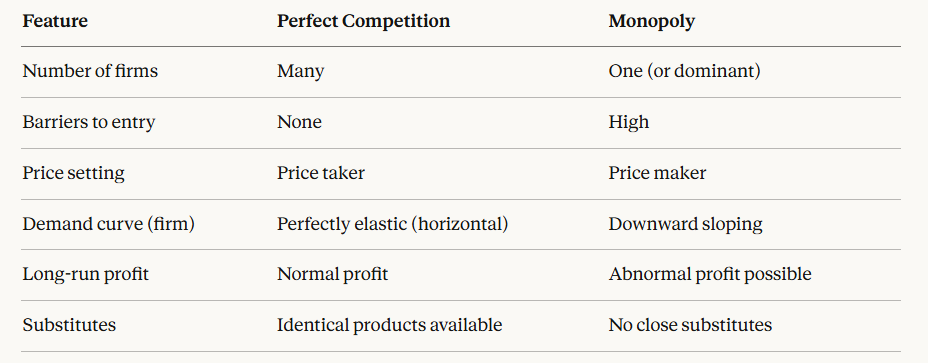
Monopoly vs Perfect Competition
Learn this table. Then understand why each cell says what it says. That's the difference between a mediocre answer and one of your best ones.
Every episode of Pint-Sized links back to what matters most for your IB Economics course:
Understanding key IB Economics concepts
Applying them in real-world IB Economics contexts
Building IB Economics course confidence without drowning in dry theory.
Subscribe for free to exclusive episodes designed to boost your IB Economics grades and confidence
IB Economics Exam Tip:
Let's try to avoid these errors in monopoly questions:
1. Never say a monopolist "can charge whatever it wants." Instead, write that a monopolist has significant pricing power but is still constrained by demand conditions and the law of demand. A price maker sets the price - but the market determines how much gets sold at that price.
2. When evaluating natural monopoly, always consider both sides - the efficiency case for allowing a single provider AND the consumer welfare argument for regulation. IB mark schemes reward evaluation, and this is a topic built for it: natural monopoly genuinely has real costs and real benefits.
IB Economics Diagrams Programme, What's included:
200+ exam-ready diagrams covering the entire IB Economics syllabus
Video for every diagram showing you exactly how each model looks
Image version perfect for modelling diagrams in you essays, presentations, and your IA
Detailed written explanations of the IB Economics theory behind each diagram
Both SL and HL IB Economics diagrams clearly labelled and organised by topic
Real IB Economics exam application showing how to use diagrams effectively in Paper 1 and Paper 2
Coming Up in Part 4: Oligopoly
In the next entry, we dive into oligopolies - where a few big firms dominate, eye each other like chess masters, and battle not just with prices, but with branding, loyalty schemes, and advertising.
Frequently Asked Questions - Monopoly (IB Economics)
What is a monopoly in economics? A monopoly is a market structure in which a single or dominant firm supplies an entire market. The monopolist acts as a price maker - setting price rather than accepting it - and faces no close competition due to high barriers to entry. Because there are no close substitutes for its product, demand is typically highly price inelastic, giving the monopolist significant pricing power.
What are the three main characteristics of a monopoly? The three core characteristics of monopoly are: (1) a single or dominant firm controlling market supply; (2) high barriers to entry that prevent rival firms from competing; and (3) the absence of close substitutes, meaning consumers have limited ability to switch away. Together these features give the monopolist sustained market power and the ability to earn abnormal profit in the long run.
Can a monopolist really charge any price it wants? No - this is a common misconception. A monopolist controls supply but not demand. If it raises prices too high, consumers reduce their purchases or eventually find alternatives. The rational monopolist sets price at the profit-maximising output level where MC = MR, not at an arbitrary maximum. The law of demand applies to monopolists just as it does to competitive firms.
What is a natural monopoly and why does it exist? A natural monopoly exists when one firm can supply an entire market at lower average cost than multiple competing firms could. This typically occurs in industries with very high fixed infrastructure costs - such as water pipes, electricity grids, or railway tracks - combined with low marginal costs per additional customer. Duplicating this infrastructure would be wasteful and more expensive, making a single provider the most efficient solution. Natural monopolies are common in utilities and are usually regulated or state-owned to prevent consumer exploitation.
Why can monopolies earn abnormal profit in the long run? In competitive markets, abnormal profits attract new entrants who expand supply, driving prices down until only normal profit remains. Monopolies avoid this because high barriers to entry - legal protections, high set-up costs, network effects - prevent rivals from entering. With no new competition to erode profits, the monopolist can sustain a position where average revenue (AR) exceeds average cost (AC) indefinitely, unless constrained by regulation.
Stay well,
More Information About:
IB Economics your IB Economics daily guide
IB Economics Module 2 Microeconomics access Monopoly here as well as the rest of the module 2
IB Economics Diagrams Check Unit 13 for All Market Power, Monopoly and Natural Monopoly diagrams with explanations
IB Economics Market Power All your Monopoly, Natural Monopoly and Market Power theory in one place
IB Economics Perfect Competition explore the differences between Monopoly and Perfect competition here
IB Economics Activity book Module 2 Microeconomics Unit 2.16 for Monopoly & Natural Monopoly exam practice, activities, model answers and IB Economics Marking schemes
IB Economics Monopoly explore Monopoly from a different angle
Revenue, Costs and Profit - abnormal profit in the long run links directly to monopoly; You need to go through this content to fully understand the profit analysis done for monopoly.
Market Failure - monopoly power causes allocative inefficiency; this is one of the biggest real-world sources of market failure
Government Intervention - price regulation, nationalisation, and Ofwat/Ofgem all connect directly to government intervention in markets
IB economics Calculations Book make sure you check unit 11 for Monopoly and Natural Monopoly calculations exercises, IB model answers, and IB marking schemes
Read Next: IB Economics Monopolistic Competition
© Theibtrainer.com 2012-2026. All rights reserved.
Legal
Have a Tip? Send us a tip using our anonymous form