
IB Economics Pollution Economics
Master pollution economics for IB with real examples of negative externalities, Pigouvian taxes, and cap-and-trade systems. Includes latest UK and EU data.
IB ECONOMICS HLIB ECONOMICS MICROECONOMICSIB ECONOMICSIB ECONOMICS SL
Lawrence Robert
6/10/202511 min read
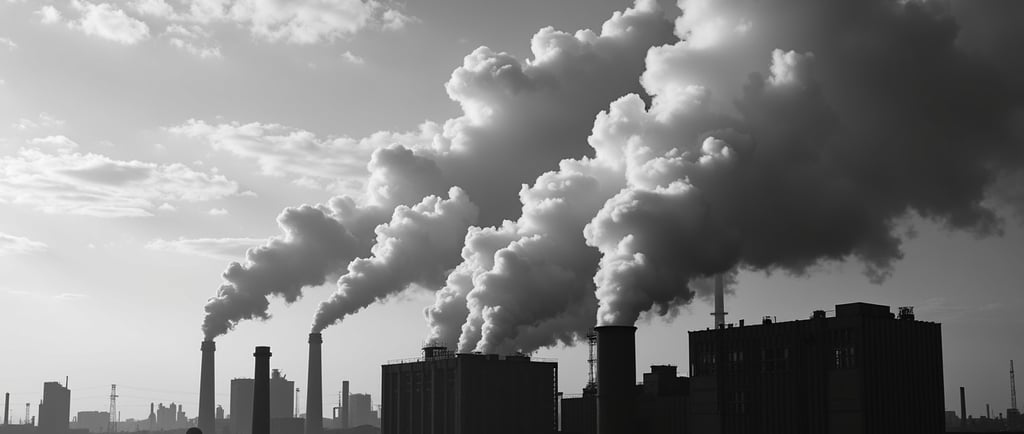

Pollution and Negative Externalities: How Markets Fail and How Economists Try to Fix Them
Target Question:
How does pollution cause market failure in IB Economics?
Imagine your neighbour decides to play loud music at two in the morning. They get the benefit - a good time. You get the cost - no sleep. Further, your neighbour does not compensate or pay you anything for imposing that cost on you, because there is no mechanism that forces them to.
Markets for goods and services work in exactly the same way when it comes to pollution. The factory pumping emissions into the air gets the benefit of production at low cost. The surrounding community bears the cost in reduced air quality and health deterioration. And the factory's accounts do not reflect a single penny of that cost.
This is the economics of negative externalities - and it is one of the most important concepts in IB Economics. Understanding this concept well means understanding why markets fail, and most importantly understanding the policy responses needed to correct them.
IB Economics Definition - Negative Externality:
A negative externality is a cost imposed on a third party - someone not directly involved in a market transaction - that is not reflected in the market price. Because the producer or consumer causing the cost does not bear it, the price mechanism fails to account for it, leading to overproduction relative to the socially optimal level.
IB Economics How Governments fight Externalities - Full Guide →
Why Pollution Is a Market Failure
IB Economics Definition - Market Failure:
Market failure occurs when the free market, left to its own devices, allocates resources inefficiently - producing either too much or too little of a good relative to the socially optimal quantity. Negative externalities are one of the principal causes of market failure in IB Economics, because they cause the market to overproduce goods whose full social costs are not reflected in the price.
Markets allocate resources efficiently when prices reflect the full costs and benefits of production and consumption. When a firm decides how much to produce, it weighs its private costs - labour, raw materials, energy - against the revenue it expects to earn. What it does not weigh, unless forced to, are the costs its production imposes on everyone else: the health costs of air pollution, the environmental damage of emissions, the reduced quality of life for communities downwind of industrial sites.
These uncounted costs are called external costs, and their existence creates a systematic gap between what is privately profitable and what is socially optimal.
IB Economics Definition - External Cost:
An external cost is the cost of a market transaction borne by parties other than the buyer and seller. When external costs exist, the marginal social cost of production exceeds the marginal private cost, leading to overproduction relative to the socially optimal output level.
IB Economics Market Failure - Full Guide →
The Negative Externality Diagram: MPC, MSC, and the Welfare Loss Triangle
The IB Economics diagram for a negative externality in production captures this gap. There are three key curves to place correctly:
Marginal Private Cost (MPC) - the cost to the firm of producing one additional unit. This is the supply curve in a competitive market, reflecting only the producer's own costs.
Marginal Social Cost (MSC) - the total cost to society of producing one additional unit, including both the private cost and the external cost. Because pollution imposes costs beyond the firm, MSC lies above MPC at every level of output. The vertical distance between MSC and MPC at any given output level is the marginal external cost - the cost imposed on third parties per additional unit produced.
Marginal Private Benefit (MPB) - represented by the demand curve, reflecting the value consumers place on each additional unit.
The free market reaches equilibrium where MPC intersects MPB - producing output quantity Qm at price Pm. But the socially optimal output is where MSC intersects MPB - a lower quantity Q* at a higher price P*. At every unit of output between Q* and Qm, the cost to society (MSC) exceeds the benefit to society (MPB). These units should not be produced from a social welfare perspective.
The area of the triangle bounded by MSC, MPB, and the vertical line at Qm - the welfare loss triangle - represents the net loss to society from overproduction. It is the value destroyed by the market's failure to account for external costs. Eliminating this welfare loss is the objective of pollution policy. (Source: IB Economics Diagrams)
The Optimal Level of Pollution Is Not Zero
To see why, consider what eliminating pollution in its entirety would actually require. All industrial production, all transport, all energy generation that involves any emissions would have to cease. The economic cost of that would be huge - far exceeding any benefit from absolute cleanliness. The marginal cost of pollution decline rises as pollution falls: the first reductions are cheap (switch to cleaner fuel, fit basic filters); the final reductions toward zero become extraordinarily expensive.
Meanwhile, the marginal benefit of reducing pollution also changes with the level of pollution. When air quality is very poor, each unit of improvement produces large gains in health and wellbeing. As air quality improves, the additional benefit of further reductions gradually declines.
The socially optimal level of pollution is therefore where the marginal cost of further reduction equals the marginal benefit of further decline. Beyond that point, society spends more cleaning up than it gains from the cleaner environment. This is precisely why IB Economics frames pollution not as something to be eliminated, but as something to be efficiently managed.
Real-World Evidence: Does Cleaning Up Pay Off?
Empirical evidence strongly supports the case for substantial pollution reduction, even if we are not talking about complete elimination. In the UK, sulphur dioxide emissions fell by approximately 97% between 1990 and 2023 - a transformation achieved through a combination of regulation, fuel switching, and market-based policy. Nitrogen dioxide concentrations at roadside monitoring sites in London fell by around 49% between 2016 and 2023, largely driven by the Ultra Low Emission Zone and the accelerated transition away from diesel vehicles.
Cleaner air significantly contributes to positive economic results. Studies consistently show that property values increase in regions with superior air quality. Households indirectly express their appreciation for clean air through their willingness to pay for housing. The European Environment Agency estimates that improving air quality to meet World Health Organisation guidelines across EU member states could prevent hundreds of thousands of premature deaths each year. The economic value of this benefit greatly surpasses the costs associated with achieving such improvements.
These arguments do not advocate for zero pollution; rather, they highlight that the existing pollution levels in various contexts surpass the socially optimal threshold, suggesting that further reductions would be justified by a cost-benefit analysis.
Complete IB Economics Activity Book:
52 Complete Units including the Market Failure and Pollution
Every unit from all four modules: Every topic. Every concept. Every theory. Nothing left out.
900+ Practice Activities
Complete IB Standard Model Answers
IB Standard Marking Schemes
Exam Practice Questions
Always Updated The Living Resource Advantage
Policy Responses: Three Tools, One Objective
IB Economics identifies three main policy responses to negative externalities from pollution, each with different mechanisms, advantages, and limitations.
1. Pigouvian Tax
IB Economics Definition - Pigouvian Tax:
A Pigouvian tax is a tax set equal to the marginal external cost of a negative externality at the socially optimal level of output. It forces the producer to internalise the externality by adding the external cost to their private cost, shifting the MPC curve upward to align with MSC and reducing output to the socially optimal quantity Q*.
The logic of a Pigouvian tax is smart. If the problem is that producers ignore external costs, the solution is to make those costs private - by taxing the producer an amount equal to the marginal external cost at the socially optimal output level. The tax shifts the MPC curve upward until it coincides with MSC. The new market equilibrium produces Q* at price P*, the welfare loss triangle is eliminated, and the producer now faces the full social cost of production. (Source: IB Economics Diagrams)
IB Economics Real-life Example: Carbon taxes are the most widely applied real-world example. The UK carbon price support mechanism, which taxes carbon emissions from power generation, has contributed to a dramatic decline in coal-fired electricity generation - from providing around 40% of UK electricity in 2012 to effectively zero by 2024. The EU carbon tax, applied across 23 member states, averaged approximately €49 per tonne of CO₂ in 2024, with projections suggesting prices could rise substantially further as the EU tightens its climate commitments.
The main limitation is measurement. Setting the tax at the correct level requires accurate measurement of the marginal external cost - which, for diffuse pollutants like carbon dioxide affecting the entire planet's climate system, is extraordinarily difficult to calculate with exact precision. If the tax is set too low, overproduction continues. If set too high, the economy undershoots the socially optimal output.
2. Tradeable Permits (Cap and Trade)
IB Economics Definition - Tradeable Permits:
Tradeable permits are a market-based pollution control mechanism in which the government sets a maximum total level of emissions (the cap), issues permits up to that level, and allows firms to buy and sell permits. Firms that reduce emissions cheaply can sell surplus permits to firms for whom abatement is more costly, achieving the total emissions reduction at the lowest possible cost to the economy.
Where a Pigouvian tax sets the price of pollution and lets the market determine the quantity of reduction, tradeable permits set the quantity and let the market determine the price. The government issues a fixed number of permits, each allowing the holder to emit a specified quantity of pollutant. Firms that can reduce emissions at low cost do so and sell their surplus permits; firms for whom pollution decline is expensive buy permits rather than installing costly clean-up technology. The total emissions reduction is achieved, but at the lowest possible aggregate cost.
The EU Emissions Trading System (EU ETS) is the largest cap-and-trade system in the world. Carbon prices in the EU ETS exceeded €100 per tonne in 2023, reflecting tightening of the cap and growing scarcity of permits.
In 2024, covered installations reduced their emissions by approximately 5% - evidence that the price signal is generating genuine pollution decline activity. The UK launched its own Emissions Trading Scheme in 2021 following Brexit, though UK carbon prices have been more volatile than EU prices.
The main limitation is the accuracy of the cap. If the government sets the total allowable emissions too high, the permit price collapses and the environmental target is not achieved. In the early years of the EU ETS, an oversupply of permits drove prices near zero, and therefore weakened the incentive to reduce emissions - a problem the EU has since addressed by gradually tightening the cap.
IB Economics - Syllabus and Programme Full Guide →
3. Command-and-Control Regulation
The traditional approach to pollution control requires firms to meet specific technology standards or emissions limits set by regulators. Vehicle emissions standards, building regulations requiring insulation, and requirements to fit catalytic converters are all examples of command-and-control regulation.
The primary benefit is certainty; compliance by firms ensures guaranteed emissions reductions. However, the drawback lies in efficiency. A uniform standard for all firms fails to consider the significant variations in pollution reduction costs across different firms and technologies. A company able to reduce emissions at a low cost is held to the same standard as one facing high costs for the same reduction. Consequently, the most cost-effective reduction opportunities are not fully utilised, leading to a higher overall economic cost for achieving a specific emissions reduction compared to a market-based approach.
This is why IB Economics - and the overwhelming consensus among environmental economists - favours market-based instruments over command-and-control regulation for pollution management. When firms are given a price signal (through a tax or permit system) and left to find the most cost-effective response, the economy achieves a given level of pollution reduction at a lower cost than when regulators specify the technology to be used.
IB Economics Common Pool Resources Failure - Full Guide →
Evaluating Pollution Policy: What Your IB Economics Examiner Expects
A strong evaluation of pollution policy in an IB Economics essay addresses four dimensions:
Efficiency: Market-based instruments (taxes and permits) are theoretically more efficient than command-and-control because they exploit the cheapest reduction opportunities first. But both require information the government may not have - the marginal external cost (for a tax) or the optimal cap (for permits).
Effectiveness: Command-and-control regulation offers greater certainty about the environmental outcome - if firms comply with the standard, the reduction is guaranteed. Market-based instruments depend on getting the price or quantity right, and on firms responding to the incentive as predicted.
Equity: Carbon taxes and permit systems can be regressive - lower-income households spend a higher share of their income on energy, so a carbon tax raises their costs proportionally more. Governments can offset this through revenue recycling - returning carbon tax revenues as income transfers or reducing other taxes. How revenues from pollution policy are used is a legitimate equity consideration in any evaluation.
Practicality: Measuring external costs with sufficient precision to set a Pigouvian tax at the correct level is genuinely difficult for global pollutants like CO₂. Permits work across borders only if countries participate in the same scheme - which requires international coordination that is difficult to achieve. These are real constraints on the real-world effectiveness of theoretically superior instruments.
IB Economics Diagrams Programme, What's included:
200+ exam-ready diagrams covering market failure and the entire IB Economics syllabus
Video for every diagram showing you exactly how each model looks
Image version perfect for modelling diagrams in you essays, presentations, and your IA
Detailed written explanations of the IB Economics theory behind each diagram
Both SL and HL IB Economics diagrams clearly labelled and organised by topic
Real IB Economics exam application showing how to use diagrams effectively in Paper 1 and Paper 2
Frequently Asked Questions - Pollution and Negative Externalities (IB Economics)
What is a negative externality in IB Economics?
A negative externality is a cost imposed on third parties not involved in a market transaction, not reflected in the market price. In IB Economics, pollution is the standard example: a firm's production imposes health and environmental costs on surrounding communities without bearing those costs itself. The result is overproduction relative to the socially optimal level and a welfare loss to society.
How do you draw the negative externality diagram in IB Economics?
The diagram shows MPC below MSC, with the vertical gap representing the marginal external cost. The free market equilibrium is where MPC intersects MPB (the demand curve), producing Qm at Pm. The socially optimal output is where MSC intersects MPB, producing the lower quantity Q* at the higher price P*. The welfare loss triangle is the area between MSC and MPB for all output between Q* and Qm - representing net social loss from overproduction.
What is a Pigouvian tax and how does it correct a negative externality?
A Pigouvian tax is set equal to the marginal external cost at the socially optimal output level. It shifts the MPC curve upward to align with MSC, moving the market equilibrium from Qm to Q* and eliminating the welfare loss triangle. Carbon taxes and fuel duties are real-world applications. The main limitation is the difficulty of measuring the marginal external cost accurately enough to set the tax at precisely the right level.
What is the difference between a Pigouvian tax and tradeable permits?
A Pigouvian tax sets the price of pollution and lets the market determine the quantity of emissions reduction. Tradeable permits set the total quantity of permissible emissions and let the market determine the price. Both are more efficient than command-and-control regulation. The key evaluation distinction is that taxes require accurate knowledge of the marginal external cost, while permits require accurate setting of the total emissions cap - both involve significant information challenges for governments.
Why is the optimal level of pollution not zero in IB Economics?
Because pollution reduction has both benefits and costs, and the marginal cost of abatement rises as pollution falls while the marginal benefit of further reduction declines. The socially optimal level is where the marginal cost of abatement equals the marginal benefit of reduction. Beyond that point, the cost of further clean-up exceeds the benefit - so complete elimination of pollution would destroy more economic value than it creates.
Explore Topics:
IB Economics your IB Economics daily guide
IB Economics Microeconomics access Market Failure, Pollution, Externalities and Common Pool Resources content as well as the rest of module 2
IB Economics Price Elasticity of Demand (PED) for exploring further concepts such as "price elasticity of demand" and "inelastic demand" these concepts are linked to market failure
IB Economics Diagrams Check Unit 12 for All Market Failure, Pollution. Externalities and Common Pool Resources diagrams with explanations
IB Economics Government Intervention in Microeconomics maybe you need to revise "indirect taxes" and "subsidies", "command and control CAC", "direct provision"
IB Economics Activity book Module 2 Microeconomics Unit 2.10 for Market Failure, Pollution, Externalities and Common Pool Resources exam practice, activities, model answers and IB Economics Marking schemes
IB Economics Calculations Book make sure you check unit 9 for Market Failure, Pollution, Externalities and Common Pool Resources calculations exercises, IB model answers, and IB marking schemes
IB Economics Inequality for concepts such as "income inequality / equity" and covering income distribution
IB Economics Economic Growth - explore this content as there is usually a link between economic growth, pollution and market failure
IB Economics Economic Development covers relevant topics such as economic growth vs sustainability, sustainable economic development
Read Next: IB Economics Regulation vs Deregulation
© Theibtrainer.com 2012-2026. All rights reserved.
Legal
Have a Tip? Send us a tip using our anonymous form