
IB Economics Common Pool Resources Failure
Discover how common pool resources drive market failure, with lively examples from overfishing to deforestation. IB Economics made real and relatable.
IB ECONOMICS HLIB ECONOMICS MICROECONOMICSIB ECONOMICSIB ECONOMICS SL
Lawrence Robert
3/24/202524 min read


The Market Has Broken Down. Now What?
Primary target question:
What are the government responses to externalities and common pool resources in IB Economics?
Secondary Target Questions:
What is the tragedy of the commons in economics?
What is the difference between a positive and negative externality?
What's in this entry? Why markets fail, the difference between private and social costs and benefits, positive and negative externalities, merit goods, demerit goods, common pool resources and the tragedy of the commons, and - crucially - all nine government responses using the acronym PIGLETS CC.
The Fish and Chips Problem
Here's a story for you. You love fish and chips. Specifically, you love a nice piece of North Sea cod. Crispy batter, bit of salt, loads of vinegar, wrapped in paper if you're following your dad's footsteps. Brilliant.
Here's the economics. Every time a fishing trawler drags its nets through the North Sea and pulls up a hold full of cod, it makes money. The captain gets paid. The crew gets paid. The fish and chip shop gets its supply. You get your dinner. Everybody wins.
But not everybody. In September 2025, the International Council for the Exploration of the Sea (ICES) - the body that advises governments on fish stock management - recommended a zero catch quota for North Sea cod. Zero. Nothing. Stop fishing it entirely. North Sea cod stocks are so depleted that scientists are warning of total collapse. A 2025 report by Oceana UK found that one sixth of all UK commercial fish stocks are now critically depleted, yet they're still being exploited. North Sea herring, mackerel, and edible crab every single one in crisis.
The fishing boat owner didn't intend to destroy the cod population. You didn't intend to destroy the cod population. But collectively, acting in your own private interests, you've contributed to doing exactly that.
This is market failure. And it's what this entry is all about.
What is Market Failure?
Markets are brilliant at a lot of things. But they have a fundamental blind spot: they respond to private costs and private benefits - the costs and benefits to the specific buyer and seller in a transaction - and largely ignore the costs and benefits imposed on everyone else.
IB Economics Definition - Market Failure:
When the price mechanism fails to allocate resources efficiently, resulting in a reduction in economic welfare. Market failure occurs when private costs and benefits do not align with social costs and benefits, leading to over-production or under-production of certain goods and services.
The price mechanism - that invisible hand that coordinates supply and demand through the price signal - has four main ways of telling you it is not working properly:
1. Society ends up with too little of something (e.g., education, vaccines, public parks) because the market doesn't account for all the social benefits.
2. Society ends up with too much of something (e.g., pollution, cigarettes, traffic congestion) because the market doesn't account for all the social costs.
3. Some goods aren't produced at all by the free market because you can't charge people for them (public goods like national defence or street lighting).
4. Resources are distributed in ways that are deeply unfair - the market rewards ownership of factors of production, meaning those who start with more tend to accumulate even more.
Some Key Concepts: Private vs. Social
IB Economics Definition - Private Costs:
The actual costs incurred by an individual firm or person in a transaction. The cost of petrol for the driver. The cost of tobacco leaf for the cigarette manufacturer.
IB Economics Definition - Social Costs:
The full costs to society of production or consumption.
Social Cost = Private Cost + External Costs (negative externalities). The cost of pollution to the lungs of nearby residents. The cost of passive smoking to the person sitting next to you.
IB Economics Definition - Private Benefits:
The benefits enjoyed by the individual consumer or producer. The joy of driving your car. The revenue earned by the factory.
IB Economics Definition - Social Benefits:
The full benefits to society of production or consumption.
Social Benefit = Private Benefit + External Benefits (positive externalities). The benefit to the whole community when one person gets vaccinated. The spill over benefits to the local economy from a well-educated workforce.
IB Economics Definition - The socially efficient point:
The socially efficient level of output occurs where Marginal Social Benefit (MSB) equals Marginal Social Cost (MSC). At this point, the full costs and benefits to society - including externalities - are balanced, and social surplus is maximised.
This is the one economists actually want the economy to hit - is where Marginal Social Benefit (MSB) = Marginal Social Cost (MSC). At this output level, the last unit produced and consumed is worth exactly what it costs society. Resources are allocated efficiently. Social surplus is maximised.
The tragedy of market failure is that free markets tend to produce at the point where Marginal Private Benefit (MPB) = Marginal Private Cost (MPC) - ignoring all the external effects. And if external costs or benefits exist, that private equilibrium is the wrong answer for society.
IB Economics Exam Tip: The single most important concept in this topic is the gap between MSB/MSC and MPB/MPC. Every externality diagram you draw should show this gap - it's literally where the welfare loss lives. Get comfortable drawing and labelling both pairs of curves.
IB Economics Diagrams Programme, What's included:
200+ exam-ready diagrams covering the entire IB Economics syllabus
Video for every diagram showing you exactly how each model looks
Image version perfect for modelling diagrams in you essays, presentations, and your IA
Detailed written explanations of the IB Economics theory behind each diagram
Both SL and HL IB Economics diagrams clearly labelled and organised by topic
Real IB Economics exam application showing how to use diagrams effectively in Paper 1 and Paper 2
Positive Externalities - When the Market Doesn't Provide Enough of the Good Stuff
Let's imagine your neighbour is a doctor. She gets vaccinated against flu every year - partly to protect herself, but the ripple effect is that she also doesn't infect her patients, her family, the people on her bus, the elderly man she passes in Tesco. Her private decision to get vaccinated generates benefits for dozens of people who have absolutely nothing to do with her. Those are positive externalities - external benefits from an economic transaction.
IB Economics definition - Positive Externality:
A benefit enjoyed by a third party who is not directly involved in a transaction. The Marginal Social Benefit (MSB) exceeds the Marginal Private Benefit (MPB). The free market underprovides goods with positive externalities because buyers and sellers only consider their own private benefits.
IB Economics Classic examples: education, vaccination programmes, public parks, research and development, public transport networks.
Think about what happens with education. You go to school and university. You benefit personally - better job prospects, higher earnings, more intellectual horizons. Your private benefit. But your community also benefits: you're more productive, you pay more tax, you're more likely to vote, you're a better-informed citizen, you might go on to invent something useful. Society benefits from your education far beyond what you personally gain. Because the private benefit (MPB) understates the true social benefit (MSB), the free market - left alone - would under-price and underprovide education. This is why virtually every government in the world either subsidises or directly provides education.
Merit Goods
IB Economics Definition - Merit Good:
A good or service that generates positive externalities, where MSB > MPB. Merit goods are under-consumed in free markets because individuals underestimate the full social benefits. Both public and private sectors can provide them.
IB Economics Key examples: education, healthcare, museums, public libraries.
Merit goods are tricky because they're not the same as public goods. You can exclude someone from a private school (it's excludable) and one more student in a class does make it slightly more crowded (it's rivalrous). But merit goods generate enough positive externalities that governments choose to subsidise or directly provide them to ensure society gets enough. The free market, acting on private signals alone, would produce less than the socially optimal quantity.
IB Economics Real-life Examples: Vaccination and Herd Immunity
The COVID-19 pandemic was, in economics terms, one of the most dramatic illustrations of positive externalities in living memory. When a country achieves high vaccination rates, it doesn't just protect the individuals who chose to be vaccinated - it creates herd immunity, protecting those who can't be vaccinated (the very young, the immunocompromised, the elderly). Each individual vaccination generates enormous positive externalities for the community. This is precisely why governments worldwide paid for vaccines out of public funds and ran major public education campaigns: the free market, charging market prices for vaccines, would have produced nowhere near enough vaccinations at the socially optimal level.
Negative Externalities - When the Market Produces Too Much of the Bad Stuff
You're driving to work. Your private calculation: the cost of petrol, wear on the car, time. Your private benefit: you arrive at work. Simple and efficient enough.
Except: every car on the road simultaneously making the same private calculation causes traffic congestion that makes everyone's journey take longer. The exhaust emissions contribute to air pollution and climate change, imposing costs on people nowhere near your commute. There's noise, there's road damage, there's the downstream health impact on people with respiratory conditions. None of that entered your private calculation. But these are also costs. A cost borne by third parties who had no say in your decision to drive.
IB Economics Definition - Negative Externality:
A cost imposed on a third party who is not directly involved in a transaction. The Marginal Social Cost (MSC) exceeds the Marginal Private Cost (MPC). The free market overprovides goods with negative externalities because producers and consumers don't account for the full social costs.
In a diagram: the MPC curve lies below the MSC curve (the external cost is the vertical gap between them). The free market produces at Qprivate where MPB = MPC. But the socially optimal output is Qsocial - lower - where MSB = MSC. The gap between these two output levels represents over-production, and the triangle of welfare loss between them is the deadweight loss imposed on society. Source visit: IB Economics Diagrams
Demerit Goods
IB Economics Definition - Demerit Good:
A good or service that generates negative externalities, where MSC > MPC. Demerit goods are over-consumed in free markets because consumers ignore the full social costs. IB Economics Classic Examples: tobacco, alcohol, gambling, junk food, single-use plastics, recreational drugs.
Demerit goods cause market failure not just because of external costs imposed on others, but often because consumers themselves underestimate the private harm too - a phenomenon economists link to information failure. The smoker discounts the future health cost. The gambler overestimates the chance of winning. This is partly why governments don't just tax these goods - they run education campaigns, impose age restrictions, and, as we covered in the Government Intervention entry, use nudges to change behaviour.
IB Economics Real-life Examples: Passive Smoking and the UK Smoking Ban
When the UK introduced a ban on smoking in enclosed public spaces in 2007, it was the expected response to a negative externality. Smoking in a pub didn't just affect the smoker - it exposed bar staff, other customers, and anyone else nearby to passive smoke, with documented links to lung cancer, heart disease, and respiratory illness. The smoker's private calculation ignored these external costs entirely. The ban was command and control regulation addressing a clear case of negative externality - and it's widely regarded as one of the most successful public health interventions in UK history. Hospital admissions for heart attacks fell measurably in the years after the ban.
Internal Assessment (IA) Guide – Free Download
Step-by-step support on topic selection, structure, evaluation, and most common IB Economics IA mistakes.
Understanding key IB Economics Internal Assessment concepts
Applying and explaining them in real-world IB Economics contexts
Building IB Economics IA confidence without drowning in dry theory and explanations.
Download the IA guide now for free and boost your IB Economics grades and confidence
Common Pool Resources - The Tragedy of the Commons
Back to the cod we mentioned at the beginning. Here's why the fish and chips problem is particularly tricky.
The North Sea isn't owned by anyone. No fishing company has a property right over the cod stock. It's what economists call a common pool resource (CPR) - or common access resource (CAR). Anyone with a boat and a fishing licence can help themselves. And because no individual fisher owns the stock, no individual fisher has an incentive to hold back for the sake of future generations. Every cod your competitor doesn't catch today is one you might as well catch and sell yourself.
IB Economics Definition - Common Pool Resource (CPR):
A resource that is non-excludable (you can't prevent people from using it) and rivalrous (one person's use reduces availability for others). Because no individual owns CPRs, they are freely available, leading to over-exploitation. IB Economics classic examples: fisheries, forests, rivers, the atmosphere, irrigation systems.
The Three Key Characteristics of CPRs
Non-Excludable: You can't stop people from accessing or benefiting from the resource. Fish in international waters, clean air, the global atmosphere - once it's there, it's there for everyone. This creates the free rider problem: people can benefit without contributing to its maintenance or paying for its upkeep.
Rivalrous: Unlike a public good (which can be "consumed" by one person without reducing availability for others), common pool resources are depleted by use. Every tonne of fish removed from the North Sea is a tonne less for future fishers and future generations. Every tonne of CO₂ pumped into the atmosphere makes the climate slightly worse for everyone else.
The Tragedy of the Commons: These two characteristics together create the most famous concept in environmental economics.
IB Economics Definition - Tragedy of the Commons:
The tendency for individuals, each acting rationally in their own self-interest, to collectively destroy a shared resource. Since no one owns the resource and everyone can access it, each individual has an incentive to exploit it as much as possible before others do - leading to degradation, depletion, or destruction.
The term was popularised by ecologist Garrett Hardin in 1968, though the concept is much older. His example: a village commons (shared grazing land). Each farmer gains privately from adding one more animal to the commons. But the cumulative effect of every farmer making the same rational decision is that the commons gets overgrazed and destroyed - harming everyone, including all the farmers who overused it.
Examples of the tragedy of the commons in action: global overfishing, deforestation of the Amazon, overuse of underground aquifers, atmospheric pollution, traffic congestion on public roads.
IB Economics Real-life Examples: North Sea Cod, 2025
In September 2025, ICES advised a zero catch quota for North Sea cod - scientifically, the only way to allow the population to recover. Yet despite this advice, political pressure from fishing industry lobbies meant that catch limits for many stocks, including the five worst-performing populations, still exceeded safe levels in 2025. Oceana UK's "Deep Decline" report found that one in six of the UK's commercial fish stocks is critically depleted yet still being exploited. The Irish Sea is the worst-affected region, with four in ten stocks overfished - up from a quarter five years ago.
In Celtic Sea cod, quotas in 2024 were set higher than the estimated total number of adult fish remaining. As one marine conservation expert put it: "Overfishing is not an unavoidable tragedy - it is a political choice." This is the tragedy of the commons affecting British dinner plates.
IB Economics Real-life Examples: The Amazon Rainforest
The Amazon is arguably the world's most important common pool resource. Covering 6.9 million square kilometres across nine countries, it's home to around 10% of all species on earth, produces vast quantities of oxygen, absorbs enormous amounts of CO₂, and drives weather patterns across the whole of South America through what scientists call "flying rivers" of moisture.
No single country or firm owns the Amazon. And the pressures destroying it - cattle ranching, soy farming, logging, infrastructure development - all generate private benefits for the individuals and businesses doing the destroying, while imposing external costs on the rest of the world.
The news around COP30 in November 2025, held in Belem in the Brazilian Amazon itself, was mixed. The good news: Amazon deforestation fell by 11% in the twelve months to July 2025, hitting an eleven-year low of 5,796 square kilometres - the fourth consecutive year of declining deforestation under President Lula. The bad news: forest degradation (from fires, logging, and infrastructure) is accelerating, up 44% compared to 2023. And just days after COP30 ended, Brazil's congress weakened Amazon environmental protections, reinstating sections of a deregulatory licensing law that Lula had vetoed. The forests and fires of the Amazon - and the politics around them - are market failure, tragedy of the commons, and the limits of international cooperation all playing out simultaneously, in real time, right now.
For access to all IB Economics exam practice questions, model answers, IB Economics complete diagrams together with full explanations, and detailed assessment criteria, explore the Complete IB Economics Course
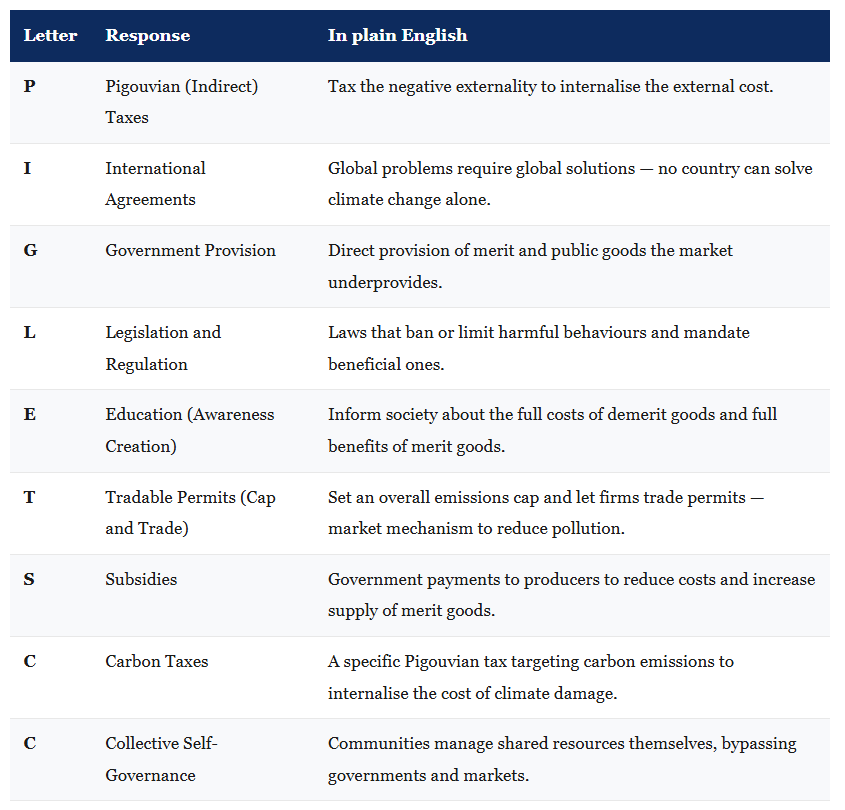
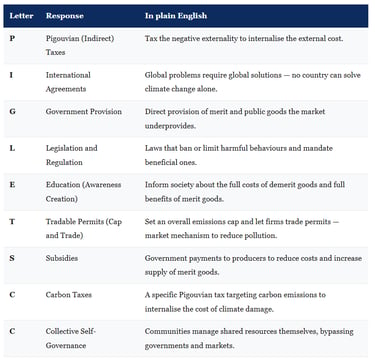
The Nine Government Responses: PIGLETS CC
In IB Economics, the nine government responses to externalities and common pool resources are summarised by the acronym PIGLETS CC: Pigouvian taxes, International agreements, Government provision, Legislation and regulation, Education (awareness creation), Tradable permits, Subsidies, Carbon taxes, and Collective self-governance.
Right. The market's broken. What can governments actually do about it? Your syllabus gives you nine tools. Thankfully, someone came up with a brilliant acronym to remember them all.
Every episode of Pint-Sized links back to what matters most for your IB Economics course:
Understanding key IB Economics concepts
Applying them in real-world IB Economics contexts
Building IB Economics course confidence without drowning in dry theory.
Subscribe for free to exclusive episodes designed to boost your IB Economics grades and confidence
Let's go through each one properly.
P - Pigouvian (Indirect) Taxes
Named after British economist Arthur Cecil Pigou (1877–1959), a Pigouvian tax is designed to do one specific thing: make the producer or consumer pay for the external costs they're currently imposing on everyone else. In economic terms, it internalises the externality - it shifts the market equilibrium from the private optimum toward the social optimum.
IB Economics Definition - Pigouvian Tax:
An indirect tax levied on goods or activities that generate negative externalities, set equal (in theory) to the marginal external cost. The aim is to align private costs with social costs, reducing output to the socially efficient level.
The tax shifts the supply curve upward (or leftward) - raising the market price and reducing the quantity consumed. If set at the right level, it closes the gap between MPC and MSC entirely.
Common IB Economics examples: fuel duty (carbon emissions from driving), tobacco tax (health costs of smoking), alcohol duty (social costs of excessive drinking), the UK sugar levy (obesity and healthcare costs).
The Limitations
Two big issues worth knowing for your exams:
Inelastic demand makes the tax less effective at changing behaviour - but great at raising revenue. Addicted smokers don't quit just because a pack of cigarettes goes up 50p. The externality is still happening; the government just gets richer. The sugar tax is clever because it targeted the supply side and incentivised reformulation, rather than just relying on consumers switching brands.
Pigouvian taxes are regressive - they take a larger share of income from low-income households, who tend to spend a higher proportion of their budget on the goods being taxed (fuel, tobacco, alcohol, junk food). A carbon tax that raises petrol prices hits someone who needs their car to get to a minimum wage job far harder than it hits someone who can afford a Tesla. This is a serious equity concern that policymakers should fully explain to people before their imposition.
C - Carbon Taxes
A carbon tax is essentially a Pigouvian tax with a very specific target: greenhouse gas emissions. You pay for every tonne of CO₂ (or CO₂ equivalent) you emit. The theory is smart economics: put a price on carbon, and firms and individuals will factor that cost into their decisions. Some will switch to renewables. Some will invest in energy efficiency. Some will move away from high-carbon fuels entirely. But it nods you into doing something and that is the whole point.
IB Economics Definition - Carbon Tax:
A Pigouvian tax levied on the carbon content of fossil fuels, or on greenhouse gas emissions directly. Designed to internalise the external costs of climate change by making polluters pay for the environmental damage they cause.
Carbon taxes are currently in use in over 40 jurisdictions globally, including the UK (through its own ETS), Canada, and parts of Scandinavia. Sweden has one of the highest carbon taxes in the world - around €130 per tonne of CO₂ - and has managed to significantly decouple economic growth from emissions growth.
Again, here we come across equity issues. Higher energy costs disproportionately affect lower-income households, who spend more of their budget on energy and are less able to switch to green alternatives. This is why carbon tax revenues are sometimes recycled back to lower-income households as rebates or used to fund the transition to clean energy - otherwise the policy is effective but deeply unfair.
T - Tradable Permits (Cap and Trade)
What if instead of just taxing pollution, you used market mechanisms to set a limit on how much pollution can exist - and then let firms trade the right to pollute among themselves? That's cap and trade.
IB Economics Definition - Tradable Permits (Cap and Trade):
The government sets a cap - a maximum total level of emissions allowed across an industry or economy. Firms are issued or buy permits allowing them to emit up to a certain amount. Firms that emit less than their allowance can sell spare permits to firms that want to emit more. The overall cap is reduced over time.
The principle behind cap and trade is that it's economically efficient: the emissions reductions happen where they're cheapest. Firms that can reduce emissions cheaply do so, and sell their spare permits. Firms for whom it's expensive to reduce emissions buy permits instead of immediately decarbonising. Society still hits its overall emissions target - just at the lowest possible economic cost.
IB Economics Real-life Examples: The EU Emissions Trading System (EU ETS)
The EU ETS, launched in 2005, is the world's largest and most mature carbon market. It covers around 40% of EU greenhouse gas emissions from power plants, heavy industry, and aviation. By mid-2025, the EU ETS had raised over €245 billion in revenues from the sale of emissions allowances, with proceeds going to Member States primarily for clean energy investments and social climate support.
In 2025, EU ETS carbon prices fluctuated between €60 and €80 per tonne of CO₂ - a price high enough to genuinely shift investment decisions toward decarbonisation. Since 2005, covered sectors have reduced emissions by approximately 47%. That's significant success and real-world outcome for a market-based mechanism.
But the system is expanding. A new scheme called ETS2 is launching in 2027 (after being delayed from 2025 under political pressure), extending the carbon price to road transport, buildings, and smaller industry. Projections suggest ETS2 carbon prices could reach €149 per tonne by 2030. The knock-on effect: road transport bills could rise by 22–27%, and home heating costs by 31–41%. Effective for the climate but also politically explosive - particularly in Poland, Czech Republic, and Slovakia, where energy poverty is already a serious concern.
In a significant development for the UK, in May 2025 the UK and the EU announced plans to link the UK ETS with the EU ETS - bringing the two systems together for greater efficiency and price alignment.
Criticisms of Cap and Trade
Cap and trade is economics clever, but it has real problems.
It can be anti-competitive against smaller firms, who often lack the resources and expertise to navigate carbon markets. Large multinationals with dedicated compliance teams can manage permit trading efficiently; a small independent manufacturer might find the administrative burden overwhelming.
And in a globalised economy, there's the problem of carbon leakage - firms simply relocating production to countries without a carbon price, where they can pollute freely. You've reduced emissions in Europe, but you haven't reduced global emissions. You've just shifted the chimney. This is one reason the EU is simultaneously introducing a Carbon Border Adjustment Mechanism (CBAM) - In reality a carbon tariff on imports - to prevent this from happening.
L - Legislation and Regulation
Sometimes the cleanest solution is the bluntest one: write a law.
Legislation addresses externalities by either mandating certain behaviours (compulsory education until 16, compulsory vaccination programmes) or prohibiting others (dumping waste in rivers, selling cigarettes to under-18s, emitting above certain pollution standards).
Regulation is broader - it covers the ongoing rules businesses and individuals must comply with, enforced by regulatory bodies. The Clean Air Act in the US (1970) set binding emissions limits on factories and vehicles. The EU's Common Fisheries Policy sets Total Allowable Catches (TACs) for fish stocks. Alcohol licensing laws limit when and to whom alcohol can be sold.
What is positive about this? legislation can be immediate and unambiguous. The disadvantage: it's rigid (same rules for everyone, regardless of size or circumstances), costly to enforce, and can create parallel illegal markets when it's too strict without adequate enforcement. And as we've seen with North Sea fishing quotas, regulations are only as effective as the political willingness to set and enforce them properly.
E - Education and Awareness Creation
You can tax cigarettes. You can ban smoking in public. But if nobody actually understands why smoking kills them, the underlying demand for cigarettes never really falls. This is where education comes in.
Governments invest in public information campaigns to change the underlying demand for demerit goods or boost the demand for merit goods. Anti-smoking campaigns. "Think!" road safety advertising. NHS campaigns promoting healthy eating. School curriculum changes. The plastic straw debate. All of these aim to change social norms and behaviours over the long run.
The limitation here is the time lag. Shifting social norms takes years, sometimes decades. Anti-smoking campaigns that started in the 1970s and 1980s contributed to a steady, generational decline in smoking rates - but the results weren't immediate. Education also has opportunity costs: the money spent on an anti-gambling awareness campaign could have been spent on a tax or regulation that delivers faster behavioural change.
I - International Agreements
The atmosphere doesn't care about national borders. A tonne of CO₂ emitted in China or the US has exactly the same effect on the global climate as a tonne emitted in the UK or Spain. Climate change, overfishing in international waters, deforestation, ocean acidification - these are all problems that can only be addressed through international cooperation. No single country acting alone can solve them.
IB Economics Definition - International Agreement:
A treaty or agreement between countries, either bilateral (two countries) or multilateral (many countries), designed to coordinate responses to shared externalities and common pool resource problems. Most are legally binding on signatory nations.
The significant agreements: the Paris Agreement (2015, targeting limiting warming to 1.5°C above pre-industrial levels), the Kyoto Protocol (1997, the first binding emissions reduction commitments), the Convention on Biological Diversity, the UN Convention on the Law of the Sea (which covers fishing rights in international waters).
IB Economics Real-life Examples: COP30, Belem, Brazil, November 2025
COP30 was held in Belem, Brazil - the first UN climate summit to take place in the Amazon itself. A deliberately symbolic choice, underscoring that the world's largest rainforest is both the most visible casualty of climate-driven market failure and the most potent natural solution to it.
The result: Amazon deforestation fell 11% in the twelve months to July 2025, reaching an eleven-year low - the fourth consecutive year of decline under President Lula. Brazilian officials announced a proposed $125 billion Tropical Forest Forever Facility to pay developing countries to preserve their forests. Positive news sending a powerful global message.
But as usual the story had further connotations. COP30 failed to agree a concrete global roadmap to end deforestation by 2030 - one of its central goals. Governments left Belem with mostly voluntary initiatives rather than binding commitments. And in a strikingly cynical piece of timing, less than a week after COP30 ended, Brazil's National Congress - under pressure from the powerful agribusiness lobby - reinstated weakened environmental protections that Lula had vetoed, effectively undoing some of the safeguards he'd promised the world just days before.
Deforestation, fires, and forest degradation in the Amazon already account for 700–800 million metric tonnes of greenhouse gases per year - this is equivalent to Germany's annual emissions.
This is the eternal challenge of international agreements: getting countries to honour commitments when domestic political and economic pressures insist on going in the opposite direction.
Why International Agreements Are Difficult
The free rider problem applies at the international level too. Every country benefits from a stable climate, healthy oceans, and preserved biodiversity. But bearing the costs of achieving these things is painful - economically and politically. Countries have an incentive to let others do the heavy lifting and then enjoy the benefits for free. Without strong enforcement mechanisms, this incentive erodes commitment.
Cultural differences matter too. Countries like Andorra, Luxembourg, and Belarus generate significant tax revenues from tobacco and alcohol sales - and are understandably reluctant to sign agreements that would undermine those revenues. Fishing nations lobby hard to keep quotas high even when scientists are screaming for zero-catch limits. Politics often undermines economics.
G - Government Direct Provision
When the market persistently underprovides merit goods and public goods, governments simply do it themselves. Direct provision means the government produces and supplies the good or service, funded through taxation.
Public goods - national defence, street lighting, flood barriers, public broadcasting - have characteristics that make private provision either impossible or deeply inefficient (non-excludable and non-rivalrous). Merit goods - education, healthcare, social housing, public parks, libraries, museums - generate positive externalities that the market consistently undervalues.
Direct provision doesn't mean zero cost to the user. University tuition fees in England are direct provision at a regulated price. NHS prescriptions cost £9.90 per item (as of 2025) - below the actual cost of the medicine in most cases. The government is providing the service but still charging a subsidised fee.
Direct Provision Limitations
Direct provision creates economic inefficiencies because public sector providers face weaker incentives to be efficient and innovative than private firms competing for customers. There are also significant opportunity costs: every pound spent on direct provision of one service is a pound not spent on something else. And government bureaucracies can be slow, inflexible, and subject to political rather than economic decision-making.
S - Subsidies
Rather than providing goods directly, governments can subsidise private producers to reduce their costs and encourage higher output. This shifts the supply curve rightward - increasing quantity supplied and reducing the market price for consumers.
Subsidies for positive externalities: research and development grants (the positive externalities of innovation spread far beyond the firm doing the research), public transport subsidies (congestion and emissions benefits to non-users), renewable energy subsidies (climate benefits to everyone), agricultural support (food security and rural community benefits). Subsidies tackle the under provision problem by effectively raising the private return from producing a good whose social return exceeds its private one.
As covered in the Government Intervention entry, the limitations are: cost (someone has to pay), reduced efficiency incentives, opportunity costs, and the welfare loss from the subsidy itself. Subsidising production that only exists because of the subsidy can promote inefficiencies.
C - Collective Self-Governance
And now in my opinion the most interesting one - the response that challenges both markets AND governments as the default solution.
In 2009, Elinor Ostrom became the first woman to win the Nobel Prize in Economics. Her work challenged the dominant assumption that common pool resources would inevitably be destroyed (Hardin's tragedy of the commons) and that the only solutions were either privatisation (giving someone ownership rights) or government regulation (top-down rules). Ostrom found a third way: communities managing shared resources themselves.
IB Economics Definition - Collective Self-Governance:
Communities voluntarily developing, agreeing, and enforcing their own rules for managing shared resources - without relying on external government regulation or market privatisation. Based on Elinor Ostrom's Nobel Prize-winning research into how communities successfully manage common pool resources.
Ostrom's insight was that local communities often have deep contextual knowledge that central governments lack. A fishing community that has relied on a particular bay for generations understands its rhythms, vulnerabilities, and sustainable limits far better than a distant bureaucrat. Communities with direct stakes in shared resources have powerful incentives to manage them sustainably if they're given the authority to set and enforce their own rules.
IB Economics Real-life Examples: community-managed lobster fisheries in Maine (where local fishers have self-regulated for decades and maintained sustainable stocks), community-controlled irrigation systems in Spain that have functioned for centuries, indigenous land management practices in the Amazon that keep deforestation rates far lower than in adjacent areas without strong community governance.
Collective self-governance works best when communities are small enough to monitor compliance, have strong social norms and trust, and have a long-term stake in the resource's survival. It's less effective when communities are large, fragmented, or when the externality is global in scale (no local community can self-govern the global atmosphere).
"Local communities excel at making informed decisions about managing shared resources. Their deep understanding of local culture and context, along with their direct stake in the outcomes, gives them an advantage over governments and regulatory bodies." - Elinor Ostrom
IB Economics Summary:
Knowing the nine responses is one thing. Being able to evaluate them - to weigh up their effectiveness and limitations - is what usually separates a 6 from a 7 in an IB Economics essay. Here's the framework your examiners want to see.
1. Measuring Externalities is Genuinely Hard
How do you put a price on the damage caused by a tonne of CO₂? How do you value the benefit to the community of one additional person getting vaccinated? These are unresolved measurement problems. If you set a Pigouvian tax too low, you don't internalise the externality fully. Too high, and you create unnecessary economic distortions. Getting the number right requires data that is often unavailable, contested, or politically sensitive.
2. Government Failure is Real
Governments intervening to fix market failures can create new failures of their own - misallocated resources, unintended consequences, policy capture by powerful lobby groups (see: fishing quota politics). The cure can sometimes be worse than the disease. Always acknowledge in evaluations that intervention isn't automatically better than the status quo - it depends on the quality of the policy design and enforcement. It also depends on genuine good will.
3. Distributional Consequences Matter
Carbon taxes, sugar taxes, fuel duties - all effective at changing behaviour, all regressive. The burden falls disproportionately on lower-income households. This doesn't make them wrong, but it means good policy design needs to consider who bears the cost and how revenues are recycled. A carbon tax that makes a billionaire slightly more conscious of their private jet use while pushing a working-class family into fuel poverty is questionable policy, it doesn't matter how theoretically sound the economic theory may be.
4. Time Lags Are Unavoidable
Climate change is happening now. But trees planted today take decades to mature. Education campaigns take years to shift social norms. Carbon reduction policies take years to produce measurable atmospheric results. The mismatch between policy timelines and environmental urgency is one of the most profound challenges in all of economics.
5. International Cooperation is Essential but Fragile
The atmosphere, the oceans, and biodiversity are genuinely global commons. Solving them requires every major country to act - and the free rider problem operates at the national level just as powerfully as at the individual level. COP30 produced some progress and a lot of symbolic gestures. The gap between ambition and action & real results remains enormous.
Frequently Asked Questions: Market Failure, Externalities and Common Pool Resources (IB Economics)
What is market failure in IB Economics?
Market failure occurs when the free price mechanism fails to allocate resources efficiently, reducing economic welfare. It happens when private costs and benefits diverge from social costs and benefits - leading to too much production of harmful goods (negative externalities) or too little production of beneficial goods (positive externalities).
What is the difference between a positive and negative externality?
A positive externality is a benefit enjoyed by a third party not involved in a transaction - for example, the herd immunity benefits of vaccination. A negative externality is a cost imposed on a third party - for example, air pollution from a factory. In both cases, the free market fails to produce at the socially optimal output level because it only accounts for private costs and benefits.
What is the tragedy of the commons in economics?
The tragedy of the commons is when individuals, each acting rationally in their own self-interest, collectively destroy a shared resource. Because common pool resources like fisheries or the atmosphere are non-excludable and rivalrous, no individual has an incentive to conserve them - leading to overexploitation. North Sea cod stocks being fished to near-collapse despite scientific warnings is a current real-world example.
What does PIGLETS CC stand for in IB Economics?
PIGLETS CC is the IB Economics acronym for the nine government responses to externalities and common pool resources: Pigouvian taxes, International agreements, Government provision, Legislation and regulation, Education (awareness creation), Tradable permits, Subsidies, Carbon taxes, and Collective self-governance. It covers the full range of tools on the IB Economics syllabus (Unit 2.9).
How does a cap and trade scheme reduce pollution in IB Economics?
A cap and trade scheme sets a maximum total level of emissions across an industry. Firms are issued permits to emit up to a certain level. Firms that emit less than their allowance can sell spare permits; firms that need to emit more must buy them. The overall cap is reduced over time, ensuring total emissions fall. The EU Emissions Trading System (EU ETS), which raised over €245 billion in revenues by mid-2025 and helped cut covered emissions by approximately 47% since 2005, is the world's largest example.
Stay well,
Explore Topics:
IB Economics your IB Economics daily guide
IB Economics Microeconomics access Market Failure Externalities and Common Pool Resources content as well as the rest of module 2
IB Economics Price Elasticity of Demand (PED) for exploring further concepts such as "price elasticity of demand" and "inelastic demand"
IB Economics Diagrams Check Unit 12 for All Market Failure Externalities and Common Pool Resources diagrams with explanations
IB Economics Government Intervention in Microeconomics maybe you need to revise "indirect taxes" and "subsidies", "command and control CAC", "direct provision"
IB Economics Activity book Module 2 Microeconomics Unit 2.10 for Market Failure Externalities and Common Pool Resources exam practice, activities, model answers and IB Economics Marking schemes
IB Economics Public Goods for terms such as public goods, non-excludable, non-rivalrous etc
IB Economics Calculations Book make sure you check unit 9 for Market Failure Externalities and Common Pool Resources calculations exercises, IB model answers, and IB marking schemes
IB Economics Inequality for concepts such as "income inequality / equity" and covering income distribution
IB Economics Development Economics cover relevant topics such as economic growth vs sustainability, sustainable economic development
Read Next: IB Economics Why Market Failure Happens
© Theibtrainer.com 2012-2026. All rights reserved.
Legal
Have a Tip? Send us a tip using our anonymous form