
IB Economics Quotas Import Restrictions
Discover how import quotas affect prices, producers, and your shopping options! Perfect guide for IB Economics students with real examples and exam tips.
IB ECONOMICS HLIB ECONOMICSIB ECONOMICS SLIB ECONOMICS THE GLOBAL ECONOMY / INTERNATIONAL TRADE
Lawrence Robert
5/1/202515 min read
The Great Bra Wars: What Import Quotas Actually Do (And Why You End Up Paying for Them)
Target Question:
What is the effect of an import quota on consumers, producers and economic welfare?
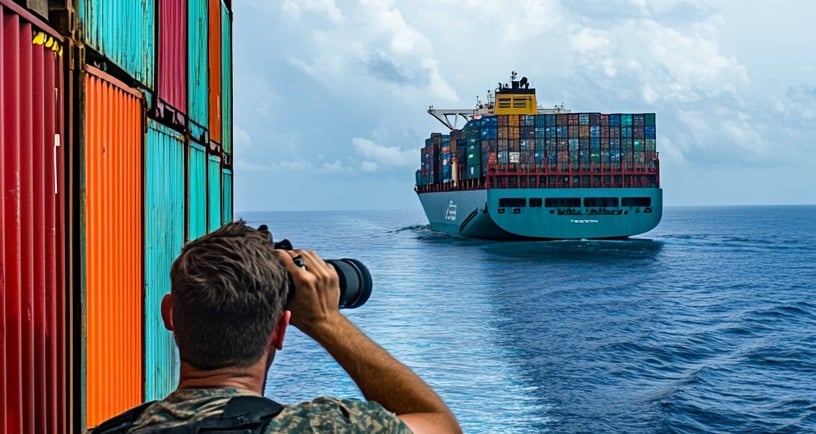
Let's go back to September 2005. You are at the port of Barcelona where warehouse workers are staring at a potential huge problem. Millions of bras. Tens of millions together with trousers, jumpers, and t-shirts. All stacked in shipping containers for days without circulating. This wasn't because of a strike, a storm, or a technology breakdown. It all happened because the European Union had run out of quota.
Earlier that year, the EU had decided it had seen enough of cheap Chinese-made clothing flooding European markets. Worried about the impact on domestic textile jobs - in countries like Italy, France, Portugal and Spain - so Brussels imposed import quotas on Chinese garments. Cap the volume of clothing coming in, protect European manufacturers, keep people working.
What was the effect of this decision? The quotas filled up far faster than anyone expected. By mid-summer, the limit had been reached, and around 75 million garments worth approximately €500 million were stuck at European ports, unable to clear customs. Retailers were furious. They'd already ordered and paid for the stock. In autumn, consumers were walking into shops with bare shelves. And the tabloid newspapers had a great time: the whole thing became known, as "Bra Wars."
Eventually the EU and China negotiated a compromise - some of the blocked quota would be released, future limits would be adjusted - but the damage was done. The Bra Wars episode is one of the most entertaining examples of what happens when governments try to control the flow of trade.
What exactly is a quota? How does one work in the market? Who wins? Who loses? And why do governments keep using this tool even when it causes this sort of awkward situations? That's everything we're covering today.
What Is an Import Quota?
An import quota is a government-imposed restriction that limits the quantity or monetary value of a specific good that can be imported into a country during a given time period.
A quota is a physical cap. It's not a price tax - that's a tariff.
A quota is not a complete ban - that's an embargo. A quota simply says: "You can bring in this much and absolutely no more." Once the ceiling is hit, no more imports come through until the quota resets - which is what happened to all those bras in Barcelona.
So, a quota reduces the supply of imports, raises the domestic price above the world price, expands domestic production, and creates a deadweight welfare loss for society.
Quotas are a form of protectionism - government policies designed to shield domestic industries from foreign competition. You'll find them in agriculture, steel, textiles, electronics, pharmaceuticals, and increasingly in more recent sectors like solar panels and electric vehicle components. They're one of the most widely used (and argued-about) tools in international trade policy.
Internal Assessment (IA) Guide – Free Download
Step-by-step support on topic selection, structure, evaluation, and most common IB Economics IA mistakes.
Understanding key IB Economics Internal Assessment concepts
Applying and explaining them in real-world IB Economics contexts
Building IB Economics IA confidence without drowning in dry theory and explanations.
Download the IA guide now for free and boost your IB Economics grades and confidence
How Does a Quota Actually Work? The Market
We are going to use an IB Economics real-life example so we can understand how the mechanism works: Japan's beef market.
Japan protects its domestic beef farmers with extraordinary care and enthusiasm. Walk into a decent Tokyo restaurant and a quality ribeye can set you back the equivalent of £50 or more. Order the exact same cut in Sydney, and you might pay a third of that price. The beef isn't three times better in Tokyo. The difference is trade protection - specifically, quotas and tariff-rate quotas that limit the volume of Australian and American beef entering the Japanese market.
Let's explain what happens in a market when an import quota is imposed. Here's the process, step by step:
Before the Quota
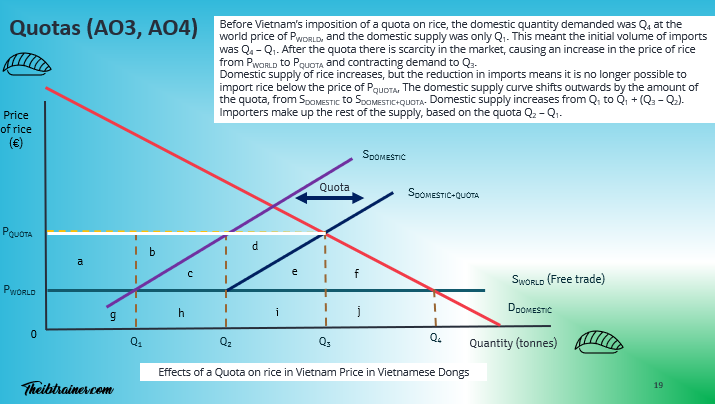
Before Japan restricts beef imports, consumers can buy beef at the world price (PWORLD) - the globally competitive price at which beef trades internationally. At this price, domestic Japanese farmers supply quantity Q1, but Japanese consumers want quantity Q4. The gap - Q4 minus Q1 - is filled by imports. Happy consumers enjoying affordable beef. But not-so-happy domestic farmers struggle to compete on price against larger, more efficient foreign producers.
After the Quota
Japan now caps beef imports at a fixed quantity. Things develop like this:
Supply falls - total supply in the domestic market drops, because imports are now capped below what the market would naturally demand.
Scarcity pushes prices up - the market can no longer clear at the world price. The domestic price rises from PWORLD to the new, higher PQUOTA.
Demand contracts - at the higher price, fewer consumers can or will buy beef. Quantity demanded falls from Q4 to Q3.
Domestic supply expands - because price has risen, domestic farmers now find it profitable to produce more. Domestic supply increases from Q1 to Q2. The domestic supply curve effectively shifts outward by the amount of the quota, from SDOMESTIC to SDOMESTIC+QUOTA.
Foreign producers supply only the quota amount - the remaining supply gap (Q3 minus Q2) is filled by imports, but only up to the quota ceiling.
The final equilibrium: domestic supply (Q2) plus quota imports (Q3 – Q2) equals total quantity supplied (Q3), which equals quantity demanded at PQUOTA. Market clears - but at a higher price, lower quantity, and with significant consequences for every stakeholder involved.
One crucial distinction to keep in mind: unlike a tariff, a quota generates no automatic tax revenue for the government. With a tariff, the government pockets the difference on every unit imported.
So, unlike a tariff, an import quota generates no automatic tax revenue for the government - unless the right to import within the quota is sold via import licences
With a quota, someone else benefits from the higher domestic price - usually domestic producers, or foreign exporters who are lucky enough to be granted an import licence. The government gets nothing unless it actively sells those licences. More on that below.
IB Economics - Syllabus and Programme Full Guide →
Effects of a Quota: Who Wins, Who Loses?
This is the core of your IB Economics answer, and examiners expect you to cover every stakeholder. Let's explain all of them.
1. Consumers: Mostly Losing
The damage is significant for consumers.
Consumers face higher prices, reduced choice, and higher total expenditure following the imposition of an import quota, even though the quantity they purchase falls.
Higher prices. This is the most obvious effect. The restriction on imports drives domestic prices up - that's the whole point of the policy. Japanese beef fans pay more. EU shoppers in 2005 faced empty shelves and, when stock finally arrived, they met higher prices. The consumer pays.
Less choice. Quotas don't just reduce quantity - they reduce variety. Instead of choosing between Argentinian grass-fed, Australian grain-fed, or American wagyu-cross beef, Japanese consumers have only limited access to imported beef options. A lot of what's on the shelves is domestic beef, which may or may not suit everyone's taste or budget.
Higher total expenditure. Even though consumers buy less of the good after the quota, they often spend more in total. Why? Because the price increase is large enough to more than balance the reduction in quantity. This is particularly true when demand is inelastic - and this happens very often for food staples and everyday goods. If you link this to price elasticity of demand in your exam answer, you will get near that grade 6 or 7 you want.
Loss of consumer surplus. In diagram terms, the area a + b + c + d + e + f represents the total loss in consumer surplus following the quota. That's a big chunk of consumer wellbeing that basically vanishes.
2. Domestic Producers: Winning (That's the Whole Point)
Domestic producers are the intended beneficiaries of quotas, and they do benefit - and substantially so.
With imports capped, the domestic price rises and domestic firms can now sell more at a higher margin. Japanese beef farmers who couldn't compete with Australian imports at the world price suddenly find production more profitable. European textile manufacturers who were being undercut by Chinese clothing factories get additional breathing room.
In diagram terms, domestic producer surplus rises by area a + b. Revenue increases because both, price and domestic quantity sold, go up. It's a direct wealth transfer from consumers to producers, promoted by government policy. Whether that's a good use of government intervention is the bigger question, the interesting question - but this is clearly what domestic producers lobby hard for.
3. Foreign Producers: Higher Price, Lower Volume - Net Losers
Foreign producers are hurt in terms of volume - they can only export the quota amount (Q3 – Q2), not the original import volume (Q4 – Q1). That's a significant cut in market delivery. An Australian beef exporter who was selling 4 million kilograms into Japan last year might only be allowed to sell 1 million under the new quota. That's not good news.
Foreign producers receive a higher price per unit under a quota but lose significant export volume - typically resulting in a net fall in total export revenues.
However, foreign producers do receive the higher PQUOTA price for every unit they do sell. So their producer surplus on the remaining quota units rises by area c + d. They get more money per unit. But in general it doesn't compensate for the volume loss. Overall foreign revenue falls, foreign producers lose out on a net basis, and they may need to redirect those exports to other markets or focus more on their local, domestic consumers.
You used to sell 100 sandwiches a day at £3 each (£300 revenue). Now you can only sell 25, but the price is £5 each (£125 revenue). Sure, the margin per sandwich went up. But your total revenue has collapsed. That's the foreign producer's experience under a quota.
4. Government: Limited Financial Gain
As we mentioned before, a key difference between a quota and a tariff, is that a quota generates no automatic revenue for the government.
With a tariff, every imported unit generates tax income for the Treasury. With a quota, the government simply limits the number of imports - the higher domestic price benefits domestic producers (and foreign producers holding licences), it does not profit the state.
The government may raise some revenue by selling import licences - the right to import goods within the quota. But this depends entirely on how the quota system itself is designed. It's not a guaranteed income stream.
On top of that, there are enforcement costs: customs monitoring, legal frameworks, verification systems. All of this costs money. So in pure financial terms, the government isn't gaining from a quota - and at the same time, it is probably spending cash to maintain the quota.
Why do governments use them, then? Politics. Strategic industrial policy. National security. And sometimes, genuine concern about the long-run health of domestic industries. More on that at the end.
5. Society and Economic Welfare: Net Loss
Quotas create what economists call a deadweight welfare loss - a net loss to society that no stakeholder manages to keep. On your diagram, this is represented by the two triangular areas e + f.
So, the welfare loss from an import quota consists of two triangular areas on the supply-demand diagram: one representing the cost of propping up inefficient domestic producers, and one representing the consumer surplus lost as some buyers can no longer afford the product at the higher quota price.
Triangle e - inefficient domestic production. Under free trade, some domestic producers aren't competitive enough to exist in the market. They simply can't produce at the world price. The quota artificially props them up by raising the price - but this means society is using resources (land, labour, capital) on production in a fundamentally inefficient way. Those resources could be deployed elsewhere in the economy more productively. Triangle e represents that wasted cost.
Triangle f - lost consumer surplus. Some consumers who could afford the product at the world price simply cannot afford it at the higher quota price. Those transactions never happen. That value - the enjoyment and utility those consumers would have gained - is permanently lost. Triangle f puts a monetary value on that loss.
Add e and f together, and you have the net welfare loss to society from the quota. It's not transferred to anyone - it just disappears. This is why most economists are deeply sceptical of protectionism: it redistributes welfare from consumers to producers, but it also destroys some of that welfare in the process. When it comes to net values, society is worse off.
Every episode of Pint-Sized links back to what matters most for your IB Economics course:
Understanding key IB Economics concepts
Applying them in real-world IB Economics contexts
Building IB Economics course confidence without drowning in dry theory.
Subscribe for free to exclusive episodes designed to boost your IB Economics grades and confidence
Calculating the Effects of a Quota - HL Students (AO4)
IB Economics SL students: feel free to read this for deeper understanding of quotas, but this calculation work won't be required in your exams. IB Economics HL students: this is absolutely key material in IB Economics Paper 3 HL, and these numbers need to be clean and fast.
Let's run the numbers on a worked example. The EU imposes a quota of 20 million pairs on imported trainers from Asian manufacturers. Here's the full data set:
World price (pre-quota): €40 per pair
Quota price (post-quota): €55 per pair
Pre-quota quantity demanded: 120 million pairs
Post-quota quantity demanded: 100 million pairs
Pre-quota domestic supply: 60 million pairs
Post-quota domestic supply: 80 million pairs
Quota (foreign supply allowed): 20 million pairs
Quick check: 80m (domestic) + 20m (quota imports) = 100m = quantity demanded at €55.
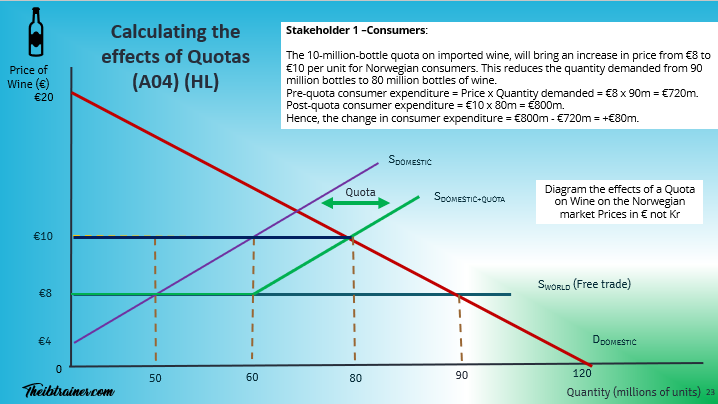
Stakeholder 1 - Consumers
The quota pushes the price of trainers from €40 to €55, reducing the quantity purchased from 120 million to 100 million pairs.
Pre-quota consumer expenditure = €40 × 120m = €4,800m
Post-quota consumer expenditure = €55 × 100m = €5,500m
Change in consumer expenditure = €5,500m − €4,800m = +€700m
Consumers are spending €700 million more to buy 20 million fewer pairs of trainers. That's the quota doing doing the damage.
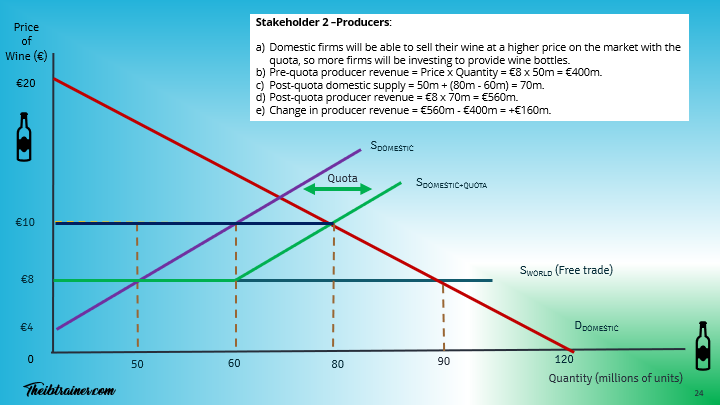
Stakeholder 2 - Domestic Producers
European trainer manufacturers can now sell more pairs at a significantly higher price - great news for revenue.
Pre-quota domestic revenue = €40 × 60m = €2,400m
Post-quota domestic supply = 60m + (100m − 80m) = 80m pairs
Post-quota domestic revenue = €55 × 80m = €4,400m
Change in domestic producer revenue = €4,400m − €2,400m = +€2,000m
That's almost double revenue for domestic producers. You can see immediately why the domestic industry lobbies hard for this kind of protection.
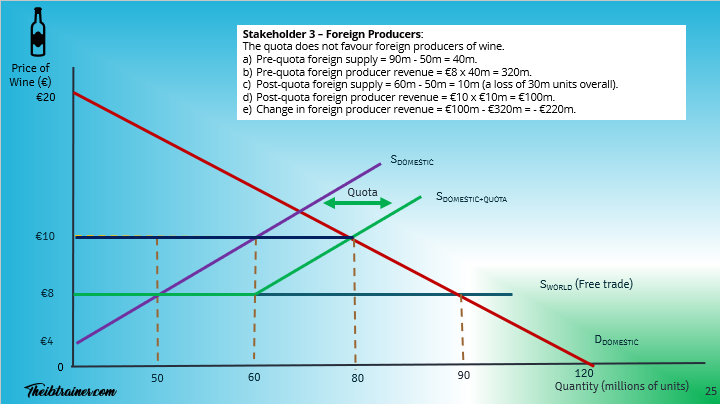
Stakeholder 3 - Foreign Producers
Asian manufacturers are now limited to selling only 20 million pairs - down from 60 million. Higher price per unit, but in exchange of a significant lower volume.
Pre-quota foreign supply = 120m − 60m = 60 million pairs
Pre-quota foreign revenue = €40 × 60m = €2,400m
Post-quota foreign supply = 20 million pairs (quota ceiling)
Post-quota foreign revenue = €55 × 20m = €1,100m
Change in foreign producer revenue = €1,100m − €2,400m = −€1,300m
They get €15 more per pair, but they've lost 40 million pairs' worth of sales. The maths doesn't lie: revenue down by over half.
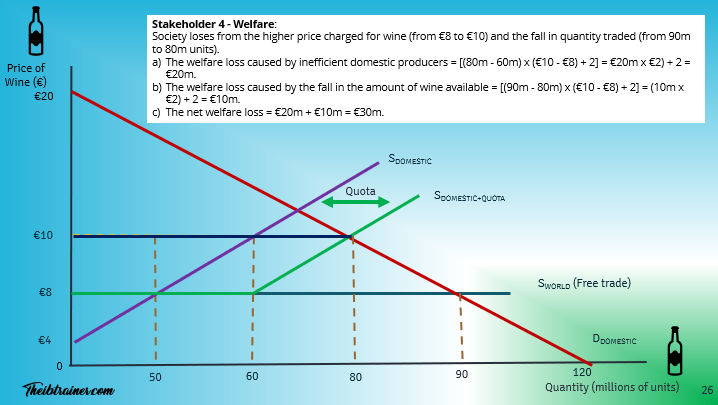
Stakeholder 4 - Welfare Loss
Society pays a real price for this protection. The net welfare loss has two components, both calculated as the area of a triangle (½ × base × height):
Welfare loss from inefficient domestic production (Triangle e):
= ½ × (80m − 60m) × (€55 − €40)
= ½ × 20m × €15
= €150m
Welfare loss from fall in consumption (Triangle f):
= ½ × (120m − 100m) × (€55 − €40)
= ½ × 20m × €15
= €150m
Total net welfare loss = €150m + €150m = €300m
With the quota, three hundred million euros of economic value simply vanish. It doesn't go to the government. It doesn't go to producers. It doesn't go to foreign exporters. It's just gone - consumed by inefficiency and lost transactions. That's what the deadweight loss triangles represent in real money.
For access to all IB Economics exam practice questions, model answers, IB Economics complete diagrams together with full explanations, and detailed assessment criteria, explore the Complete IB Economics Course
So Why Do Governments Still Use Quotas?
If all the stakeholders (except domestic producers) lose out, why do governments keep using them? It's a fair question, and if you get a good IB Economics essay question in your exams it would be something similar to this.
By the way, the honest answer is: politics, strategy, and occasionally genuine economic necessity.
Strategic industries. The UK and EU both maintain steel import quotas - particularly relevant since Russia's invasion of Ukraine disrupted European energy and metals markets. When geopolitical tensions flare, governments don't want to be entirely dependent on a potentially hostile country for steel. That's a national security argument, not an economic efficiency argument. But it's real.
Food sovereignty. Japan's famous agricultural protectionism isn't purely about economics - it's about ensuring Japan could feed itself in a crisis. Post-COVID supply chain disruptions made this argument more compelling than ever. Countries that are entirely dependent on food imports are vulnerable to market-based progress and development.
Infant industry protection. The WTO does allow developing economies to use quotas to protect emerging industries that couldn't survive global competition in the short run. The idea is: give a young industry time to develop, gain scale, and become competitive before removing protection. It's controversial - many infant industries never grow up and become permanently dependent on protection - but at least in this case the justification for protection is legitimate.
Trade leverage. Quotas can be used as bargaining chips. "Ease your quota on our exports and we'll ease ours on yours." That's trade negotiation at its best.
But - from a pure welfare economics standpoint, free trade wins on efficiency grounds almost every time. Quotas redistribute welfare from consumers to domestic producers, and they destroy some of that welfare in the process by creating deadweight loss. IB Economics exams usually want you to understand why quotas exist and why they're economically costly. Both things are true.
IB Economics Diagrams Programme, What's included:
200+ exam-ready diagrams covering the entire IB Economics syllabus
Video for every diagram showing you exactly how each model looks
Image version perfect for modelling diagrams in you essays, presentations, and your IA
Detailed written explanations of the IB Economics theory behind each diagram
Both SL and HL IB Economics diagrams clearly labelled and organised by topic
Real IB Economics exam application showing how to use diagrams effectively in Paper 1 and Paper 2
Quick Revision Checklist
Before you move on, make sure you can do all these things:
Define an import quota clearly and concisely (standalone definition - examiners will test this)
Draw the quota diagram correctly: show PWORLD, PQUOTA, Q1, Q2, Q3, Q4, the outward shift of the supply curve, and the deadweight welfare loss triangles e and f
Explain the effect on domestic price, domestic quantity demanded, domestic supply, and import volume
Analyse the impact on each stakeholder: consumers, domestic producers, foreign producers, government, and society
Identify and explain the two welfare loss triangles (inefficient production vs. lost consumer surplus)
Explain how a quota differs from a tariff (particularly the absence of government revenue)
(HL only) Calculate changes in consumer expenditure, domestic producer revenue, foreign producer revenue, and net welfare loss using the triangle formula
Frequently Asked Questions: Import Quotas (IB Economics)
Q1: What is an import quota in IB Economics?
A: An import quota is a government-imposed limit on the quantity of a specific good that can be imported into a country during a set time period. It restricts supply, raises domestic prices above the world price, and protects domestic producers from foreign competition - at a cost to consumers and overall economic welfare.
Q2: How does an import quota affect consumers?
A: Consumers face higher prices and reduced product choice. Even though they buy less of the good, total consumer expenditure usually increases because the price rise more than compensates for the fall in quantity - especially when demand is inelastic. Consumer surplus falls by the area a + b + c + d + e + f on the quota diagram.
Q3: What is the difference between a quota and a tariff?
A: A tariff is a tax on imported goods that raises prices and generates revenue for the government. A quota directly caps the quantity of imports and generates no automatic government revenue (unless import licences are sold). Both raise domestic prices and protect domestic producers, but the key distinction is the government revenue effect.
Q4: What is the welfare loss caused by an import quota?
A: The welfare (deadweight) loss has two components: triangle e represents the economic cost of sustaining inefficient domestic producers who would not survive under free trade; triangle f represents the consumer surplus permanently lost because some buyers can no longer afford the product at the higher quota price. Neither loss is transferred to any stakeholder - it is simply destroyed.
Q5: Why do governments impose import quotas if they reduce economic welfare?
A: Governments use quotas to protect domestic jobs, safeguard strategic industries (such as steel or agriculture), ensure national food or resource security, or as leverage in trade negotiations. While quotas are economically inefficient in terms of welfare, they can be justified on grounds of national security, industrial strategy, or the need to support developing-economy industries that cannot yet compete globally.
Stay well,
Related Topics:
IB Economics your IB Economics daily guide
IB Economics The Global Economy access Quotas here as well as the rest of the module 4
IB Economics Activity book Module 4 The Global Economy Unit 4.3 for Types of trade protection exam practice, activities, model answers and IB Economics Marking schemes
IB Economics Market Equilibrium for exploring in depth the Price Mechanism & Resource Allocation. It has a direct relationship with welfare loss and efficient resource allocation
IB Economics Benefits of International Trade - Explore this topic as contrast to trade protectionism policies such as Quotas
IB Economics Diagrams Check Unit 26 for All Types of trade protection including Quotas diagrams with explanations
IB Economics Price elasticity of demand, and IB Economics elasticity, both are basic to understand the effect on the market
IB economics Calculations Book make sure you check unit 23 for Benefits of International trade and types of trade protection HL calculations exercises, IB model answers, and IB marking schemes
Read Next: IB Economics Subsidies
© Theibtrainer.com 2012-2026. All rights reserved.
Legal
Have a Tip? Send us a tip using our anonymous form