
IB Econ Quotas
Target Question:
What is a quota in IB Economics and how does it affect trade?
Everything you need to understand, and evaluate import quotas for your IB Economics course - theory, welfare effects, quota rent, real-world examples, diagrams and exam technique.
Full activity practice breakdown, exam practice, model answers and evaluation tools are available exclusively in the IB Economics Activity Book.


What Is a Quota?
A quota: Is a physical limit on the quantity of a good that can be imported into a country over a given period. Unlike a tariff, which raises the price of imports, a quota restricts the volume directly - forcing the domestic price up as a consequence of the restricted supply.
Quotas are classified as a non-tariff barrier (NTB) to trade and, like tariffs, are a form of protectionism. The World Trade Organisation (WTO) generally discourages their use, preferring tariffs as a more transparent and less distorting form of protection.
IB Economics definition:
A quota is a quantitative restriction on imports that sets a maximum limit on the volume of a good allowed into a country, raising the domestic price above the world price and reducing import competition.
Types of quota:
Absolute quota - a hard limit on import volume; once reached, no further imports are permitted
Tariff-rate quota (TRQ) - a lower tariff applies up to a specified import volume; imports above that threshold face a higher tariff rate
Voluntary Export Restraint (VER) - technically an export quota agreed by the exporting country under political pressure, but functioning identically to an import quota from the importing country's perspective
In terms of trade protection, only absolute Quotas, Tariffs and Export Subsidies are part of the IB Economics syllabus.
How Quotas Work: The Welfare Analysis
The quota diagram is one of the most important in IB Economics international trade. Starting from a free trade equilibrium at the world price:
A quota is imposed - limiting import volume to a fixed quantity
Domestic supply + quota = total supply - total supply at the world price is now less than demand
Domestic price rises - above the world price, to the point where the market clears with the restricted import volume
This creates four welfare effects:
Consumers lose - they pay higher prices on all units consumed; consumer surplus falls significantly
Domestic producers gain - higher prices increase their producer surplus
Two deadweight loss triangles appear - one from inefficient domestic production drawn in by the higher price; one from consumption priced out of the market
Quota rent is created - the area representing the value of being allowed to import under the quota
The difference from a tariff: with a tariff, the government automatically captures the equivalent of the quota rent as tax revenue. With a quota, the quota rent accrues to whoever holds the import licence - typically foreign exporters or domestic importers. This is an important evaluation point: quotas may be no more protective than tariffs but deliver less government revenue and create rent-seeking incentives.
IB Economics Quota Diagram - Full Visual Guide →
Quota Rent: Who Captures the Benefit?
Quota rent is the economic gain that is generated from the right to import at the world price and sell at the higher domestic price. It equals the price difference multiplied by the quota volume.
Who captures quota rent depends on how import licences are allocated:
If the government auctions licences, it captures the rent as revenue - making the quota economically equivalent to a tariff
If licences are given free to domestic importers, domestic firms capture the rent
If the exporting country negotiates a VER, foreign exporters capture the rent - a significant disadvantage of VERs from the importing country's perspective
The existence of quota rent creates rent-seeking behaviour - firms and lobby groups spend resources trying to obtain import licences rather than improving productive efficiency.
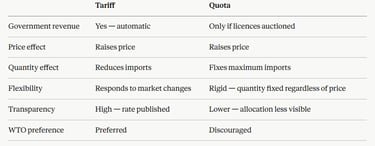
Quotas vs Tariffs: Key Differences
This is directly examined in IB Economics and requires genuine critical thinking.
Key evaluation point: a quota is more specific when restricting quantities - if a government wants to guarantee no more than X tonnes of steel imported, a quota achieves this regardless of world price changes. A tariff at the equivalent level would allow more imports if world prices fall. This makes quotas more attractive for industries where volume control is the priority - but at a greater economic efficiency cost.
Real-World Quota Examples
OPEC production quotas - the Organisation of Petroleum Exporting Countries allocates production quotas to member countries, restricting global oil supply to support prices. This is technically an export quota cartel rather than an import quota, but it functions as a supply restriction with global price effects - this is directly relevant to IB Economics discussions of commodity markets and resource economics.
Agricultural quotas (EU and Japan) - the EU's Common Agricultural Policy historically used production quotas (dairy milk quotas ran from 1984 to 2015) to prevent surpluses and support farm incomes.
Japan maintains tight import quotas on rice, permitting only minimal access volumes (around 770,000 tonnes annually) under WTO commitments. Both examples illustrate the political economy of agricultural protection - domestic farmers are a concentrated, organised interest group, while consumers carry individually small costs.
Fishing quotas - international fishing agreements allocate national quotas for fish stocks to prevent the tragedy of the commons - the overexploitation of shared fish stocks that would occur if fishing were unrestricted. The EU's Common Fisheries Policy uses total allowable catch (TAC) limits distributed as national quotas. This is a case where quotas correct market failure (negative externality from overfishing) rather than just protecting domestic producers.
Textile quotas (historical) - the Multi-Fibre Arrangement (MFA, 1974-2005) governed global textile trade through a complex system of bilateral quotas, largely protecting developed country textile industries from cheaper developing country exports. Its abolition in 2005 is a significant case study in trade liberalisation and development.
Quotas and Development Economics
The relationship between quotas and development economics needs to be addressed by IB Economics students.
Import substitution industrialisation (ISI) - many developing countries in the post-war period used import quotas alongside tariffs to protect domestic industries from foreign competition, allowing them to develop behind protective barriers. Countries like Brazil, India, and South Korea used import restrictions as part of broader industrialisation strategies. Results were mixed: some industries developed genuine competitiveness; others became permanently dependent on protection.
Agricultural quotas in developed countries harm developing country exporters - when the EU, US, or Japan restricts agricultural imports through quotas, developing countries with absolute and comparative advantage in agriculture lose market access. This is a major point of contention in WTO negotiations and relevant to IB Economics discussions of trade and development.
Export quotas on commodities - some developing countries impose export quotas on raw materials to force downstream processing domestically, capturing more value from their resources. This strategy has limitations: trading partners may retaliate, and the higher domestic input prices can put manufacturers at an obvious disadvantage.
IB Economics - Syllabus and Programme Full Guide →
Quotas in the IB Economics Exam
Quotas appear in the IB Economics exam primarily:
IB Economics Paper 1 - essay questions may ask students to explain quota welfare effects with diagrams, compare quotas and tariffs, or evaluate arguments for and against protectionism. A strong 15-mark response will include the welfare diagram, genuine evaluation of both sides, and a supported judgement on policy effectiveness.
IB Economics Paper 2 - data response questions may present trade data involving quotas and ask students to identify welfare effects, assess policy, or discuss development implications.
IB Economics Paper 3 HL - extended questions may integrate quota analysis with market failure, development economics, or comparative advantage.
Most common exam mistakes: drawing the quota diagram without labelling the quota rent area; confusing quota rent with government revenue; failing to compare quotas with tariffs as an evaluation point; not connecting agricultural quotas to development economics impacts.
IB Economics Trade Protection - Full Comparison Guide →
IB Economics Tariffs - Full Guide →
IB Economics Development Economics - Full Guide →
IB Economics Diagrams Course
Every quota diagram you need - including the welfare effects breakdown, quota rent area, and the quota vs tariff comparison - fully labelled with video.
✔ Complete quota welfare diagram with all areas labelled
✔ Quota vs tariff side-by-side comparison
✔ 200+ diagrams covering the full syllabus
✔ Both SL and HL content clearly labelled
Frequently Asked Questions: Quotas in IB Economics
What is a quota in IB Economics? A quota is a quantitative limit on the volume of a good that can be imported. It raises the domestic price above the world price by restricting supply, reducing consumer surplus, increasing domestic producer surplus, creating two deadweight loss triangles, and generating quota rent - the gain from buying at the world price and selling at the higher domestic price.
What is the difference between a quota and a tariff? Both raise the domestic price and reduce imports, but through different mechanisms. A tariff raises the price directly; a quota restricts quantity. The key differences are that a tariff automatically generates government revenue, responds flexibly to world price changes, and is more transparent. A quota fixes the import volume regardless of price changes and its revenue benefit depends on how import licences are allocated.
What is quota rent? Quota rent is the economic gain created by the right to import under a quota - equal to the price difference between the domestic and world price multiplied by the quota volume. Who captures it depends on licence allocation: governments capture it by auctioning licences; domestic importers capture it if licences are distributed free; foreign exporters capture it under voluntary export restraints (VERs).
Why does the WTO prefer tariffs to quotas? The WTO prefers tariffs because they are more transparent, more flexible, and less distorting than quotas. Tariff rates are published and quantifiable; quotas involve less visible allocation decisions and create rent-seeking incentives. Under WTO rules, countries are generally required to convert existing quotas into equivalent tariffs - a process called tariffication.
How do quotas relate to development economics in IB Economics? Agricultural import quotas in developed countries restrict market access for developing country exporters, undermining their comparative advantage in farming. Conversely, developing countries have used import quotas as part of import substitution industrialisation strategies. The effectiveness of this approach is debated - some industries developed genuine competitiveness behind quota protection; others became permanently dependent on it without becoming internationally competitive.
Current Global Quota Systems (2024-2025)
UK Steel Safeguards - Comprehensive Trade Protection Britain's steel safeguard quotas protecting against import surges, with tariff-rate quotas allowing limited tariff-free imports before 25% duties apply.
US Steel Tariffs and Quotas - Section 232 Measures President Trump's 25% tariffs on steel imports from the UK and other countries, replacing previous quota systems, demonstrating the shift from quotas to tariffs.
EU Steel Safeguards - Regional Trade Protection The European Commission's steel safeguard measures with increasingly restrictive tariff-rate quotas to protect against global overcapacity.
China Steel Overcapacity - Global Trade Imbalance China's massive steel overcapacity estimated at 602 million tonnes in 2024, leading to export surges affecting global markets.
Agricultural Quota Examples
EU Common Agricultural Policy - Agricultural Quotas Historical milk quotas and current sugar quotas under the EU's Common Agricultural Policy.
US Agricultural Import Quotas - Food Security Measures American quotas on sugar, dairy, and other agricultural products to protect domestic farmers.
Japanese Rice Quotas - Cultural and Economic Protection Japan's minimal access quotas for rice imports balancing WTO obligations with domestic protection.
WTO Agriculture Agreement - Quota Commitments How WTO rules require minimum access quotas for agricultural products in developed countries.
Textile and Clothing Quotas
Multi-Fibre Arrangement History - Quota Systems in Textiles The historical Multi-Fibre Arrangement (MFA) that governed global textile trade through quotas until 2005.
Current Textile Restrictions - Modern Quota Systems Remaining textile quotas and restrictions in various countries post-MFA abolition.
Developing Country Textile Exports - Quota Impacts How textile quotas historically affected developing country exports and industrialisation.
Energy and Resource Quotas
Oil Export Quotas - OPEC Production Limits How OPEC uses production quotas to control oil supply and influence global prices.
Rare Earth Export Quotas - China's Resource Diplomacy China's historical quotas on rare earth exports and their impact on global technology supply chains.
Fishing Quotas - Sustainable Resource Management International fishing quotas designed to prevent overfishing and preserve marine resources.
Related Topics:
IB Economics your IB Economics daily guide
IB Economics The Global Economy access Quotas here as well as the rest of the module 4
IB Economics Activity book Module 4 The Global Economy Unit 4.3 for Types of trade protection including quotas exam practice, activities, model answers and IB Economics Marking schemes
IB Economics Market Equilibrium for exploring in depth the Price Mechanism & Resource Allocation. It has a direct relationship with welfare loss and efficient resource allocation
IB Economics Benefits of International Trade - Explore this topic as contrast to trade protectionism policies such as Quotas
IB Economics Diagrams Check Unit 26 for All Types of trade protection including Quotas diagrams with explanations
IB Economics Price elasticity of demand - and IB Economics elasticity both are basic to understand the effect on the market
IB economics Calculations Book make sure you check unit 23 for Benefits of International trade and types of trade protection including quotas HL calculations exercises, IB model answers, and IB marking schemes
Read Next: IB Economics Subsidies

© Theibtrainer.com 2012-2026. All rights reserved.
Legal
Have a Tip? Send us a tip using our anonymous form