
IB Economics Subsidies & Administrative Barriers
Discover how government subsidies and administrative barriers affect global trade! Perfect guide for IB Economics students with real examples and exam tips.
IB ECONOMICS HLIB ECONOMICSIB ECONOMICS SLIB ECONOMICS THE GLOBAL ECONOMY / INTERNATIONAL TRADE
Lawrence Robert
5/1/202517 min read
The €369 Billion Problem: How Government Subsidies Reshape Global Trade
Target Question:
How do production subsidies affect consumers, producers and welfare in IB Economics?
In August 2022, Joe Biden signed a piece of legislation called the Inflation Reduction Act. It didn't make the front page in most European newspapers. But behind closed doors in Brussels, Paris, and Berlin, there was an immediate reaction.
Why? Because the IRA quietly committed $369 billion in subsidies and tax incentives for American clean energy industries - electric vehicles, solar panels, wind turbines, battery manufacturing, green hydrogen. This meant American firms building EVs in America would receive subsidies of up to $7,500 per vehicle. European carmakers like Volkswagen, Stellantis and Renault? Would get nothing.
Europe took action immediately. Volkswagen accelerated plans for a battery Gigafactory in Canada instead of Germany. The EU's trade commissioner described the IRA as a direct threat to European industry. French President Macron called it "super aggressive." The entire episode became one of the biggest trade disputes of the 2020s - not over tariffs, not over quotas, but over subsidies.
And that's exactly what today's post is about. Subsidies are one of the most powerful, most controversial, and most frequently misunderstood tools in trade protection. They don't block imports at the border the way tariffs and quotas do. They work from the inside, efficiently reshaping a domestic industry's cost structure until foreign competitors simply become second best.
What Is a Trade Subsidy?
IB Economics definition - Subsidy:
A subsidy is a form of financial assistance provided by a government to domestic firms that lowers their costs of production and enables them to compete more favourably against foreign rivals.
So the government quietly pays part of a domestic company's bills. The firm can then produce more, charge less, or both - giving it a competitive edge over foreign firms that don't get the same helping hand.
There are two main types of trade subsidies you need to know for IB Economics:
1. Production Subsidies
The most common form. A production subsidy reduces directly the costs of domestic firms, allowing them to produce more at any given market price. The world price doesn't change. Consumer prices don't change. But domestic output expands and imports shrink. We'll cover the mechanics in detail below.
2. Export Subsidies
Less common, and more controversial internationally. An export subsidy targets firms that sell goods abroad, incentivising them to export more. Unlike a production subsidy, an export subsidy changes the domestic price - it rises by the amount of the subsidy. This is because domestic firms can earn the higher subsidised price by exporting, so they're no longer willing to sell domestically at the lower world price. Consumers at home lose out. We'll cover this separately.
Producer subsidies as trade protection do not change the world price paid by consumers or the amount they purchase.
Price stays at PW. Quantity demanded stays at Q3. The subsidy works entirely on the supply side. This makes subsidies fundamentally different from tariffs and quotas, where consumers always feel the impact.
How Does a Production Subsidy Work? The Market Mechanics
IB Economics definition - Production Subsidy:
A production subsidy does not change the world price paid by consumers or the total quantity they purchase. Consumer price remains at the world price and consumer surplus is unchanged - making production subsidies less visible and less politically controversial than tariffs or quotas.
Here's an IB Economics Real-life example to illustrate this: UK wheat farming.
Britain has been subsidising its farmers for decades - first through the EU's Common Agricultural Policy (CAP), and post-Brexit through its own system of agricultural support payments. At the world price for wheat, many British farmers simply cannot compete with cheaper imports from Ukraine, Canada, or Argentina, where land costs are lower and farms are far larger in scale. Without subsidies, British wheat production would shrink significantly, imports would rise, and British rural farming communities would be seriously affected.
So the government steps in. Here's what happens in the market, step by step:
Before the Subsidy
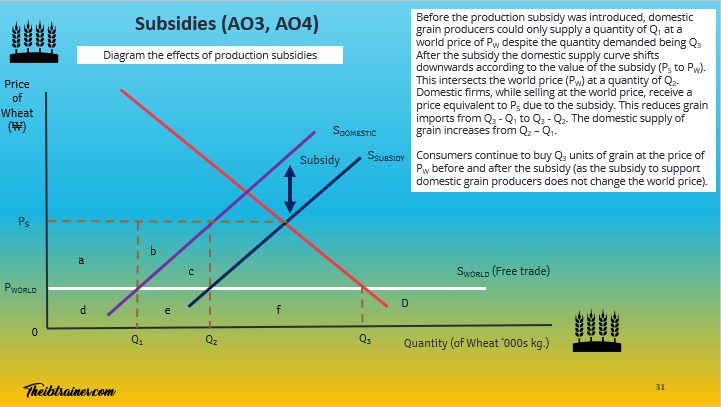
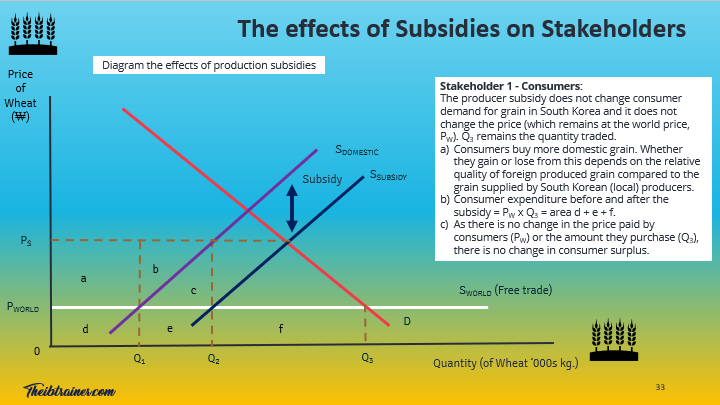
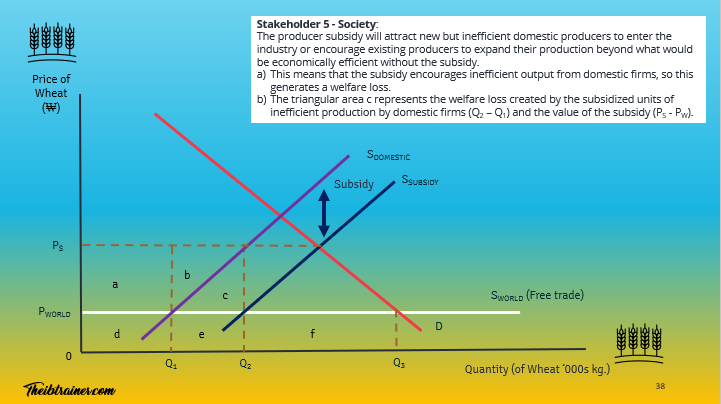
UK wheat consumers can buy at the world price (PW). At this price, domestic UK farmers only supply quantity Q1 - many can't produce profitably below the cost that the world price reflects. Total demand is Q3, so the gap (Q3 – Q1) is filled by imported wheat. This is the typical free trade outcome: consumers get cheap bread, domestic farmers struggle.
After the Production Subsidy
The government now pays domestic wheat farmers a per-unit subsidy - the difference between PS (the subsidy price that producers receive) and PW (the world price consumers still pay). Here's what follows:
The domestic supply curve shifts downward by the value of the subsidy - from SDOMESTIC to a new, lower curve. This means domestic farmers can now profitably supply more wheat at the world price, because their effective production cost has fallen.
Domestic supply increases from Q1 to Q2. More UK farmers find it worthwhile to grow wheat. Some who were previously unprofitable at the world price can now operate viably with government support.
Imports fall from (Q3 – Q1) to (Q3 – Q2). The gap between domestic demand and domestic supply narrows, so fewer imports are needed.
Consumer price stays at PW. This is a key concept. UK shoppers buying bread, pasta, or cereal still pay the world price. Nothing changes on the consumer side. The subsidy works entirely behind the scenes, between the government and domestic producers.
Domestic firms sell at PW but effectively receive PS - the world price plus the government top-up.
So someone is secretly paying part of your restaurant bill. The restaurant charges you the full menu price. You pay the menu price. But someone has slipped some cash under the table to cover part of it. The restaurant gets fully paid; you didn't notice a thing. That's a production subsidy.
For access to all IB Economics exam practice questions, model answers, IB Economics complete diagrams together with full explanations, and detailed assessment criteria, explore the Complete IB Economics Course
Effects of a Production Subsidy: Stakeholder by Stakeholder
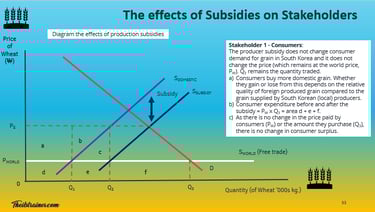
Stakeholder 1 - Consumers: Unchanged
A lot of my students have problems understanding this the first time: a production subsidy doesn't help consumers directly at all. At least, not in terms of price or quantity.
The price consumers pay remains at PW - the world price. No discount, no benefit.
The quantity consumers purchase remains at Q3. No change in total availability.
Consumer expenditure stays the same: PW × Q3 before and after the subsidy.
There is no change in consumer surplus.
There is one potential indirect effect: consumers now buy more domestically produced goods. Whether that's positive it depends on whether domestic production is as good as imported alternatives. If UK wheat is just as good as Ukrainian wheat, fine. If domestic quality is lower, consumers might complain quietly - but that can't be shown on a diagram.
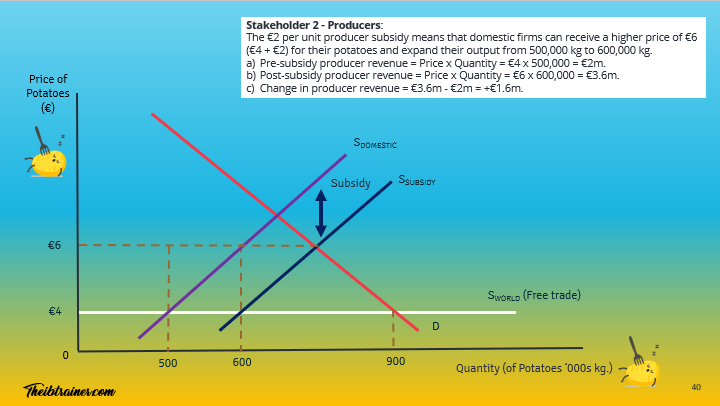
Stakeholder 2 - Domestic Producers: Winners
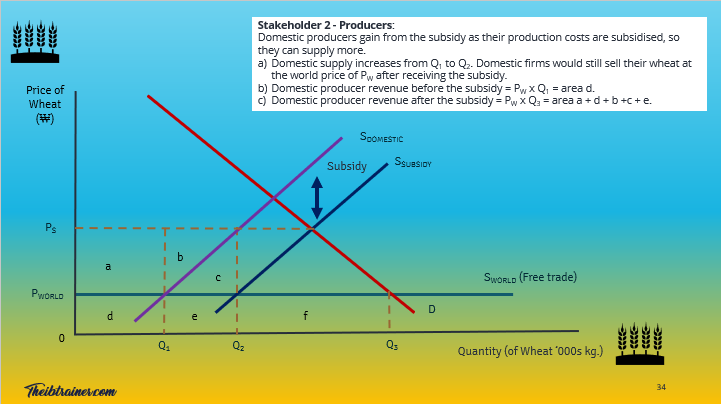
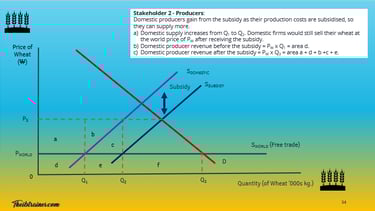
Domestic firms are the intended winners, and they do win - there is no doubt about this.
Output increases from Q1 to Q2 as production becomes profitable for more firms.
Domestic firms sell at the world price PW - but with the government topping them up to PS, their effective revenue per unit is higher.
Producer revenue rises: pre-subsidy it was PW × Q1; post-subsidy it's effectively PS × Q2. A significant jump.
More firms can viably operate, employment in the sector rises, and existing firms can expand.
This is exactly the story of UK farming post-Brexit. The government replaced EU CAP payments with its own ELMS scheme (Environmental Land Management), continuing to support domestic agricultural output - this time with a greener, environmentally friendly focus.
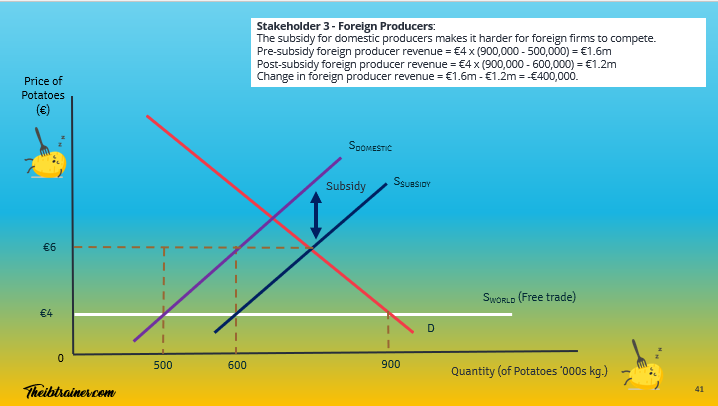
Stakeholder 3 - Foreign Producers: Squeezed Out
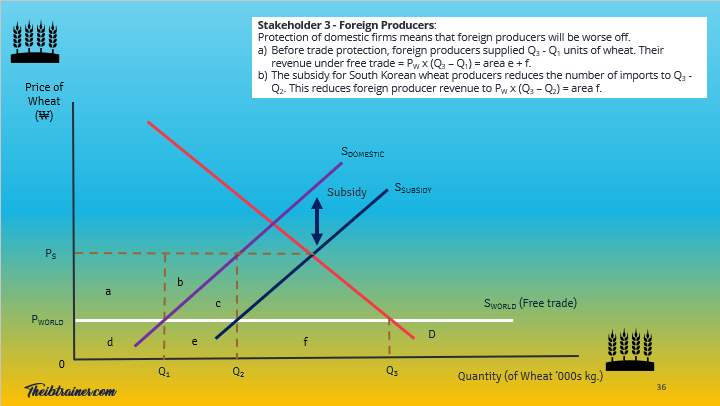
Foreign producers are silent losers. There is no direct policy applied to them - no tariff, no quota. But the expanded, stronger domestic supply eats into their market share anyway.
Before the subsidy, foreign producers supplied Q3 – Q1 units at the world price PW. Revenue = PW × (Q3 – Q1).
After the subsidy, imports fall to Q3 – Q2. Foreign revenue = PW × (Q3 – Q2). A clear reduction.
The world price hasn't changed - they're just selling fewer units into this market.
This is exactly why Ukrainian, Canadian and Argentine wheat exporters have pushed back against EU and UK agricultural subsidies for years. From their perspective, they're being beaten not on merit, but because a foreign government is paying part of their competitor's costs.
Stakeholder 4 - Government: Paying the Bill
Every subsidy has to be funded from somewhere, and that somewhere is the taxpayer. This is the cost side of the whole system that often ignored in policy debates.
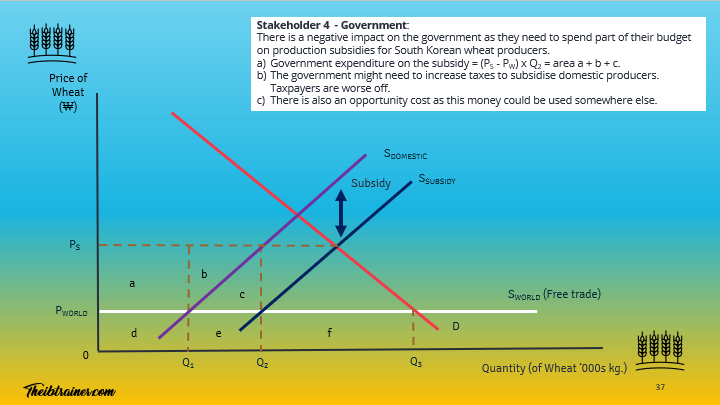
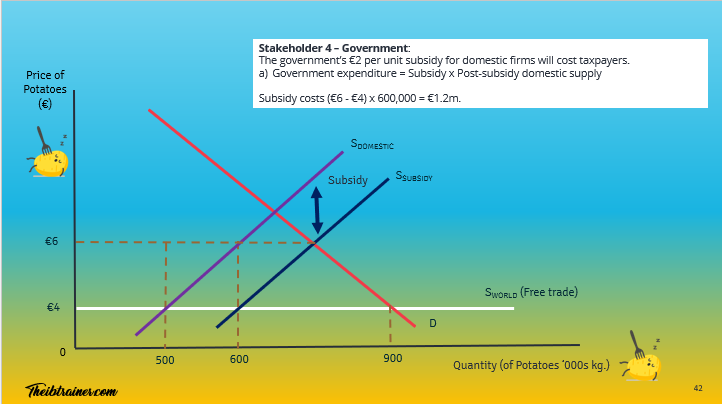
The cost of a production subsidy to the government equals the per-unit subsidy multiplied by total post-subsidy domestic output: (PS − PW) × Q2.
Government expenditure on the subsidy = (PS – PW) × Q2 - the per-unit subsidy multiplied by the total quantity of supported domestically produced goods.
This represents a real budget cost. To fund it, the government must either raise taxes, cut spending elsewhere, or borrow.
There is a significant opportunity cost: that same money could have been spent on hospitals, schools, infrastructure, or R&D. By choosing to subsidise domestic producers it means those alternatives will probably never happen.
IB Economics Real-life Example:
In the EU, the Common Agricultural Policy (CAP) consumes roughly a third of the entire EU budget - about €55 billion per year. That is an enormous opportunity cost for 27 countries. It's kept millions of European farmers in business, but it's also diverted staggering sums away from other public priorities.
Stakeholder 5 - Society: Welfare Loss From Inefficiency
The welfare loss from a production subsidy is represented by a triangle on the supply-demand diagram, reflecting the cost of sustaining inefficient domestic producers who could not survive at the world price without government financial support.
So, a production subsidy welcomes inefficient producers into the market - firms that could not survive at the world price without government support. They're not competitive globally. They produce only because the subsidy covers their cost and operational disadvantage. This generates a welfare loss for society, shown on the diagram as the triangular area c.
Triangle c represents the cost of the inefficient output produced between Q1 and Q2 - units that cost more to produce domestically than they would cost if you import them at the world price. It's a waste of resources. Society would be better off (in pure efficiency terms) by letting those firms exit the market and importing the goods instead.
Note: this welfare loss is smaller than under a tariff or quota, because at least consumers are not paying higher prices. But it still exists, so don't forget to identify it.
Every episode of Pint-Sized links back to what matters most for your IB Economics course:
Understanding key IB Economics concepts
Applying them in real-world IB Economics contexts
Building IB Economics course confidence without drowning in dry theory.
Subscribe for free to exclusive episodes designed to boost your IB Economics grades and confidence
Export Subsidies: When Governments Pay Firms to Sell Abroad
Rather than supporting domestic production generally, an export subsidy specifically incentivises firms to sell their goods to foreign markets. So the government is telling domestic producers: "Every unit you export abroad, we'll top you up."
The effects on the domestic market of an export subsidy are different from those of a production subsidy.
Unlike a production subsidy, an export subsidy raises the domestic price for consumers, because domestic producers can earn the higher subsidised price by exporting and are therefore unwilling to sell domestically at the lower world price.
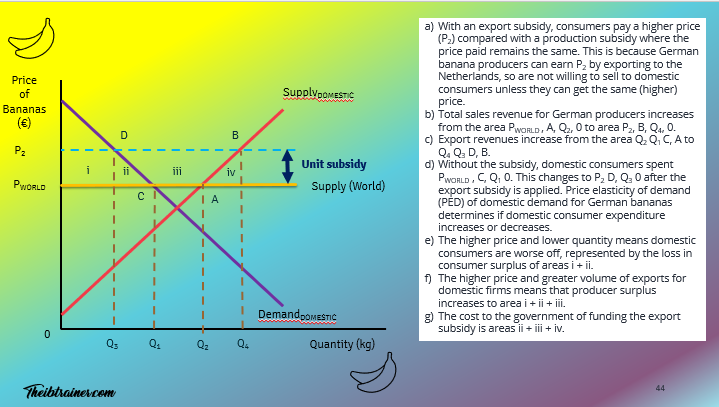
Let's use a hypothetical example: a European country subsidising its banana exports to neighbouring markets.
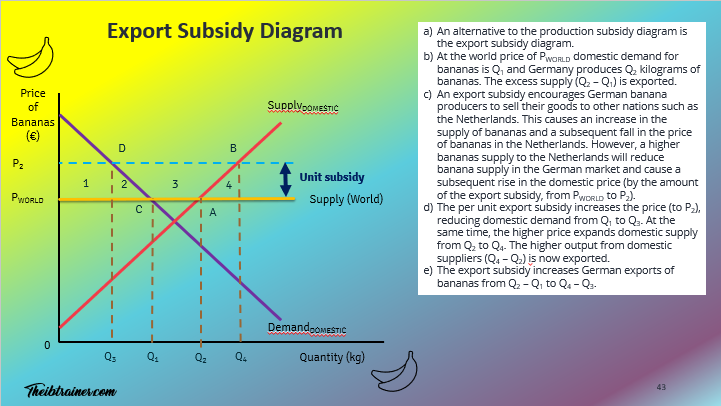
Before the export subsidy, at the world price (PWORLD), domestic demand is Q1 and domestic supply is Q2. The excess supply (Q2 – Q1) is already being exported - producers are selling abroad because they produce more than domestic consumers want at the world price.
Now the government introduces an export subsidy:
Domestic producers can now earn a higher price (P2) by exporting - so they redirect supply toward export markets to capture that higher subsidised price.
This reduces domestic supply, causing the domestic price to rise from PWORLD to P2. Domestic consumers now face higher prices - this is different from a production subsidy where prices were unchanged.
At the higher domestic price P2, domestic demand falls from Q1 to Q3. Domestic supply expands from Q2 to Q4.
Exports increase significantly: from (Q2 – Q1) to (Q4 – Q3). Producers are exporting more and selling to domestic consumers less.
The welfare consequences:
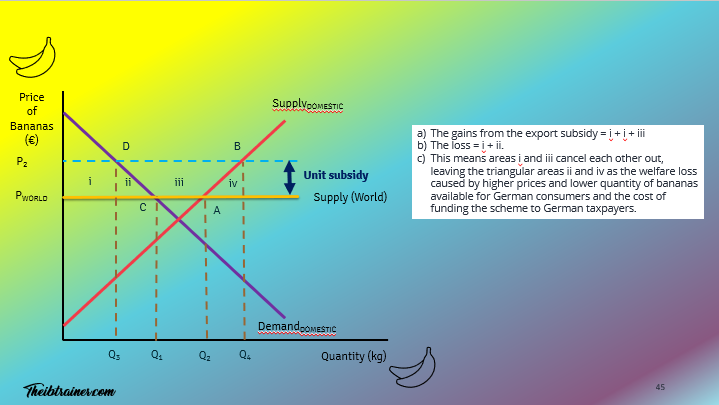
Consumers lose: higher domestic prices and lower domestic quantities - consumer surplus falls by areas i + ii.
Producers gain: higher prices and greater export volumes - producer surplus rises by areas i + ii + iii.
Government spends: the cost of the export subsidy is areas ii + iii + iv.
Net welfare loss = triangular areas ii + iv: representing the cost to consumers of higher prices and the cost to taxpayers of funding the scheme, after producer gains net out.
Export subsidies are heavily restricted under WTO rules because they distort global markets, undercut foreign producers, and effectively dump subsidised goods into overseas markets. The US-EU Boeing-Airbus dispute - which ran for nearly two decades at the WTO and resulted in billions in retaliatory tariffs - was fundamentally a fight about whether government support for aircraft manufacturers constituted illegal export subsidisation. Even the world's two most powerful trading blocs couldn't agree on where legitimate industrial support ends and unfair subsidy begins.
IB Economics - Syllabus and Programme Full Guide →
Calculating the Effects of Production Subsidies (HL Students - AO4)
IB Economics SL students: read this for context but HL calculation work won't be required in your exams. IB Economics HL: clean and structured - every step must be shown.
Let's work through a full numerical example. The UK government introduces a £80 per tonne production subsidy for domestic wheat farmers. Here's the data:
World price (PW): £200 per tonne
Subsidy per unit: £80 per tonne
Effective price received by domestic producers (PS): £280 per tonne
Pre-subsidy domestic supply: 5 million tonnes
Post-subsidy domestic supply: 7 million tonnes
Total quantity demanded (unchanged throughout): 12 million tonnes
Stakeholder 1 - Consumers
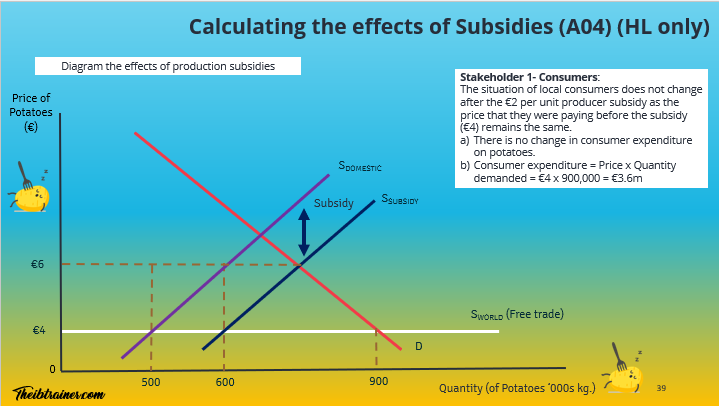
The production subsidy does not change the price that consumers pay, nor the amount they purchase. The world price remains at £200 per tonne and quantity demanded remains at 12 million tonnes.
Consumer expenditure before subsidy = £200 × 12m = £2,400m
Consumer expenditure after subsidy = £200 × 12m = £2,400m
Change in consumer expenditure = £0
Change in consumer surplus = £0
No winners, no losers here. The consumer is entirely insulated from the subsidy.
Stakeholder 2 - Domestic Producers
Domestic wheat farmers can now receive £280 per tonne (world price + subsidy) and expand output from 5 million to 7 million tonnes.
Pre-subsidy domestic producer revenue = £200 × 5m = £1,000m
Post-subsidy domestic producer revenue = £280 × 7m = £1,960m
Change in domestic producer revenue = £1,960m − £1,000m = +£960m
Almost double revenue. UK wheat farmers are considerably better off.
Stakeholder 3 - Foreign Producers
Expanded UK domestic supply squeezes imports without any direct policy action against foreign exporters.
Pre-subsidy foreign supply = 12m − 5m = 7 million tonnes
Pre-subsidy foreign revenue = £200 × 7m = £1,400m
Post-subsidy foreign supply = 12m − 7m = 5 million tonnes
Post-subsidy foreign revenue = £200 × 5m = £1,000m
Change in foreign producer revenue = £1,000m − £1,400m = −£400m
Foreign wheat exporters lose £400 million in revenues - not because of a tariff or quota being applied, but because a foreign government made their competitors artificially more competitive.
Stakeholder 4 - Government
The government pays the subsidy on every unit of domestic production - not just on the additional units, but on the full post-subsidy output.
Government expenditure = Subsidy per unit × Post-subsidy domestic supply
= £80 × 7m = £560m
That's £560 million in taxpayer money going to support UK wheat production. And remember - that's money that cannot simultaneously be spent on the NHS, schools, or public infrastructure. The opportunity cost is obvious.
Administrative Trade Barriers
IB Economics definition - Administrative barriers:
Administrative barriers are government-imposed standards, regulations, and bureaucratic procedures that increase the costs or delays faced by foreign firms, creating a competitive advantage for domestic producers without directly restricting import quantities or imposing price taxes.
Unlike tariffs, quotas, or subsidies, administrative barriers don't normally look like protectionism. They look like consumer protection. Food safety regulations. Environmental standards. Health inspections. Product certification requirements. Labelling rules. And it is true that sometimes, they genuinely are about consumer protection. But other times - often - they're also quietly designed to make life very difficult for foreign competitors.
IB Economics Real-life Examples:
Japan and foreign cars. For decades, Japan has required all imported cars to pass a unique Japanese safety certification process that domestic cars don't need - because Japanese cars are tested to domestic standards during production. Foreign carmakers had to pay for separate testing, separate inspections, and separate certifications. What is the effect of this? Japan consistently has one of the lowest rates of foreign car ownership among major economies. Japan's roads are full of Toyotas, Hondas, and Suzukis. German or American cars are a rarity. Is this a coincidence? Not really.
Chlorinated chicken and post-Brexit trade. When the UK began negotiating a trade deal with the United States after Brexit, one of the most contentious issues was American chlorine-washed chicken. The US cleans chicken carcasses with chlorine to kill bacteria. The EU (and UK) ban the practice - not because chlorine is necessarily harmful, but because EU/UK food standards require the entire production chain to be clean enough to make chemical washing unnecessary. American poultry producers call it a technical barrier designed to block cheap US chicken. European regulators call it consumer protection. Both sides are, in their own way, correct.
China and foreign tech. China's regulatory requirements for foreign internet platforms, data storage, and technology products are so extensive - local data servers required, government security reviews, licensing hurdles - that most Western tech firms (Google, Facebook, Twitter) have found it practically impossible to operate in China. The Great Firewall is the most famous version. Administrative barriers at their very best.
EU product standards and regulations. The EU's REACH regulations (chemicals), CE marking requirements (electronics and machinery), and GDPR (data) all impose significant compliance costs on foreign firms seeking to enter European markets. Domestic firms already operate within these frameworks. Foreign firms have to build entirely new compliance infrastructure. That asymmetry is, partly by design, and at the same time, an obvious competitive advantage for the European industry.
The Effect on Stakeholders
The economic logic of administrative barriers is straightforward:
Foreign firms face higher costs to comply with regulations, reducing their competitiveness and potentially preventing market entry altogether.
Domestic firms gain a competitive advantage - they already meet domestic standards, so the administrative burden falls almost entirely on foreign competitors.
Consumers may benefit from genuinely higher safety and quality standards - or they may lose out from reduced choice and higher prices if the regulations are primarily of a protectionist nature.
Overall efficiency may fall, as markets become less competitive and resources are wasted on compliance rather than production.
Embargoes: The Extreme Administrative Barriers
IB Economics definition - Embargo:
An embargo is an extreme form of administrative trade barrier that completely bans trade with a specific country or the import of specific goods. Embargoes are typically politically motivated and rarely benefit domestic consumers, who lose out from reduced choice and higher prices.
The most extreme form of administrative barrier is the embargo - a complete ban on trade with a specific country, or on specific goods from that country.
Embargoes are almost always politically motivated. They're imposed as economic punishment following political disputes, human rights violations, or military aggression. Some recent examples:
Western sanctions on Russia (2022–present): Following Russia's full-scale invasion of Ukraine, the EU, UK, US, and allies imposed sweeping embargoes on Russian oil, gas, coal, luxury goods, and financial services - the most significant package of economic sanctions since the Second World War. Russia responded with its own counter-embargoes on European food imports.
US embargo on Cuba: In place since 1962, the US embargo on Cuba restricts almost all trade and financial transactions with the island. It is one of the longest-standing embargoes in modern history.
China's trade restrictions on Australia (2020–2023): After Australia called for an independent inquiry into the origins of COVID-19, China imposed unofficial embargoes on Australian wine, barley, coal, beef, and lobster - affecting billions in export revenues. The restrictions were quietly lifted in 2023 as diplomatic relations improved.
The economics of embargoes are clear: domestic consumers lose out from lack of choice and higher prices. Domestic producers in affected sectors may benefit if imports are replaced by domestic alternatives. The targeted country's export industries suffer significant revenue losses. And there is almost always the risk of retaliatory escalation, as China-Australia and Russia-EU demonstrated.
IB Economics Summary
Of all the trade protection tools - tariffs, quotas, subsidies, admin barriers - production subsidies are arguably the most politically popular. But why?
Consumers don't notice. Prices don't change. There's no visible "tax on imports." No angry consumers complaining at the supermarket checkout. The cost is hidden in the government budget, and shown to all taxpayers as a barely perceptible increase in public spending.
Domestic producers visibly benefit. Jobs are preserved or created. Factories stay open. Farmers keep farming. Politicians get credit. The benefit is concentrated and visible; the cost is diffuse and invisible. That's a very comfortable political dynamic.
They're harder to retaliate against. A country hit with a tariff can impose a counter-tariff. A subsidy is more difficult to respond to - you can file a WTO complaint, but that takes years. The US and EU were at the WTO over Boeing and Airbus subsidies for seventeen years before reaching a temporary truce in 2021.
The American IRA episode shows subsidies are still very much alive: the world's most sophisticated trading blocs are still fighting subsidy wars in the 2020s, just updated the terminology. Now they use terms such as green transition and industrial strategy rather than old-fashioned protectionism.
Quick Revision Checklist
Before moving on, make sure you can:
Define a production subsidy and an export subsidy clearly
Explain why a production subsidy does not change consumer price or quantity demanded (unlike a tariff or quota)
Draw and explain the production subsidy diagram: downward shift of supply curve, new domestic output Q2, unchanged world price PW, reduced imports
Analyse the effects on all five stakeholders: consumers, domestic producers, foreign producers, government, and society
Identify the welfare loss triangle c (inefficient domestic production)
Explain how an export subsidy differs from a production subsidy, and its effects on domestic consumers
Define administrative trade barriers and give at least two real-world examples
Define an embargo and explain its economic effects on consumers, producers, and welfare
(HL only) Calculate changes in consumer expenditure, domestic producer revenue, foreign producer revenue, and government spending from a production subsidy
Frequently Asked Questions: Production Subsidies (IB Economics)
Q1: What is a production subsidy in IB Economics?
A: A production subsidy is a government payment to domestic firms that reduces their costs of production, enabling them to supply more at any given market price and compete more effectively against cheaper foreign imports. Unlike tariffs and quotas, production subsidies do not raise the price paid by consumers - the world price is unchanged.
Q2: Why doesn't a production subsidy affect consumers?
A: Because a production subsidy works on the supply side only. The government pays domestic producers directly, lowering their costs without restricting the flow of cheaper imports. Consumers can still buy at the world price, so their expenditure, quantity demanded, and consumer surplus remain unchanged.
Q3: What is the difference between a production subsidy and an export subsidy?
A: A production subsidy reduces domestic production costs across the board - domestic consumers see no price change. An export subsidy specifically rewards firms for selling goods abroad, which draws supply away from the domestic market, raises domestic prices, and harms domestic consumers. Export subsidies are more controversial internationally and more tightly restricted by WTO rules.
Q4: What are administrative trade barriers? Can you give examples?
A: Administrative barriers are regulations, standards, and bureaucratic rules that make it more costly or difficult for foreign firms to enter a domestic market. Examples include Japan's unique vehicle safety certification requirements for imported cars, the EU's chemical compliance regulations (REACH), and China's data localisation rules for foreign tech companies. They can serve genuine consumer protection purposes, but are often also deliberately protectionist.
Q5: What is an embargo and what are its economic effects?
A: An embargo is a complete ban on trade with a specific country or on specific goods. It is typically imposed for political reasons rather than purely economic ones. The economic effects include higher prices and reduced choice for domestic consumers, possible gains for domestic producers who substitute for banned imports, and significant export revenue losses for the targeted country. Embargoes frequently trigger retaliatory trade restrictions.
Stay well,
Related Topics:
IB Economics your IB Economics daily guide
IB Economics The Global Economy access Production Subsidies here as well as the rest of the module 4
IB Economics Absolute & Comparative Advantage useful to review World price / comparative advantage at this stage
IB Economics Activity book Module 4 The Global Economy Unit 4.3 for Types of Trade Protection and Subsidies exam practice, activities, model answers and IB Economics Marking schemes
IB Economics Diagrams Check Unit 26 for All Types of trade protection and Subsidies diagrams with explanations
IB Economics Trade Protection - The logical next step - check what happens when trade is restricted
IB Economics Market Failure for revising Welfare loss / deadweight loss
IB Economics Price Elasticity of Demand PED to fully understand the export subsidy consumer expenditure discussion
IB economics Calculations Book make sure you check unit 23 for Types of trade Protection and Subsidies HL calculations exercises, IB model answers, and IB marking schemes
Read Next: IB Economics Trade Protection
© Theibtrainer.com 2012-2026. All rights reserved.
Legal
Have a Tip? Send us a tip using our anonymous form