IB Business Management Paper 1 Pre-Release Case Study May 2026
Abraca (ABC) Pre-Release Case Study Analysis, Predicted Questions & Model Answers, IB Business Management May 2026 examinations - SL and HL students.
IB BUSINESS MANAGEMENT SLIB BUSINESS MANAGEMENT MODULE 5 OPERATIONS MANAGEMENTIB BUSINESS MANAGEMENTIB BUSINESS MANAGEMENT MODULE 2 HUMAN RESOURCE MANAGEMENTIB BUSINESS MANAGEMENT MODULE 3 FINANCE AND ACOUNTSIB BUSINESS MANAGEMENT 1 INTRODUCTION TO BUSINESS MANAGEMENTIB BUSINESS MANAGEMENT HLIB BUSINESS MANAGEMENT MODULE 4 MARKETINGIB BUSINESS MANAGEMENT TOOLKIT
Lawrence Robert
4/1/202622 min read


The Complete Student Guide to Abraca (ABC): Pre-Release Analysis, Predicted Questions & Model Answers
Everything you need to walk into the May 2026 examination with confidence - for both SL and HL students.
Primary question:
What is the Abraca (ABC) IB Business Management May 2026 pre-release case study, and what questions and model answers should students prepare?
Every year, the IB releases a brief pre-release statement a few months before the Paper 1 examination. A few paragraphs. Some terminology. A fictional company. And for many students, that is where preparation stops - with a quick read and a vague plan to "have a look at it later."
The students who score highest do the opposite. They treat the pre-release as a roadmap. Because if you know how to read it, it tells you almost in detail what is coming.
This guide is designed to do that reading for you - and to take you all the way through to full model answers at every mark level, including the HL 20-mark essay. Whether you are sitting SL or HL, this is the most thorough preparation resource available for the May 2026 Paper 1.
The case study company is Abraca (ABC) - Country Z's largest concrete producer, and the unlikely owner of a revolutionary e-waste processing discovery. Let's get into it.
1. Understanding Paper 1: What You Are Actually Being Tested On
Paper 1 is the pre-released case study paper. The IB Business board publishes a brief statement about a fictionalised business several months before the exam. In the examination room, students receive the full case study - including those opening paragraphs they have already seen - and answer structured questions based on it.
Paper 1 Format at a Glance
Paper 1 is the same examination paper for both SL and HL students. Duration: 1 hour 30 minutes. Maximum mark: 30.
Section A (approximately 20 marks) - answer all questions. This section contains a mix of short-answer questions using command terms such as "state," "describe," and "explain." Expect around five to six questions of varying mark allocations: typically [2]-mark state questions, a [4]-mark describe or explain question, and a [6]-mark theory-application question in which students must apply a named business management theory, concept or toolkit (such as Ansoff's Matrix or Maslow's hierarchy) directly to the case study.
Section B (10 marks) - answer one question from a choice of two. Both questions often use "discuss" as the command term and require a balanced, well-applied argument with a clear conclusion.
The pre-release statement serves a specific purpose: it alerts students to terminology and topics that sit outside the standard Business Management syllabus, but which will appear in the full case study. Students are expected to spend up to five hours researching these areas before the exam. This guide covers everything you need.
How to Use This Guide
Read the business profile section first to understand ABC in depth. Then work through the syllabus map and SWOT so you can connect the case study to theory. Study the predicted questions, then - crucially - read the model answers and understand why they score highly, not just what they say. Finally, memorise the arguments bank before your exam. This guide covers all question types you are likely to encounter: from [2]-mark "state" questions through to the [10]-mark Section B discuss question.
2. Meet Abraca (ABC): The Business in Full
Abraca - trading as ABC - is Country Z's largest concrete producer. On the surface, that sounds straightforward: a big industrial company selling building materials to the construction industry. But the pre-release statement reveals a more complex business than the description originally suggests.
The Core Business
ABC purchases large quantities of limestone and clay - the raw aggregates used to manufacture cement, which is then used to make concrete. This is ABC's bread and butter. It operates in a business-to-business (B2B) market: its customers are construction companies, developers, and infrastructure contractors rather than individual consumers. Concrete is essentially a commoditised product - meaning it is difficult to differentiate from competitors' offerings, so competition tends to be driven by price, reliability, and volume.
The Accidental Discovery
While researching whether recycled materials could be used as aggregates in concrete, ABC's scientists stumbled upon something entirely different: a process to recover gold and other precious metals from electronic circuit boards - at room temperature.
This matters enormously. The previous method for extracting precious metals from circuit boards required burning them at extremely high temperatures - a carbon-intensive process with significant environmental consequences. ABC's room-temperature process is cleaner, cheaper, and potentially patentable. It is, in business strategy terms, a breakthrough that arrived as a by-product of research aimed at something else entirely.
The E-Waste Operation
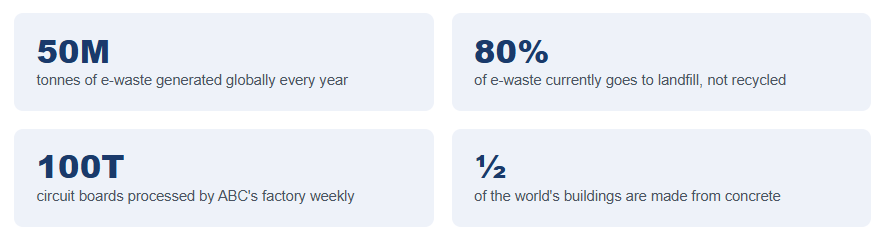
In 2024, ABC opened a dedicated factory to process e-waste. Every week, this factory processes 100 tonnes of circuit boards sourced from discarded electronics - computers, mobile phones, games consoles. Annually, it recovers hundreds of kilograms of gold, which ABC sells to jewellery manufacturers.
The Four Strategic Priorities
The pre-release statement closes with four bullet points that students should treat as a direct signal from examiners. These are not filler - they are the four themes that will drive the examination questions. ABC is considering:
Read This Carefully - These Are Your Exam Themes
1. Increasing efficiencies in its current concrete production
2. Methods to reduce its impact on the environment
3. Becoming more market-orientated
4. Growth options
Every question on Paper 1 will connect to one or more of these four themes. Your revision should be structured around them.
3. Key Terminology
The pre-release lists 13 terms that students should be familiar with before entering the exam room. Below are IB-style definitions for each - precise, clear, and suitable for use in exam answers.
Aggregates
Raw construction materials - such as limestone, clay, gravel, and sand - used in the manufacture of cement and concrete. Aggregates form the bulk of concrete's composition by volume.
Business-to-business (B2B)
A commercial transaction or business model in which a company sells its products or services to other businesses rather than to individual consumers. ABC sells concrete to construction companies and gold to jewellery manufacturers - both B2B relationships.
Carbon-intensive
A process, industry, or activity that produces large quantities of carbon dioxide (CO₂) and other greenhouse gas emissions. The previous method of burning circuit boards to recover metals was carbon-intensive; ABC's room-temperature process is not.
Circuit boards
The flat electronic components found inside computers, mobile phones, and other devices that connect and support electronic components. Circuit boards contain recoverable precious metals - including gold and silver - alongside toxic materials.
Clay
A naturally occurring fine-grained mineral used as a key raw aggregate in cement and concrete manufacturing. ABC purchases clay in large quantities as part of its core production inputs.
Concrete
A widely used construction material produced by mixing cement, water, and aggregates. Concrete is ABC's primary product and forms the structural basis of approximately half the world's buildings.
E-waste
Discarded electronic products - such as computers, mobile phones, games consoles, and televisions - that have reached the end of their useful life. E-waste often contains toxic metals alongside recoverable precious metals including gold and silver.
Landfill
A site where waste is buried in the ground, often with environmental consequences. Currently 80% of global e-waste ends up in landfill, where toxic metals can leach into soil and groundwater.
Limestone
A sedimentary rock and key raw material used in the production of cement. When heated, limestone releases calcium oxide - the primary active ingredient in cement - making it essential to ABC's manufacturing process.
Plastic-shredding machinery
Industrial equipment used to break down plastic waste into smaller particles suitable for recycling or reprocessing. This may feature in ABC's e-waste handling process, given that circuit boards contain plastic casings alongside metal components.
Recycling
The process of converting waste materials into new usable products or raw materials, thereby reducing the need for virgin resources and minimising landfill. ABC's e-waste operation is fundamentally a recycling business.
Solar panels
Devices that convert sunlight into electrical energy, providing a renewable and low-carbon power source. Installing solar panels could help ABC reduce the carbon footprint of its energy-intensive manufacturing operations.
Toxic metals
Heavy metals such as lead, mercury, and cadmium found in electronic components that pose significant environmental and health risks when improperly disposed of. Their presence in landfill-bound e-waste is a key driver of the environmental argument for ABC's recycling model.
4. Syllabus Map: What to Revise and Why
The four strategic themes from the pre-release map directly onto IB Business Management syllabus units. Here is exactly where to focus your revision.
Theme 1 - Increasing Efficiencies
Module 5 - Operations Management
Lean production (Kaizen, JIT, TQM)
Capacity utilisation
Automation and technology
Theme 2 - Environmental Impact
Unit 1.3 - Business Objectives & CSR
Environmental sustainability
Circular economy concept
Stakeholder impact (communities, government)
Triple bottom line (people, planet, profit)
Theme 3 - Market Orientation
Module 4 - Marketing
The 7Ps marketing mix (Product, Price, Place, Promotion, and People, Processes, and Physical Evidence)
Target markets and segmentation
Branding and differentiation (B2B context)
Theme 4 - Business Growth Options
Unit 1.6 - Growth and Evolution
Ansoff's Matrix (all four strategies)
Organic vs. inorganic growth
Beyond these four themes, you should also revise the following, as they connect directly to the business profile of ABC:
Additional Revision Areas
Unit 1.2 - Types of business organisation: ABC is a publicly held company. Know the implications: shareholders, share capital, regulatory requirements, separation of ownership and control.
Unit 1.4 - Stakeholders: Construction firms, jewellery makers, local communities near landfill, government regulators, shareholders, and employees all have distinct interests in ABC's decisions.
Unit 5.7 - Research and Development: ABC's e-waste discovery is a product of R&D. The unexpected nature of the discovery raises interesting questions about product vs. market orientation.
5. SWOT Analysis of Abraca (ABC)
Every student sitting Paper 1 should arrive in the exam room with a SWOT analysis of ABC mentally prepared. You will not be asked to write the full SWOT - but its contents are the raw material for almost every question you will face. Memorise the key points and deploy them where relevant.
Strengths
Largest concrete producer in Country Z - economies of scale and market dominance
Publicly held - access to capital markets for funding growth
Proprietary room-temperature e-waste extraction process - unique, low-carbon, potentially patentable
First-mover advantage in sustainable precious metal recovery
Two diversified revenue streams (concrete + gold)
Proven scientific capability and in-house R&D
Established B2B relationships in the construction sector
Weaknesses
Concrete manufacturing is carbon-intensive - significant emissions from core business
Concrete is a commoditised product - difficult to differentiate on quality alone
Dependent on external supply of e-waste (circuit boards) - supply chain vulnerability
E-waste processing is new and unproven at scale
Currently limited to Country Z - no geographic diversification
Management attention stretched across two very different businesses
Opportunities
80% of 50 million tonnes of global e-waste currently goes to landfill - enormous untapped supply
Growing ESG investor demand - ABC's green credentials could raise its share price
Increasing government regulation on e-waste disposal globally
Develop recycled-aggregate concrete - the original research goal - as a premium product
License the room-temperature extraction process to other companies or countries
Expand e-waste processing internationally (market development)
Circular economy trend strengthens the commercial case for ABC's model
Threats
Competitors may eventually replicate or reverse-engineer the extraction process
Carbon taxes and emissions regulation could significantly raise ABC's concrete production costs
Gold price volatility directly affects e-waste revenue
Construction industry downturns reduce demand for concrete
Reputational risk if e-waste processing generates toxic by-products
Alternative construction materials (timber, recycled plastics) could disrupt concrete demand in the long-term
6. Predicted Exam Questions
Based on the pre-release statement, the four strategic themes, and the question patterns of recent IB Business Management Paper 1 examinations (2024, 2025), the following are the most likely areas of focus. Paper 1 is the same examination for all students - the 30 marks are split across Section A (all questions, approximately 20 marks) and Section B (one discussion question, 10 marks).
Section A - Possible Questions
State two stakeholders of ABC. [2 marks]
State two methods of growth available to ABC. [2 marks]
Define the term "publicly held company." [2 marks]
Define the term "e-waste." [2 marks]
Define the term "market-orientated." [2 marks]
Describe two ways ABC could increase efficiency in its concrete production. [4 marks]
Explain one advantage and one disadvantage for ABC of being a publicly held company. [4 marks]
Explain two ways in which ABC could reduce its environmental impact. [4 marks]
Explain two reasons why ABC's entry into e-waste processing represents a diversification strategy. [4 marks]
Referring to Ansoff's Matrix, explain two growth strategies available to ABC. [6 marks]
Referring to two stakeholders of ABC, explain the impacts of the e-waste factory on each. [6 marks]
Referring to a relevant motivation theory, explain two ways ABC could motivate workers in its e-waste factory. [6 marks]
Section B - Possible Discussion Questions (choose one from two)
Discuss the growth options available to ABC. [10 marks]
Evaluate the decision by ABC to become more market-orientated. [10 marks]
Discuss the methods ABC could use to reduce its impact on the environment. [10 marks]
Discuss the potential impacts on ABC's stakeholders of expanding its e-waste processing operation. [10 marks]
7. Model Answers
This section provides full model answers at every mark level. Read each one carefully - not just as text to memorise, but to understand the structure and technique being used. That understanding is transferable to whichever specific question appears in your exam.
2-Mark Questions - Define / State [2]
1- Define the term "publicly held company." [2 marks]
Mark scheme guidance: Award [1] for a basic definition identifying share ownership by the public. Award a further [1] for development - e.g. shares listed on a stock exchange, separation of ownership and control, regulatory requirements, or ability to raise large amounts of capital.
Model Answer
A publicly held company is a business whose shares are listed on a stock exchange and are available for purchase by members of the general public. [1] As a result, ownership is distributed among potentially thousands of shareholders, and the company is subject to greater regulatory scrutiny and financial reporting requirements than a privately held company. [1]
Lawrence's tip: Do not simply write "a company owned by the public." That alone scores [0] - it is too vague. You must reference shares, the stock exchange, or shareholder ownership to access the first mark, and add specific development to secure the second.
2 - Define the term "e-waste." [2 marks]
Mark scheme guidance: Award [1] for identifying e-waste as discarded electronic products. Award a further [1] for development - e.g. examples of products, reference to toxic materials, or environmental consequence.
Model Answer
E-waste refers to discarded electronic products - such as computers, mobile phones, and games consoles - that have reached the end of their useful life. [1] These products frequently contain toxic metals and hazardous materials that pose significant environmental risks when sent to landfill rather than being properly recycled. [1]
Lawrence's tip: Linking your definition back to the ABC case study (e.g. mentioning circuit boards or ABC's processing factory) is not required for [2] but demonstrates strong contextual awareness, which is a habit worth building for the longer-answer questions.
3- Define the term "market-orientated." [2 marks]
Mark scheme guidance: Award [1] for identifying that the business bases decisions on customer needs/wants. Award a further [1] for development or contrast with product orientation.
Model Answer
A market-orientated business is one that makes its decisions based on the needs, wants, and preferences of its customers, using market research to guide product development, pricing, and promotional strategy. [1] This approach contrasts with a product-orientated business, which develops products based on what it can produce rather than what customers actually want to buy. [1]
4-Mark Questions - Explain Two [4]
1- Explain two advantages of ABC being a publicly held company. [4 marks]
Mark scheme guidance: Award [1] for each advantage identified + [1] for each explanation in context of ABC. Maximum [2] per advantage. Maximum [4] total.
Model Answer
One advantage is that ABC can raise substantial capital by issuing shares to the public on a stock exchange. [1] This is particularly relevant given ABC's growth ambitions: funding the expansion of its e-waste processing operations, or investing in new concrete manufacturing technologies, would require significant capital that might not be available through retained profit alone. [1]
A second advantage is that public listing raises ABC's profile and credibility with potential B2B clients and partners. [1] Large construction companies awarding long-term concrete supply contracts may favour suppliers who operate with the financial transparency and regulatory oversight that publicly held companies are legally required to demonstrate, increasing trust and the likelihood of securing significant commercial agreements. [1]
Lawrence's tip: Notice how every sentence connects the advantage back to ABC's specific situation. Generic advantages ("can raise money," "is well-known") score only [1] per point. Application - linking the advantage to ABC's concrete business, e-waste plans, or B2B context - is what unlocks the second mark each time.
2- Explain two ways in which ABC could reduce its environmental impact. [4 marks]
Mark scheme guidance: Award [1] for each method identified + [1] for explanation applied to ABC. Accept any two relevant methods with contextual explanation.
Model Answer
One method would be for ABC to invest in renewable energy - such as solar panels - to power its factories. [1] Concrete manufacturing is an energy-intensive process; switching to clean energy sources would significantly reduce the carbon emissions associated with ABC's core production operations without requiring changes to the production process itself. [1]
A second method would be to scale up and expand its e-waste processing capacity. [1] Currently, only 20% of the 50 million tonnes of global e-waste is recycled each year, with 80% going to landfill where toxic metals contaminate soil and groundwater. By processing greater volumes of circuit boards, ABC would divert hazardous waste from landfill while simultaneously generating additional gold revenue - aligning environmental responsibility with commercial gain. [1]
3- Explain two reasons why ABC's entry into e-waste processing represents a diversification strategy. [4 marks]
Mark scheme guidance: Award [1] for each reason identified + [1] for explanation showing understanding of diversification in context of ABC. Reference to Ansoff not required but strengthens the answer.
Model Answer
According to Ansoff's Matrix, diversification occurs when a business enters a new market with a new product. ABC's e-waste processing - recovering gold from circuit boards and selling it to jewellery manufacturers - is precisely this: a new product (precious metal recovery) sold to a new market (jewellery makers), making it a clear example of conglomerate diversification. [1+1]
A second reason is that the e-waste operation uses an entirely different value chain to ABC's concrete business. [1] In its core business, ABC sources raw aggregates from quarries and sells cement and concrete to construction companies. The e-waste operation, by contrast, sources discarded electronics, applies a chemical extraction process, and sells refined gold to luxury goods manufacturers - different inputs, different processes, and different customers - confirming that this is not an extension of the existing business but a genuinely separate market entry. [1]
Lawrence's tip: When Ansoff's Matrix is relevant, naming it earns no marks on its own - but using it to structure an explanation that genuinely demonstrates understanding of why this is diversification (new product + new market) is strong technique at any level.
10-Mark Questions - Discuss / Evaluate / Analyse
10-Mark Question: What the Examiner Expects
A strong 10-mark answer (scoring 8–10) will: identify and explain multiple relevant points, apply theory and concepts accurately, show genuine balance (both sides of the argument), apply all analysis consistently to ABC's specific context, and conclude with a clear, justified judgement. Aim for approximately 500–600 words.
1- Discuss the growth options available to Abraca (ABC). [10 marks]
Model Answer
Abraca (ABC), as Country Z's largest concrete producer, faces a challenge familiar to many dominant businesses: where does meaningful growth come from when you already lead your core market? The pre-release statement signals that ABC is actively evaluating growth options, and Ansoff's Matrix - which maps growth strategies against the dimensions of product (existing vs. new) and market (existing vs. new) - provides a useful framework for evaluating the choices available.
The most conservative option is market penetration: selling more concrete within Country Z by competing more aggressively on price or reliability. As the market leader, ABC already enjoys economies of scale that give it a structural cost advantage over smaller rivals. Investing in lean production techniques or automation could reduce unit costs further, improving margins or enabling ABC to undercut competitors. However, the upside of this strategy is limited: in a market where ABC already leads by volume, further penetration gains are likely to be incremental rather than transformational.
Product development offers a more promising avenue. ABC's original research goal - developing concrete that incorporates recycled materials as aggregates - remains unrealised, and pursuing it could create a genuine competitive differentiator. Construction companies face growing pressure from governments and investors to reduce their carbon footprints; recycled-content concrete could command a price premium over standard products and open new customer segments. The primary risks are R&D costs and the time required before a commercially viable product reaches market.
Market development - expanding ABC's concrete business geographically - is a third option. Given that half the world's buildings are made from concrete, and that construction is growing rapidly in many economies, international expansion could unlock significant new revenue. However, entering foreign markets requires navigating unfamiliar regulatory environments, competing with established local producers, and potentially significant capital investment in new production infrastructure.
The most dramatic growth move, already underway, is diversification into e-waste processing - the highest-risk quadrant of Ansoff's Matrix. The e-waste market is enormous: 50 million tonnes generated annually, with 80% currently going to landfill. ABC's proprietary room-temperature extraction process gives it a first-mover advantage that competitors cannot immediately replicate. The revenue from selling recovered gold also provides a financial buffer against downturns in the cyclical construction market, reducing overall business risk. However, the e-waste operation requires managing a fundamentally different supply chain - sourcing discarded electronics rather than quarried aggregates - and sells to completely different customers. This stretches management attention and expertise.
On balance, the most strategically coherent approach for ABC is to pursue diversification and product development simultaneously. The e-waste operation leverages ABC's unique scientific capability and first-mover status, while recycled-content concrete development connects both revenue streams and builds sustainable advantage within ABC's core market. Pure market penetration offers diminishing returns for a company that already dominates domestically, and full international expansion should only be pursued once the complexity of operating two distinct businesses is under control.
Lawrence's notes: estimated band: 8–10 marks. Reasons for this award: Multiple growth strategies explained and applied to ABC. Balanced discussion of benefits and limitations. Ansoff used analytically, not just named. Clear, justified conclusion.
2- Evaluate the decision by ABC to become more market-orientated. [10 marks]
Model Answer
A market-orientated business places the needs and wants of its customers at the centre of its decision-making, using market research to guide product development, pricing, and strategy. For ABC - a company that has historically operated in a B2B environment supplying commoditised concrete - a shift towards greater market orientation represents a significant strategic change, and one that carries both considerable benefits but also genuine limitations.
The case for greater market orientation is strong. Concrete is a commoditised product in which competition typically centres on price and delivery reliability rather than product differentiation. By investing in market research, ABC could identify emerging customer needs - for example, growing demand from construction companies for low-carbon building materials - and develop differentiated products to meet them. Recycled-aggregate concrete, if successfully commercialised, could allow ABC to move away from pure price competition and establish a premium segment within its core market. In this sense, market orientation could be the catalyst for product innovation that ABC's concrete business currently lacks.
Market orientation could also improve ABC's e-waste operation. Currently, ABC sells recovered gold to jewellery makers - a relationship that may have been established reactively rather than through systematic customer research. A more market-orientated approach could identify additional buyers willing to pay a premium: electronics manufacturers seeking ethically sourced gold, or industrial users requiring specific purity levels. Market research could also reveal which companies generate the highest volumes of e-waste and are most willing to pay for compliant recycling, helping ABC target its e-waste sourcing strategy more effectively.
However, there are significant arguments against a wholesale shift to market orientation. ABC's most valuable competitive asset - its room-temperature precious metal extraction process - was not the product of market research. It was discovered by chance during internal R&D: this is a typical example of product orientation driving innovation. An over-reliance on customer surveys and demand analysis might have stifled this discovery entirely, since customers rarely articulate demand for products that do not exist yet. Henry Ford's observation about customers asking for faster horses rather than cars is highly relevant here.
Furthermore, conducting meaningful market research in a B2B environment is more complex and costly than in consumer markets. ABC's customers are professional procurement managers at construction companies, not individual shoppers whose preferences can be tracked digitally. Specialist B2B market research is expensive, and its findings may not justify the investment, particularly for a company already managing the operational complexity of a new e-waste business.
On balance, ABC should pursue selective market orientation rather than a wholesale strategic shift. Market research should inform commercial decisions - customer targeting, pricing, and sales strategy - while the R&D function remains free to pursue scientific innovation without the constraint of only developing what customers say they want today. ABC's competitive advantage was built on internal capability and scientific expertise; a rigid market orientation should not be allowed to undermine the culture that produced it.
Lawrence's notes: estimated band: 8–10 marks. Reasons for this award: Clear definition applied. Balanced evaluation of advantages and risks. Specific application to both concrete and e-waste contexts. Nuanced, justified conclusion that avoids confusion and binary thinking.
6-Mark Questions - Theory Application
6-Mark Question: What the Examiner Expects
The [6]-mark question is the most demanding in Section A and follows a consistent pattern: it asks you to apply a named business management theory, toolkit instruments or concept directly to the case study. You are typically asked to address two elements, worth [3] marks each. For each element: identify it [1], explain it accurately [1], and apply it specifically to ABC's situation [1]. Do not write in general or descriptive terms - every sentence must connect back to the case study.
1- Referring to Ansoff's Matrix, explain two growth strategies available to ABC. [6 marks]
Mark scheme guidance: Award up to [3] per strategy: [1] for identifying the strategy correctly within Ansoff's framework, [1] for explaining what the strategy involves, [1] for applying it specifically to ABC's context. Maximum [6].
Model Answer
Strategy 1 - Diversification: Diversification, the highest-risk quadrant of Ansoff's Matrix, involves entering a new market with a new product. [1] It carries the greatest risk because the business has no prior experience of either the product or the market, meaning it cannot rely on existing expertise or customer relationships. [1] ABC's e-waste processing operation - recovering gold from circuit boards and selling it to jewellery manufacturers - is an example of typical diversification: both the product (precious metal recovery) and the market (jewellery makers) are entirely new to a company whose core business is selling concrete to construction firms. [1]
Strategy 2 - Product Development: Product development involves creating a new product for an existing market. [1] This strategy leverages existing customer relationships and market knowledge, reducing risk compared to diversification, though it still requires investment in R&D and product testing. [1] ABC could pursue product development by creating concrete that incorporates recycled materials - such as plastics recovered from circuit boards - as aggregates. This would offer its existing B2B construction clients a lower-carbon product option, responding to growing environmental expectations in the building industry without the need to find entirely new customers. [1]
Estimated: 6/6. Reasons: Both strategies correctly identified within Ansoff's framework. Each explained with accurate business management language. Both applied precisely to ABC's specific circumstances rather than stated generically.
Lawrence's tip: Students commonly lose marks here by naming the Ansoff strategy but failing to explain what it means before applying it. The examiner needs to see all three steps - identify, explain, apply - to award all three marks per strategy. A student who only identifies and applies (skipping the explanation) is likely to score [2] rather than [3] per point.
2- Referring to two stakeholders of ABC, explain the impacts of the e-waste processing factory on each. [6 marks]
Mark scheme guidance: Award up to [3] per stakeholder: [1] for identifying the stakeholder, [1] for explaining the impact on that stakeholder, [1] for specific application to ABC's e-waste factory. Accept any relevant stakeholders with justified impacts. Maximum [6].
Model Answer
Stakeholder 1 - Shareholders: Shareholders are the owners of ABC's publicly held company, who have invested capital and expect a financial return. [1] The e-waste factory creates a new revenue stream from the gold recovered and sold to jewellery manufacturers, which could increase ABC's profitability and - if the operation scales successfully - result in higher dividends and a rising share price. [1] However, shareholders may also be concerned about the significant capital investment required to build and operate the e-waste factory, and the risk that management focus is being diverted away from ABC's core concrete business. [1]
Stakeholder 2 - Local Community: The local community refers to people living near ABC's e-waste processing factory, who are affected by its operations without being directly involved in the business. [1] The factory creates employment opportunities in the local area, providing income and economic activity for residents - a clearly positive social impact. [1] However, community members may have concerns about potential environmental hazards from the processing of circuit boards, which contain toxic metals such as lead and cadmium. If these are not handled safely, the factory could pose health and environmental risks to people living nearby, generating opposition to its operation. [1]
Lawrence's Notes: estimated: 6/6. Reasons for this award: Two clearly identified stakeholders. Impacts explained with business management understanding. Each applied specifically to ABC's e-waste factory rather than stated in general terms. Both positive and negative dimensions explored - this demonstrates strong analytical thinking.
8. Arguments Bank for the Exam Room
The following are ready-made argument points that you can adapt and deploy in any of the questions above. Work with the ones most relevant to your predicted question areas.
ABC + Economies of Scale: As Country Z's largest concrete producer, ABC benefits from purchasing aggregates in bulk at lower unit costs. Any increase in production volume will spread fixed costs further, reducing average costs - relevant to efficiency and market penetration questions.
ABC + E-Waste Market Size: 50 million tonnes of e-waste generated globally, 80% going to landfill. ABC currently processes 100 tonnes per week - a tiny fraction of total supply. The growth potential is enormous, without ABC needing to compete for market share.
ABC + Innovation Paradox: ABC's breakthrough was a by-product of product-orientated R&D - not market research. This is a strong counter-argument against pure market orientation and supports a balanced approach to strategy.
ABC + ESG Premium: Publicly held companies with strong environmental credentials attract ESG investors. ABC's e-waste recycling narrative could raise its share price and lower its cost of capital - connecting environmental strategy to financial performance.
ABC + Stakeholder Tension: Shareholders want profit maximisation; local communities want landfill reduction; government wants carbon reduction; employees want job security. ABC's decisions involve genuine stakeholder conflicts - use these in any stakeholder or CSR question.
ABC + Circular Economy: ABC's model - turning waste into raw materials - is a common circular economy approach. This aligns with UN Sustainable Development Goals, government policy trends, and growing corporate sustainability requirements in supply chains.
ABC + Diversification Risk: Managing concrete production and e-waste processing simultaneously requires completely different supply chains, skills, and commercial relationships. The risk of management distraction and diluted capital allocation is a legitimate concern - use in balanced discussion questions.
ABC + First-Mover Advantage: The room-temperature extraction process is unique. If patented, it creates a legal barrier to entry. Even without a patent, the operational knowledge and established supply relationships give ABC years of head start over potential competitors.
Frequently Asked Questions About the ABC Pre-Release
What is the IB Business Management May 2026 Paper 1 pre-release case study about?
The May 2026 pre-release case study centres on Abraca (ABC), a publicly held company and the largest concrete producer in the fictional Country Z. ABC recently discovered a revolutionary room-temperature process for recovering gold and precious metals from e-waste (discarded electronic circuit boards), and has opened a dedicated factory to process 100 tonnes of circuit boards per week. The case study focuses on four strategic themes: increasing production efficiency, reducing environmental impact, becoming more market-orientated, and evaluating growth options.
What is the format of IB Business Management Paper 1 for May 2026?
Paper 1 is the same examination for all students - there is no separate SL and HL version. The paper lasts 1 hour 30 minutes and is worth a maximum of 30 marks. Section A (approximately 20 marks) contains a series of compulsory questions using command terms such as "state," "describe," and "explain," including a [6]-mark theory-application question. Section B (10 marks) offers a choice of two "discuss" questions, from which students must answer one. The pre-released case study is the basis for all questions.
What is Ansoff's Matrix and why is it important for the ABC case study?
Ansoff's Matrix is a strategic planning tool that maps four growth strategies against two dimensions: whether the product is existing or new, and whether the market is existing or new. The four strategies are market penetration (existing product, existing market), product development (new product, existing market), market development (existing product, new market), and diversification (new product, new market). It is central to the ABC case study because ABC's e-waste operation is classic diversification, while its other strategic considerations - efficiency improvements, recycled concrete, and potential international expansion - map onto the other three quadrants.
Why is ABC's e-waste discovery significant from a business management perspective?
ABC's discovery is significant for several reasons. It represents an unexpected innovation arising from product-orientated R&D - a reminder that market research does not always drive the most important breakthroughs. It gives ABC a genuine first-mover advantage in a market with enormous untapped supply (80% of 50 million tonnes of annual global e-waste goes to landfill). The room-temperature process is both lower-cost and lower-carbon than the previous burning method, creating competitive and environmental advantages simultaneously. And the new revenue stream from gold sales to jewellery makers diversifies ABC's income away from the cyclical construction sector.
What does "market-orientated" mean in the context of ABC?
A market-orientated business makes decisions based on what its customers need and want, using market research to drive strategy. For ABC - historically a product-orientated B2B supplier of commoditised concrete - becoming more market-orientated would mean conducting research to understand what construction companies actually want (for example, low-carbon building materials), and developing products and services to match. It could also mean identifying the most commercially attractive buyers of recovered gold or e-waste processing services. The tension in the ABC case is that its greatest competitive asset was discovered through product-orientated R&D, not market research - which makes a blanket shift to market orientation potentially counterproductive.
© Theibtrainer.com 2012-2026. All rights reserved.
Legal
Have a Tip? Send us a tip using our anonymous form