
IB Business Management Toolkit Ansoff Matrix
The complete guide to the IB Business Toolkit. Learn about Ansoff Matrix - Key business growth strategies for IB Business Management students.
IB BUSINESS MANAGEMENTIB BUSINESS MANAGEMENT SLIB BUSINESS MANAGEMENT HL
Lawrence Robert
5/25/20263 min read
Toolkit 2: Ansoff Matrix
Target question:
What is the Ansoff Matrix in IB Business Management?
Matrix For Determining Strategic Growth
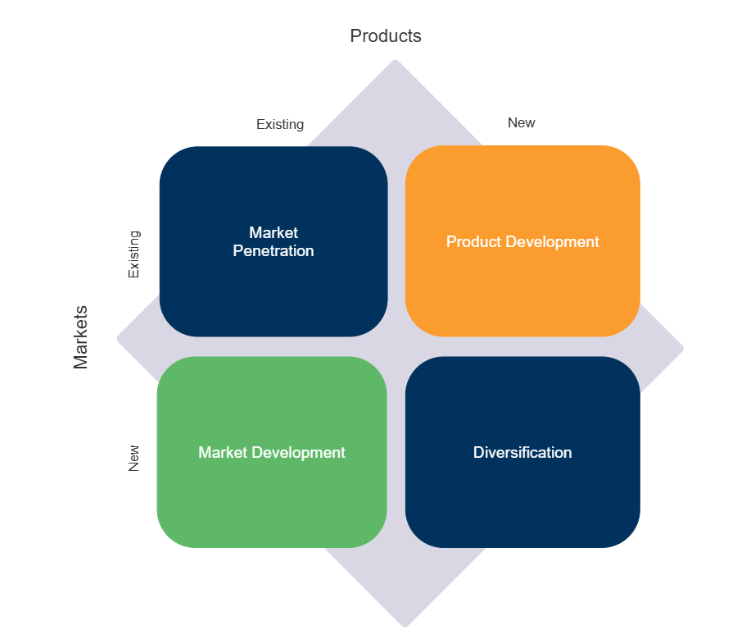
The Ansoff Matrix evaluates four fundamental growth strategies based on products and markets. Igor Ansoff introduced this model in 1957 through his seminal article "Strategies for Diversification," establishing a basic framework for strategic marketing and corporate strategy. The matrix balances a company's growth ambition against the risk exposure by analysing whether the business pursues growth through existing or new products within their current market or new markets.
Four Growth Strategies:
Market Penetration - Growing sales of existing products within existing markets:
Increasing market share by attracting competitors' customers
Encouraging existing customers to increase purchase frequency
Finding new uses for existing products among current customers
Competitive pricing strategies or promotional campaigns
Improving product features or customer service
Expanding distribution coverage within current markets
Market penetration represents the lowest-risk strategy taking into account a company's established capabilities and market knowledge. With 67% of growth strategies initially focusing on market penetration, this approach suits organisations with strong competitive positions in attractive markets.
Market Development - Introducing existing products into new markets:
Geographic expansion into new regions or countries
Targeting new demographic segments or customer groups
Accessing new distribution channels (online expansion)
Repositioning products for different usage occasions
Adapting products minimally for new market segments
Market development involves moderate risk requiring market research that may describe new customer needs while taking into account existing product expertise. International expansion exemplifies market development as businesses adapt their offerings to different cultural contexts.
Product Development - Creating new products for existing markets:
Developing new product variants or extensions
Innovating breakthrough products serving existing customers
Acquiring or licensing complementary products
Investing in R&D for next-generation offerings
Responding to changing customer preferences
Product development carries moderate-to-high risk requiring innovation capabilities and financial investment. Understanding existing customers reduces some of that risk, though it does not guarantee new product success.
Diversification - Introducing new products into new markets:
Related diversification leveraging existing capabilities
Unrelated diversification entering completely different industries
Vertical integration backward into supply chains
Conglomerate expansion across multiple sectors
Diversification represents the highest-risk strategy as it involves operating in unfamiliar markets with unproven products. Success requires substantial resources, management expertise, and risk flexibility. However, diversification spreads risk across portfolios reducing dependence on single markets or products.
Risk-Return Trade-offs
The Ansoff Matrix illustrates the following strategic principle: the expected returns typically correlate with the accepted risks. Market penetration offers modest growth potential with lower risk. Diversification promises substantial growth but accepts significant uncertainty and resource requirements.
Any strategic choice depends on multiple factors:
Organisational risk tolerance and financial resources
Market saturation levels and competitive intensity
Innovation capabilities and product development expertise
Management experience and international capabilities
Stakeholder expectations for growth versus stability
Ansoff's Strategic Application Across Business Contexts
Current digital transformation has re-shaped Ansoff's strategy implementation:
Platform Strategies - Digital platforms enable simultaneous pursuit of multiple Ansoff strategies. Amazon is a good example by penetrating existing markets (retail expansion), developing markets (international growth), creating products (Amazon devices, AWS), and diversifying (entertainment, healthcare).
Agile Growth - Rather than a single strategic commitment, modern businesses pursue multiple growth initiatives by testing several Ansoff strategies simultaneously. Rapid testing and learning based in market response enables rotating between strategies.
Ecosystem Development - Successful growth increasingly requires thinking beyond individual firm boundaries. Strategic partnerships, acquisitions, and platform development enable growth strategies that in principle would be impossible to attain independently.
Example company & Ansoff Matrix Analysis
Researched Company example: Ecosip
Find Support For Practicing Ansoff Matrix
The IB Business Management Activity and Case Study Book includes a full Module 6 section with case studies across all 15 sub-topics - Swot Analysis, Ansoff Matrix, Steeple Analysis, Boston Consulting Group (BCG) Matrix, Business Plan, Decision Trees, Descriptive Statistics, Circular Business Models, Gantt Charts (HL only), Porter’s Generic Strategies (HL only), Hofstede’s cultural dimensions (HL only), Force Field Analysis (HL only), Critical Path Analysis (HL only), Contribution (HL only), Simple Linear Regression (HL only) (All with worked exam responses and marking schemes aligned to every assessment objective.)
Explore IB Business Management And Ansoff Matrix
IB Business Management Main Hub your daily IB Business Management resource
IB Business Management Ansoff Matrix in the Business Management Toolkit
IB Business Management Paper 1 Exam Review Hub find Ansoff Matrix exam questions in Paper 1
IB Business Management Paper 2 Exam Review Hub study Ansoff Matrix exam questions in Paper 2
IB Business Management Paper 3 Exam Review Hub explore Ansoff Matrix exam questions in Paper 3
IB Business Management Activity Book: Explore and practice The Business Management Toolkit including Ansoff Matrix, Unit 1 Swot Analysis, Unit 2 Ansoff Matrix, Unit 3 Steeple Analysis, Unit 4 Boston Consulting Group (BCG) Matrix, Unit 5 Business Plan, Unit 6 Decision Trees, Unit 7 Descriptive Statistics, Unit 8 Circular Business Models, Unit 9 Gantt Charts (HL only), Unit 10 Porter’s Generic Strategies (HL only), Unit 11 Hofstede’s cultural dimensions (HL only), Unit 12 Force Field Analysis (HL only), Unit 13 Critical Path Analysis (HL only), Unit 14 Contribution (HL only), Unit 15 Simple Linear Regression (HL only) activities, exam questions, case studies, IB Standard model answers and IB marking schemes.
Read Next: IB Business Management Toolkit Steeple Analysis
© Theibtrainer.com 2012-2026. All rights reserved.
Legal
Have a Tip? Send us a tip using our anonymous form