
IB Business Management Paper 1
Explore IB Business Management Paper 1 format, pre-release strategy, and session-by-session exam guides - everything in one place for IB Business students
IB BUSINESS MANAGEMENTIB BUSINESS MANAGEMENT SLIB BUSINESS MANAGEMENT MODULE 5 OPERATIONS MANAGEMENTIB BUSINESS MANAGEMENT MODULE 2 HUMAN RESOURCE MANAGEMENTBUSINESS MANAGEMENT TOOLKITIB BUSINESS MANAGEMENT MODULE 3 FINANCE AND ACOUNTSIB BUSINESS MANAGEMENT 1 INTRODUCTION TO BUSINESS MANAGEMENTIB BUSINESS MANAGEMENT HLIB BUSINESS MANAGEMENT MODULE 4 MARKETINGIB BUSINESS MANAGEMENT MODULE 3 FINANCE AND ACCOUNTS
Lawrence Robert
3/29/202610 min read


IB Business Management Paper 1: The Complete Guide
Target question:
What is IB Business Management Paper 1, how does the pre-release statement work, and how should students prepare for the examination?
Every year, thousands of IB Business Management students sit down with a case study they have spent weeks preparing for - and every year, a significant number of them arrive under-prepared, not because they revised the wrong material, but because nobody clearly explained what Paper 1 is actually testing and how the pre-release system works.
This page is the permanent home for everything you need to know about IB Business Management Paper 1. The format stays the same year after year at least until the new IB Business Management subject specifications arrive. The session-specific guides - with case study analysis, predicted questions, and model answers for each examination sitting - are all linked below.
1. What Is IB Business Management Paper 1?
Paper 1 is the pre-released case study examination. It sits at the heart of the IB Business Management assessment because it does something unusual: it gives students advance notice of the business context before they enter the exam room. About three months before each exam session, the IB publishes a short pre-release statement identifying the fictional company and sector that will form the basis of the full case study in the examination.
However, this is not an open-book exam - students cannot bring notes in with them. But the advance notice creates a new scenario that really rewards preparation. And I insist on this, you will be seriously rewarded if you prepare your case study properly and do your homework. My experience as an IB Economics and Business Management teacher is that students who research the sector, learn the terminology, construct a SWOT analysis, and anticipate the likely question areas will consistently outperform those who simply read the pre-release statement once and hope for the best.
The Most Important Thing to Understand About Paper 1
Paper 1 is the same examination paper for both SL and HL students. There is no separate HL version, no additional section, and no difference in time allocation. Both sit the same paper, for the same duration, for the same marks. The distinction between SL and HL in Business Management is made through other components of the assessment, not through Paper 1.
2. Paper 1 Format
IB Business Management Paper 1 - At a Glance
Section A - Answer All Questions
Approximately 20 marks
Five to six compulsory questions
Command terms: state, define, describe, explain
Includes a [6]-mark theory-application question - the most demanding in this section, requiring students to apply a named concept or Toolkit instrument (e.g. Ansoff's Matrix, Maslow's hierarchy) directly to the case study
All questions are compulsory
Section B - Answer One Question
10 marks
A choice of two questions
Command term: discuss
Requires a balanced argument with evidence from the case study
A clear, justified conclusion is essential
Aim for approximately 400–500 words
Duration: 1 hour 30 minutes
Total marks: 30
Calculator: Allowed
Case study: Provided in full in the exam room
A word on timing. Thirty marks in ninety minutes is roughly three minutes per mark - a useful rule of thumb. A [2]-mark question should take around six minutes; a [6]-mark question around eighteen minutes; the [10]-mark Section B question around thirty minutes.
In practice, the short Section A questions tend to move faster than this, which gives you a buffer for the longer answers. Do not sacrifice Section B to over-elaborate on Section A. You can only solve this issue by practicing answering IB Business Management activities, case studies and exam questions throughout your two-year programme. Most students don't, so most students find it difficult to manage timing properly when the real exam arrives.
3. The Pre-Release Statement Explained
Three months before each examination session, the IB publishes a pre-release statement for Paper 1. Students receive this document - typically two to three pages - through their school. It contains three things: a description of the industry or sector the case study is set in, a list of additional terminology students should learn, and the opening paragraphs of the case study itself.
The pre-release exists for a specific reason: it allows the IB to set questions about contemporary business topics that could not have been anticipated when the Business Management syllabus was written. E-waste recycling, avatar-based advertising, the circular economy - these are real-world business phenomena that post-date the guide. The pre-release brings the exam up to date without requiring a full syllabus revision every year.
What the Pre-Release Statement Contains
Industry/sector description: A brief statement of the business context - for example, "a concrete producer and e-waste" or "a multinational non-alcoholic drinks manufacturer." This is your first clue about which syllabus areas are most likely to appear.
Terminology list: Between six and fifteen terms that students should research before the exam. These are defined within the context of the case study, not the general dictionary. Learn them precisely.
Opening paragraphs: The first four to five paragraphs of the full case study. These are exactly the paragraphs that will appear in the examination paper. Read them carefully - they introduce the company, its business model, its current situation, and, crucially, its strategic priorities. Those priorities are almost always the basis of the exam questions.
IB Business Management - Syllabus and Programme Full Guide →
How to Read the Strategic Priorities
Every pre-release statement closes with a list of what the company is "considering" or "planning." These bullet points are not incidental - they are the examiner's roadmap. Each one signals a theme that questions in the exam will address. Map each bullet point to the relevant Business Management syllabus units before your exam, and you have constructed most of your revision list without having to guess a single line.
4. Command Terms: What They Mean and What They Require
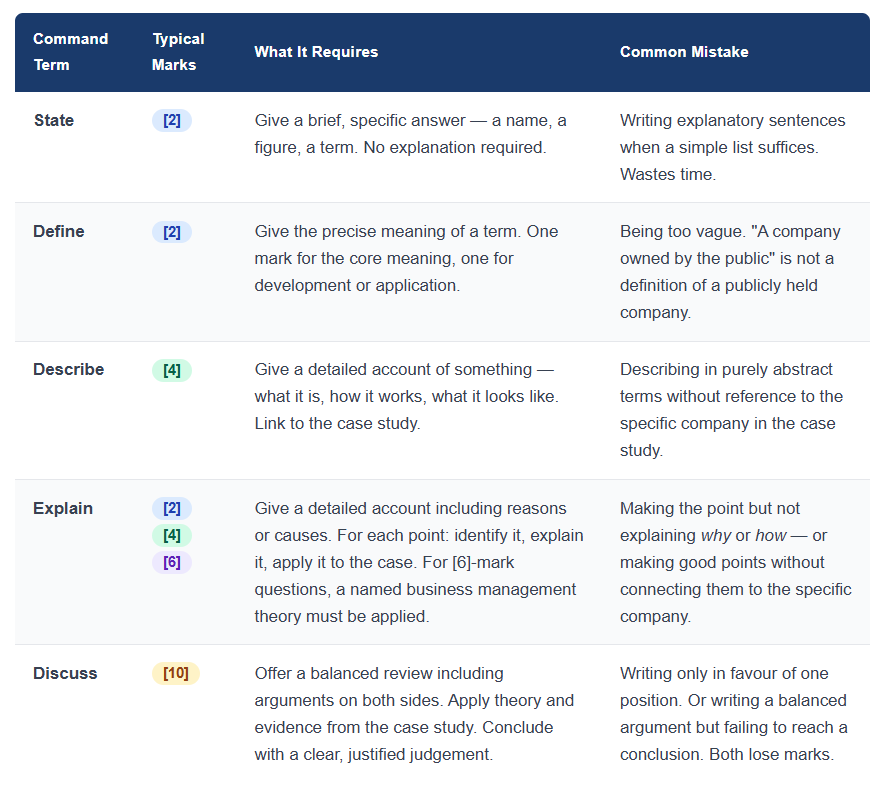
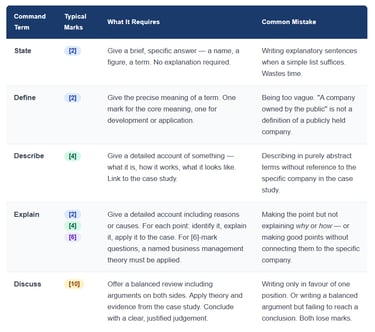
The IB Business Management subject uses specific command terms that tell you exactly what kind of response is expected. Misreading a command term is one of the most common - and most avoidable - ways students lose marks in Paper 1. The table below covers every command term you will encounter in the examination.
The [6]-Mark Question: How to Structure It
The [6]-mark question is consistently the most challenging in Section A and the one students are least prepared for. It will ask you to apply a syllabus theory or a toolkit instrument - Ansoff's Matrix, Maslow's hierarchy of needs, the product life cycle, the Boston Consulting Group matrix, or similar - directly to the case study company.
There are [3] marks available per element, and the structure is always the same:
Identify the element [1] → explain what it means [1] → apply it precisely to the case study company [1].
Students who skip the explanation step and jump straight from identification to application almost always score [2] instead of [3].
5. How to Prepare for Paper 1: My Five-Step Approach
Students are told they should spend a maximum of five hours researching the pre-release statement. In practice, the students who score in the top bands spend that time strategically. Here is a preparation framework that covers all the necessary ground without wasted effort.
1- Read the Pre-Release Statement Carefully - Twice
Your first reading is for orientation: what kind of business is this, what sector is it in, and what are its strategic priorities? Your second reading is analytical: highlight every detail that connects to a Business Management concept you know. A "publicly held company" connects to Unit 1.2. A mention of "growth options" connects to Ansoff and Unit 1.6. Map everything to a syllabus unit before you research anything.
2- Research the Sector - Not Just the Terminology
The terminology list tells you the vocabulary you need. But the deeper preparation is understanding the industry context: what are the competitive pressures, the regulatory environment, the typical cost structures, and the stakeholder landscape for a business operating in this sector? That contextual knowledge allows you to write with genuine depth rather than generic business theory. If you do this, your answer will always come across as a student who has done his/her homework.
3- Build a SWOT Analysis for the Case Study Company
A well-prepared SWOT - based on the opening paragraphs and your sector research - is the single most useful revision tool for Paper 1. The strengths, weaknesses, opportunities, and threats you identify will appear across multiple questions at multiple mark levels. You will not be asked to write the SWOT itself, but its contents are the raw material for almost every answer you write. You will benefit from doing this throughout the whole paper.
4- Map the Strategic Priorities to Exam Questions
Take each bullet point in the "what the company is considering" section and write a plausible exam question for it. Then ask: which business management theory or concept would the examiner expect students to apply here? Ansoff for growth options, Maslow or Herzberg for motivation, the 7Ps for marketing - mapping theories to themes in advance saves crucial thinking time in the exam room.
5- Practise Under Timed Conditions
Read a predicted [10]-mark question and write a timed answer. The single most common source of lost marks in Section B is students who know the material but cannot organise it into a balanced, concluded argument under pressure. Practise the structure - both sides, case study evidence, clear conclusion - until it is automatic.
6- Key Business Management Theories to Have Ready
The [6]-mark theory-application question will name a specific framework. The [10]-mark discuss question rewards students who deploy appropriate theory accurately. The following frameworks are the most frequently tested in Paper 1 and should be thoroughly understood - not memorised as definitions, but understood well enough to apply to a business you have never seen before.
High-Priority Frameworks for Paper 1
Ansoff's Matrix - Four growth strategies mapped against product (existing/new) and market (existing/new). Market penetration, product development, market development, and diversification. Essential for any growth options question.
Maslow's Hierarchy of Needs - Five levels of human motivation: physiological, safety, social, esteem, and self-actualisation. Applied to how a business meets employee needs. A recurring choice for the [6]-mark question.
Herzberg's Two-Factor Theory - Distinguishes between hygiene factors (which prevent dissatisfaction) and motivators (which drive engagement). Relevant to human resources questions.
The Product Life Cycle - Introduction, growth, maturity, and decline stages. Applied to how a company manages its product portfolio and marketing strategy across time.
The Boston Consulting Group (BCG) Matrix - Maps products by market share and market growth: Stars, Cash Cows, Question Marks, and Dogs. Used to analyse portfolio strategy.
Stakeholder Mapping - Identifying stakeholders and their interests, power, and influence. Almost always relevant to discuss questions that explore the consequences of a business decision.
The 7Ps of Marketing - Product, Price, Place, Promotion, People, Process, and Physical evidence. Applied to market orientation and marketing strategy questions.
7. Session-by-Session Lawrence's Exam Guides
Each examination session has its own dedicated guide on The IB Trainer - covering the pre-release statement in full, key terminology, a SWOT analysis of the case study company, predicted questions at every mark level, and complete model answers. Use the session guide for the examination you are preparing for, and return to this page for the format and strategy fundamentals.
4- May 2026 - Paper 1
Concrete producer & e-waste recycling - Country Z
Frequently Asked Questions About IB Business Management Paper 1
What is IB Business Management Paper 1?
IB Business Management Paper 1 is the pre-released case study examination, sat by both Standard Level and Higher Level students on the same paper. Three months before the exam, the IB publishes a pre-release statement that identifies the fictional company and business context for the case study. In the examination room, students receive the full case study and answer structured questions in Section A (all questions, approximately 20 marks) and one discussion question from Section B (10 marks). The paper lasts 1 hour 30 minutes for a maximum of 30 marks.
Is IB Business Management Paper 1 the same for SL and HL students?
Yes. Paper 1 is identical for Standard Level and Higher Level students - the same questions, the same time, the same maximum mark of 30. The distinction between SL and HL in IB Business Management is made through other assessment components, not through Paper 1. Both groups receive and are expected to prepare using the same pre-release statement.
How should students use the pre-release statement to prepare?
The pre-release statement should be treated as a revision roadmap rather than a document to read once and put away. Students should: map the additional terminology to IB-grade definitions; research the industry and sector in which the case study company operates; identify which Business Management syllabus units are signalled by the company's strategic priorities; build a SWOT analysis of the case study company; and anticipate likely exam questions by studying the strategic themes listed at the end of the statement. The IB recommends spending a maximum of five hours on this preparation, and that time is best spent on contextual understanding rather than rote memorisation.
What is the [6]-mark question in Section A and how should students approach it?
The [6]-mark question is the most demanding question in Section A and follows a consistent format: students are asked to apply a named business management theory or concept - such as Ansoff's Matrix, Maslow's hierarchy of needs, or the product life cycle - directly to the case study company, typically addressing two elements worth [3] marks each. For each element, the examiner awards one mark for correctly identifying it, one mark for explaining what it involves, and one mark for applying it specifically to the case study company. Students frequently lose marks by skipping the explanation step - jumping from identification directly to application - which typically limits the answer to [2] marks per element rather than [3].
What does "discuss" mean in an IB Business Management exam question?
In IB Business Management, "discuss" is the command term used for the [10]-mark Section B questions. It requires students to offer a balanced, considered review that presents arguments on more than one side of the issue. A strong "discuss" answer will identify and explain multiple relevant points, apply appropriate business management theory accurately, connect all analysis to the specific case study company, and conclude with a clear, justified judgement. The most common reason students fail to score in the top band is the absence of genuine balance - presenting only arguments in favour of a position, without acknowledging limitations or alternatives.
Related IB Business Management Resources
Paper 1 draws from the entire syllabus. The following resources on The IB Trainer cover each unit, key theories, and the Business Management Toolkit in depth - use them to build the broad subject knowledge that Paper 1 demands.
IB Business Management Introduction to Business Management Module 1 contents
IB Business Management Human Resource Management Module 2 contents
IB Business Management Finance and Accounts Module 3 contents
IB Business Management Marketing Module 4 contents
IB Business Management Operations Management Module 5 contents
IB Business Management Toolkit Access the Toolkit here, SL and HL content
IB Business Management Activity Book case study exam practice and case study activities, including IB standard model answers and IB standard marking schemes covering the entire IB Business Management syllabus.
Quick access to:
© Theibtrainer.com 2012-2026. All rights reserved.
Legal
Have a Tip? Send us a tip using our anonymous form