IB Business Management Paper 1 May 2025
IB Business Management Paper 1 from May 2025: Format, command terms, quantitative skills, theory, and annual exam analysis for SL & HL students.
IB BUSINESS MANAGEMENTIB BUSINESS MANAGEMENT SLIB BUSINESS MANAGEMENT HL
Lawrence Robert
4/28/202617 min read


IB Business Management Paper 1 - May 2025: Full Exam Review (HL & SL)
Target Question:
What was the IB Business Management Paper 1 May 2025 about?
Secondary Target Questions:
What was the case study for IB Business Management Paper 1 May 2025?
What was Maslow's theory question in the May 2025 Paper 1?
What operations methods came up in the May 2025 Paper 1?
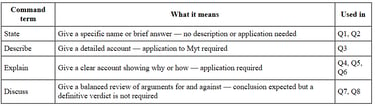
What command terms were used in the May 2025 Paper 1?
How should students calculate profit margins for the Cuz question?
The May 2025 Paper 1 for both Higher Level and Standard Level was built around Myt PLC (Myt) - a fictional publicly listed multinational, non-alcoholic drinks manufacturer headquartered in the United States. Paper 1 carries 30 marks, lasts 1 hour 30 minutes, and is the same paper for HL and SL students.
Section A (all six questions, 20 marks) covered operations, marketing, and motivation theory.
Section B offered two 10-mark discussion questions - one on the social and economic impacts of a new facility on a developing island, and one on a contested corporate takeover.
The pre-released statement, issued three months before the exam, told candidates to expect content on a multinational non-alcoholic drinks manufacturer and the business operations of multinationals. Pre-signalled vocabulary included: avatar, biodegradable, chain, pressure group, recycling, and social media influencer.
The full case study introduced Myt's acquisitions of Lotssa Coffee (LC) and Honest Water (HW), a proposed recycling and distribution facility on the island of Omega, and an active takeover bid for Cuz, a coffee shop chain with a troubled recent history.
This page walks through every question with mark-scheme-informed guidance, command term analysis, and examiner insights - plus worked financial calculations for the Section B Cuz discussion.
Paper Format at a Glance
Applicable to: HL and SL (same paper for both levels)
Duration: 1 hour 30 minutes
Total marks: 30
Section A: Answer all six questions (20 marks)
Section B: Answer one question from a choice of two (10 marks)
Calculator: Permitted
Case study: Pre-released statement issued three months before the exam; full case study seen in the examination room only
The Myt Case Study: What You Needed to Know
Myt PLC is a US-headquartered multinational that grew from manufacturing a single root beer to a portfolio of over 30 drinks sold globally. Its growth strategy included both internal development (product range expansion) and external growth through acquisitions.
Two 2023 acquisitions were central to the paper. Lotssa Coffee (LC) is a 4,000-outlet coffee chain across 35 countries - a new market segment for Myt, running entirely on a company-owned (non-franchise) model with a strong reputation for ethical employment. Its 2024 financials showed a net profit margin of 5% and a stated ambition to reach 8% within two years. Honest Water (HW) is a bottled water manufacturer now eyeing expansion via a new distribution and plastic bottle recycling facility on the island of Omega - a move supported by the prospect of 450 new jobs but contested by a pressure group (FOTP) over environmental and operational concerns.
The third major storyline involves Myt's active takeover of Cuz, a 900-outlet US coffee chain. Cuz had a 500-outlet franchise model, a 10% net profit margin - but also a $250 million government fine for profit overstatement, plunging share price ($18 to $10), and accusations of exploitative employment practices. Financial arithmetic calculations made it potentially cheap to acquire due to its net asset value.
Myt's own promotional strategy relied heavily on social media influencers and a computer-generated avatar (Myt Jane), with impressive results - until its most-followed influencer was jailed for theft.
Section A: Question-by-Question Breakdown
Question 1 - State two methods of promotion, other than social media [2 marks]
Command term: State - give a specific name. No description, explanation, or application required.
Any two valid promotional methods that are not social media. The mark scheme accepted a broad range across above-the-line, below-the-line, and through-the-line categories. Examples included: television advertising, radio advertising, billboards, newspaper/magazine ads, direct mail, personal selling, sales promotions (discounts, competitions, buy-one-get-one-free), loyalty programmes, sponsorship, public relations, point-of-sale displays, trade fairs.
Lawrence's comments:
This is the most straightforward question on the paper - one mark per method, no elaboration needed. The only difficulty is naming social media in disguise (e.g. "influencer marketing" or "YouTube ads"). The mark scheme explicitly excludes social media since the question asks for methods other than social media. A clean, confident answer takes under thirty seconds here.
Common errors:
Describing the method when only a name is required - wastes valuable time
Listing two very similar methods (e.g. "Facebook ads" and "Instagram ads") when the question context implies distinct categories
Question 2 - State two types of internal economy of scale [2 marks]
Command term: State - one mark per named type. No explanation, description, or example required.
Any two of the six standard types: purchasing (bulk buying), managerial, technical, marketing, financial, risk-bearing. The mark scheme explicitly excluded examples - naming a type earned the mark, but describing an example without naming the type did not anything.
Lawrence's comments:
Students who wrote "buying in bulk" instead of "purchasing economies of scale" potentially lost the mark - the mark scheme credited named types only, not examples. The Myt context (a large multinational manufacturer with highly automated factories) makes this question feel intuitive, but application was not required. This is a very basic pure recall / remember theory question.
The six internal economies of scale (learn all six):
Purchasing (bulk buying): larger orders allow negotiation of lower unit input costs
Technical: large-scale machinery becomes cost-effective at high output volumes
Managerial: specialist managers can be hired as the business grows, increasing efficiency
Marketing: fixed marketing costs (campaigns, branding) are spread over more units
Financial: larger firms can borrow at lower interest rates due to reduced lender risk
Risk-bearing: diversified product ranges reduce dependence on a single product's performance
Question 3 - Describe two operations methods used by Myt in its drinks factories [4 marks]
Command term: Describe - give a detailed account. Application to Myt is required. Two methods, 2 marks each.
Flow (mass) production - continuous, automated production of large quantities of an identical product. Myt's Viola drink (one flavour, highly automated factory, 24-hour continuous operation) is the case study evidence that clearly points to flow production.
Batch production - groups of products move through each stage of production simultaneously; allows different variants to be produced in the same facility in separate runs. Myt's new range of eight fresh fruit juice drinks, all made on a single production line, fits the batch production model.
Mark allocation per method: 1 mark for correctly identifying the production method; 1 additional mark for a description with application to Myt. A method described but not named was capped at 1 mark. A method named but not applied to Myt was also capped at 1 mark per method.
Lawrence's comments: The case study made it very easy to identify both production methods - the examiner gave students two distinct production scenarios. Highly automated, single-product, continuous operation = flow production. Multiple variants, single production line = batch production. Students who identified both methods without applying them to the Myt evidence left marks on the table.
Common errors:
Confusing "mass production" and "batch production" - mass/flow production makes one identical product continuously; batch makes groups of similar products in runs
Mentioning job production without case study support - there is no evidence of one-off/bespoke production in the case study
Describing both methods correctly but failing to link each one to a specific Myt example
Question 4 - Explain one advantage and one disadvantage of Myt using social media influencers [4 marks]
Command term: Explain - one advantage and one disadvantage, each with application to Myt. 2 marks each.
Accepted advantages (any one):
Cost efficiency: Social media influencers have helped Myt increase global brand recognition since 2020 without any increase in its annual marketing expenditure - a compelling real-world outcome from the case study.
Reach to younger consumers: Myt's sales to younger consumers have grown significantly in the four years since the influencer strategy was adopted - demonstrating clear commercial impact on a target demographic.
Accepted disadvantages (any one):
Reputational risk: Myt's most-followed influencer was convicted of theft and jailed for 12 months. An influencer's personal conduct is outside Myt's control; if their behaviour conflicts with brand values, the association becomes a liability rather than an asset.
Narrow demographic reach: Influencer marketing is most effective with younger audiences. Older consumers - also part of Myt's customer base - may be excluded from this promotional channel.
Lawrence's comments: The case study was almost too generous here - it gave a concrete positive outcome (brand recognition at no extra cost) and a dramatic negative event (jailed influencer) within a few lines of each other. The highest-scoring answers named the advantage or disadvantage clearly, then went straight to the OWL-equivalent case study evidence. Generic statements about influencer marketing without linking to the Myt context earned only 1 mark per component.
Question 5 - Explain one advantage for Myt of penetration pricing for its new fruit drinks [2 marks]
Command term: Explain - demonstrate understanding of penetration pricing and apply to Myt's context. 1 mark for demonstrating understanding of the concept; 1 additional mark for application.
Penetration pricing involves setting a low introductory price when entering a market for the first time - typically below competitor prices - to attract buyers quickly and build market share. The advantage for Myt is that the fresh fruit juice range represents a new market segment (not just a new product), meaning consumer awareness and brand loyalty need to be built from scratch. A low entry price encourages trial purchases, helping Myt establish a foothold before raising prices later.
Lawrence's comments: One mark for correctly identifying what penetration pricing is; one mark for applying it to the specific Myt context (new product range, new market segment). Students who only defined penetration pricing without connecting it to the fresh fruit juice launch were capped at 1 mark.
What penetration pricing is not:
Penetration pricing is not the same as cost-plus pricing, predatory pricing, or skimming. It is specifically an entry strategy for new products or new markets involving a deliberately low initial price, with the intent to raise prices once market share is established.
Question 6 - Using two elements of Maslow's theory, explain how Myt meets sales managers' needs [6 marks]
Command term: Explain - this is the most demanding question in Section A. Three marks per Maslow element: name the need, explain it, apply to Myt. Mark allocation: 3 + 3.
Students needed to identify two specific levels from Maslow's hierarchy (not just any two), explain what that level means, and then link it to a specific feature of how Myt manages its US sales managers. The mark scheme accepted social/belonging needs, esteem needs, and self-actualisation - all three are met by evidence in the case study.
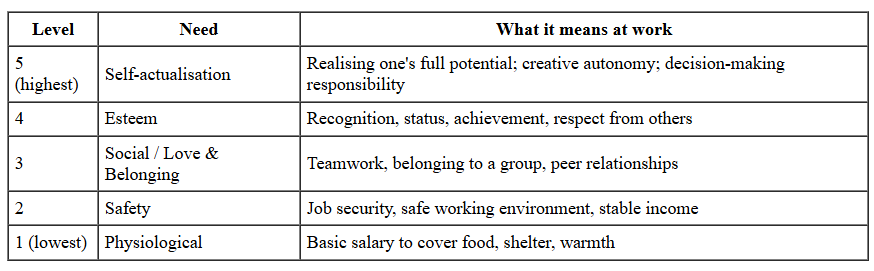
Maslow's Hierarchy of Needs - Quick Reference:
How Myt meets each need - case study evidence:
Social / Love and Belonging needs: These are met by the regular team-building events that Myt organises for its US sales managers. These events provide opportunities for colleagues to interact, build relationships, and develop a sense of group identity.
Esteem needs: These are met by the Sales Manager of the Year award. Sales managers who exceed their targets compete for formal recognition - and the winner receives a new car, a tangible symbol of status and achievement that satisfies the need for external validation and recognition.
Self-actualisation: Myt's sales managers have genuine decision-making autonomy: they choose which days to work from home, and they independently decide how to allocate the centrally-set marketing budget across their state. Both of these provide the kind of creative control and responsibility that Maslow associates with self-actualisation - the desire to grow and reach one's potential.
Lawrence's comments:
The mark scheme required a three-step structure for each need: name the need → explain what it means → apply to Myt's sales managers. Students who named two needs and applied them without explaining the needs themselves were capped below full marks. Students who explained two needs without naming the level of Maslow's hierarchy correctly (e.g. calling esteem needs "recognition needs" without the Maslow terminology) may have missed marks - always use the standard IB Business Management terminology.
Important restriction from the mark scheme:
No marks were awarded if the student only provided application without naming or explaining a Maslow level. The theory must be explicitly present - application alone is not enough for this question.
Common errors:
Using physiological or safety needs - while Myt presumably provides salaries that cover these, the case study gives no specific evidence for them, so application is impossible
Confusing esteem needs (external recognition) with self-actualisation (internal fulfilment and growth)
Writing three Maslow levels - only two are required; the third earns nothing extra and wastes valuable exam time
Section B: Essay Question Frameworks (10 marks each)
Both Section B questions in May 2025 used the command term Discuss - requiring a balanced review of arguments and a conclusion, but not necessarily a definitive recommendation.
Understanding the 10-Mark Mark bands:
Marks and What earns those marks:
9-10 Clear focus on the question. Relevant and accurate theory. Stimulus material integrated effectively. Balanced, substantiated arguments with acknowledgement of case study limitations.
7-8 Mostly addresses the question. Mostly accurate theory. Stimulus material generally used. Some balance.
5-6 Partial understanding. Some relevant theory. Some case study use. Arguments mostly one-sided.
3-4 Some understanding, lacking accuracy. Superficial stimulus use - may only name the organisation. Arguments largely unsubstantiated.
1-2 Little understanding. Little or irrelevant theory. Little to no stimulus reference. No real arguments.
Key insight for bands 9–10: The mark scheme explicitly states that reaching the highest level requires "an explanation of the limitations of the case study or stimulus material." This means acknowledging what you don't know or what you need but is not there: for example, that visitor numbers on Omega might differ from projections, or that Cuz's true financial position is unclear given profit overstatement.
Question 7 - Discuss the potential impacts on Omega if HW builds the facility [10 marks]
What the question was testing: A stakeholder-impact analysis of a business investment decision on a developing island economy. Students needed to consider impacts across multiple dimensions - employment, government finances, the environment, the tourist industry, and community welfare - drawing on case study evidence throughout their answers.
Positive impacts on Omega:
Job creation: 450 direct unskilled jobs would be created - significant for an island where unemployment is high and tourism is the dominant employer.
Reduced unemployment: Lower unemployment means higher household incomes, increased consumer spending, and greater social stability.
Tax revenue: Employee income tax and potential business rates would add to the government's tax revenue, increasing fiscal capacity.
Forced infrastructure investment: HW's demand for improved electricity supply is a condition of the investment. If the government upgrades the electricity grid to attract HW, the entire island - including the tourist industry - benefits from a more reliable power source.
Environmental benefit of recycling: The plastic bottle recycling facility supports Myt's stated CSR goals and reduces plastic waste across 100 islands in the region - a tangible environmental benefit.
Negative impacts on Omega:
Government fiscal pressure: The requested $100 million government contribution represents 15% of Omega's entire forecasted 2025 tax revenue. Diverting this sum to HW could require cuts to public services or create fiscal strain.
Proximity to tourist resort: The proposed site is adjacent to the island's main tourist resort. Construction activity, industrial traffic, and visual disruption could harm Omega's tourism appeal - the island's biggest employer.
Reputational risk from HW's labour record: A recent television programme accused HW of unsafe working conditions and low wages across its factories. If Omega becomes associated with these practices, the island's reputation - including as a tourist destination - could suffer.
Only unskilled jobs created: The 450 positions are unskilled, limiting upward mobility for local workers and offering limited long-term career development.
Pressure group opposition: FOTP (Friends of the Planet) has raised concerns about HW's plans. Continued pressure group activity could generate negative media coverage and complicate the project.
Loss of agricultural land: The site currently grows fruit - a primary sector activity that supports existing livelihoods. Its sale and conversion to industrial use ends that economic activity permanently.
Pollution and congestion concerns: Lorry traffic transporting plastic bottles to the island's ports and industrial waste from the recycling process could generate pollution and infrastructure wear.
Case study limitations to mention for full marks (for bands 9–10):
The actual employment terms and wages HW will offer on Omega are not specified - the television programme allegations about other facilities create uncertainty
The scale of tourism impact from the nearby industrial site is unclear - it depends on size, layout, and noise levels
Whether the Omega government will actually fund the electricity upgrade, and how long it would take, is unknown
Question 8 - Discuss Myt's decision to launch a takeover of Cuz [10 marks]
What the question was testing: A critical evaluation of an external growth strategy (hostile or agreed takeover) in the context of two businesses with very different profiles - LC (ethical, profitable, company-owned) and Cuz (scandal-hit, franchise-heavy, financially questionable). The strongest answers used financial data from Table 1 alongside qualitative strategic analysis.
Key financial calculations for this question:
Profit margins for LC and Cuz (2024, before government investigation):
LC gross profit margin: (1200 ÷ 3000) × 100 = 40%
LC net profit margin: (150 ÷ 3000) × 100 = 5%
Cuz gross profit margin: (320 ÷ 600) × 100 = 53.3%
Cuz net profit margin: (60 ÷ 600) × 100 = 10%
Market capitalisation vs net asset value of Cuz:
Cuz shares in issue: 80 million at current price of $10 = market capitalisation of $800 million
Cuz net assets: $1 billion
Implication: Cuz's market cap ($800m) is below its net asset value ($1bn). In theory, Myt could acquire Cuz for less than the value of the assets it would own. This is a classic case of a potentially undervalued acquisition target.
Arguments FOR the Cuz takeover:
Potential undervaluation: At $10 per share, the total cost to acquire all Cuz shares is approximately $800 million - $200 million less than the stated net asset value of $1 billion. This is financially attractive if asset values are reliable.
Stronger net profit margin: Cuz's net profit margin of 10% (before the investigation) exceeds LC's 5% - and more than meets LC's stated target of 8%. Integrating Cuz's financial model could help drag LC's margins upward.
Revenue growth: Adding Cuz's $600m revenue to LC's $3,000m would increase LC's total sales by 20%, accelerating scale and purchasing power.
Speed of growth: External growth through acquisition is much faster than building 900 new outlets organically.
Economies of scale: A combined LC and Cuz operation creates potential for purchasing, managerial, financial, and marketing economies of scale across a larger combined entity.
Market presence: Cuz operates exclusively in the USA - a market where LC has 4,000 outlets globally but where the Cuz network adds additional domestic density and coverage.
Arguments AGAINST the Cuz takeover:
Profit overstatement and regulatory risk: Cuz was fined $250 million for overstating profits by 10% every year from 2020 to 2023. This raises serious questions about the reliability of Cuz's financial reporting - and by extension, the true value of those "net assets" of $1 billion.
LC's ethical reputation at risk: LC's employees regard it as an ethical employer. Cuz's franchisees are accused of requiring employees to work unpaid overtime hours while reclassifying them to avoid paying hourly wages. Integrating this workforce and culture represents a significant reputational and HR risk for LC.
Franchise complexity: LC has no franchisees and no experience managing a franchise model. Cuz operates 500 of its 900 outlets via franchisees - a fundamentally different governance and quality-control challenge.
Falling share price: Cuz's share price has dropped from $18 to $10 - a fall of 44%. Further reputational or legal damage could send the price lower still, eroding the apparent undervaluation rationale.
Negative media coverage: The combination of the government fine, overstated profits, and employment practice allegations has generated extensive negative media attention. Myt/LC absorbing this baggage could damage both brands.
Integration challenges: Myt is already managing the LC acquisition and the HW Omega expansion simultaneously. Attempting a third major integration increases strategic overstretch risk.
Case study limitations to mention for full marks (for bands 9–10):
Cuz's financials are stated as being "before the government investigation" - the true post-fine, post-correction figures are unknown and likely to be worse
The net asset valuation of $1 billion is not independently audited in the case study and should be treated cautiously given Cuz's accounting history
Whether Myt is making a full takeover or a partial acquisition is not specified, affecting the total cost calculation
Suggested conclusion in a "discuss" essay:
Financial calculations make the Cuz acquisition look superficially attractive - potential undervaluation, stronger margin, faster growth. But the accounting scandal, the franchise model mismatch, and the direct threat to LC's ethical employer reputation mean taking serious risks that financial figures do not summarise. A strong discuss response might conclude that the case for the takeover is weaker than the numbers suggest, or that it could only be justified if Myt conducts rigorous due diligence and secures credible assurances on Cuz's true financial position and employment practices.
Lawrence's Comments for Paper 1 May 2025:
1. Maslow requires three steps - not two
Question 6 had a mark allocation of 3 + 3: one mark for naming the Maslow level, one for explaining the need, one for applying it to Myt's sales managers. Students who only named and applied - skipping the explanation of what the need actually means - were capped at 2 per level, not 3. Always explain the theory before applying it.
2. Operations methods must be named, not just described
Question 3's mark scheme was explicit: a method described but not named was worth only 1 mark, even with correct application. "Myt uses continuous production…" without naming it "flow production" or "mass production" left marks unclaimed.
3. Internal economies of scale require the correct terminology - not examples
Question 2 excluded examples from the mark scheme. "Buying ingredients in large quantities" without saying "purchasing economies of scale" earned nothing. Always lead with the correct term.
4. Section B: both questions used "Discuss" - not "Recommend"
Unlike November 2024 where one Section B question was "Recommend" (requiring a definitive conclusion), both May 2025 Section B questions used "Discuss." This means students needed balance but were not penalised for stopping short of a clear verdict. Having said that, a well-reasoned conclusion was included in all the highest-scoring responses.
5. Financial data in Q8 was there to be used
Table 1 provided financial data on LC and Cuz that most strong answers added to their Section B Q8 responses. Calculating profit margins and comparing them - especially noting that Cuz's pre-investigation net margin exceeded LC's own target - was the kind of quantitative effort that helped push responses into bands 7–8 and above.
Command Term Quick Reference
Frequently Asked Questions: IB Business Management Paper 1 May 2025
What was the case study for IB Business Management Paper 1 May 2025?
The May 2025 Paper 1 case study was Myt PLC (Myt), a fictional US-headquartered multinational non-alcoholic drinks manufacturer with a portfolio of over 30 drinks. The case study also featured Myt's acquisitions of Lotssa Coffee (LC) and Honest Water (HW), a proposed new facility on the island of Omega, and a live takeover bid for Cuz, a US coffee chain chain with a troubled financial history.
Is Paper 1 the same for HL and SL in IB Business Management?
Yes. IB Business Management Paper 1 is the same examination paper for both Higher Level and Standard Level students. It carries 30 marks and lasts 1 hour 30 minutes for both levels. This contrasts with Paper 2, which has separate HL and SL versions with different mark totals and timing.
What was Maslow's theory question in the May 2025 Paper 1?
Question 6 asked students to use two elements of Maslow's hierarchy of needs to explain how Myt meets the needs of its US sales managers. The mark scheme accepted social/belonging needs (met through team-building events), esteem needs (met through the Sales Manager of the Year award), and self-actualisation (met through autonomy over working days and marketing budget allocation). Each element was worth 3 marks: 1 for naming the level, 1 for explaining it, and 1 for applying to Myt.
What operations methods came up in the May 2025 Paper 1?
Question 3 tested flow (mass) production and batch production. Flow production applied to Myt's Viola drink - one flavour, highly automated, operating 24 hours a day. Batch production applied to Myt's new range of eight fresh fruit juice drinks, all produced on a single production line in Mexico. Both methods needed to be identified by name and applied to the Myt context to earn full marks.
What is penetration pricing and why did Myt use it?
Penetration pricing is a strategy where a business enters a market with a low introductory price to attract customers and build market share quickly. Myt used penetration pricing for its new range of fresh fruit juice drinks because they represented a new market segment - an area where Myt had no existing brand recognition. The low price encouraged trial and helped Myt establish itself before prices could be raised.
How should students calculate profit margins for the Cuz question in May 2025?
Using the Table 1 data: LC's net profit margin was 5% (150 ÷ 3000 × 100) and Cuz's was 10% (60 ÷ 600 × 100). Cuz's market capitalisation at $10 per share with 80 million shares was $800 million - below its stated net asset value of $1 billion, making it potentially undervalued as an acquisition target. These calculations were not directly asked as calculation questions but were valuable supporting evidence in a Section B discuss answer.
What command terms were used in the May 2025 Paper 1?
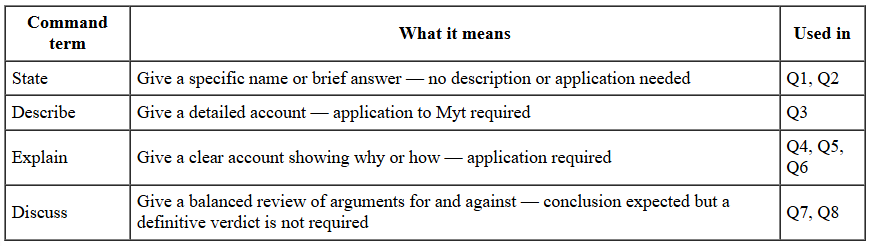
The command terms were: state (Q1, Q2), describe (Q3), explain (Q4, Q5, Q6), and discuss (Q7, Q8). Both Section B questions used "discuss" - unlike November 2024, where one Section B question used "recommend." A "discuss" response requires balance and a conclusion but does not require a definitive recommendation.
What were the two Section B questions in the May 2025 Paper 1?
Question 7 asked students to discuss the potential impacts on the island of Omega if Honest Water (HW) built its proposed distribution facility and plastic bottle recycling factory there. Question 8 asked students to discuss Myt's decision to launch a takeover of Cuz, a US coffee shop chain with a franchise model and a recent government fine for profit overstatement. Students chose one question to answer.
Related IB Business Management Resources
Paper 1 draws from the entire syllabus. The following resources on The IB Trainer cover each unit, key theories, and the Business Management Toolkit in depth - use them to build the broad subject knowledge that Paper 1 demands.
Module 1 - Business Organisation & Environment
Module 2 - Human Resource Management
Module 5 - Operations Management
Paper 1 - May 2026 Pre-Release Case Study Guide
IB Business Management Paper 1 Guide
IB Business Management Activity Book case study exam practice and case study activities, including IB standard model answers and IB standard marking schemes covering the entire IB Business Management syllabus.
Quick access to:
IB Business Management Paper 2 Guide
IB Business Management paper 3 Guide
© Theibtrainer.com 2012-2026. All rights reserved.
Legal
Have a Tip? Send us a tip using our anonymous form