
IB Business Management Paper 2
IB Business Management Paper 2 Guide: Format, command terms, quantitative skills, syllabus coverage, and annual exam analysis for SL and HL students.
IB BUSINESS MANAGEMENT SLIB BUSINESS MANAGEMENTIB BUSINESS MANAGEMENT HL
Lawrence Robert
4/26/202611 min read


IB Business Management Paper 2: The Complete Guide
Format, command terms, quantitative skills, syllabus coverage, and annual exam analysis - everything in one place for SL and HL students.
Target question:
What is IB Business Management Paper 2, how does it differ from Paper 1, what skills does it test, and how should SL and HL students prepare?
If Paper 1 is the pre-released case study - the paper where preparation narrows your focus - then Paper 2 is the opposite. No single company to research in advance. No strategic priorities to map to exam questions. Paper 2 draws from the entire IB Business Management syllabus, and it could be argued that every question arrives as a complete surprise.
This is what many students find daunting about Paper 2. But it is also what makes it so valuable to have a clear preparation strategy. The paper has a consistent structure, a predictable mix of question types, and a known set of calculations that appear year after year. Students who understand the format and have practised the quantitative skills thoroughly will not be taking guesses in the exam room - they will be executing their revision plan.
This hub page covers everything you need to understand Paper 2 and prepare for it effectively.
1. Paper 2 Is Different for SL and HL
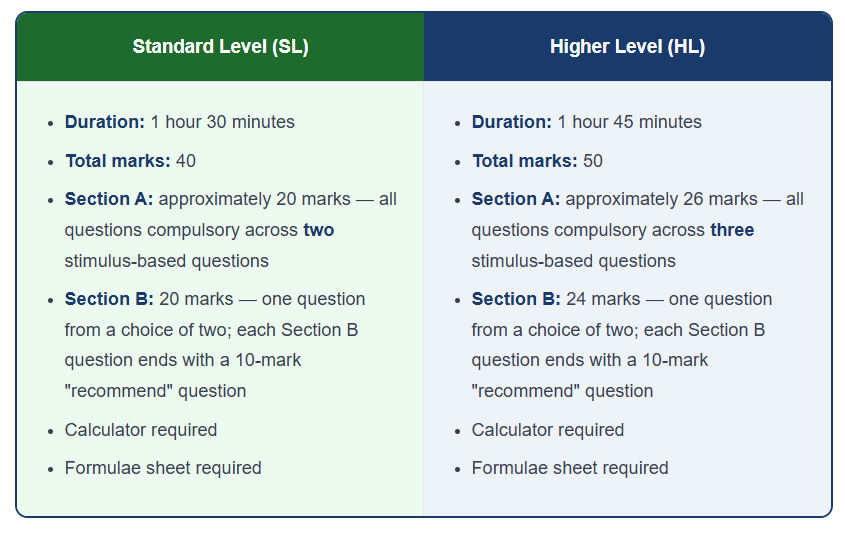
Unlike Paper 1 - which is identical for Standard Level and Higher Level students - Paper 2 is a separate, different examination paper for SL and HL. The format is similar in structure but differs in duration, total marks, and the depth and complexity of the questions. This is one of the most commonly misunderstood facts about the IB Business Management assessment.
All IB Business Management SL and HL papers exist in multiple time zone versions - TZ1 and TZ2 - and contain different stimulus companies and questions but follow identical formats and mark allocations. A student sitting in Asia will face different companies than one sitting in Europe, but the structure, skills tested, and standards required are the same.
2. Paper 2 Format in Detail
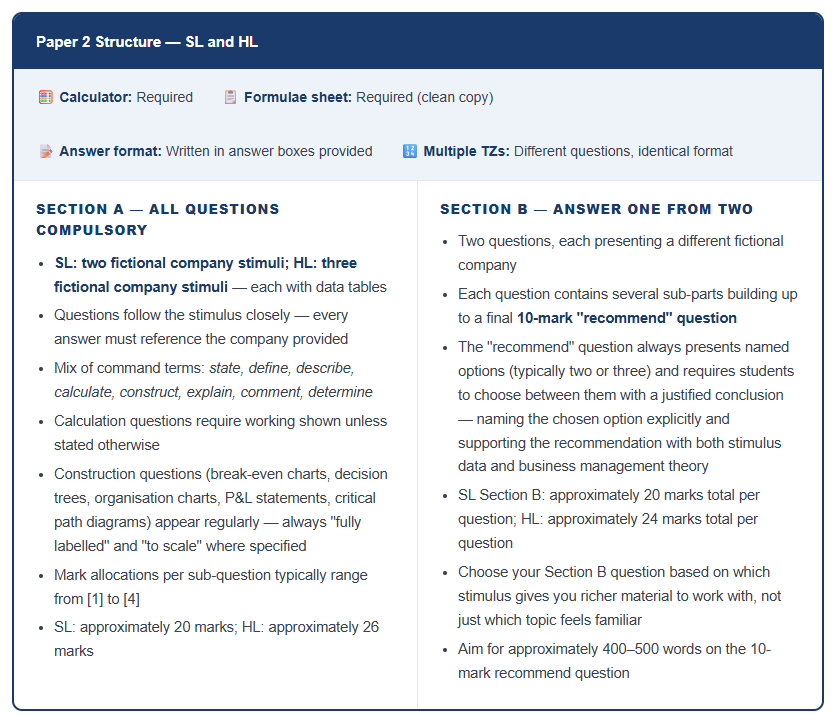
Paper 2 uses a multiple short-stimulus model. Unlike Paper 1, where a single case study runs through the entire paper, Paper 2 introduces a fresh fictional company for each Section A question. Each stimulus is typically two to four paragraphs, together with one or more data tables. Questions then test specific skills connected to that company's situation.
The Most Important Thing to Know About Paper 2
Paper 2 is a quantitative paper. In virtually every examination session, the majority of Section A marks involve calculations, chart construction, or numerical interpretation. Students who focus their revision exclusively on theory and neglect to practise the calculations repeatedly, under timed conditions, consistently underperform and obtain lower grades than previously estimated. The formulae sheet is provided - but knowing which formula to use, setting up the working correctly, and interpreting the result in context are skills that require practice, not just memorisation.
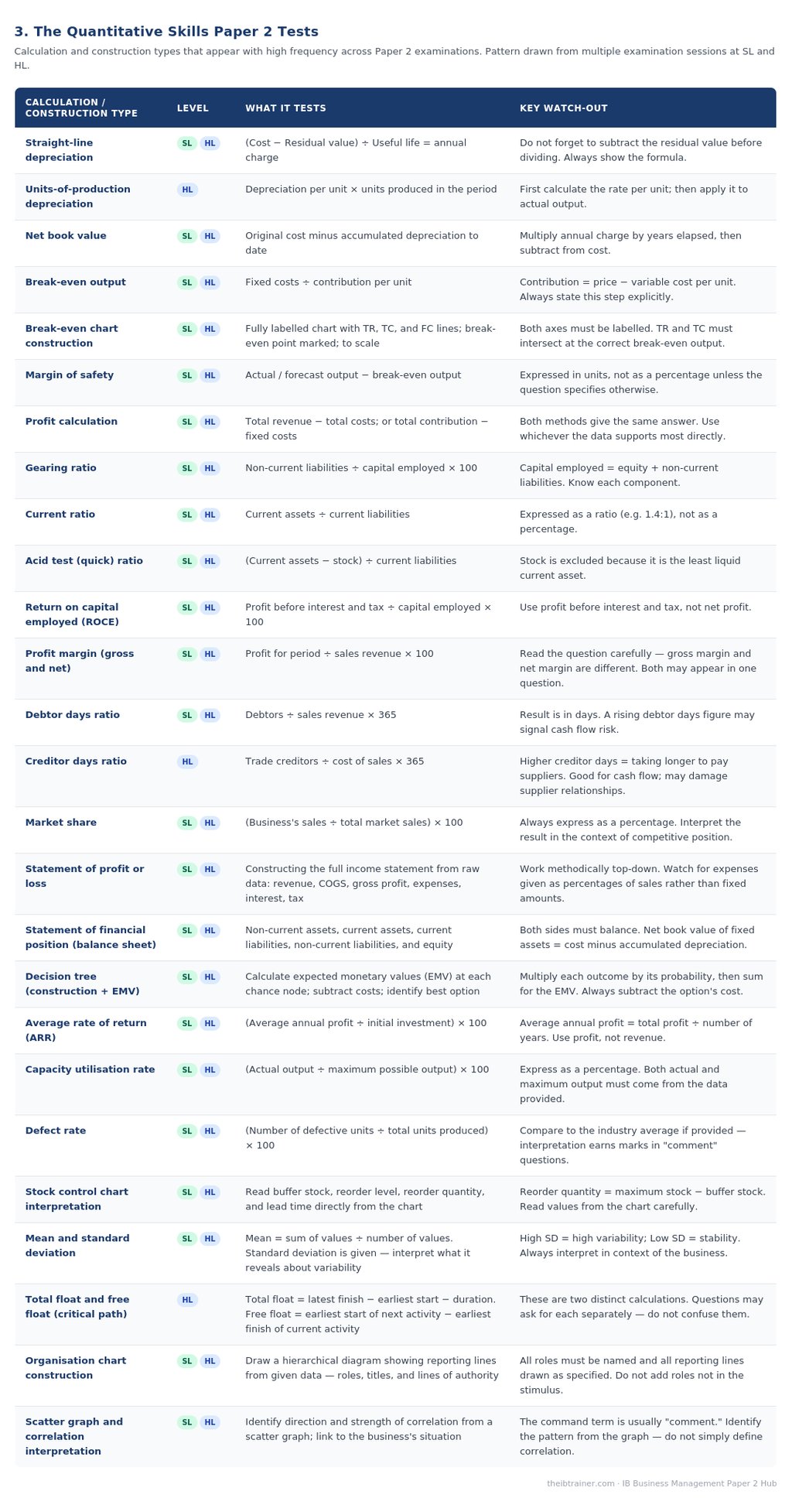
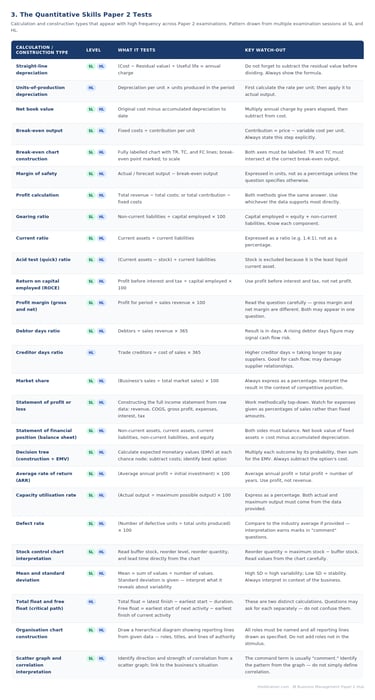
3. The Quantitative Skills Paper 2 Tests
The following calculation types appear with high frequency across Paper 2 examinations at both SL and HL. This is not a prediction of what will appear in any given session - it is a pattern obtained from the consistent structure of the paper over the last 2 years. Every student should be able to perform all these calculations accurately, efficiently and most importantly fluently and within time frame, before sitting the examination.
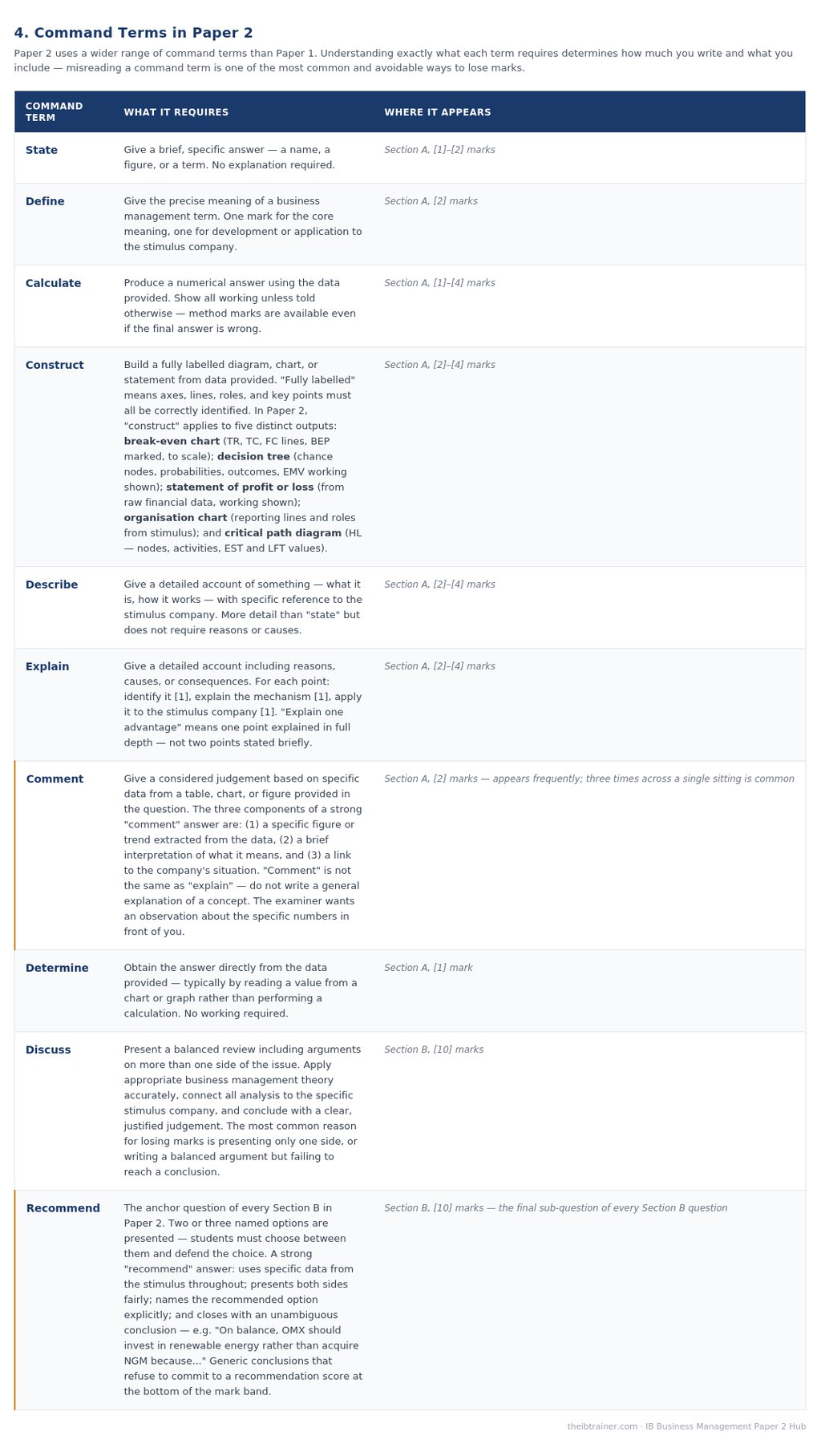
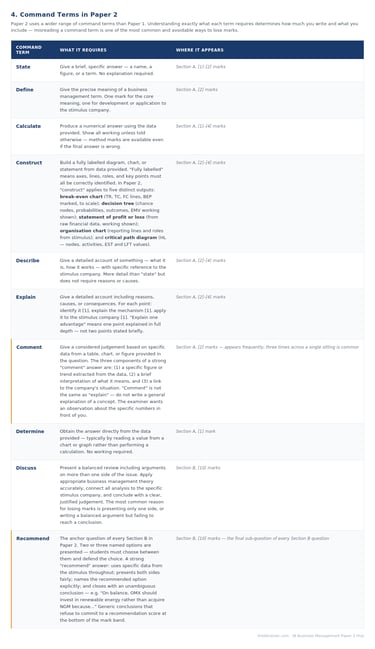
4. Command Terms in Paper 2
Paper 2 uses a wider range of command terms than Paper 1, reflecting a broader range of question types. Understanding exactly what each term requires is essential - an answer to a "comment" question organised as an "explain" answer will lose a lot of marks, and vice versa.
The "Comment" Command Term - A Frequent Source of Lost Marks
"Comment" is consistently one of the most mishandled command terms in Paper 2. Students frequently respond with a general explanation of a concept rather than a direct observation about the specific data in front of them.
A strong "comment" answer has three components: a specific figure or trend extracted from the data, a brief explanation of what it means, and a link to the company's situation. For example: "HC's acid test ratio has declined from 1.0 to 0.6 between 2021 and 2024, suggesting that liquidity has weakened significantly as the company's rapid growth may have tied up cash in stock or debtors." That is a "comment" answer. A generic explanation of what an acid test ratio is would not score well here.
5. Syllabus Coverage: What Paper 2 Can Test
Unlike Paper 1, where the pre-release signals the likely focus areas, Paper 2 draws from the entire syllabus with no specifications given in advance. The following module description covers the full range of topics that appear across Section A and Section B. All units can appear at both SL and HL, though HL questions may demand greater analytical depth.
Module 1 - Business Organisation & Environment (Introduction to Business Management)
Types of business organisation (sole trader, privately held, publicly held companies, franchises, social enterprises, NGOs)
Business objectives and ethics
Business Growth, external growth and evolution (organic vs inorganic, Ansoff, joint ventures, mergers, acquisitions)
Multinational companies, offshoring, reshoring, outsourcing
The circular economy and cradle-to-cradle design
Disruptive innovation and its impact on established businesses
Internal Sources of finance and External Sources of finance, including crowdfunding
STEEPLE analysis - Social, Technological, Economic, Environmental, Political, Legal, Ethical factors; used particularly in offshoring and market entry questions to compare two countries or contexts
Module 2 - Human Resource Management
Organisational structure (hierarchies, span of control, matrix structures, organisation chart construction)
Motivation theories (Maslow, Herzberg, Taylor/scientific management, Deci & Ryan)
Scientific/Taylorist management vs intuitive/democratic management approaches - a distinction that appears in Section B questions requiring evaluation of management styles
Financial and non-financial rewards (PRP, fringe payments, job enrichment, job rotation)
Industrial/employee relations (trade unions, collective bargaining, single-union agreements, industrial action)
Recruitment and selection (internal vs external, flexi-time, remote working, off-the-job training)
Labour turnover and its causes and consequences
Hofstede's cultural dimensions
Module 3 - Finance & Accounts
Sources of finance (internal vs external, bank loans, share capital, retained profit)
Financial statements (income statement / P&L, balance sheet / statement of financial position)
Profitability ratios (gross profit margin, net profit margin, ROCE)
Liquidity ratios (current ratio, acid test ratio)
Efficiency ratios (gearing, debtor days, stock turnover)
Investment appraisal (ARR, payback period)
Depreciation (straight-line, units-of-production, net book value)
Module 4 - Marketing
Market orientation vs product orientation
Market research (primary and secondary, qualitative and quantitative)
The marketing mix - 7Ps
Pricing strategies (premium, penetration, competitive, dynamic, cost-plus / mark-up)
Promotion (above-the-line, below-the-line, social media influencers, avatars)
Positioning maps and market segmentation
Product life cycle and Boston Consulting Group matrix
Customer loyalty programmes
Module 5 - Operations Management
Production methods (job, batch, mass / flow production)
Lean production (JIT, kaizen, TQM)
Quality management (defect rate, quality circles, quality assurance vs quality control)
Capacity utilisation and capacity planning
Stock control (JIC, buffer stock, reorder levels, lead time - chart construction and interpretation)
Break-even analysis (chart construction, BEP calculation, margin of safety)
Decision trees (construction, EMV calculation, identification of best option)
The Business Management Toolkit (force field analysis, standard deviation, positioning maps)
Cradle-to-cradle design and circular business models
Lawrence's Note on the Business Management Toolkit
The IB Business Management 2022 syllabus introduced an elaborated Business Management Toolkit - a set of analytical tools that appear across all five units and are explicitly examined in Paper 2. These include: decision trees, force field analysis, fishbone diagrams (Ishikawa), Gantt charts, positioning maps, stakeholder mapping, SWOT analysis, and statistical tools including mean and standard deviation. HL students in particular should expect toolkit questions to require both construction and and business interpretation.
Ratio Clustering - A Pattern Worth Knowing
Section A includes questions involving financial analysis and the examiner frequently groups multiple ratios together within a single stimulus question rather than testing them in isolation. A common cluster seen in recent papers combines current ratio, gross profit margin, net profit margin, and stock turnover - asking students to calculate some and interpret others, often including a "comment" question that requires them to explain the gap between gross and net margins. Preparing these four ratios as a group - understanding how each relates to the others and the different impact they bring to the question - will serve you better than treating them as separate revision items.
STEEPLE in Section B
STEEPLE analysis - covering Social, Technological, Economic, Environmental, Political, Legal, and Ethical factors - appears in Paper 2 Section B, particularly in questions that ask students to evaluate an offshoring, market entry, or strategic location decision. In recent sessions, STEEPLE has been presented as a comparison table between two countries or contexts, with students required to use the data to recommend which option is preferable.
This is a toolkit skill that bridges module 1 (business environment) and module 5 (operations strategy) and should be thoroughly understood, not just defined.
6. How to Prepare for Paper 2
The challenge with Paper 2 is that it cannot be prepared by studying a specific company or narrowing your focus. The syllabus is the syllabus, and the paper draws from all the available content. Therefore, effective preparation would be building a reliable skill set and a broad body of knowledge that can be applied flexibly to any company, any industry, and any situation.
A- Master Every Calculation on the List
Work through the full quantitative skills table above and practise each calculation type until it is automatic. Do not rely on the formulae sheet to tell you what formula to use - you need to be able to identify which calculation a question requires, set it up correctly, show your working clearly, and interpret the result. A calculation done correctly but not interpreted earns fewer marks than one that is both correct and contextualised.
B- Practise Chart Construction Repeatedly
Break-even chart construction, stock control charts, stacked bar charts, pie charts, and decision trees all require precision and practice. A break-even chart missing axis labels, an unlabelled break-even point, or lines that do not cross at the correct output will lose marks even when the basic calculations and numbers are right. Practise these under timed conditions until every element is produced automatically.
C- Learn the Command Term Distinctions
The difference between "state" and "explain," between "comment" and "describe," and between "discuss" and "recommend" determines how much you write and what you include. In my experience, students who do not pay attention to these command terms consistently under-answer or over-answer questions, losing marks and time in both directions. The command terms table above is your reference - learn the command terms properly.
D- Revise Theory Across All Five Units
Section A can draw questions from any unit, and Section B questions also test the full syllabus. Do not make the mistake of revising heavily for one or two modules hoping the rest will not come up. Every unit link on this page leads to a comprehensive resource covering that unit's key concepts, definitions, and frameworks.
E- Apply Theory to Each Stimulus Company - Not in General
Every mark in Paper 2 is awarded for applied responses. The examiner is not interested in an isolated definition of JIT production - they want to know what JIT means for Very Mochi's perishable ingredients and few reliable suppliers. Read the stimulus material carefully before writing anything, and build every answer around the specific details provided. Generic answers that could apply to any company score at the bottom of every mark band.
F- Answer the "Recommend" Question With a Named Option and a Justified Conclusion
Every Section B question in Paper 2 usually ends with a 10-mark "recommend" question that presents two or three named options and asks students to choose between them. The most common reason students lose marks here is failing to name their recommended option explicitly and failing to reach a clear conclusion.
A strong answer presents both sides, uses specific data from the stimulus throughout, and closes with an unambiguous recommendation - "On balance, OMX should invest in renewable energy rather than acquiring NGM because..." - supported by the most persuasive argument from the preceding analysis. Generic conclusions that refuse to commit to a recommendation score at the bottom of the mark band.
7. Annual Exam Analysis
Each year, after the examination session, The IB Trainer publishes an analysis of what Paper 2 actually tested - which units dominated, which calculations appeared, which command terms were used, and what Section B questions required. These annual entries are the closest thing available online to a legitimate retrospective on the paper, and they are genuinely useful for students preparing in subsequent years.
There are no "predicted questions" for Paper 2. Any site claiming to predict specific Paper 2 questions is guessing - or misleading you. What the annual analysis can tell you is which areas of the syllabus have received less coverage in recent sessions and therefore warrant particular attention, and which calculation types appeared again after not appearing the previous year.
Lawrence's Paper 2 Reviews and Comments
What the papers actually tested - units, calculations, answers, command terms, and Section B themes across SL and HL
1- November 2024 Paper 2 HL Analysis
2- November 2024 Paper 2 SL Analysis
3- May 2025 Paper 2 HL Analysis
4- May 2025 Paper 2 SL Analysis
5- November 2025 Paper 2 HL Analysis
6- November 2025 Paper 2 SL Analysis
Coming soon:
May 2026 - Paper 2 Analysis
November 2026 - Paper 2 Analysis
8. Related IB Business Management Resources
Paper 2 draws from the entire syllabus. The following resources on The IB Trainer cover each unit, key theories, and the Business Management Toolkit in depth - use them to build the broad subject knowledge that Paper 2 demands.
Module 1 - Business Organisation & Environment
Module 2 - Human Resource Management
Module 5 - Operations Management
Paper 1 - May 2026 Pre-Release Case Study Guide
IB Business Management Paper 1 Guide
IB Business Management Activity Book
Frequently Asked Questions About IB Business Management Paper 2
What is IB Business Management Paper 2?
IB Business Management Paper 2 is a written examination that draws from the entire IB Business Management syllabus without any pre-release case study. Unlike Paper 1, which is based on a fictional company presented weeks in advance, Paper 2 introduces fresh fictional case studies in the exam room itself. Section A contains several compulsory short-stimulus questions requiring a mix of calculations, chart construction, definitions, and short explanations. Section B offers a choice of two longer discussion or recommendation questions worth 10 marks each. The paper has separate versions for SL and HL students.
Is Paper 2 the same for SL and HL students?
No - Paper 2 is a separate examination paper for SL and HL, which is the opposite of Paper 1. SL Paper 2 lasts 1 hour 30 minutes and is worth 40 marks. HL Paper 2 lasts 1 hour 45 minutes and is worth 50 marks. Both require a calculator and the business management formulae sheet. The HL paper contains additional or more complex sub-questions within Section A that account for the additional 10 marks. The Section B structure - one question from a choice of two, worth 10 marks - is the same for both levels.
Why is Paper 2 considered the most difficult IB Business Management paper?
Paper 2 is often considered the most demanding because it combines two very different skill sets: quantitative analysis and theoretical discussion, across the full breadth of the syllabus, with no advance notice of topics. Students who have prepared well for the pre-release case study sometimes find Paper 2 disorienting because the familiar preparation strategy - researching a specific company and sector - does not apply. In addition, the quantitative demands of Section A are consistent and non-negotiable: calculation errors add quickly, and a student who cannot construct a break-even chart or calculate a gearing ratio accurately will lose multiple marks within a single question.
What is the "comment" command term and how should students answer it?
In IB Business Management, "comment" means giving a considered judgement based on specific data provided - typically a table, chart, or figure within the question. It is not the same as "explain." A strong "comment" answer identifies a specific trend or figure from the data, briefly interprets what it means, and links the observation to the company's situation. For a [2]-mark "comment" question, one mark is typically awarded for a relevant observation supported by data from the source, and one mark for a meaningful interpretation. Students who write a general explanation of a concept without referring to the specific figures provided will score poorly.
Do I need to memorise all the financial formulae for Paper 2?
A clean copy of the business management formulae sheet is provided in the examination - so you do not need to memorise every formula. However, the formulae sheet only tells you the formula; it does not tell you which formula to use, what the components mean, or how to apply the business theory and interpret the result. Students who rely on the formulae sheet without understanding the underlying concepts frequently misunderstand formulas, use wrong inputs, or produce correct calculations with no business interpretation. The goal of revision is not to memorise the formulas themselves, but to understand them thoroughly enough that you can identify when to apply each of them, execute the calculation correctly, and explain what the result means for the specific company in the question.
© Theibtrainer.com 2012-2026. All rights reserved.
Legal
Have a Tip? Send us a tip using our anonymous form