IB Business Management Paper 1 November 2024
IB Business Management Paper 1 from November 2024: Format, command terms, quantitative skills, theory, and annual exam analysis for SL & HL students.
IB BUSINESS MANAGEMENTIB BUSINESS MANAGEMENT SLIB BUSINESS MANAGEMENT HL
Lawrence Robert
4/27/202617 min read


IB Business Management Paper 1 - November 2024: Full Exam Review (HL & SL)
Target Question:
What was the IB Business Management Paper 1 November 2024 about?
Secondary Target Questions:
What was the case study for IB Business Management Paper 1 November 2024?
Is Paper 1 the same for HL and SL in IB Business Management?
What is the ARR for OWL's theme park in the November 2024 case study?
What command terms appeared in November 2024 Paper 1?
What were the two Section B questions in November 2024 Paper 1?
The November 2024 Paper 1 for both Higher Level and Standard Level was built around OneWay Ltd (OWL) - a family-owned chain of hotels on the fictional island of Xanadu. Paper 1 is the same examination paper for both HL and SL students. It carries 30 marks, lasts 1 hour 30 minutes, and is split into two sections: Section A (all questions compulsory, 20 marks) and Section B (one essay-style question from a choice of two, 10 marks).
The pre-released statement - published three months before the exam - told candidates to expect content on hotels and theme parks, and introduced vocabulary including all-inclusive, bed and breakfast, hospitality, interest rate, migrant worker, phone app, self-service buffet, and theme park. The full case study, only distributed in the examination room, added significant detail around OWL's HR challenges, a new food-waste app called Waste Not, the conversion of one hotel to all-inclusive, and a major theme park investment proposal.
This page walks through every question: what the examiner was testing, how marks were allocated, where students commonly lost marks, and how to structure strong responses.
Paper Format
Applicable to: HL and SL (same paper for both levels)
Duration: 1 hour 30 minutes
Total marks: 30
Section A: Answer all six questions (20 marks)
Section B: Answer one question from a choice of two (10 marks)
Calculator: Permitted
Case study: Pre-released statement issued three months before the exam; full case study distributed only in the examination room.
The OWL Case Study: What You Needed to Know
OWL is a family-owned hotel chain operating eight hotels across eight beach resorts on the island of Xanadu. The majority of its employees are migrant workers from the mainland country of Utopia. Each hotel accommodates 450 guests across twin and family rooms.
The pandemic forced OWL to temporarily close seven of its eight hotels in 2020, triggering significant HR challenges when the hotels reopened in 2022. Many former employees had moved on to gig economy work offering flexi-time and remote working options. To attract new staff, the HR director introduced flexi-time and a work-from-home day for managers. OWL also outsourced its hotel cleaning, previously handled by 30 part-time cleaners per hotel.
On the commercial side, OWL piloted an all-inclusive model at one hotel (the Ryen) in 2023. The results were largely positive - wage costs fell, room bookings and profits rose - though food wastage increased and guests complained of long waits for dinner tables. OWL planned to convert all hotels to all-inclusive in 2025.
A separate strategic proposal involved closing the least profitable hotel (the Zube) and building a theme park at a cost of $78 million, externally financed at an interest rate of 5%. The finance director calculated an ARR of 4.82% and a payback period falling within year 5.
OWL also launched a CSR initiative: a phone app called Waste Not, which allows local residents to collect surplus food for $2 per box (retail value at least $10), reducing food waste while benefiting lower-income community members.
Section A: Question-by-Question Breakdown
Question 1 - Define the term "market share" [2 marks]
Command term: Define - give the precise meaning of a term. No application to OWL is required.
A definition that captured the idea of a business's proportion of total sales within a market or industry. The correct formula - (business sales ÷ total market sales) × 100 - could support a full-mark answer, though the formula alone without an explanation support statement was not sufficient for 2 marks.
1 mark: a basic definition conveying partial understanding (e.g. "the amount of sales a business has")
2 marks: a complete definition referring to the proportion or percentage of total market/industry sales held by one business
Lawrence's notes:
Market share is a foundational Module 1 / Module 4 concept. Most students omit the comparative element and therefore, are rewarded one mark only - students define it as "a business's sales" rather than "a business's sales as a proportion of total industry sales." That comparative element is the difference between 1 and 2 marks.
Correct answer:
Market share is the proportion of total sales in a given market held by one business, expressed as a percentage. It is calculated by dividing the business's sales by total market sales and multiplying by 100.
Question 2 - State two possible causes of a cash-flow problem [2 marks]
Command term: State - give a specific name, value, or brief answer. No explanation is needed. No application to OWL is required.
Any two valid causes of a cash-flow problem, one mark each. Acceptable answers included: insufficient sales revenue; excessive costs or expenses; holding too much unsold stock; poor credit control (debtors paying slowly); paying creditors too quickly; seasonal variation in demand; overtrading.
Lawrence's notes:
Students sometimes confuse cash-flow problems with losses. A business can be profitable but still face cash-flow difficulties - for example, if it has sold goods on credit but the cash has not arrived yet. Similarly, high stock levels tie up cash. Both of these concepts are worth understanding even though this question only asked for two causes.
Question 3 - Describe the two types of training used by OWL [4 marks]
Command term: Describe - give a detailed account of a topic. Application to the case (OWL) is essential.
This question tested knowledge of on-the-job and off-the-job training, applied to OWL's specific training programme:
On-the-job training: Training delivered at the normal place of work. OWL provides three days of training at the hotel itself, delivered by existing employees.
Off-the-job training: Training delivered away from the normal workplace. OWL sends employees to a specialist hospitality training centre for four days.
Mark allocation: 2 marks per training type. 1 mark for describing the type in general; 1 additional mark for using the correct terminology ("on-the-job" and "off-the-job") and linking to the OWL context.
Lawrence's notes:
Students who described the two types without using the correct terminology - on-the-job and off-the-job - capped themselves at 1 mark per type. The terminology is very relevant here. It is also worth noting what the mark scheme does not credit as a separate type: the split between three days and four days is a contextual detail, not a third type of training.
Common errors:
Describing the types without applying to OWL - this was explicitly required
Referring to "internal" and "external" training - these terms are not the standard IB Business terminology and were unlikely to earn full marks without also using "on-the-job" / "off-the-job"
Question 4 - Explain two impacts on OWL of the gig economy [4 marks]
Command term: Explain - give a clear account of something, showing why or how. Two separate impacts required, each with a developed explanation. Application to OWL is expected.
Two distinct impacts, each earning up to 2 marks (1 mark for identifying the impact; 1 additional mark for explaining it in the OWL context). Accepted answers included:
Flexibility: The gig economy allows OWL to scale its workforce up or down more easily - particularly relevant to the busy summer season when additional temporary hotel staff are needed.
Reduced loyalty / higher staff turnover: Gig workers may be less committed to OWL, increasing turnover and recruitment costs.
Pressure to adapt working conditions: OWL had to introduce flexi-time and work-from-home options for managers to compete with gig economy alternatives and fill vacancies.
Reduced costs: Gig workers typically do not receive the same benefits (fringe payments, PRP) as permanent employees, potentially lowering OWL's labour costs.
Lawrence's notes:
The gig economy is not listed explicitly in the 2022 IB BM syllabus as a named concept, but the pre-released statement referenced it directly and the case study expanded on it - which is precisely the point of the pre-released statement. Students who had researched the gig economy thoroughly were ready for this case study. Those who did not, risked vague answers that fell short of earning the second mark per impact.
Structuring your answer:
For a 4-mark explain question, a clean structure is: Impact 1 + explanation linked to OWL → Impact 2 + explanation linked to OWL. Avoid listing three or four impacts for the sake of it - depth on two earns more marks than breadth on four.
Question 5 - Explain one disadvantage to OWL of outsourcing hotel cleaning [2 marks]
Command term: Explain - one disadvantage with a developed explanation. Application to OWL required.
1 mark for identifying the disadvantage; 1 additional mark for explaining it with reference to OWL. Accepted answers included:
Loss of control over quality: OWL can no longer directly manage cleaning standards. The case study reports an increase in customer complaints about room cleanliness following outsourcing - this is the strongest contextual link available.
Reputational risk as an employer: The 30 part-time cleaners per hotel lost their jobs (or were relocated), which may damage OWL's reputation in the local community and make future recruitment harder.
Ongoing cost dependency: OWL must now pay the external cleaning contractor; if that contractor raises prices, OWL has limited flexibility.
Lawrence's notes:
The strongest answer here was the quality control point directly linked with customer complaints - the case study made this connection explicit. Students who identified a generic disadvantage of outsourcing without linking to OWL earned only 1 mark. Always close the loop: state the disadvantage, then show the consequence for OWL using evidence from the case study.
Question 6 - Explain two ways OWL is improving its CSR and one way it is not [6 marks]
Command term: Explain - this is the most complex Section A question. Three separate explanations are required (two improvements, one non-improvement), each earning up to 2 marks.
Ways OWL is improving CSR (accept any two):
Food waste reduction via the Waste Not app: OWL set a formal target to cut food waste by 50%. The app allows local residents to collect surplus food for $2 per box (worth at least $10), benefiting lower-income community members while reducing environmental waste.
Staff accommodation for theme park workers: OWL plans to provide accommodation at the Zube for the 250 new theme park employees, which supports worker welfare rather than leaving migrant workers to find their own housing.
Community benefit through affordable food: Local Xanadu residents gain access to quality food at a fraction of the retail cost - a direct social benefit to the community.
Ways OWL is NOT improving CSR (accept any one):
Exploitative accommodation charges: OWL plans to charge theme park employees 40% of their wages as rent for the Zube accommodation. The HR director himself flagged this as potentially exploitative - a significant ethical red flag.
Increased plastic waste: The Waste Not app requires food to be stored in plastic boxes kept in refrigerators - directly increasing OWL's plastic use and energy consumption, both of which have environmental costs.
Job losses from outsourcing and all-inclusive conversion: Outsourcing cleaning removed 30 part-time cleaning jobs per hotel. Converting to all-inclusive reduced kitchen and restaurant staffing. Both actions reduced employment in OWL's local community.
Higher food wastage under all-inclusive: The all-inclusive model increased food wastage at the Ryen by 25% - directly conflicting with OWL's stated 50% food waste reduction target.
Mark allocation:
Mark as [2 + 2] for the two CSR improvements + [2] for the one non-improvement. Each component: 1 mark for identifying the point; 1 additional mark for explaining it with evidence from the case study.
Lawrence's notes:
Note what the mark scheme explicitly excludes as CSR improvements: flexi-time, work-from-home, fringe payments, and employing migrant workers. These are HR practices that benefit OWL operationally - they are not CSR initiatives in the IB Business Management syllabus sense. Students who cited them as CSR improvements lost marks.
The highest-quality answers on the "not improving" side cited the plastic waste increase from the Waste Not app - an ironic contradiction in the case study - or the exploitative rent charge. Both show sophisticated case study reading.
Common errors:
Treating HR benefits (flexi-time, PRP, fringe payments) as CSR improvements
Listing three CSR improvements but no non-improvement - read the question carefully
Generic CSR statements not linked to OWL evidence
Section B: Essay Question Frameworks (10 marks each)
In Section B, students answered one of the two 10-mark questions. Both questions required a structured argument using business management tools and theories, supported by OWL case study evidence, and marked against IB Business Management standard 10-mark band descriptors.
Understanding the 10-Mark Markbands
What earns the marks:
9–10 Clear focus on the question demands. Relevant and accurate BM tools/theories. Stimulus material integrated effectively. Balanced, substantiated arguments with acknowledgement of limitations.
7–8 Mostly addresses the question. Mostly relevant and accurate theory. Stimulus material generally used to support arguments. Some balance.
5–6 Partial understanding. Some relevant theory. Some use of stimulus material but not fully integrated. Arguments mostly one-sided.
3–4 Some understanding but lacking accuracy. Superficial use of stimulus - may only name the company. Arguments mostly unsubstantiated.
1–2 Little understanding. Little or irrelevant theory. Little to no stimulus reference. No arguments.
Lawrence's notes: Marks 9–10 require balance and an acknowledgement of limitations or counter-arguments. A one-sided case - however well argued - is unlikely to reach band 9–10. Every Section B answer needs a "however" moment.
Question 7 - Discuss whether OWL should convert all hotels to the all-inclusive model [10 marks]
Command term: Discuss - offer a considered and balanced review that includes a range of arguments for and against. A conclusion is expected but candidates are not required to give a definitive recommendation (unlike "Recommend").
What the question was really asking:
Students needed to weigh the commercial and operational evidence for and against a full roll-out of the all-inclusive model across all eight OWL hotels. The Ryen pilot provided concrete data to engage with. The best answers treated the Ryen data critically - acknowledging both the strong financial results and the operational problems that emerged.
Arguments FOR converting to all-inclusive:
Strong pilot data: The Ryen's conversion produced a 30% increase in room bookings, 25% profit growth (to $12 million), and a 15% fall in wage costs - all significant and concrete results.
Competitive differentiation: Very few competitors currently offer all-inclusive on Xanadu. OWL would be a first-mover in this product format on the island.
Labour cost efficiency: The all-inclusive self-service buffet model requires fewer kitchen and restaurant staff, reducing OWL's staffing overhead.
Conversion cost is manageable: Restaurant extensions cost $0.5 million per hotel - funded over the first three months of 2025, with increased capacity (50% more seating) as the tangible return.
Addresses the seating bottleneck: The current 200-seat capacity contributed to the Ryen's summer queuing problem. Extensions to 300 seats should resolve this.
Winter conversion timeline: Extensions can take place in the low season, minimising revenue disruption.
Arguments AGAINST converting to all-inclusive:
Queuing and guest dissatisfaction: During the Ryen's first summer, guests waited up to two hours for dinner tables. Negative social media posts threatened OWL's brand reputation - and this was from just one hotel at the time.
Increased food wastage: Food wastage rose 25% at the Ryen. Scaling this across all eight hotels would significantly worsen OWL's environmental footprint and directly undermine its stated 50% food waste reduction target.
Risk of losing loyal customers: 65% of OWL's guests in 2022 were repeat customers who mostly preferred the bed and breakfast option. Converting to all-inclusive removes that choice entirely, potentially alienating a loyal and stable customer base.
Conversion costs multiplied across eight hotels: $0.5 million per hotel equals $4 million total - a substantial capital outlay for a business that only recently emerged from pandemic-era losses.
No guarantee of scalability: The Ryen's success may not replicate across all hotels. Different locations, different clientele, different staff mixes - results may vary considerably.
Redundancy costs: Reducing kitchen and restaurant staff across eight hotels will trigger redundancy costs and potential reputational consequences in the local employment market.
Suggested conclusion for a discuss response:
A strong "discuss" conclusion weighing the evidence without necessarily landing firmly on one side, though taking a reasoned position is acceptable. An example: the Ryen pilot data is genuinely compelling, and the first-mover advantage on Xanadu is real - but the social media backlash from queuing problems and the direct contradiction with OWL's food waste CSR target suggest that a phased roll-out (with larger restaurant capacity confirmed first) would be a more prudent approach than an immediate full conversion in 2025.
Question 8 - Recommend whether OWL should open a theme park [10 marks]
Command term: Recommend - present a preferred course of action with supporting evidence. Unlike "discuss", a "recommend" question requires a definitive, justified conclusion. Sitting on the fence is not appropriate here.
The financial picture:
The theme park project costs $78 million, externally financed at 5% interest. The finance director calculated:
Payback period: Within year 5 (cumulative profit reaches $96.80 million by end of year 5, surpassing the $78 million investment)
ARR: 4.82% - below the current interest rate of 5%
This ARR figure is the central quantitative issue in the question. An ARR of 4.82% against a borrowing cost of 5% means OWL would be paying more to finance the project than it earns back on average - at least on these forecasts.
Arguments FOR opening the theme park:
External financing reduces immediate cash burden: OWL does not need to fund the project from its own reserves upfront.
Diversification strategy: Xanadu has no existing theme park. This is a genuine strategic gap that OWL could fill. Diversification reduces OWL's dependence on hotel revenues and slow tourist growth.
Catering outsourcing generates $2 million per year: By outsourcing food and refreshments, OWL earns revenue without operational risk - a relatively low-risk income stream embedded in the project.
Payback within five years: If forecasts hold, OWL recovers the full $78 million investment before year 6.
First-mover advantage: No competitor has a theme park on Xanadu. OWL could establish itself as the dominant leisure destination on the island.
Arguments AGAINST opening the theme park:
ARR below interest rate: An ARR of 4.82% against a financing cost of 5% means the project does not cover its own cost of capital on the mark scheme's figures. This is a fundamental investment criterion failure.
Competitor risk in years 4 and 5: The finance director's own warning - if a competitor enters the market and halves visitor numbers in years 4 and 5 - it would delay payback significantly beyond year 5 and reduce the ARR further.
Year 6 additional investment: Replacing older rides after five years requires significant unspecified further capital - a recurring cost not fully captured in the five-year model.
Employee exploitation risk: Charging theme park workers 40% of their wages as rent at the Zube would generate serious negative publicity, threatening OWL's brand and its ability to attract future staff.
Strategic overstretch: OWL is a hotel business. Building and operating a theme park is a major strategic departure from the sector requiring new management expertise, at a time when OWL is also planning an all-inclusive conversion across all hotels.
Pandemic legacy: OWL only returned to profitability in 2022. Taking on $78 million of external debt at 5% represents a significant financial risk for a business with a recent history of losses.
Worked payback calculation (from Table 1):
Year 1: cumulative profit $6.40 million
Year 2: cumulative profit $19.85 million
Year 3: cumulative profit $43.85 million
Year 4: cumulative profit $70.00 million
Year 5: cumulative profit $96.80 million
Investment = $78 million. Cumulative profit goes over $78 million during year 5 (having reached $70 million at end of year 4 and $96.80 million at end of year 5). Payback falls in year 5.
ARR calculation:
Total profit over 5 years = $96.80 million. Average annual profit = $96.80 ÷ 5 = $19.36 million. ARR = ($19.36 ÷ $78) × 100 = 24.82%...
But there is more - the mark scheme states 4.82%, which suggests the ARR uses a different denominator. This requires using the standard IB Business ARR formula:
ARR = (Average annual profit ÷ Initial investment) × 100
If we take ARR = 4.82% and investment = $78m, then average annual profit implied = $78m × 0.0482 = approximately $3.76 million.
Lawrence's notes:
The ARR figure of 4.82% is given by the finance director in the case study. In the examination, take the given figure at face value and engage with its meaning - i.e. it is below the 5% interest rate, which is the key critical insight. Do not spend valuable examination time trying to derive the ARR from the table.
Recommendation framework:
For a "recommend" command term, the strongest approach is: present the quantitative evidence clearly → acknowledge the counter-argument → land on a clear, justified recommendation.
Example: Given the ARR falls below the 5% borrowing rate and the finance director's own competitor concern would push payback beyond year 5, the financial case for the theme park is weaker than it initially appears. Add to this the reputational risk of charging workers 40% of wages in rent and the strategic mixing of running both an all-inclusive conversion and a theme park simultaneously, and a recommendation against going ahead with the project - at least in the short term - is easier to defend than one in favour. However, a well-argued recommendation in favour of the theme park is equally valid, providing it engages honestly with the ARR problem and the competitor risk.
Lawrence's notes: Insights for Paper 1
1. Application is non-negotiable above 2 marks
For any question worth 4 marks or more, generic business theory earns partial credit at best. Every developed point needs to be pinned to OWL, the Ryen, the Zube, the Waste Not app, Sandeep Kumar, or another specific case study element. Students who wrote about outsourcing without applying it to the case - rather than OWL's decision to outsource cleaning and the subsequent rise in complaints - left marks on the table.
2. Section B: balance is required for bands 9–10
The mark bands are explicit scores 9–10 require "balanced" arguments. A one-sided answer - however technically accomplished - is capped below band 9. Every Section B answer must include arguments on both sides, even if the conclusion ultimately favours one.
3. "Discuss" vs "Recommend": they are different commands
"Discuss" (Q7) asks for a balanced review - a conclusion is expected but sitting somewhat in the middle is acceptable. "Recommend" (Q8) requires a definitive course of action with supporting evidence. Students who treated Q8 as a discussion without committing to a clear recommendation missed the command term requirement. Missed a lot of marks.
4. The ARR vs interest rate comparison is the key financial insight
In Q8, the most intellectually rewarding analytical point was recognising that an ARR of 4.82% against a 5% borrowing cost means the theme park does not earn enough return to cover what it costs to finance. This was hinted at in the case study itself (the finance director "is concerned"). Students who spotted and articulated this distinction demonstrated exactly the kind of financial literacy that earns marks in band 9–10.
5. Read the pre-released statement seriously
The pre-released statement listed specific vocabulary candidates were expected to know. Terms like all-inclusive, bed and breakfast, self-service buffet, and gig economy all appeared in Section A questions. Students who had researched these topics in the three months prior to the exam and that used them in their answers, clearly did well.
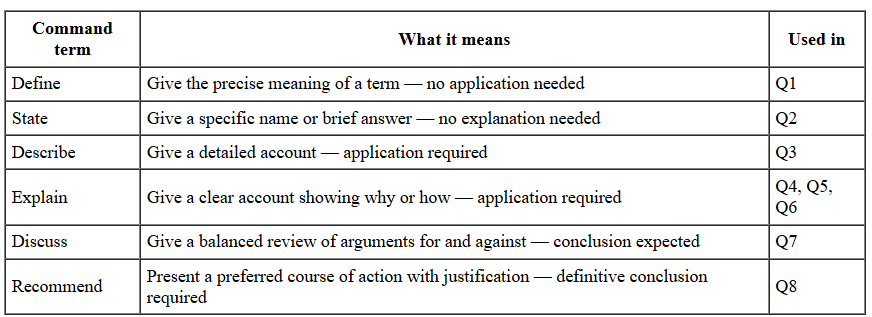
Command Term Quick Reference
Frequently Asked Questions: IB Business Management Paper 1 November 2024
What was the case study for IB Business Management Paper 1 November 2024?
The November 2024 Paper 1 case study was OneWay Ltd (OWL), a fictional family-owned hotel chain on the island of Xanadu. The case study covered HR challenges, the gig economy, outsourcing, a food waste CSR app, the conversion of one hotel to all-inclusive, and a $78 million theme park investment proposal.
Is Paper 1 the same for HL and SL in IB Business Management?
Yes. IB Business Management Paper 1 uses the same examination paper for both Higher Level and Standard Level students. This is different from Paper 2, where HL and SL sit separate papers with different mark totals and timing. Paper 1 carries 30 marks and lasts 1 hour 30 minutes for both levels.
What topics came up in Section A of the November 2024 Paper 1?
Section A covered: market share (definition), causes of cash-flow problems, on-the-job and off-the-job training, the gig economy, outsourcing disadvantages, and corporate social responsibility. All questions required application to the OWL case study (except Q1 and Q2, where no application was needed).
What were the two Section B questions in November 2024?
Section B offered two choices: a discussion question on whether OWL should convert all its hotels to the all-inclusive model, and a recommendation question on whether OWL should build a theme park. Both questions carried 10 marks. Students answered one.
What is the ARR for OWL's theme park in the November 2024 case study?
The finance director calculated an ARR of 4.82% for the proposed theme park. This is significant because it falls below the current interest rate of 5%, meaning the project does not earn enough on average to cover its cost of financing - a key analytical point for Question 8.
What is the payback period for OWL's theme park?
Payback falls within year 5. Cumulative profits reach $70 million by the end of year 4 and $96.80 million by the end of year 5, recovering the $78 million investment during the fifth year of operation.
What command terms appeared in the November 2024 Paper 1?
The command terms used were: define (Q1), state (Q2), describe (Q3), explain (Q4, Q5, Q6), discuss (Q7), and recommend (Q8). The distinction between "discuss" and "recommend" in Section B is important - "recommend" requires a definitive, justified conclusion, while "discuss" requires balance but not necessarily a firm verdict.
What was the Waste Not app in the OWL case study?
Waste Not was a phone app launched by OWL as part of its CSR strategy to cut food waste by 50%. Local residents could pay $2 to collect a box of surplus food from the nearest OWL hotel, food that would otherwise have been thrown away. The app was both a genuine community benefit and - ironically - a source of increased plastic use and energy consumption.
Related IB Business Management Resources
Paper 1 draws from the entire syllabus. The following resources on The IB Trainer cover each unit, key theories, and the Business Management Toolkit in depth - use them to build the broad subject knowledge that Paper 1 demands.
Module 1 - Business Organisation & Environment
Module 2 - Human Resource Management
Module 5 - Operations Management
Paper 1 - May 2026 Pre-Release Case Study Guide
IB Business Management Paper 1 Guide
IB Business Management Activity Book case study exam practice and case study activities, including IB standard model answers and IB standard marking schemes covering the entire IB Business Management syllabus.
Quick access to:
© Theibtrainer.com 2012-2026. All rights reserved.
Legal
Have a Tip? Send us a tip using our anonymous form