IB Business Management Toolkit Steeple Analysis
The complete guide to the IB Business Toolkit. Learn about Steeple Analysis - Key external environment analysis for IB Business Management students.
IB BUSINESS MANAGEMENTIB BUSINESS MANAGEMENT SLIB BUSINESS MANAGEMENT HL
Lawrence Robert
5/26/20263 min read
Toolkit 3: STEEPLE Analysis
Target question:
What is Steeple analysis in IB Business Management?
The Nature and Purpose of Steeple Analysis
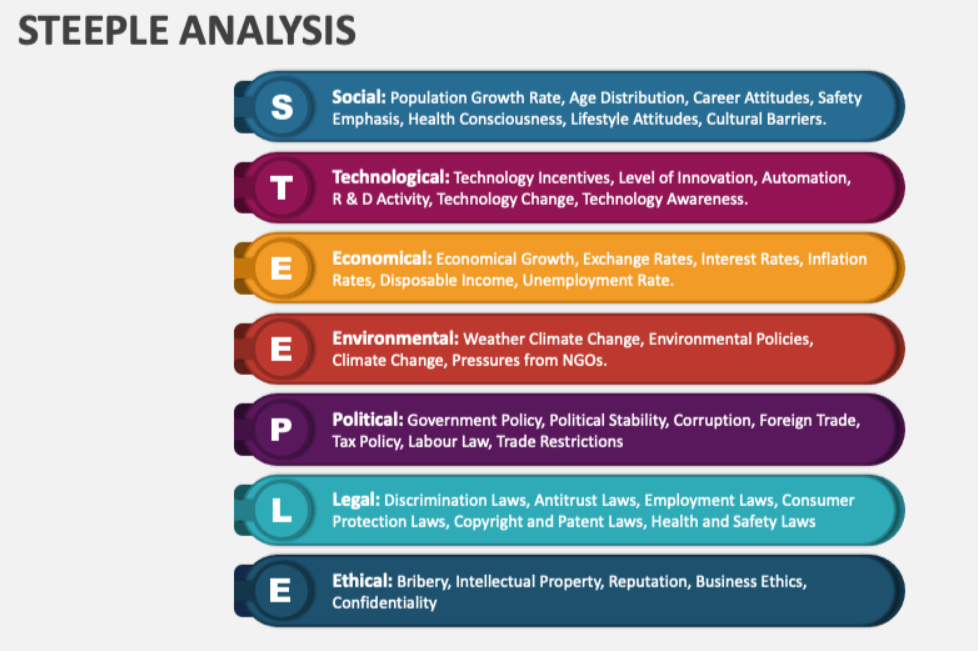
STEEPLE analysis provides an analysis of the macro-environmental factors affecting business strategy and operations. This expanded environmental analysis initially evolved from PEST (Political, Economic, Social, Technological) and later on added Legal, Environmental, and Ethical dimensions recognising the increasing importance of sustainability, regulation, and corporate responsibility. STEEPLE enables organisations to identify external opportunities and threats by informing strategic planning and risk management.
STEEPLE Framework Components:
Social Factors - Demographics, cultural trends, and lifestyle changes:
Population growth, aging, and migration patterns
Education levels and workforce characteristics
Health consciousness and wellness trends
Cultural attitudes and values shifts
Consumer behaviour and purchasing patterns
Work-life balance expectations and remote work preferences
Diversity, equity, and inclusion expectations
Technological Factors - Innovation, automation, and digital transformation:
Artificial intelligence and machine learning applications
Internet of Things (IoT) and connected devices
Blockchain and cryptocurrency technologies
5G networks and telecommunications infrastructure
Biotechnology and medical innovations
Renewable energy and clean technology
Cybersecurity and data protection capabilities
Economic Factors - Macroeconomic conditions and financial environment:
GDP growth and economic development stages
Interest rates, inflation, and currency exchange rates
Unemployment levels and wage trends
Consumer confidence and spending power
Credit availability and monetary policy
International trade and globalisation
Economic inequality and wealth distribution
Environmental Factors - Sustainability and natural resource considerations:
Climate change and carbon emissions
Natural resource depletion and scarcity
Waste management and pollution
Biodiversity loss and ecosystem degradation
Renewable energy transition
Water scarcity and management
Circular economy opportunities
Political Factors - Government policies and political stability:
Government stability and policy consistency
Political ideology and economic philosophy
Trade policies and international relations
Tax policies and government spending
Labour laws and employment regulations
Political risk and corruption levels
Brexit, trade wars, and geopolitical tensions
Legal Factors - Legislation and regulatory compliance:
Employment law and worker protections
Consumer protection regulations
Competition law and antitrust enforcement
Intellectual property protection
Health and safety regulations
Data privacy legislation (GDPR, CCPA)
Industry-specific regulations and licensing
Ethical Factors - Moral expectations and corporate responsibility:
Corporate governance and transparency expectations
Fair trade and ethical sourcing
Human rights throughout supply chains
Animal welfare considerations
Marketing ethics and truthful advertising
Executive compensation and inequality
Stakeholder engagement and accountability
Steeple's Strategic Application Across Business Contexts
STEEPLE analysis serves several strategic purposes:
International Expansion - Businesses evaluating foreign market entry usually conduct STEEPLE analysis comparing institutional environments across countries. Political stability, legal protections, economic development, technological infrastructure, and cultural compatibility determine market attractiveness and operational complexity.
Risk Management - Identifying external threats enables proactive risk mitigation strategies. Businesses monitor STEEPLE factors anticipating regulatory changes, economic shifts, technological disruption, or social movements affecting operations.
Innovation Strategy - Technological and social trends revealed through STEEPLE analysis identify innovation opportunities. Understanding changing consumer values, emerging technologies, and sustainability pressures guides product development and business model innovation.
Sustainability Planning - Environmental and ethical factors drive corporate sustainability strategies. STEEPLE analysis reveals regulatory pressures, stakeholder expectations, and competitive sustainability initiatives requiring strategic response.
Integration with Other Analytical Tools
STEEPLE analysis often combines with complementary analytical tools:
SWOT Integration - STEEPLE findings feed into SWOT analysis. External opportunities and threats identified through STEEPLE provide context for strategic planning.
Porter's Five Forces - While STEEPLE examines macro-environment, Porter's framework analyses industry-specific competitive forces. Together these tools provide comprehensive external analysis.
Context Planning - Multiple STEEPLE analyses under different assumptions simulate different scenarios and will help businesses explore how environmental factors might evolve, enabling strategic flexibility.
Example company & Steeple Analysis
Researched example: Ecosip
Find Support For Practicing Steeple Analysis
The IB Business Management Activity and Case Study Book includes a full Module 6 section with case studies across all 15 Business tools - Swot Analysis, Ansoff Matrix, Steeple Analysis, Boston Consulting Group (BCG) Matrix, Business Plan, Decision Trees, Descriptive Statistics, Circular Business Models, Gantt Charts (HL only), Porter’s Generic Strategies (HL only), Hofstede’s cultural dimensions (HL only), Force Field Analysis (HL only), Critical Path Analysis (HL only), Contribution (HL only), Simple Linear Regression (HL only) (All with worked exam responses and marking schemes aligned to every assessment objective.)
Explore IB Business Management And Steeple Analysis
IB Business Management Main Hub your daily IB Business Management resource
IB Business Management Steeple Analysis in the Business Management Toolkit
IB Business Management Paper 1 Exam Review Hub find Steeple Analysis exam questions in Paper 1
IB Business Management Paper 2 Exam Review Hub study Steeple Analysis exam questions in Paper 2
IB Business Management Paper 3 Exam Review Hub explore Steeple Analysis exam questions in Paper 3
IB Business Management Activity Book: Explore and practice The Business Management Toolkit including Steeple Analysis, Unit 1 Swot Analysis, Unit 2 Ansoff Matrix, Unit 3 Steeple Analysis, Unit 4 Boston Consulting Group (BCG) Matrix, Unit 5 Business Plan, Unit 6 Decision Trees, Unit 7 Descriptive Statistics, Unit 8 Circular Business Models, Unit 9 Gantt Charts (HL only), Unit 10 Porter’s Generic Strategies (HL only), Unit 11 Hofstede’s cultural dimensions (HL only), Unit 12 Force Field Analysis (HL only), Unit 13 Critical Path Analysis (HL only), Unit 14 Contribution (HL only), Unit 15 Simple Linear Regression (HL only) activities, exam questions, case studies, IB Standard model answers and IB marking schemes.
Read Next: IB Business Management Toolkit Boston Consulting Group (BCG) Matrix
© Theibtrainer.com 2012-2026. All rights reserved.
Legal
Have a Tip? Send us a tip using our anonymous form