IB Business Toolkit Circular Business Models
Guide to the IB Business Toolkit. Learn about Circular Business Models - Sustainable and future proofed business initiatives. For IB Business students.
IB BUSINESS MANAGEMENTIB BUSINESS MANAGEMENT SLBUSINESS MANAGEMENT TOOLKITIB BUSINESS MANAGEMENT HL
Lawrence Robert
5/27/20265 min read
Toolkit 8: Circular Business Models
Target question:
What is a Circular Business Model in IB Business Management?
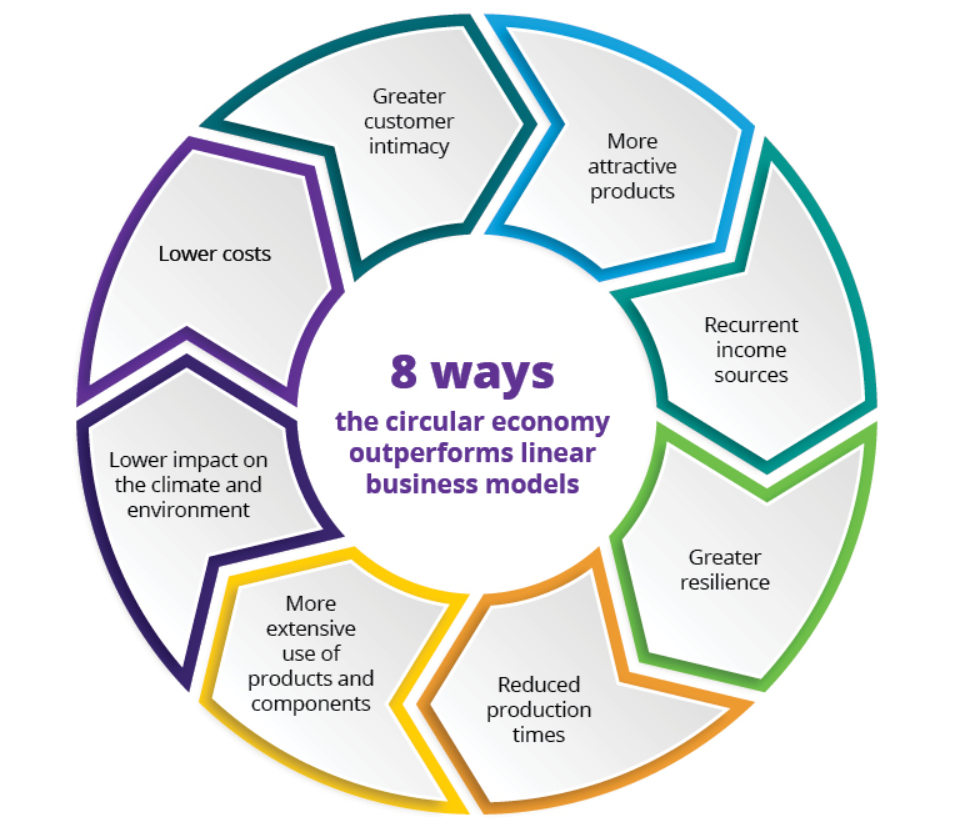
Circular business models represent a considerable transformation from traditional linear "take-make-dispose" value chains, and create closed-loop systems where products, components, and materials circulate at highest utility and value throughout lifecycles.
This regenerative approach, popularised by the Ellen MacArthur Foundation, addresses resource scarcity, environmental degradation, and waste generation by reducing waste and pollution, keeping products and materials in use, and regenerating natural systems. With global resource consumption projected to double by 2050, circular economy principles become a strategic recommendation rather than an optional sustainability initiative.
A circular supply model consists of four main stages: production, use, reuse, and recycling
Circular supply models reduce the need for and reliance on the extraction of resources in the long run, by replacing traditional raw material inputs with renewable or recovered materials.
Circular Economy Main Principles:
Design Out Waste and Pollution - The manufacturer process, from product design to final output, uses the fewest materials and resources possible, while still ensuring the output meets the required quality standards. Products are designed for durability, repairability, re-manufacturability, and recyclability from creation. Resource recovery models involve recycling waste into secondary raw materials, which postpones or reduces final disposal and waste. Such an approach also means there is less of a need for extraction and processing of scarce natural resources for production. Material selection favours non-toxic, biodegradable, or infinitely recyclable materials. Packaging minimised or eliminated. Pollution prevention built into the design rather than managed post-production.
Keep Products and Materials in Use - Product life extension models involve methods that prolong the useful life of existing products. This helps to reduce the rate at which scarce resources are extracted from the Earth, as well as reducing the generation of waste. Extending the life of a product can be achieved through several means, including repairing, refurbishing, remanufacturing, or renovating; all of which help to reduce the need for new production and waste.
The objective is to recover and reuse components rather than throw them away. The materials are recycled maintaining their quality and value rather than downcycled into lower-value use. This also means that product life extension models create new revenue streams for the business (from customers who pay for repairs and upgrades, for example).
Regenerate Natural Systems - Move beyond minimising harm to the environment to actively re-store ecosystems. Use the power of renewable energy for operations. Implement regenerative agriculture practices to improve soil health. Biomaterials replace synthetic alternatives where appropriate.
Circular Business Model Standards:
Product-as-a-Service - Customers access products through service contracts rather than ownership:
Lighting-as-a-service where providers install and maintain fixtures
Mobility-as-a-service through vehicle sharing and subscriptions
Clothing rental services replacing ownership
Equipment leasing where maintenance is the manufacturer's responsibility
Benefits include incentives for durability and maintenance, reduced customer capital requirements, and manufacturer retention of material ownership enabling recovery.
Challenges include cultural acceptance of access over ownership and capital requirements for providing inventory.
Product Life Extension - Maximising product lifespan through repair, refurbishment, and remanufacturing:
Repair services and spare parts availability
Trade-in programs recovering used products for refurbishment
Re-manufacturing restoring products to like-new condition
Software updates extending functional life
Patagonia's Worn Wear program exemplifies life extension through repair services, resale platforms, and advocacy for product longevity over frequent replacement.
Sharing Platforms - Sharing models involve customers sharing products that tend to be underutilised, in this way, reducing the demand for more new products. This also helps to reduce the demand for the scarce resources that would otherwise be used to produce these products. Maximising product utilisation by enabling multiple users:
Peer-to-peer sharing platforms (Airbnb, tool libraries)
B2B equipment sharing optimising capacity utilisation
Collaborative consumption reducing ownership requirements
Community-supported agriculture sharing harvest risk and benefits
Sharing models enable businesses to gain from lower production costs, additional revenue streams, and an improved corporate image due to the lower environmental impact of their business activities.
Sharing models can also provide customers with access to goods and services that they might not otherwise be able to afford.
Circular Supplies - Replacing raw materials with renewable or recycled inputs:
Bio-based materials from regenerative sources
Incorporating recycled content maintaining original quality
Closed-loop material flows within supply chains
Industrial symbiosis where one operation's waste becomes another's input
Resource Recovery - Recovering valuable materials from end-of-life products:
Take-back programs collecting used products
Material extraction and sorting for recycling
Component harvesting for remanufacturing
Energy recovery from non-recyclable materials
Strategic Implementation:
Circular transition requires comprehensive business model innovation:
Design Integration - Circular principles integrated from product conception using design for disassembly, standardised components, modular architecture, and component passports tracking composition and enabling end-of-life recovery.
Reverse Logistics - Collection systems recovering used products from customers. Infrastructure requirements include collection points, transportation networks, sorting facilities, and processing capabilities.
Value Capture Mechanisms - Revenue models adapted for circular approaches. Product-as-a-service generates recurring revenue streams. Refurbished product sales capture residual value. Material resale monetises recovered resources.
Partnership Ecosystems - Circular economy requires collaboration across value chains. Partnerships enable scale achievement, technology access, and infrastructure sharing reducing individual implementation barriers.
Barriers and Challenges:
Economic Viability - Raw material costs are often lower than recycled alternatives due to subsidies and environmental externalities which are not included in market transactions. Circular models require premium pricing or policy support to achieve profitability.
Consumer Behaviour - Ownership-based consumption patterns are deeply embedded in consumer psychology. Shifting to access-based models requires overcoming cultural preferences and social status association with ownership.
Infrastructure Requirements - Circular systems require reverse logistics, reprocessing facilities, and quality assurance systems that currently do not exist at scale. Capital investment barriers limit the adoption of circular models particularly for smaller enterprises.
Regulatory Frameworks - Policy environments are mostly designed for linear systems and require the flexibility to support circular approaches through extended producer responsibility, recycled content laws, and right-to-repair legislation.
Contemporary Circular Innovation:
Digital product passports tracking materials enabling end-of-life recovery
Blockchain verification ensuring recycled content authenticity
AI-powered and advanced technologies to improve recycling efficiency
Biotechnology creating compostable materials replacing plastics
Platform businesses facilitating peer-to-peer resource sharing
Find Support For Practicing Circular Business Models
The IB Business Management Activity and Case Study Book includes a full Module 6 section with case studies across all 15 tools - Swot Analysis, Ansoff Matrix, Steeple Analysis, Boston Consulting Group (BCG) Matrix, Business Plan, Decision Trees, Descriptive Statistics, Circular Business Models, Gantt Charts (HL only), Porter’s Generic Strategies (HL only), Hofstede’s cultural dimensions (HL only), Force Field Analysis (HL only), Critical Path Analysis (HL only), Contribution (HL only), Simple Linear Regression (HL only) (All with worked exam responses and marking schemes aligned to every assessment objective.)
Explore IB Business Management And Circular Business Models
IB Business Management Main Hub your daily IB Business Management resource
IB Business Management Circular business models in the Business Management Toolkit
IB Business Management Paper 1 Exam Review Hub find Circular business models exam questions in Paper 1
IB Business Management Paper 2 Exam Review Hub study Circular business models exam questions in Paper 2
IB Business Management Paper 3 Exam Review Hub explore Circular business models exam questions in Paper 3
IB Business Management Activity Book: Explore and practice The Business Management Toolkit including Unit 8 Circular business models, Unit 1 Swot Analysis, Unit 2 Ansoff Matrix, Unit 3 Steeple Analysis, Unit 4 Boston Consulting Group (BCG) Matrix, Unit 5 Business Plan, Unit 6 Decision Trees, Unit 7 Descriptive Statistics, Unit 8 Circular Business Models, Unit 9 Gantt Charts (HL only), Unit 10 Porter’s Generic Strategies (HL only), Unit 11 Hofstede’s cultural dimensions (HL only), Unit 12 Force Field Analysis (HL only), Unit 13 Critical Path Analysis (HL only), Unit 14 Contribution (HL only), Unit 15 Simple Linear Regression (HL only) activities, exam questions, case studies, IB Standard model answers and IB marking schemes.
Read Next: IB Business Management Toolkit Gantt Chart
© Theibtrainer.com 2012-2026. All rights reserved.
Legal
Have a Tip? Send us a tip using our anonymous form