
IB Business Toolkit Force Field Analysis
Guide to the IB Business Toolkit - Learn Force Field Analysis HL for examining the factors for and against Change. For IB Business students.
IB BUSINESS MANAGEMENTIB BUSINESS MANAGEMENT TOOLKITIB BUSINESS MANAGEMENT HL
Lawrence Robert
6/1/20265 min read
Toolkit 12: Force Field Analysis (HL Only)
Target question:
What is Force Field Analysis in IB Business Management?
Change Management Analytical Tool
Force Field Analysis (FFA) was developed by German-American psychologist Kurt Lewin as a framework for planning and decision-making. It helps us examine the factors that support or oppose change.
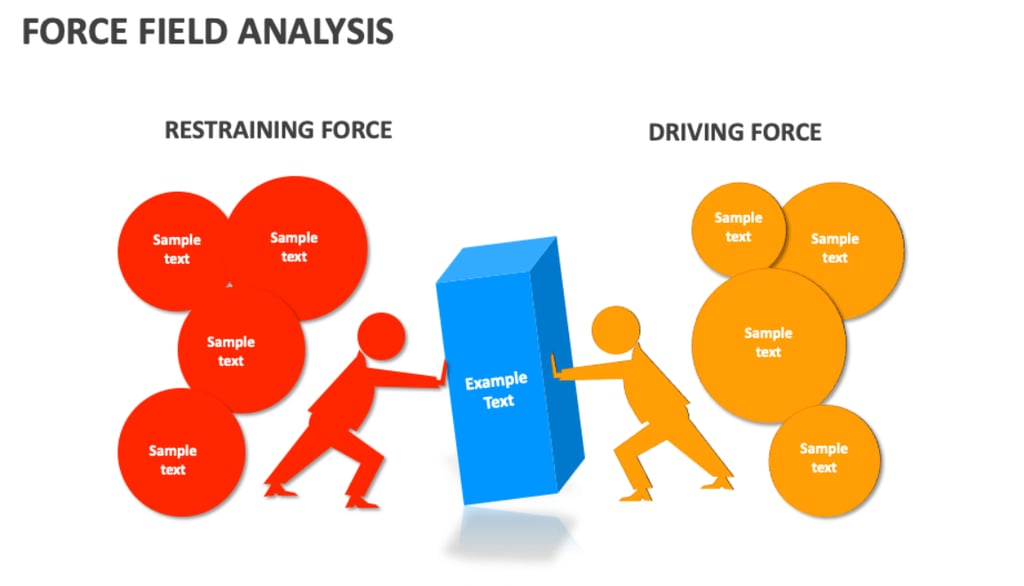
The factors that promote change towards a goal are known as driving forces, while those that obstruct or hinder change are referred to as restraining forces. FFA enables managers to identify and assess these driving and restraining forces in specific change situations or decisions.
These forces are given numerical weights to calculate their relative strengths, providing a clear and objective basis for decision-making. This tool offers a deeper understanding of the change scenario, allowing managers to consider all influences at play.
After identifying the driving and restraining forces, managers can devise strategies to enhance the driving forces and diminish the restraining forces to achieve the desired outcome.
Example company & Force Field Analysis
Researched example: Ecosip
Force Field Framework:
Current State - This is the present situation requiring change. It May be about underperformance, market threats, strategic misalignment, or operational inefficiencies anything that may motivate the consideration of a change.
Desired State - This is the future vision representing change objectives. A clear description of what the desired state looks like provides direction and a success criteria for designing the change initiatives.
Driving Forces - Factors promoting movement toward the desired future state:
External pressures: competition, regulation, technology, customer demands
Internal motivators: leadership vision, employee dissatisfaction, performance gaps
Opportunities: market expansion, innovation potential, efficiency gains
Stakeholder support: change champions, resource availability, cultural alignment
Restraining Forces - Factors resisting movement from the current state:
Resistance to change: employee fear, cultural inertia, comfort with status quo
Resource constraints: insufficient budget, time limitations, skill gaps
Structural barriers: incompatible systems, rigid procedures, organisational silos
Stakeholder opposition: powerful resistors, conflicting interests, low trust
Equilibrium - Balance point between driving and restraining forces maintaining the current state. Change occurs when driving forces strengthen relative to restraining forces shifting the equilibrium toward the desired state.
Conducting Force Field Analysis:
Step 1: Define Current and Desired States - Clearly articulate the current situation and the desired changes. Ambiguous definitions can hinder analysis, leaving stakeholders uncertain about the goals of the change and how success will be measured.
Step 2: Identify Driving Forces - Identify all the factors that facilitate change by engaging with stakeholders, analysing data, and conducting environmental scans. Take into account external trends, internal strengths, leadership backing, employee motivations, and the availability of resources.
Step 3: Identify Restraining Forces - Identify the factors that hinder change, such as sources of resistance, limitations in resources, structural obstacles, cultural challenges, and opposition from stakeholders. An honest evaluation recognises these barriers instead of overlooking valid concerns.
Step 4: Assess Force Strength - Evaluate the intensity of each force using a numerical scale (1-5 or 1-10) or descriptive terms (weak, moderate, strong). The relative strength will help identify which forces require the most focus.
Step 5: Visualise Forces - Create a diagram featuring the current state represented by a centreline. Use arrows to depict driving forces pointing towards the desired state, while restraining forces should be shown as arrows pointing back towards the current state. The length or thickness of the arrows should reflect the strength of each force.
Step 6: Develop Action Plans - Consider ways to enhance the driving forces and/or reduce the restraining forces.
Strengthening Drivers:
Communicate change urgency and benefits
Secure leadership visible support
Allocate sufficient resources
Build coalition of change supporters
Create quick wins demonstrating progress
Weakening Restrains:
Address legitimate concerns through adaptation
Provide training to reduce lack of skill-related anxiety
Involve resistors in change design to increase ownership of the process
Remove structural barriers impeding change
Negotiate with powerful opponents finding middle ground
Strategic Applications:
Merger Integration - Force field analysis helps to pinpoint both barriers and facilitators of integration. Factors that drive integration may include cost synergies, market influence, and a clear leadership vision. Conversely, restraining factors can include cultural differences, concerns about redundancy, and incompatibilities between systems.
Digital Transformation - The adoption of technology is influenced by key driving factors such as competitive pressure and the potential of improved efficiency. However, it also encounters challenges, including investments in legacy systems, gaps in digital literacy, and fatigue from constant change.
Sustainability Initiatives - Environmental programmes are influenced by factors such as regulatory requirements and stakeholder expectations. However, they also face challenges, including implementation costs, operational complexity, and competing priorities.
Restructuring - Organisational redesign is supported by efficiency initiatives and strategic alignment, yet it often faces resistance due to concerns about job security, power dynamics, and existing relationships.
Strengths of Force Field Analysis:
Comprehensive Perspective - The framework promotes a balanced approach by systematically considering both the positive and negative factors, rather than concentrating solely on either the benefits or the challenges.
Stakeholder Engagement - Creating a participative force field with diverse stakeholders fosters a shared understanding and commitment, while also highlighting any concerns that need to be addressed.
Action Orientation - Analysis naturally results in practical strategies aimed at specific factors, rather than just planning for abstract changes.
Flexibility - The framework can be applied to various types of changes, ranging from strategic re-orientations and operational improvements to cultural transformations.
Limitations:
Static Analysis - A force field provides a snapshot in time, but the surrounding environments are constantly evolving. Forces may strengthen or weaken, and new forces can emerge, which means the assessment needs continuous reassessment to be efficient.
Subjective Assessment - Force strength ratings can be influenced by subjective judgement, which may introduce bias. Various stakeholders might evaluate the same forces differently, depending on their individual perspectives and interests.
Oversimplification - Simplifying complex change dynamics and show them together with opposing forces can ignore the intricate interdependencies, feedback loops, and emerging characteristics that define the complex process of organisational change.
Implementation Gap - Recognising the forces at play is often simpler than creating effective strategies to tackle them. Analysis is not enough; you also need the ability to implement and execute your plans.
Contemporary Change Management: Modern applications support and enhance traditional force field through:
System dynamics modelling involves capturing feedback loops and time delays.
Network analysis focuses on mapping stakeholder relationships and influence patterns.
Agile change management allows for iterative adaptation.
Consideration of change fatigue acknowledges the cumulative impact of multiple initiatives.
Digital collaboration tools facilitate the creation of a distributed force field.
Find Support For Practicing Force Field Analysis
The IB Business Management Activity and Case Study Book includes a full Module 6 section with case studies across all 15 tools - Swot Analysis, Ansoff Matrix, Steeple Analysis, Boston Consulting Group (BCG) Matrix, Business Plan, Decision Trees, Descriptive Statistics, Circular Business Models, Gantt Charts (HL only), Porter’s Generic Strategies (HL only), Hofstede’s cultural dimensions (HL only), Force Field Analysis (HL only), Critical Path Analysis (HL only), Contribution (HL only), Simple Linear Regression (HL only) (All with worked exam responses and marking schemes aligned to every assessment objective.)
Explore IB Business Management And Force Field Analysis
IB Business Management Main Hub your daily IB Business Management resource
IB Business Management Force Field Analysis in the Business Management Toolkit
IB Business Management Paper 1 Exam Review Hub find Force Field Analysis exam questions in Paper 1
IB Business Management Paper 2 Exam Review Hub study Force Field Analysis exam questions in Paper 2
IB Business Management Paper 3 Exam Review Hub explore Force Field Analysis exam questions in Paper 3
IB Business Management Activity Book: Explore and practice The Business Management Toolkit including Force Field Analysis, Unit 1 Swot Analysis, Unit 2 Ansoff Matrix, Unit 3 Steeple Analysis, Unit 4 Boston Consulting Group (BCG) Matrix, Unit 5 Business Plan, Unit 6 Decision Trees, Unit 7 Descriptive Statistics, Unit 8 Circular Business Models, Unit 9 Gantt Charts (HL only), Unit 10 Porter’s Generic Strategies (HL only), Unit 11 Hofstede’s cultural dimensions (HL only), Unit 12 Force Field Analysis (HL only), Unit 13 Critical Path Analysis (HL only), Unit 14 Contribution (HL only), Unit 15 Simple Linear Regression (HL only) activities, exam questions, case studies, IB Standard model answers and IB marking schemes.
Read Next: IB Business Management Toolkit Critical Path Analysis HL
© Theibtrainer.com 2012-2026. All rights reserved.
Legal
Have a Tip? Send us a tip using our anonymous form