IB Business Toolkit Hofstede's Cultural Dimensions
Guide to the IB Business Toolkit. Learn Hofstede's HL Cultural Dimensions - Understanding Cultures enhances business communication in a global world.
IB BUSINESS MANAGEMENTIB BUSINESS MANAGEMENT TOOLKITIB BUSINESS MANAGEMENT HL
Lawrence Robert
6/1/20265 min read
Toolkit 11: Hofstede's Cultural Dimensions (HL Only)
Target question:
What is Hofstede's Cultural Dimensions Tool in IB Business Management?
Cross-Cultural Management Framework
The model was developed by Dutch psychologist and former IBM manager Geert Hofstede (1928–2020). Hofstede’s cultural dimensions serve as a valuable tool for businesses, enabling them to better understand cultural differences. This understanding enhances communication within diverse teams and improves negotiations with international clients, which is especially crucial for multinational corporations.
The six cultural dimensions offer a framework to understand better how individuals from various cultures interact and connect. They highlight differing approaches and attitudes towards communication, management, leadership, and decision-making.
By exploring these cultural dimensions, businesses can gain insights into the diverse behaviours of individuals from different backgrounds, as well as the factors that may motivate or demotivate them.
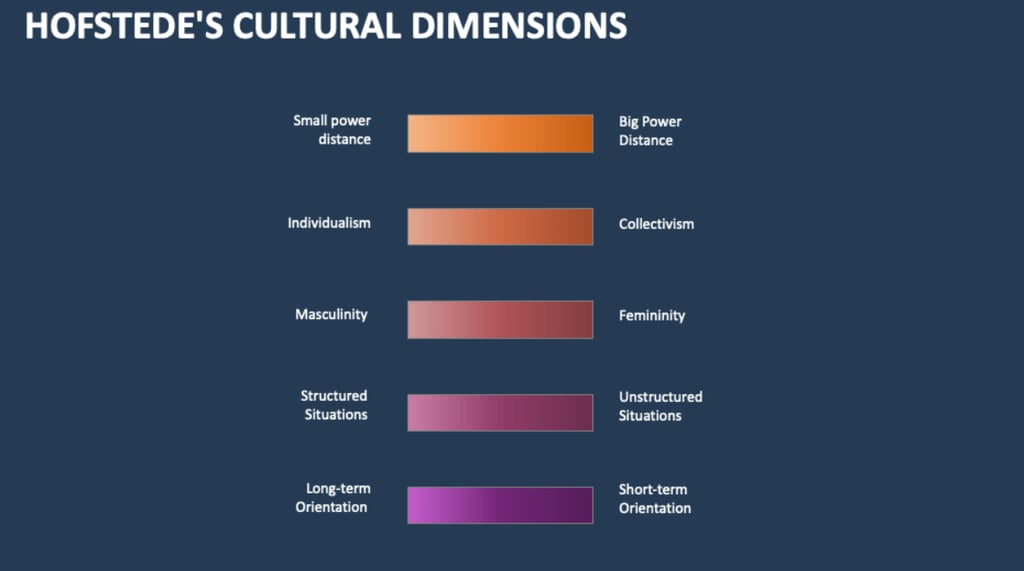
The six cultural dimensions include power distance, individualism versus collectivism, masculinity versus femininity, uncertainty avoidance, long-term versus short-term orientation, and indulgence versus restraint.
It’s important to recognise the limitations of this model. The calculations used to measure these dimensions are based on limited data, which may even be outdated. As a result, they may not accurately represent all cultures or subcultures present in various communities and countries.
Six Cultural Dimensions:
1- Power Distance Index (PDI) - Extent to which less powerful members accept and expect unequal power distribution:
High Power Distance (Malaysia 100, China 80):
Centralised decision-making and hierarchical organisations
Respect for authority and acceptance of inequality
Formal communication following chains of command
Paternalistic leadership styles
Status symbols and titles emphasised
Low Power Distance (Denmark 18, Austria 11):
Decentralised decision-making and flat organisations
Equality emphasis and informal relationships
Open communication across levels
Participative leadership styles
Status deemphasised; merit-based advancement
Management Implications: Multinational companies adapt management structures, decision processes, and communication patterns to cultural expectations. Imposing participative management in high power distance cultures causes confusion; autocratic approaches in low power distance cultures generates resentment.
2- Individualism vs. Collectivism (IDV) - Degree to which individuals feel integrated into groups:
Individualist Cultures (USA 91, UK 89):
Self-reliance and personal achievement valued
Individual rights prioritised over group harmony
Direct communication and explicit contracts
Merit-based rewards and individual performance
"I" consciousness and personal opinions expressed
Collectivist Cultures (Guatemala 6, China 20):
Group loyalty and harmony prioritised
In-group interests go beyond individual preferences
Indirect communication maintaining relationships
Group-based rewards and collective responsibility
"We" consciousness and consensus-seeking
Management Implications: Individualist cultures favour individual performance incentives, personal recognition, and autonomous work. Collectivist cultures emphasise team rewards, group harmony, and collaborative decision-making.
3- Masculinity vs. Femininity (MAS) - Distribution of emotional roles between genders:
Masculine Cultures (Japan 95, Slovakia 100):
Achievement, competition, and success emphasis
Material success and performance rewarded
Distinct gender roles with assertive masculinity
Conflicts resolved through confrontation
Work-life integration with career priority
Feminine Cultures (Sweden 5, Norway 8):
Cooperation, caring, and quality of life emphasis
Relationships and environment valued over material success
Overlapping gender roles with nurturing encouraged
Conflicts resolved through compromise and negotiation
Work-life balance prioritised
Management Implications: Masculine cultures respond to competitive goals, performance rankings, and achievement recognition. Feminine cultures value collaborative environments, consensus decision-making, and employee wellbeing.
4- Uncertainty Avoidance Index (UAI) - Tolerance for ambiguity and uncertainty:
High Uncertainty Avoidance (Greece 100, Portugal 99):
Need for rules, structure, and predictability
Low tolerance for ambiguous situations
Resistance to change and preference for stability
Formal procedures and detailed planning
Career stability and long-term employment valued
Low Uncertainty Avoidance (Singapore 8, Denmark 23):
Comfortable with ambiguity and change
Flexible approaches and adaptive strategies
Innovation and risk-taking encouraged
Minimal rules and informal procedures
Job mobility and variety accepted
Management Implications: High uncertainty avoidance cultures require detailed procedures, comprehensive training, and change management processes. Low uncertainty avoidance cultures thrive with flexibility, experimentation, and minimal bureaucracy.
5- Long-Term vs. Short-Term Orientation (LTO) - Time horizon for decision-making:
Long-Term Orientation (South Korea 100, Japan 88):
Persistence, perseverance, and future rewards
Prudence, low risk and savings emphasis
Adaptation of traditions to modern context
Investment in long-term relationships
Pragmatic problem-solving
Short-Term Orientation (Nigeria 13, Ghana 4):
Immediate results and quarterly performance
Consumption and spending current resources
Respect for tradition and maintaining face
Focus on quarterly earnings and annual targets
Principled positions regardless of circumstances
Management Implications: Long-term oriented cultures accept patient capital deployment, relationship building, and delayed gratification. Short-term oriented cultures demand quick returns, immediate feedback, and rapid results.
6- Indulgence vs. Restraint (IVR) - Extent society allows gratification of basic human desires:
Indulgent Cultures (Venezuela 100, Mexico 97):
Importance of leisure and enjoying life
Freedom of expression and personal gratification
Optimism and positive attitudes
Higher importance on friends and happiness
Loose social norms
Restrained Cultures (Pakistan 0, Egypt 4):
Suppression of gratification through social norms
Duty and obligation prioritised over pleasure
Pessimism and cynicism more common
Strict social norms and regulation
Limited personal freedom perception
Management Implications: Indulgent cultures value work-life balance, flexible policies, and employee happiness initiatives. Restrained cultures emphasise discipline, self-control, and adherence to rules.
Hofstede's Strategic Application Across Business Contexts:
International HR Management - Hofstede's dimensions guide recruitment, training, compensation, and performance management. Leadership styles, motivation approaches, and team structures align with cultural values.
Marketing Strategies - Advertising messages, brand positioning, and customer communication adapt to cultural dimensions. Individualist cultures respond to personal benefit messaging; collectivist cultures emphasise social harmony and relationships.
Organisational Structure - Power distance influences hierarchy flatness, decision-making centralisation, and reporting relationships. Uncertainty avoidance affects standardisation, formalisation, and control systems.
Negotiation Strategies - Cultural awareness prevents misunderstandings during international negotiations. Communication directness, time expectations, and relationship-building importance vary culturally.
Limitations and Critiques:
National Level Analysis - Hofstede measures national averages, potentially overlooking diversity within countries and geographical, industries and sub-culture differences. Assuming for instance that all Chinese or Americans share identical cultural values oversimplifies reality.
Outdated Data - Original research was conducted in the 1960s-1970s and may not reflect modern cultural values particularly in rapidly changing societies.
Binary Dimensions - Cultures reduced to positions on six dimensions only may miss additional basic cultural characteristics that may not be captured by the framework.
Western Bias - Framework developed through Western research philosophies may not fully capture non-Western cultural dimensions.
Contemporary Cultural Intelligence: Modern global businesses supplement Hofstede with:
GLOBE study providing updated cultural measurements
Cultural intelligence (CQ) development programmes
Diversity and inclusion initiatives recognising intersectional identities
Virtual team management addressing digital culture differences
Scenario-based cultural training replacing stereotype reinforcement
Example company & Hofstede's Cultural Dimensions
Researched example: Ecosip
Find Support For Practicing Hofstede's Cultural Dimensions
The IB Business Management Activity and Case Study Book includes a full Module 6 section with case studies across all 15 tools - Swot Analysis, Ansoff Matrix, Steeple Analysis, Boston Consulting Group (BCG) Matrix, Business Plan, Decision Trees, Descriptive Statistics, Circular Business Models, Gantt Charts (HL only), Porter’s Generic Strategies (HL only), Hofstede’s cultural dimensions (HL only), Force Field Analysis (HL only), Critical Path Analysis (HL only), Contribution (HL only), Simple Linear Regression (HL only) (All with worked exam responses and marking schemes aligned to every assessment objective.)
Explore IB Business Management And Hofstede’s Cultural Dimensions
IB Business Management Main Hub your daily IB Business Management resource
IB Business Management Hofstede’s cultural dimensions in the Business Management Toolkit
IB Business Management Paper 1 Exam Review Hub find Hofstede’s cultural dimensions exam questions in Paper 1
IB Business Management Paper 2 Exam Review Hub study Hofstede’s cultural dimensions exam questions in Paper 2
IB Business Management Paper 3 Exam Review Hub explore Hofstede’s cultural dimensions exam questions in Paper 3
IB Business Management Activity Book: Explore and practice The Business Management Toolkit including Hofstede’s cultural dimensions, Unit 1 Swot Analysis, Unit 2 Ansoff Matrix, Unit 3 Steeple Analysis, Unit 4 Boston Consulting Group (BCG) Matrix, Unit 5 Business Plan, Unit 6 Decision Trees, Unit 7 Descriptive Statistics, Unit 8 Circular Business Models, Unit 9 Gantt Charts (HL only), Unit 10 Porter’s Generic Strategies (HL only), Unit 11 Hofstede’s cultural dimensions (HL only), Unit 12 Force Field Analysis (HL only), Unit 13 Critical Path Analysis (HL only), Unit 14 Contribution (HL only), Unit 15 Simple Linear Regression (HL only) activities, exam questions, case studies, IB Standard model answers and IB marking schemes.
Read Next: IB Business Management Toolkit Force Field Analysis (HL only)
© Theibtrainer.com 2012-2026. All rights reserved.
Legal
Have a Tip? Send us a tip using our anonymous form