IB Business Toolkit Porter's Generic Strategies
Guide to the IB Business Toolkit. Learn about HL only Porter's Generic Strategies - Assess a company's competitive potential. For IB Business students.
IB BUSINESS MANAGEMENTIB BUSINESS MANAGEMENT TOOLKITIB BUSINESS MANAGEMENT HL
Lawrence Robert
5/29/20264 min read
Toolkit 10: Porter's Generic Strategies (HL Only)
Target question:
What are Porter's Generic Strategies in IB Business Management?
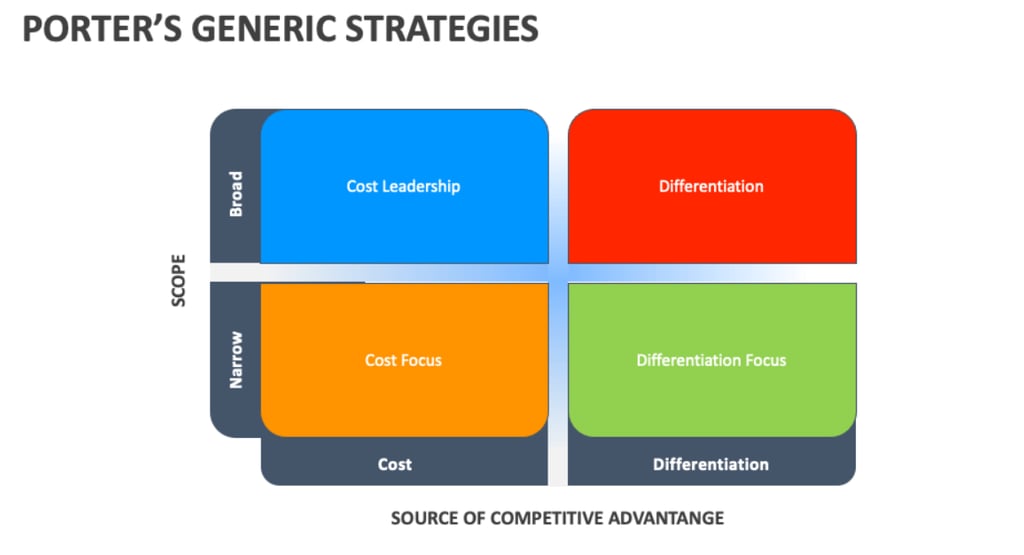
Porter's Generic Strategies assess an organisation's competitive potential by providing a strategic framework for achieving sustainable competitive advantage through three fundamental approaches: cost leadership, differentiation, and focus strategies.
Michael Porter introduced this model in his 1980 seminar "Competitive Strategy," arguing businesses must make explicit strategic choices so to avoid "stuck in the middle" positioning and therefore, lacking any clear competitive advantage. Porter's generic strategies framework guides strategic positioning decisions determining how businesses compete within industries and which customers they target.
Three Generic Strategies:
Cost Leadership - Achieving lowest cost position within industry:
Economies of scale through high-volume production
Efficient operations and process optimisation
Proprietary technology reducing costs
Favourable access to raw materials or distribution
Tight cost and overhead control
Minimising R&D, service, and marketing costs
Cost leaders compete on price offering standard products but at lower prices than competitors. Walmart is the typical example of cost leadership mainly achieved through supply chain efficiency, bargaining power with suppliers, and operational excellence enabling "everyday low prices."
Strategic Requirements:
Sustained capital investment in efficient facilities
Process engineering expertise
Intensive supervision and control systems
Standardised product design
Low-cost distribution systems
Risks:
Technology changes undermining cost advantages
Imitation by competitors learning cost reduction techniques
Inability to detect market changes as the focus is solely on cost reduction
Inflation raising costs faster than price recovery
Differentiation - Creating products perceived as unique industry-wide:
Superior quality and performance
Innovative features and technology
Strong brand identity and reputation
Superior customer service
Dealer network strength
Product design and aesthetics
Differentiation enables premium pricing as customers pay more for unique attributes. Apple is a good example of differentiation achieved through design excellence, ecosystem integration, brand strength, and premium customer experience justifying higher prices than competitors.
Strategic Requirements:
Strong R&D and innovation capabilities
Product engineering and design excellence
Marketing and communication expertise
Creative talent attraction
Reputation for quality and innovation
Risks:
Price differential too large for differentiation to encourage loyalty
Customers no longer valuing differentiating factors
Imitation narrows down perceived differentiation
Cost-focused competitors undermining differentiation through lower prices
Focus - Targeting narrow market segments:
Cost Focus: Achieving lowest costs when serving particular segment
Differentiation Focus: Creating unique offerings for specific segments
Focus strategies serve specific buyer groups, geographic markets, or concrete product line segments better than generic competitors. Regional banks are a good example of this using focus strategies to better serve local communities with personalised service and competing against large national banks.
Strategic Requirements:
Deep understanding of target segment needs
Tailored products or services meeting specific requirements
Strong reputation within target segment
Specialised distribution or service channels
Risks:
The cost differential between focused competitors and broad competitors widens eliminating focus advantages
Differences between target segment and overall market narrow
Competitors find sub-segments within focus target, out-focusing the focuser
"Stuck in the Middle" Risk:
Porter argues businesses failing to achieve a clear specific strategic position become stuck in the middle lacking competitive advantage. Without cost leadership, businesses cannot compete on price. Without differentiation, offerings are perceived as generic and not adding value. Without focus, the benefits of specialisation are not accomplished. Stuck businesses experience below-average profitability and market share.
However, critics argue that successful companies sometimes combine strategies. Amazon demonstrates cost leadership through operational efficiency while differentiating through customer experience and Prime membership benefits. Digital technologies enable simultaneous pursuit of efficiency and customisation previously considered incompatible.
Strategic Choice Factors:
Selecting generic strategies depends on:
Industry Structure - Generic market industries favour cost leadership. Industries valuing innovation and brand favour differentiation. Fragmented markets enable focus strategies.
Organisational Capabilities - Cost leadership requires process discipline and a culture of efficiency within an organisation. Differentiation requires creativity and innovation capabilities. Focus requires market intimacy and specialisation.
Competitive Dynamics - The available positions depend on a market's competitor strategies. To have multiple cost leaders is rarely sustainable industry-wide. Differentiation requires unique positioning versus existing competitors.
Modern Strategic Evolution:
Platform businesses combining network effects with multi-sided differentiation
Mass customisation enabling differentiation at cost-leadership scale
Sustainability differentiation creating premium positions
Hybrid strategies becoming viable through digital technologies
Dynamic capabilities enabling strategic flexibility across different situations
Example company & Porter's Generic Strategies Analysis
Researched example: Ecosip
Find Support For Practicing Porter's Generic Strategies
The IB Business Management Activity and Case Study Book includes a full Module 6 section with case studies across all 15 tools - Swot Analysis, Ansoff Matrix, Steeple Analysis, Boston Consulting Group (BCG) Matrix, Business Plan, Decision Trees, Descriptive Statistics, Circular Business Models, Gantt Charts (HL only), Porter’s Generic Strategies (HL only), Hofstede’s cultural dimensions (HL only), Force Field Analysis (HL only), Critical Path Analysis (HL only), Contribution (HL only), Simple Linear Regression (HL only) (All with worked exam responses and marking schemes aligned to every assessment objective.)
Explore IB Business Management And Porter's Generic Strategies
IB Business Management Main Hub your daily IB Business Management resource
IB Business Management Porter's Generic Strategies in the Business Management Toolkit
IB Business Management Paper 1 Exam Review Hub find Porter's Generic Strategies exam questions in Paper 1
IB Business Management Paper 2 Exam Review Hub study Porter's Generic Strategies exam questions in Paper 2
IB Business Management Paper 3 Exam Review Hub explore Porter's Generic Strategies exam questions in Paper 3
IB Business Management Activity Book: Explore and practice The Business Management Toolkit including Porter's Generic Strategies, Unit 1 Swot Analysis, Unit 2 Ansoff Matrix, Unit 3 Steeple Analysis, Unit 4 Boston Consulting Group (BCG) Matrix, Unit 5 Business Plan, Unit 6 Decision Trees, Unit 7 Descriptive Statistics, Unit 8 Circular Business Models, Unit 9 Gantt Charts (HL only), Unit 10 Porter’s Generic Strategies (HL only), Unit 11 Hofstede’s cultural dimensions (HL only), Unit 12 Force Field Analysis (HL only), Unit 13 Critical Path Analysis (HL only), Unit 14 Contribution (HL only), Unit 15 Simple Linear Regression (HL only) activities, exam questions, case studies, IB Standard model answers and IB marking schemes.
Read Next: IB Business Management Toolkit Hofstede’s Cultural Dimensions
© Theibtrainer.com 2012-2026. All rights reserved.
Legal
Have a Tip? Send us a tip using our anonymous form