
IB Economics Extended Essay
Most students avoid the IB Economics EE - and that's their error. Fewer candidates, fresher topics, a real shot at a grade A. Here is How to get started
IB ECONOMICSIB ECONOMICS SLIB ECONOMICS HL
Lawrence Robert
4/6/202617 min read


Why You Should Write Your IB Economics Extended Essay (And Why Most Students Are Making a Big Mistake)
Updated Post April 2026
Target Question:
"Should I do my IB extended essay in Economics?"
Today let me tell you about something that happened to me - or rather, to some of my students - over the last five years.
For three years running, I've sent strong final Extended Essay work to IB examiners under the subject of Business Management. We're talking well-structured arguments, solid data, proper use of theory and IB Business Management tools. The kind of essays that make a teacher feel 100% confident a grade A will be returned. And three years running, the result has come back the same: grade B's. Not a C, not a disaster - but work slightly short of a grade A.
At first I thought it was the essays. Read them many times. Then I started to wonder if it was me. But eventually, after comparing notes with colleagues and digging into the numbers, the truth became pretty clear: Business Management has become the "safe" Extended Essay choice for so many IB students worldwide that examiners have quietly, steadily raised the bar. What would have earned an A five years ago now earns a B. The subject has become a victim of its own popularity.
Here's something nobody tells you before you pick your EE subject: the fewer students who take a subject, the more realistic your chances of landing a top grade. This is human nature. The less competition, the lower the expectations always within reason. And right now, Economics is sitting quietly in the corner like an underestimated dark horse - with fewer candidates, fresher topics, and examiners who haven't yet seen every possible angle repeated time after time like for instance, those examiners in IB Business Management have.
Choosing the IB Economics Extended Essay is your "secret" competitive advantage. Let's make the most of it.
What Is the Extended Essay?
If you've somehow made it to the IB programme without anyone explaining the Extended Essay (EE) to you, welcome - you're in the right place. The EE is a 4,000-word independent research essay you write on a topic of your choosing, from a list of approved IB subjects. This is your one chance in the whole Diploma to write about something you're actually interested in, without an exam paper telling you exactly what to say.
Extended Essay definition: "A 4,000-word independent research essay on a topic of the student's choosing, assessed externally by an IB examiner, graded from A to E."
The essay is assessed externally - meaning your teachers don't mark it, (well they do, at least I do, but for internal reference only) an IB examiner does - and it's graded from A to E. You'll also need to complete three reflection sessions with your supervisor (more on those later) and finish the whole thing with a short interview called the viva voce, where your supervisor asks you a few questions about what you learned from the process.
In terms of time commitment, the IB expects you to invest roughly 40 hours across the whole process. That sounds a lot, but if your priorities are clear and spread over several months it's very manageable - and the payoff is considerable. Further, as months go by you will probably realise those 40 hours are not enough to reach your final copy, especially if you need to make significant changes as you move along the project.
The Diploma Points You Can't Afford to Ignore The EE is marked out of 34. Combined with your Theory of Knowledge (TOK) essay, the two grades together can earn you up to 3 bonus points towards your final IB total. That's potentially the difference between an overall 37 and a 40 - and a 40-point diploma is genuinely rare, genuinely impressive, and genuinely university-application gold.
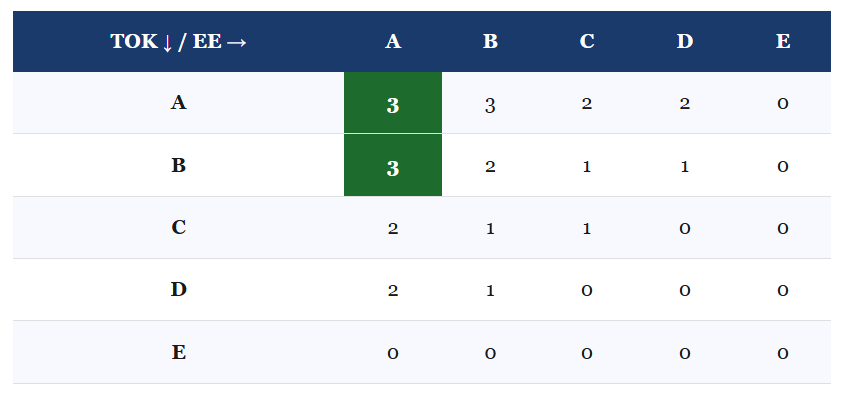
Here's how the bonus points work:
So, An A grade on the Extended Essay combined with a B in TOK earns the maximum 3 bonus points towards the IB Diploma total.
An A on your EE and a B on TOK? That's 3 bonus points. An A in Economics and a 7 in your IB Economics exam? That's 10 Diploma points from one subject alone. The maths here can make your life very easy indeed.
One Thing You Cannot Afford to Ignore If you receive an E grade for either your EE or TOK, you automatically fail your IB Diploma - regardless of how well you did in everything else. An E is not a risk worth taking. Fortunately, with the right subject choice and a bit of planning, an E is very avoidable.
The Reality Behind Popular EE Subject Choice - And the Numbers That Prove It
Think about it from the examiner's perspective for a second. Imagine you're an IB marker, and you've just been handed a pile of 80 Business Management extended essays to assess. By essay number 15, you've already read four different takes on Apple's marketing strategy, three analyses of Tesla's pricing decisions, and at least two essays about whether Zara's supply chain is sustainable. It is human to put it mildly, not to be thrilled.
Now imagine you're the same examiner, but this time you've been sent 20 Economics essays. The topics are more varied. The data is more original. The research questions are sharper and more locally grounded. You're reading with fresh eyes. In that context, a well-executed essay genuinely stands out - because it doesn't have to fight through a crowd of identical work to get noticed.
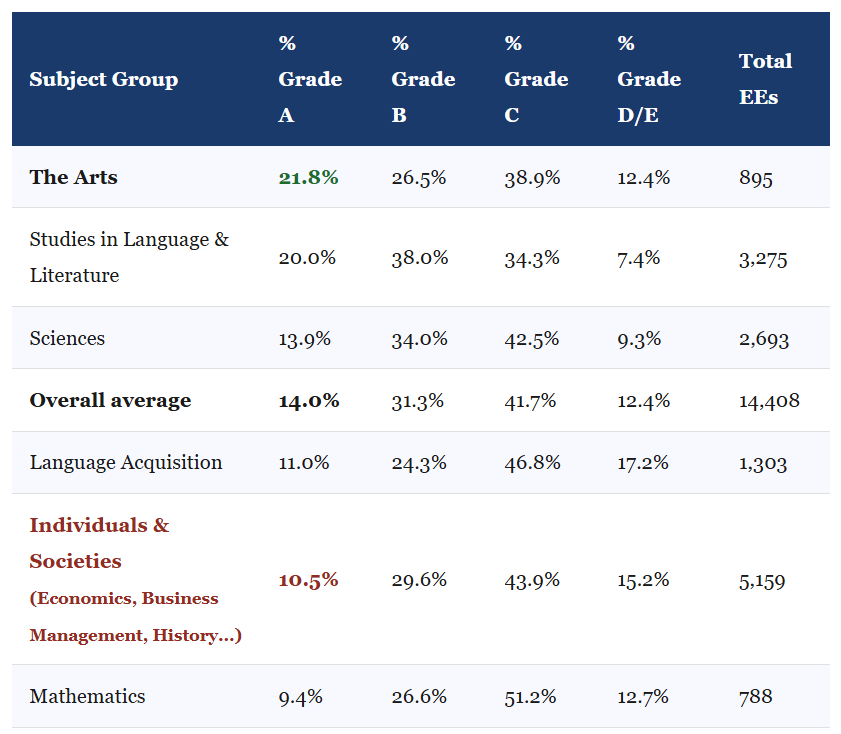
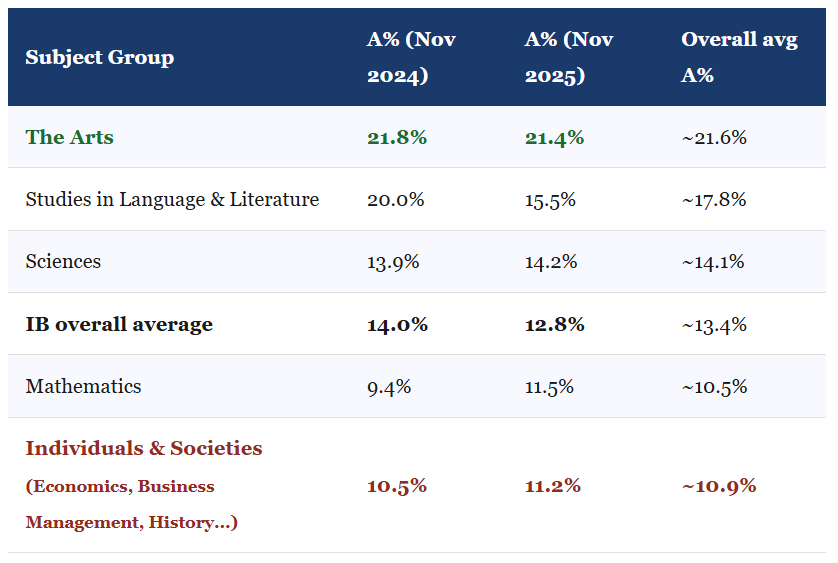
This isn't just my own theory. The IB publishes its own grade statistics - and they teach a very consistent lesson across two consecutive years. The table below shows the EE grade distribution by subject group from the IB Diploma Programme Final Statistical Bulletin, November 2024, with November 2025 provisional data following immediately after:
Source: IB Diploma Programme Final Statistical Bulletin, November 2024 Assessment Session © International Baccalaureate Organization 2025
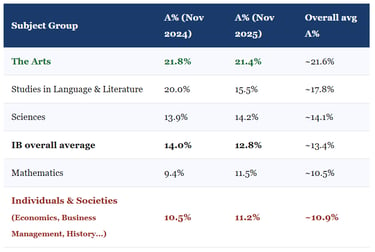
Read that table carefully. The table below combines both the November 2024 Final Bulletin and the November 2025 Provisional Bulletin:
Sources: IB Diploma Programme Final Statistical Bulletin, November 2024 © IBO 2025; IB Diploma Programme Provisional Statistical Bulletin, November 2025 © IBO 2025. Note: November 2025 data is provisional and subject to minor revision.
For two years running, Individuals and Societies - the group containing Economics, Business Management, History, Psychology, and Geography - sits below the overall IB average for A grades. Across both sessions, it averages roughly 10.9% grades As. The Arts, by comparison, averages around 21.6%. That's not circumstantial or happening by chance. That's a structural pattern.
Now look at the most popular EE subjects globally, according to the November 2025 bulletin:
History
Spanish A
English A
English B
Business Management (dropped from 4th in 2024 - still top 5)
Biology
Mathematics
Physics
Psychology
Visual Arts
Notice what's missing from that list? IB Economics. Not in the top ten. Not in November 2024. Not in November 2025. Two years, same story. Business Management, meanwhile, remains a top-5 EE subject globally - meaning thousands and thousands of students are all competing for A grades within an already below-average group, while IB Economics students face a fraction of that competition.
Put it this way: if you choose IB Business Management for your EE, you're fighting a large, well-practised crowd for a relatively small number of As. If you choose Economics, you're entering a much smaller field - with the same marks available and an examiner who hasn't already read forty variations of your essay arguments and tools before they get to yours.
The Numbers in Plain English In November 2025, just 630 students globally submitted an Individuals & Societies EE and received a grade A - out of 5,568 total entries in that group. IB Business Management accounts for a large chunk of those entries, with IB Economics students competing in a far less crowded corner of the same pool. Fewer competitors. Same marks on offer. I don't know about you, but I personally think that's just good strategy.
I am not speculating about how exam boards work. It's two years of the IB's own published data, pointing in exactly the same direction. Once you've seen it, it's very hard to look at IB Business Management as the "safe" choice for your extended essay in the same way again.
Why IB Economics Is Actually a Great Fit for the EE
Further, there are genuine academic reasons why Economics works brilliantly as an EE subject:
It gives you real analytical tools. The IB Economics syllabus is packed with models - supply and demand, price elasticity of demand, AS/AD frameworks, market structures, externalities - that can be applied directly to real-world research questions. Unlike a History or Psychology essay where you're largely engaging with other people's interpretations, an Economics EE lets you do the analysis yourself using tools you already know (or should know) from class.
Local topics are abundant. Almost anything happening in your town, city or country right now has an economic dimension. A new supermarket opening up the road, rising rent prices in your neighbourhood, a government policy affecting local businesses - any of these can become a focused, original research question that no other student in the world is writing about.
Primary research is genuinely achievable. Want to calculate the price elasticity of demand for something sold locally? Survey people. Want to analyse how a business sets prices or is affected by current taxes? Interview the owner. Economics gives you a clear route from primary data to economic theory that makes your essay feel original and properly academic at the same time. This is exactly the type of work the IB Board wants you to carry out.
It connects to everything students already care about. Why are concert tickets so expensive? (Price discrimination and market power.) Why does the price of your weekly shop keep rising? (Cost-push inflation and supply chain disruption.) Why are energy bills through the roof? (Commodity markets and government policy.) Economics isn't some abstract discipline at all - it's the story of every decision every person makes with money, every single day.
How to Choose Your Research Question
Your research question (RQ) is probably the single most important decision you'll make in the entire EE process. Get it right and the essay practically plans itself. Get it wrong and you'll spend weeks fighting an uphill battle against a topic that either has too much to say or not nearly enough.
Here's the first and most important piece of advice: pick something you're genuinely curious about. You're going to spend 40 hours and possibly more with this question. If you chose it because it seemed manageable rather than because you find it interesting, those 40 hours are going to feel very, very long. An uphill task.
The ideal research question in IB Economics has five qualities. This is your checklist.
The Five Rules for a Brilliant Economics Research Question
Up-to-date - relates to economic events or policies no more than five years old (see the 5-year rule below)
Localised - focused on a specific business, area, market or demographic rather than an entire economy
Testable - can be answered using real data you can actually get hold of
Debatable - allows you to argue and evaluate, not just describe
Syllabus-connected - clearly linked to a concept or theory from the IB Economics course
What Makes a Bad Research Question?
A bad research question is usually too broad. "What is the impact of inflation on the UK economy?" sounds fine until you realise you're basically trying to write a whole textbook in 4,000 words. No chance. The examiner wants to see you go deep, not wide. A far better version might be: "To what extent has the 2022–2024 inflation surge affected consumer spending patterns at local supermarkets in Bristol?"
Similarly, avoid questions that are purely descriptive. "How has unemployment changed in Spain since 2020?" is a question that can be answered by copying statistics from a government website - it gives you no room to analyse, evaluate or argue. That means you'll struggle badly on Criterion C (Critical Thinking), which is worth a massive 12 of the 34 available marks.
Lawrence's Macro Warning: Macroeconomics topics are absolutely fine - but your research question must be narrowed to a particular part of the economy, not the economy as a whole. You can study the effect of a tax change on a specific industry. You cannot study the effect of a tax change on the entire economy. The IB is very clear on this.
The 5-Year Rule: Too Many Students Still Falling For This
The IB's current guide includes a very specific rule that a surprising number of students keep on ignoring: your essay topic must relate to economic events, policies or data no more than approximately five years old.
So, IB Economics EE topics must relate to economic events, policies or data no more than approximately five years old.
Why? Because essays based on historical events almost always end up being descriptive. If you're writing about something that happened ten years ago, everything is already documented and analysed - all you can really do is summarise what other people have already concluded. That's not what the IB is looking for.
Equally - and this catches a few students out - you can't write about future events. "What will be the economic impact of the 2030 World Cup on Host Country X?" is entirely speculative and unsupported by data. The IB rejects this category outright.
The worst thing you can do is to have to change your extended essay question halfway through the project. Time works against you. It seriously compromises your final grade.
The Grade Cap You Don't Want Breaching the 5-year rule doesn't just lose you a few marks - it places a hard ceiling on what you can score across multiple criteria. For Criterion C (Critical Thinking, worth 12 marks), a 5-year rule breach caps your mark at 3 out of 12. In a particularly strong paper, that's a potential penalty of 13 marks. Don't let a poor topic choice made in Year 1 of the Diploma cost you a grade boundary in Year 2.
Given that the current IB session covers 2025–2026, your research question should relate to events from roughly 2020 onwards to be safely within the rule. The good news? That window includes some of the most economically eventful years in living memory - the post-COVID recovery, the global inflation surge, the energy crisis, rising interest rates, AI disruption in labour markets, and the ongoing cost-of-living squeeze especially in developed economies. You are not short of material.
What a Good Economics Research Question Actually Looks Like
Rather than just telling you the theory, let's look at some proper examples - including some updated ones that fit the current window perfectly. Notice how each one is specific, locally grounded, and clearly connected to an economic concept.
Microeconomics and Markets
"To what extent has the entry of Bolt into the ride-hailing market in [City X] affected taxi fares and market structure?"
"What is the price elasticity of demand for plant-based food products amongst 18–35-year-olds in [City X], and what does this suggest for producers' pricing strategies?"
"How has the 2023 rise in the National Living Wage affected employment levels in the hospitality sector in [Local Area]?"
Inflation and the Cost of Living (very current)
"To what extent has the 2022–2024 inflationary period changed consumer switching behaviour between budget and premium supermarket brands in [Country X]?"
"What has been the impact of rising energy costs on the profitability of small independent businesses in [Town X] between 2022 and 2024?"
Technology and Market Disruption
"How has the growth of TikTok Shop affected the revenue and pricing strategies of independent fashion retailers in [City X]?"
"To what extent has the introduction of AI writing tools affected the market for freelance content writers in [Country X]?"
International Economics
"How has the depreciation of the [Currency X] between 2022 and 2024 affected export revenue for agricultural producers in [Country X]?"
"To what extent has Country X's post-Brexit trade policy affected the profitability of SMEs in [Sector X]?"
Development Economics
"What has been the effect of mobile banking adoption on financial inclusion among low-income households in [Region X]?"
"To what extent has the expansion of solar energy infrastructure in [Developing Country X] contributed to economic development in rural communities?"
Lawrence's Tip: Local is Powerful The best research questions are the ones where you have the home advantage. If you're based in Spain, write about a Spanish market. If you're in Singapore, write about Singapore. You'll have easier access to primary data, your local knowledge will show in the analysis, and your essay will feel genuinely original - because it will be all your own work.
Before You Commit: Check This List
Before you get your supervisor to approve your RQ, run it through these three tests. They'll save you a lot of pain later on.
1. Can You Actually Get the Data?
This is the one students most often underestimate. A question that sounds great on paper can become useless the moment you realise you can't access the information you need to answer it. Business data can be confidential. Survey respondents can be hard to reach. Government statistics don't always exist at the level of detail you need.
Think carefully about your sample frame - who you actually need to talk to or survey. If your research question is about the price elasticity of demand for electric vehicles, your respondents should ideally be people who are actually in the market for a car, not just your classmates. If you need to interview a business owner, make sure you have a genuine connection or a realistic route to getting that interview - and do it early. If a key contact hasn't responded within a month, you need to change direction.
2. Can You Answer It in 4,000 Words?
4,000 words sounds like a lot until you actually start writing, at which point it'll feel very tight. The danger goes both ways: some topics are too broad to cover adequately in the word limit, while others are so narrow they run dry after 2,000 words.
A good test: could a focused, well-organised student write a coherent essay answering this question in roughly eight to ten sections? If you can sketch out that structure and each section has something meaningful to contribute, you're probably in the right territory.
Also worth noting: the word count doesn't include your contents page, diagrams, tables, graphs, calculations, bibliography, or references. Those can take up considerable space - so your actual content has room to breathe.
3. Is It Academically Rigorous Enough?
The EE is meant to demonstrate that you can think like an economist - not just describe what happened, but analyse why it happened, evaluate competing explanations, and reach a reasoned conclusion. If your topic doesn't give you any room to do that, it's not a strong EE topic.
A quick way to test this: can you think of at least two economic theories or models from the IB Economics syllabus that you could apply to your question? If you're struggling to connect it to the course material, the examiner will struggle too - and that's not a fight you want to go through at 11pm the night before submission.
Primary and Secondary Research: What's the Difference and Which One Do You Need?
Your essay can be based entirely on secondary research - published data, academic papers, government reports, think-tank analysis, newspaper articles. In fact, a strong secondary-only essay is absolutely possible and can score very highly.
Having said that, primary research - data you collect yourself through surveys, interviews, or questionnaires - can give your essay a real edge. It means your findings are genuinely original, your data is tailored exactly to your research question, and the examiner can't just Google the answer. That's a good combination.
Strong secondary sources for an IB Economics EE include:
Economics textbooks and academic journals
Think-tank publications (OECD, New Economics Foundation, Resolution Foundation)
Government statistical offices (ONS in the UK, INE in Spain, BLS in the USA)
World Bank and IMF data portals
Quality newspaper reporting (Financial Times, The Economist, Reuters)
If you do choose to include primary research, the IB is clear that it must meet academic standards. Surveys need to be designed to gather meaningful, relevant data - not leading questions that point respondents towards the answer you want. And your sample size needs to be large enough to produce statistically meaningful results. Surveying your three best friends does not count as primary research, it is not relevant how enthusiastically they fill in your questionnaire.
Lawrence's tip: Expert Interviews Is A Powerful Primary Research Tool One of the most underused options in the IB Economics EE is a structured interview with an expert - a local business owner, an economist at a local university, a government official, or a financial journalist. A well-conducted expert interview can provide data and insight that simply isn't available anywhere online, and it signals genuine intellectual initiative to the IB examiner. Just make sure you've secured the interview before you commit to a research question that depends on it. Show initiative it pays off.
Should You Do Your EE in Economics?
If you enjoy Economics - if you find yourself genuinely curious about why prices rise, how markets work, what governments should do about inequality or climate change - then yes. You should do your Extended Essay in Economics.
But even if you're on the fence, consider the strategic picture. Fewer competitors. More original topics. A subject with a rich toolbox of analytical models that makes the hard part - the critical thinking that earns you those 12 marks in Criterion C - become more achievable than in many alternatives. And an examiner pool that hasn't yet been beaten into submission by ten thousand essays about the same three companies or the same IB Business Management toolkit instruments.
Criterion C weighting: "Critical Thinking (Criterion C) is worth 12 of the 34 available marks - more than any other single criterion."
Update 2025 -
With the New Assessment Criteria (For exam entries year 2027) Your EE will be assessed using a five assessment criteria only, and will receive a mark out of 30 instead of out of 34.
Criterion A Framework for the essay 6 marks
Criterion B Knowledge and understanding 6 marks
Criterion C Analysis and line of argument 6 marks
Criterion D Discussion and evaluation 8 marks
Criterion E Reflection 4 marks
Total = 30 marks
May 2027 onwards:
Total number of marks is 30
Before: criterion C "Critical thinking" marked out of 12
Now: divided into criterion C "Analysis and line of argument" marked out of 6 and criterion D "Discussion and evaluation" marked out of 8.
Before: criterion D "Formal presentation" marked out of 4
Now: included as part of criterion A "Framework for the essay" under "structure", which contributes to a total mark out of 6 for the criterion.
Before: Criterion E ‘Engagement’ marked out of 6, based on three written reflections produced after each of the three mandatory reflection sessions on progress and planning form (RPPF)
Now: Criterion E ‘Reflection” marked out of 4, based on one reflective statement written on the reflection and progress form (RPF) after the viva voce, with a focus on the growth of the learner and an emphasis on skills development and transfer
The students who win at the Extended Essay aren't always the cleverest. They're the ones who make smart well-planned decisions early - starting with the subject choice. You're reading this, which suggests you're already thinking ahead. That's more than half the battle.
In the next entry in this series, we'll look at exactly how to structure your essay, apply your analytic tools properly, and write the kind of critical evaluation that turns a B into an A.
Frequently Asked Questions: IB Economics Extended Essay
Should I do my IB Extended Essay in Economics? Yes - especially if you enjoy the subject. IB Economics is less popular as an EE choice than IB Business Management or IB Psychology, which means fewer candidates and a more realistic shot at an A grade. Combined with a strong toolbox of analytical models and an abundance of locally grounded research topics, it's a strategically smart choice.
How many words is the IB Economics Extended Essay? The maximum word count is 4,000 words. This does not include your contents page, diagrams, tables, graphs, calculations, bibliography, or references - so you have plenty of room to work with.
What is the 5-year rule in the IB Economics Extended Essay? The IB requires that Economics EE topics relate to economic events, policies or data no more than approximately five years old. Breaching this rule places a hard ceiling on your marks across multiple criteria - including a cap of 3 out of 12 for Criterion C (Critical Thinking). Always check your topic falls within the current window before committing.
How many bonus points can I get for my Extended Essay? Up to 3 bonus points, awarded based on a combination of your EE grade and your Theory of Knowledge (TOK) grade. An A in the EE and a B in TOK earns the full 3 points. These bonus points are added directly to your final IB Diploma total.
What makes a good IB Economics Extended Essay research question? A strong Economics EE research question is up-to-date (within the last five years), locally focused (on a specific business, market or area), testable with real data, debatable enough to support analysis and evaluation, and clearly connected to a concept from the IB Economics syllabus.
© Theibtrainer.com 2012-2026. All rights reserved.
Legal
Have a Tip? Send us a tip using our anonymous form