
IB Economics the Division of Labour Making a Smartphone
Understand the concept of the division of labour and how it leads to greater productivity in IB Economics. Learn why no one can make a smartphone alone.
IB ECONOMICSIB ECONOMICS INTRODUCTION
Lawrence Robert
3/7/20258 min read


The Division of Labour in IB Economics: Why Nobody Makes a Smartphone Alone
Target Question:
What are the advantages and disadvantages of division of labour in IB Economics?
When people pick up their phones most people never realise that not a single human being on Earth could make that device from scratch. Not a single person, could create a smartphone by themselves without any external help. Why? Because your smartphone's components come from all over the world. The rare earth metals were mined by someone in the Democratic Republic of Congo, the processor was designed by engineers in California, the glass was chemically treated in South Korea, the assembly itself happened in a factory in Shenzhen, and the box was printed in a facility you'll never know about. What holds all of this together is what we call in IB Economics the division of labour - and it's another fundamental concept in your IB Economics course.
IB Economics Diagrams Programme, What's included:
200+ exam-ready diagrams covering the entire IB Economics syllabus
Video for every diagram showing you exactly how each model looks
Image version perfect for modelling diagrams in you essays, presentations, and your IA
Detailed written explanations of the IB Economics theory behind each diagram
Both SL and HL IB Economics diagrams clearly labelled and organised by topic
Real IB Economics exam application showing how to use diagrams effectively in Paper 1 and Paper 2
1. What Is the Division of Labour? (IB Economics Definition)
IB Economics Definition - Division of Labour:
The breaking down of the production process into a series of separate, specialised tasks, each performed by different workers (or groups of workers).
IB Economics Definition - Specialisation:
The process by which individuals, firms, or economies focus on producing a narrow range of goods or services in which they are most efficient.
These two concepts are closely linked. Division of labour is the mechanism, the system; specialisation is the outcome. When workers divide up tasks in a production process, each person ends up specialising in what they do best or most efficiently. The result, as Adam Smith famously observed in his pin factory example in The Wealth of Nations (1776), is a dramatic increase in productivity and in output. Smith showed that ten workers dividing the eighteen steps of pin-making could produce 48,000 pins a day. How about workers doing the whole job individually? Perhaps a few each.
IB Economics Syllabus tip:
The IB syllabus requires you to understand both the benefits and the limitations of the division of labour. An IB Economics Paper 1 Part (a) response that lists only advantages will be capped. Always show both sides.
Internal Assessment (IA) Guide – Free Download
Step-by-step support on topic selection, structure, evaluation, and most common IB Economics IA mistakes.
Understanding key IB Economics Internal Assessment concepts
Applying and explaining them in real-world IB Economics contexts
Building IB Economics IA confidence without drowning in dry theory and explanations.
Download the IA guide now for free and boost your IB Economics grades and confidence
2. The Benefits of the Division of Labour
The IB Economics syllabus identifies several clear advantages.
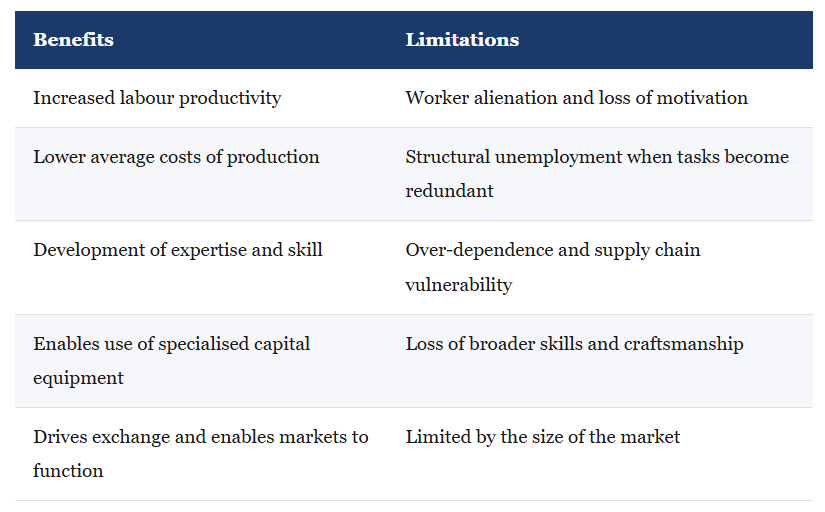
Increased Productivity
When workers repeat the same task continuously, they become faster and more skilled at it. A worker who spends the entire day tightening one type of bolt will do it faster and with fewer errors on the 500th bolt than on the 1st. Output per worker - labour productivity - rises. This is the central gain from the division of labour, and it directly increases the productive capacity of an economy.
Lower Average Costs of Production
Higher productivity means more output from the same labour input. If a factory produces twice as many units in the same time, the labour cost per unit falls. Firms benefit through lower average costs, which can translate into lower prices for consumers or higher profit margins for producers. This connects directly to the production possibilities curve (PPC) you study in Unit 1 - specialisation pushes economies closer to (and eventually beyond) their PPC frontier.
Development of Expertise and Skill
Repetition builds mastery. A worker performing the same task day after day develops a level of expertise that "all purpose" workers never reach. It also reduces the time lost switching between different tasks - economists call this "time lost in transition." In general, it is safe to assume that an economy of specialists is a more productive economy.
Use of Capital Equipment and Technology
The division of labour makes it cost-effective to invest in specialised machinery. If a production line is broken into distinct tasks, purpose-built machines can be deployed for each stage - increasing output further and reducing dependence on human error.
IB Economics Real-world example: Toyota's production system is a typical example. Each worker on the assembly line performs a defined, specialised task - welding, fitting, testing - rather than building an entire car. This system has allowed Toyota to achieve extraordinary consistency and low defect rates, illustrating how division of labour raises productivity and at the same time, lowers average costs.
For access to all IB Economics exam practice questions, model answers, IB Economics complete diagrams together with full explanations, and detailed assessment criteria, explore the Complete IB Economics Course
3. The Limitations of the Division of Labour
This is where many of my IB Economics students get confused - they treat the division of labour as an exclusively positive force. The syllabus requires you to evaluate it critically.
Remember: The IB Economics course rewards balanced evaluation. For every benefit, you should be able to identify a corresponding limitation or condition under which the benefit is limited or at least seriously diminished.
Worker Alienation and Repetitive Work
When workers perform the same narrow task all day, every day, the psychological cost can be significant. This was noted by Karl Marx, but it's also an economic concern - disengaged workers are less productive, take more sick days, and leave jobs more frequently. High staff turnover increases costs for firms, partially offsetting the productivity gains from specialisation. The division of labour, pushed to its extreme, can dehumanise the production process.
Structural Unemployment
Highly specialised workers are vulnerable when their specific task becomes redundant - whether through automation, technological change, or a shift in consumer demand. A worker who has spent twenty years tightening one type of bolt has skills that may not transfer easily to a different industry. The result is structural unemployment: workers whose skills no longer match what the market demands. This is a genuine macroeconomic cost of specialisation.
Over-Dependence and Vulnerability
The division of labour creates interdependence - every part of the production process depends on every other part functioning correctly. A strike, supply chain disruption, or machinery failure at one stage can halt the entire process. This was clearly demonstrated during the COVID-19 pandemic, when the global semiconductor shortage - caused by supply disruptions in a handful of specialised chip manufacturers - brought car production lines around the world to a standstill.
Loss of Craftsmanship and Flexibility
Extreme specialisation can lead to the disappearance of broader skills. If every worker knows only one task, the workforce as a whole loses flexibility. There is also a quality dimension: mass-produced goods made through highly divided labour may sacrifice the quality, creativity, or uniqueness associated with skilled artisan production.
Dependence on a Large Market
The division of labour only makes economic sense if there is sufficient demand to absorb the increased output. As Adam Smith observed, "the division of labour is limited by the extent of the market." In small or isolated economies with limited consumer demand, highly specialised production may not be viable - firms will not invest in specialised capital if markets cannot absorb the resulting output.
Every episode of Pint-Sized links back to what matters most for your IB Economics course:
Understanding key IB Economics concepts
Applying them in real-world IB Economics contexts
Building IB Economics course confidence without drowning in dry theory.
Subscribe for free to exclusive episodes designed to boost your IB Economics grades and confidence
4. Specialisation, Exchange, and Why Markets Exist
Specialisation is exactly why markets exist. If every household produced everything it needed, there would be no need for exchange. But once workers specialise, they produce many more things than they can personally consume - so they need a mechanism to trade their surplus output for the goods and services they no longer produce themselves.
IB Economics Definition - Exchange:
The trading of goods and services between buyers and sellers, made necessary by the fact that specialised producers cannot satisfy all their own needs from their own output alone.
Markets - whether local, national, or global - exist to facilitate this exchange. This is a foundational point in the first units of the IB Economics course: the division of labour creates the conditions that make market economies necessary. Specialisation without markets would simply leave workers with vast surpluses of one product and nothing else. It is the combination of specialisation and exchange that generates the productive and allocative efficiency markets can achieve.
5. Division of Labour: IB Economics Summary
IB Economics Exam Application:
In IB Economics Paper 1 Part (a) questions worth 10 marks, you will be asked to "explain" a concept. For the division of labour, a strong response would be: define both division of labour and specialisation clearly, explain at least two benefits with real-world examples, explain at least two limitations with analysis, and link specialisation to the need for exchange. Don't forget your diagrams where relevant - a PPC shift or movement toward the frontier can support your argument in support of productive efficiency.
Frequently Asked Questions: Division of Labour in IB Economics
Q: What are the advantages and disadvantages of the division of labour in IB Economics?
The main advantages of division of labour in IB Economics are increased labour productivity, lower average costs of production, and the development of worker expertise. The main disadvantages are worker alienation and reduced motivation, structural unemployment when specialised skills become redundant, and over-dependence on interconnected supply chains. IB Economics requires students to evaluate both sides, as the net effect depends on the specific context of the firm or economy.
Q: What is the difference between the division of labour and specialisation in IB Economics?
Division of labour is the process of breaking production down into separate, specialised tasks performed by different workers. Specialisation is the outcome: workers, firms, or economies become focused on a narrow range of activities in which they are most efficient. Division of labour is the mechanism; specialisation is the result. Both concepts appear in IB Economics Unit 1.
Q: Why does the division of labour lead to lower costs of production?
Because specialised workers become faster and more skilled at their particular task, producing more output in the same amount of time. This raises labour productivity, which means the labour cost per unit of output falls. Firms can also invest in purpose-built machinery for specific tasks, further reducing average costs over higher volumes of output.
Q: What is meant by "structural unemployment" in the context of the division of labour?
Structural unemployment occurs when highly specialised workers find their specific skills are no longer in demand - typically because of technological change, automation, or a shift in what consumers want. Because their skills are so narrow, these workers cannot easily move into other industries. This is a recognised limitation of specialisation in the IB Economics syllabus and represents a genuine long-run economic cost.
Q: Why is division of labour "limited by the extent of the market" in IB Economics?
The division of labour only makes economic sense when there is sufficient market demand to absorb the higher output that specialised production generates. If a market is too small, firms will not invest in specialised capital or highly divided production processes because the resulting output cannot be sold profitably. This insight, from Adam Smith, is directly relevant to IB Economics discussions of why small economies may not be able to exploit the full gains from specialisation.
Stay well,
Related Topics:
IB Economics your IB Economics daily guide
IB Economics Introduction to Economics access the division of labour content as well as the rest of module 1
IB Economics Diagrams Check Unit 1 for All PPC / PPF diagrams with explanations
IB Economics Activity book Module 1 Introduction to Economics Units 1.1 for Economics basics and the division of labour and unit 1.3 for production possibilities PPC or PPF exam practice, activities, model answers and IB Economics Marking schemes
IB Economics Paper 1 as the division of labour and basic economics concepts may appear in these IB Economics exam papers
IB economics Calculations Book make sure you check unit 1 Introduction to economics for The division of labour and basic economics calculations exercises, IB model answers, and IB marking schemes
Read Next: IB Economics An Introduction to IB Economics
© Theibtrainer.com 2012-2026. All rights reserved.
Legal
Have a Tip? Send us a tip using our anonymous form