
IB Econ Quota
Target Question:
What are the different types of quotas in economics and how do they each work?
A comprehensive guide to the full range of quota types in IB Economics - from production quotas and voluntary export restraints to fishing quotas and tariff-rate quotas - with real-world examples and policy evaluation.
Full quota activity practice breakdown, exam practice, model answers and evaluation tools are available exclusively in the IB Economics Activity Book and IB Economics Calculations book.


Beyond the Import Quota
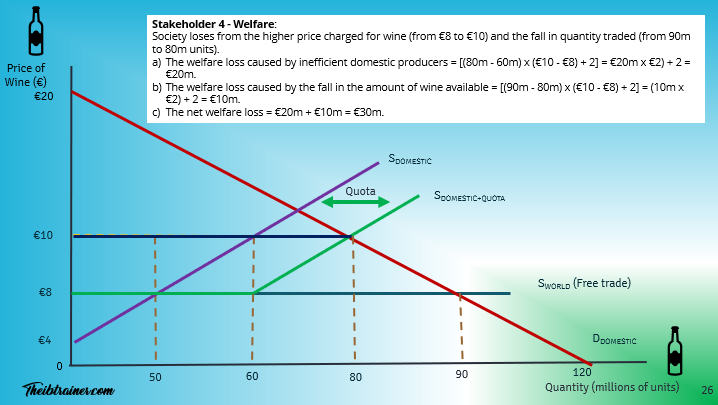
Most IB Economics students are familiar with the import quota - a government-imposed limit on the volume of a good entering a country. But quotas appear in many other forms across international trade and resource management, each with distinct mechanisms, justifications, and welfare implications.
IB Economics definition:
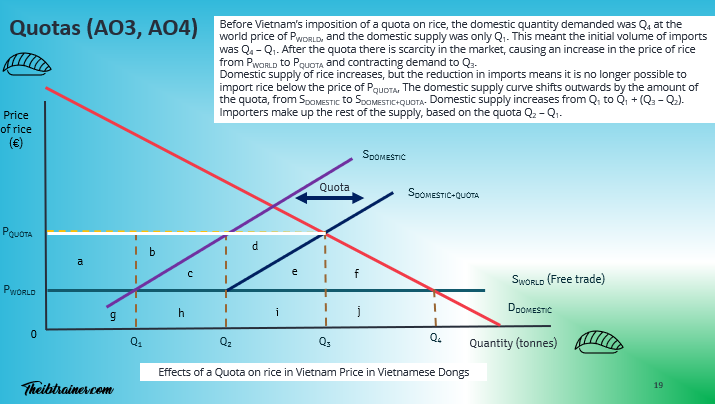
A quota is any quantitative restriction on the production, export, or import of a good. While import quotas are the most commonly examined form, quotas also govern oil production (OPEC), fish catches, export volumes under voluntary restraints, and preferential market access under tariff-rate quota systems.
Understanding the different types is therefore relevant for IB Economics because the welfare analysis, the rationale, and the policy evaluation differ significantly across each form.
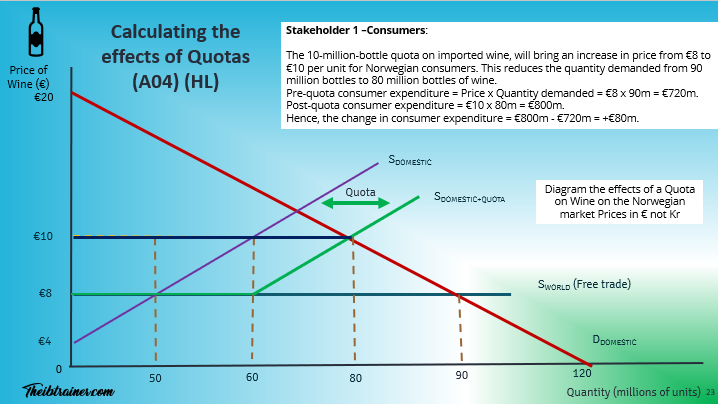
IB Economics Quotas - Theory and Welfare Analysis →
Tariff-Rate Quotas (TRQs)
A tariff-rate quota is a hybrid trade policy tool that combines quota and tariff elements. It works in two tiers:
Within-quota imports - up to a specified volume, imports enter at a low or zero tariff rate
Above-quota imports - imports beyond that volume face a much higher out-of-quota tariff
TRQs are the dominant form of agricultural trade protection in the modern WTO system. Following the Uruguay Round Agreement on Agriculture (1995), many countries were required to convert pure import quotas into TRQs - maintaining protection while technically providing some market access.
How TRQs work in practice: the EU's TRQ on chicken imports from Brazil allows a specific volume to enter at a 15% tariff. Any imports above that volume face an 80%+ tariff - effectively prohibitive. The result: the quota volume enters, but the market is protected from large-scale import competition.
Who benefits from the TRQ rent? The low-tariff slots are valuable - exporters who obtain them can sell at the domestic price while paying only the low tariff. Allocation systems are especially relevant: historical allocations (based on past trade flows), first-come-first-served, auctions, and administrative licensing all have different efficiency and equity implications.
Evaluation: TRQs are more transparent than pure quotas and technically WTO-compliant. However, complex administration creates rent-seeking; low-cost exporters without historical allocations may be shut out regardless of their efficiency advantage.
Voluntary Export Restraints (VERs)
A Voluntary Export Restraint is a quota agreed by the exporting country under political pressure from the importing country - rather than imposed unilaterally as an import quota. The exporting country "voluntarily" limits its exports to avoid more punitive measures (such as tariffs or mandatory import quotas).
The most important VER in economic history: Japan's voluntary restraint on automobile exports to the United States in the 1980s. Facing US pressure over its surging car exports, Japan agreed to limit exports to approximately 1.68 million vehicles annually. This protected US automakers from Japanese competition during a period of significant domestic industry adjustment.
Why VERs are worse than import quotas from the importing country's perspective:
With an import quota, the importing country can auction licences and capture the quota rent as government revenue. With a VER, the exporting country's exporters capture the quota rent - they sell at the high domestic price while controlling supply. The importing country's consumers pay higher prices AND the rent flows abroad. This makes VERs arguably the least efficient form of trade protection for the importing economy.
WTO status: VERs were effectively prohibited by the WTO Agreement on Safeguards (1994), which required existing VERs to be eliminated by 1999. However, politically negotiated export restraints continue in various forms - the recent steel export restrictions negotiated between the US and EU have some VER-like characteristics.
Production Quotas: OPEC and Cartel Behaviour
Production quotas restrict the output of producers rather than imports or exports. The most significant example in economics is the OPEC (Organisation of the Petroleum Exporting Countries) system of oil production quotas.
How OPEC quotas work: OPEC member countries (currently 13, including Saudi Arabia, UAE, Iraq, and Kuwait) agree on national production limits at periodic ministerial meetings. By collectively restricting supply below the competitive level, the cartel maintains oil prices above the level that uncoordinated production would produce.
Economic analysis:
OPEC production quotas function as a cartel supply restriction. The welfare analysis from the perspective of consuming countries is similar to a monopoly restriction: output below the competitive equilibrium, price above marginal cost, consumer surplus transferred to producers, and deadweight loss. Source: IB Economics Diagrams
From the producers' perspective, the quota system solves the prisoners' dilemma inherent in any cartel: each individual country has an incentive to exceed its quota and sell more at the maintained high price, but if all countries do this simultaneously, the price falls and all are worse off. OPEC's enforcement capacity - and the dominant role of Saudi Arabia as a "swing producer" that can increase or decrease output to discipline members - determines how effectively the cartel maintains the agreed restrictions.
Instability of production quotas: OPEC's history illustrates the fundamental challenge of cartel quota enforcement. Quota cheating has been persistent throughout OPEC's existence - members routinely exceed allocated production when prices are high. The cartel has been most effective when Saudi Arabia is willing to bear the adjustment costs (cutting its own production to compensate for others' overproduction) and least effective during periods of fiscal stress for member governments.
2020 price war: the dramatic breakdown of OPEC+ cooperation in early 2020 - when Saudi Arabia and Russia failed to agree on production cuts as COVID-19 collapsed demand - briefly produced negative oil futures prices. The episode illustrates how production quota systems depend on political cooperation that can fail under stress.
Fishing Quotas: Managing Common Pool Resources
Fishing quotas are quantitative limits on the volume of specific fish species that can be caught by fishers in a given period. Unlike trade quotas (which address distribution of welfare between countries) or production quotas (which address cartel coordination), fishing quotas address a market failure - the tragedy of the commons.
The economic problem: ocean fish stocks are a common pool resource - non-excludable (difficult to prevent fishing) and rival (each fish caught reduces availability to others). Without regulation, the market equilibrium involves overfishing: each individual fisher has an incentive to catch as much as possible before others do, and no individual has an incentive to conserve stocks. The result is stock depletion and long-run collapse - the classic tragedy of the commons.
How fishing quotas work: governments or international bodies set a Total Allowable Catch (TAC) based on scientific stock assessments. This is then divided into national or individual quotas - allocations specifying how much each country or vessel may catch. The EU's Common Fisheries Policy distributes TACs as national quotas allocated to member states, which then distribute them among domestic fishing fleets.
Individual Transferable Quotas (ITQs): a market-based approach to quota allocation - quota rights are initially distributed to existing fishers and can be bought and sold. ITQs allow quota to flow toward the most efficient operators (those who can fish profitably at the highest market price for quota), consolidating the industry and potentially reducing overcapacity. New Zealand pioneered ITQs in the 1980s; Iceland and several other countries have adopted similar systems.
Evaluation of fishing quotas:
They address the market failure directly by creating scarcity and forcing collective restraint
Setting the correct TAC requires accurate stock assessment - scientific uncertainty creates risk of setting quotas too high
Quota enforcement is difficult and costly - illegal, unreported, and unregulated (IUU) fishing undermines conservation
ITQs can concentrate quota ownership in large operators, raising equity concerns for small-scale fishing communities
International coordination is required for migratory species that cross national boundaries
Export Quotas
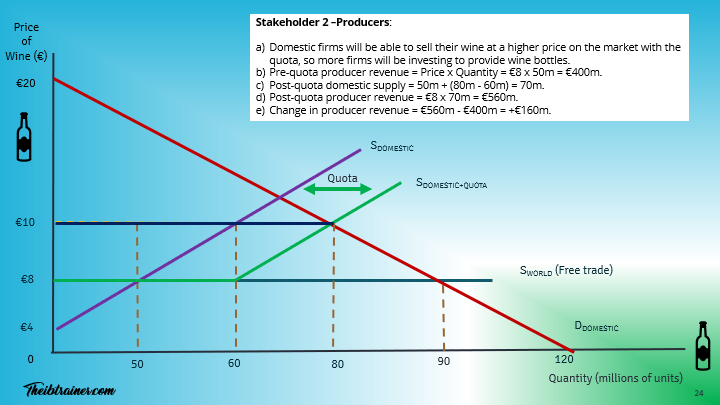
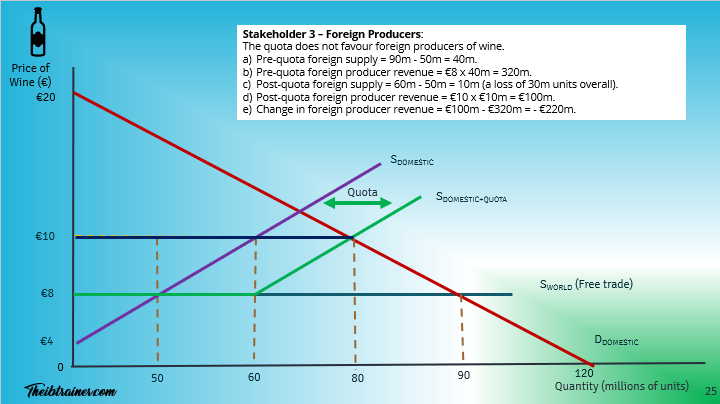
Export quotas restrict the volume of a good that producers can export, keeping more supply in the domestic market and reducing the domestic price below the world price. Source: IB Economics Diagrams
Why countries use export quotas:
Domestic price stabilisation - during periods of global commodity price spikes, export quotas can prevent domestic food prices from rising to world market levels. Indonesia has used palm oil export quotas; India has restricted rice and wheat exports during price spikes to protect domestic consumers.
Resource nationalism - countries may restrict exports of raw materials to encourage downstream processing domestically, capturing more value from natural resources. China's historical rare earth export quotas (challenged and ultimately ruled WTO-illegal in 2014) were partly motivated by this logic - forcing technology manufacturers to locate production in China to access inputs.
Strategic trade policy - export restrictions on critical materials (semiconductors, rare earths, battery minerals) have become increasingly prominent as geopolitical competition intensifies. China's 2023-2024 restrictions on gallium and germanium exports - both critical for semiconductor production - are a current example of export quotas used as strategic economic tools.
Welfare effects of export quotas: domestic consumers benefit from lower prices; domestic producers lose revenue; the country may capture some rent if it has market power in the commodity. From the perspective of importing countries, export quotas are equivalent to a supply shock - they face higher prices and reduced availability of the restricted good.
IB Economics - Syllabus and Programme Full Guide →
WTO Rules on Quotas
The WTO framework generally prohibits quantitative restrictions on trade under Article XI of GATT - preferring transparent tariffs over obscure quantity restrictions. However, several exceptions apply:
Agricultural TRQs - the Uruguay Round required countries to convert quotas to tariff equivalents but allowed TRQs to maintain market access commitments. Most agricultural protection now operates through TRQ systems rather than pure quotas.
Safeguard measures - WTO rules allow temporary import restrictions (quotas or tariffs) when a surge in imports causes or threatens serious injury to domestic industry. Safeguard measures must be applied on a most-favoured-nation basis (affecting all trading partners, not just one), must be temporary (typically 4 years, extendable to 8), and must be accompanied by liberalisation commitments.
Anti-dumping and countervailing measures - these are not technically quotas but can function similarly, restricting import volumes from specific countries found to be dumping or receiving prohibited subsidies.
Export restrictions - WTO disciplines on export quotas are weaker than on import quotas, creating ongoing tensions as countries use export restrictions strategically.
Quotas in the IB Economics Exam
This broader understanding of quota types complements IB Economics exam responses in several ways:
IB Economics Paper 1 - questions on trade protection can be answered with richer examples by drawing on OPEC production quotas, fishing quota market failures, and VERs alongside the standard import quota analysis
Evaluation - noting that fishing quotas correct market failure (unlike import quotas which create inefficiency) demonstrates sophisticated analytical thinking about when government intervention through quotas is justified
IB Economics Economic Development - export quota restrictions on agricultural goods and raw materials connect directly to terms of trade and commodity dependence analysis
Most valuable cross-references: the VER's quota rent flowing to exporting country governments contrasts directly with import quota rent analysis; the OPEC production quota system connects to oligopoly and cartel theory; fishing quotas connect to market failure (common pool resources) and government intervention.
IB Economics Quotas Import Restrictions - Theory and Welfare Analysis →
IB Economics Tariffs - Full Guide →
IB Economics Market Failure - Full Guide →
IB Economics Trade - Full Guide →
IB Economics Diagrams Course
Every quota diagram - import quota welfare analysis, TRQ two-tier system, and production quota supply restriction - fully labelled with video support.
✔ Import quota welfare diagram with quota rent area
✔ OPEC-style production quota and cartel supply restriction
✔ 200+ diagrams covering the full syllabus · Both SL and HL labelled
Frequently Asked Questions - Quota Types in IB Economics
What is the difference between an import quota and a tariff-rate quota? An import quota sets a hard limit on the volume of imports permitted - no more can enter regardless of price. A tariff-rate quota (TRQ) allows a specified volume to enter at a low tariff, with any additional imports facing a much higher tariff. TRQs are the dominant form of agricultural trade protection under WTO rules - they provide some market access while maintaining effective protection against large-scale import competition.
What is a voluntary export restraint and why is it considered worse than an import quota? A VER is an export limit agreed by the exporting country under political pressure from the importing country. It is considered worse than an import quota for the importing country because the quota rent - the economic gain from selling at the higher domestic price - flows to the exporting country's firms rather than being captured as government revenue by the importing country. The importing country's consumers pay higher prices and receive no fiscal benefit.
How do OPEC production quotas work economically? OPEC members agree on national production limits to collectively restrict global oil supply below the competitive level, maintaining prices above marginal cost. It functions as a cartel - solving the collective action problem of overproduction. The system is inherently unstable because individual members have incentives to cheat on their quotas; enforcement depends on political cooperation and Saudi Arabia's willingness to act as swing producer.
Why are fishing quotas justified economically when import quotas typically are not? Import quotas create deadweight loss by restricting beneficial trade. Fishing quotas correct a market failure - the tragedy of the commons - where the absence of property rights over fish stocks leads to overexploitation and long-run stock collapse. Fishing quotas impose a cost on current fishers but preserve the stock for future use, addressing a genuine externality. The justification is market failure correction, not producer protection.
What are export quotas and why are countries increasingly using them? Export quotas restrict the volume of goods a country can sell abroad, keeping more supply in the domestic market and lowering domestic prices. They are used for domestic price stabilisation (food security during commodity spikes), resource nationalism (encouraging downstream processing domestically), and increasingly as strategic trade policy tools — restricting exports of critical materials (rare earths, gallium, battery minerals) to gain geopolitical leverage over countries dependent on those inputs.
This hub is updated regularly to reflect current IB Economics syllabus requirements and international trade developments.
IB Economics Key Quota Diagrams
Related Topics:
IB Economics your IB Economics daily guide
IB Economics The Global Economy access Quotas here as well as the rest of the module 4
IB Economics Activity book Module 4 The Global Economy Unit 4.3 for Types of trade protection exam practice, activities, model answers and IB Economics Marking schemes
IB Economics Market Equilibrium for exploring in depth the Price Mechanism & Resource Allocation. It has a direct relationship with welfare loss and efficient resource allocation
IB Economics Benefits of International Trade - Explore this topic as contrast to trade protectionism policies such as Quotas
IB Economics Diagrams Check Unit 26 for All Types of trade protection including Quotas diagrams with explanations
IB Economics Price elasticity of demand - and IB Economics elasticity - both are basic to understand the effect on the market
IB economics Calculations Book make sure you check unit 23 for Benefits of International trade and types of trade protection HL calculations exercises, IB model answers, and IB marking schemes
Read Next: IB Economics HL
© Theibtrainer.com 2012-2026. All rights reserved.
Legal
Have a Tip? Send us a tip using our anonymous form